
Early November 2026: Open-Source RASP, the 2026 Banking Report and New CVEs
Our RASP is now open source, and Mobile ADR adds it to the apps you already build. We published the 2026 Mobile Banking App Security Report, started disclosing the vulnerabilities we find in open-source software, and shipped risk lineage, iOS taint analysis and new scan overviews.
We now publish two changelogs a month. This first November update covers 1 to 17 November and follows the October 31 update.
Our RASP is now open source, and Mobile ADR adds it to a mobile app you have already built. We published the 2026 Mobile Banking App Security Report, and we now find and disclose vulnerabilities in open-source software: 25 CVEs and 2 advisories since 7 October, along with 70 vulnerability deep dives. Scans also get SMS codes for two-factor logins in time, a new overview, risk lineage and taint analysis for iOS apps.
Our RASP is now open source
Once a mobile app ships, it runs on devices you don't control. Some are rooted or jailbroken, some run a debugger or Frida, and some route every request through a proxy. RASP (runtime application self-protection) is code inside the app that checks for these conditions while the app runs.
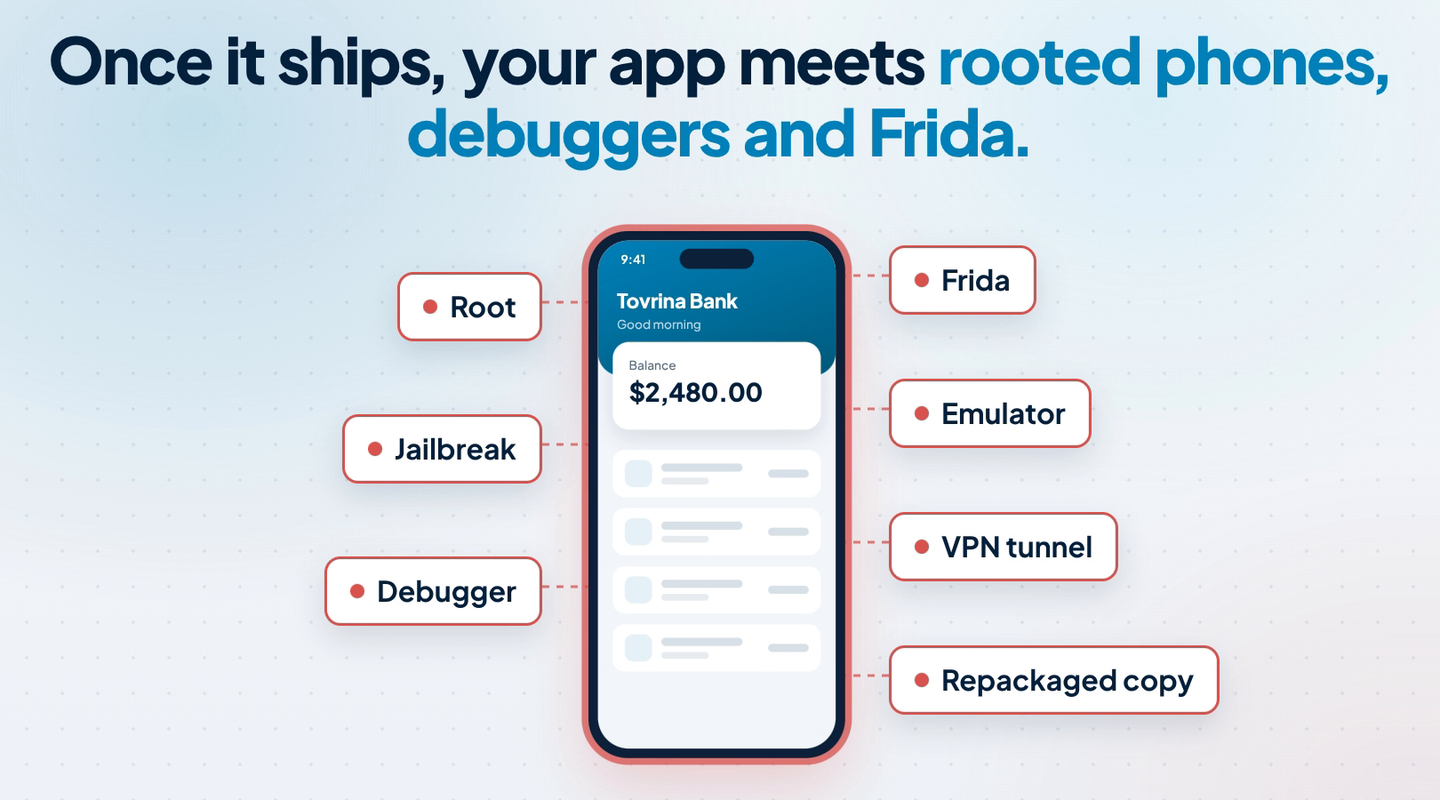
What a shipped app runs into.
The code that runs inside the protected app is on GitHub under Apache-2.0, so your security team can read the code and build it. It checks for rooted and jailbroken devices, debuggers, Frida and other hooks, emulators and simulators, app cloning, code integrity (Android) and VPNs and proxies (proxies on iOS).
Mobile ADR adds RASP to an app you have already built
Mobile ADR (Mobile Application Detection & Response) adds RASP to a copy of your app, with no source code and no SDK. Upload the APK, AAB or IPA you would publish, choose the checks, then download the protected copy, sign it and publish it as usual.
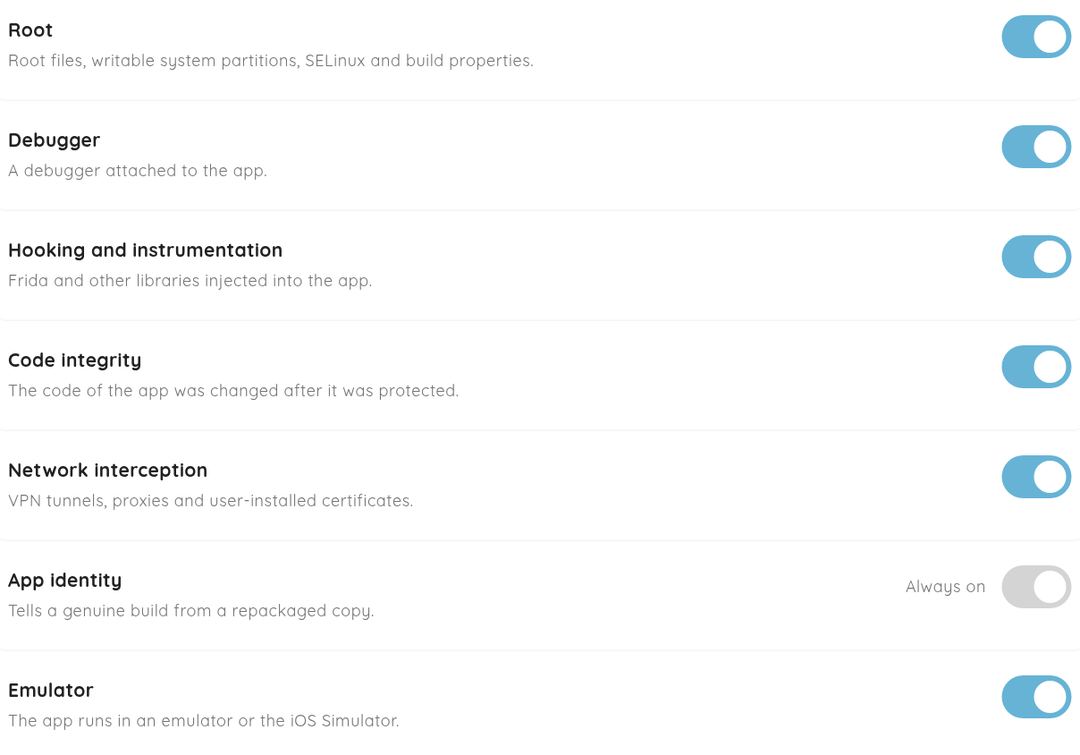
Every check is on by default; app identity always runs. Demonstration app.
- You choose what runs: turn off the checks that don't fit your users, for example the VPN check for an app whose users all go through a company VPN.
- Every install reports: the checks run when the app starts and then about every minute. The Events tab shows which check ran, what it saw and which build reported it.
- Platforms: Android 12 and later, on every Android CPU architecture, and iOS 12 and later. The protected Android copy won't install on older devices.
Mobile ADR detects and reports: it doesn't score events or send alerts yet. Read Introducing Mobile ADR for the full launch post.
The 2026 Mobile Banking App Security Report
We analysed 2,686 banking apps from 487 banks in 64 countries, on Android, iOS and HarmonyOS, as published in the stores. 51.5% of them have at least one high or critical finding.
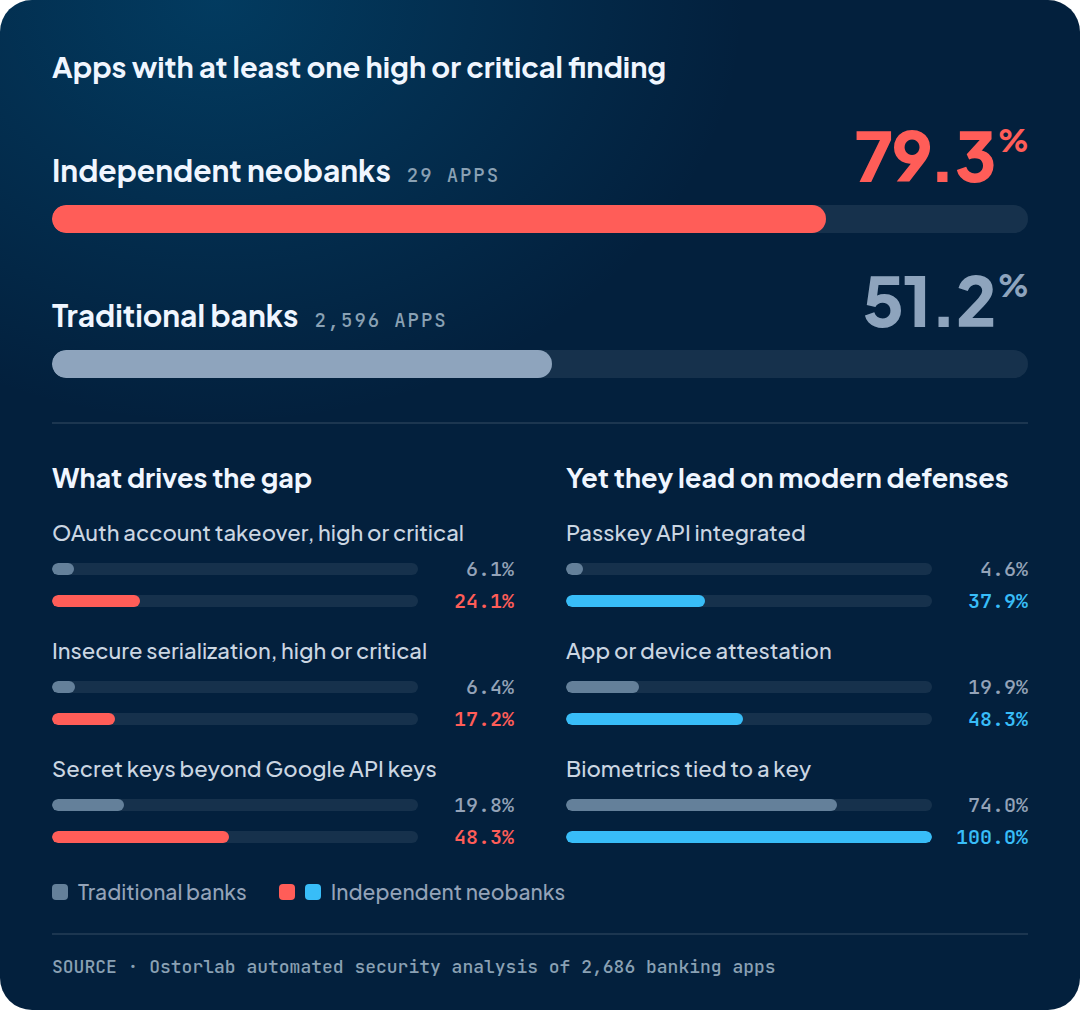
Source: Ostorlab automated security analysis of 2,686 banking apps.
Independent neobanks lead on passkeys and app attestation, yet 79.3% of their apps have a high or critical finding, against 51.2% of traditional-bank apps. OAuth account takeover, insecure serialization and secret keys shipped in the app drive the gap. These are scanner findings, not proof of exploitability.
The report is available in English, French, Spanish, Japanese and Chinese: read the 2026 report, or the blog summary.
We now find and disclose vulnerabilities in open-source software
Research is now a regular part of what we ship. Since 7 October we have disclosed 25 CVEs and 2 advisories in 12 widely used open-source projects, published 70 vulnerability deep dives on this blog from 1 to 17 November, and brought our work together on a new research page.
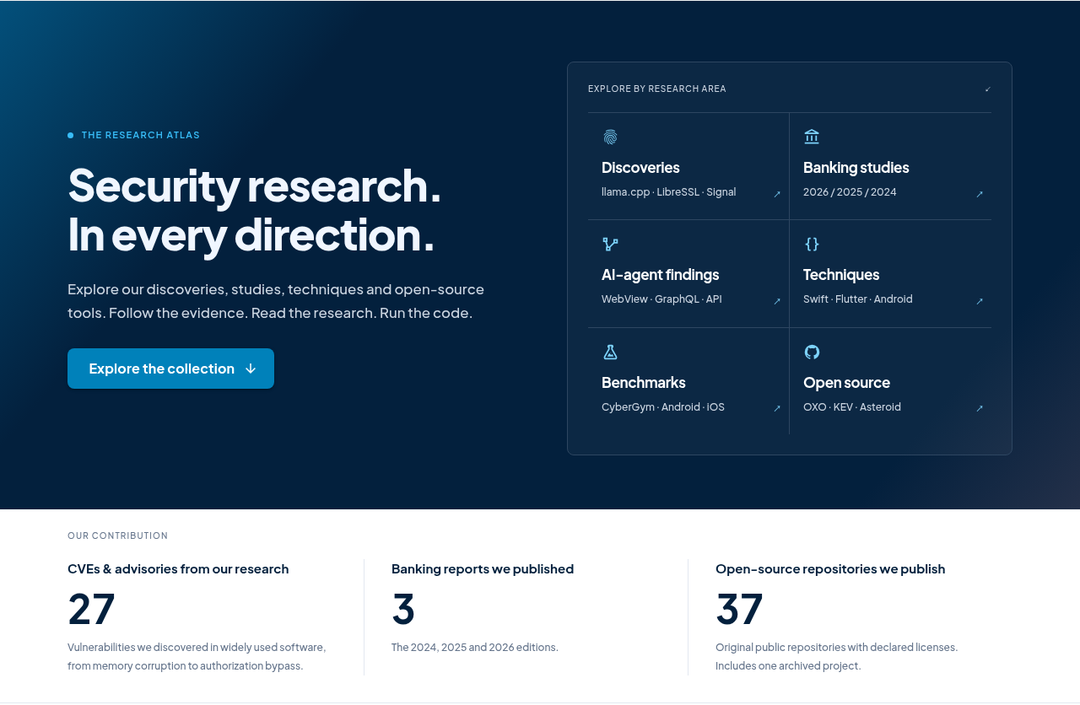
The research page on ostorlab.co: our disclosures, banking studies, AI-agent findings, techniques, benchmarks and open-source tools.
Vulnerabilities we found and disclosed
We report each vulnerability to its maintainers, and publish it on the research page once it is disclosed. Since 7 October:
| Project | What we found | Reference |
|---|---|---|
| GoPhish | Five vulnerabilities: SSRF, XSS, a rate-limit bypass and object takeover | CVE-2026-107269 to CVE-2026-107273 |
| Poppler | A stack buffer overflow in Decrypt::revision6Hash when opening encrypted PDFs | CVE-2026-107705 |
| llama.cpp | A stack buffer overflow in the ggml-rpc RDMA receive path, and a denial of service through an oversized message length | CVE-2026-118375, CVE-2026-119052 |
| LibreSSL | CRLF injection, cleartext transmission and memory exhaustion in OCSP | CVE-2026-118371 to CVE-2026-118374 |
| HarfBuzz | An out-of-bounds write and a denial of service in the WebAssembly shaper | CVE-2026-113679, CVE-2026-113680 |
| VLC for Android | A file overwrite through a spoofed mail attachment provider | CVE-2026-115724 |
| Chatwoot | Stored XSS through Help Center video embed links | CVE-2026-113355 |
| OpenImageIO | A heap out-of-bounds read in the Cineon reader | CVE-2026-113681 |
| OpenEXR | A heap out-of-bounds write in the DWA decoder, and an unbounded multipart-header denial of service | GHSA-whf5-29mj-gp53, GHSA-fp76-2fh4-4xww |
| Keycloak | A stored XSS on the login page through a kcSanitize bypass, and an unauthenticated denial of service through oversized SAML date and duration values | CVE-2026-107889, CVE-2026-107123 |
| Expat | Symlink following through the output directory of xmlwf | CVE-2026-128241 |
| Assimp | Five bugs in the glTF, Ogre and MD2 importers, from path traversal to out-of-bounds reads and an integer overflow | CVE-2026-117608, CVE-2026-129477 to CVE-2026-129480 |
More findings are still with their maintainers. We publish each one once it is disclosed.
70 vulnerability deep dives
From 1 to 17 November we published 70 deep dives on newly disclosed and actively exploited vulnerabilities: what is affected, how the attack works and what to do. They include SAP NetWeaver ICM2SHELL, the N-able N-central Able2Shell chain, the Apache HTTP Server HTTP/2 RCE, the Chrome XSLT use-after-free exploited in the wild and the OpenSSH musl password bypass, as well as supply-chain attacks such as the WPPConnect npm backdoor and malicious Hugging Face models.
New research articles
- Does AI security testing hallucinate? Why a model's guess has to become a proof before Agentic Deep Scan reports it.
- Can autonomous security testing break your application? The scope, network, approval and rate controls around each test.
- How to vet a third-party mobile app before you allow it in your company.
- How FairPlay protects iOS app binaries, and an account-level weakness.
- Building a security software factory: how our detection engines and agent maintainers work together.
SMS codes reach your scans before they expire
Testing behind an SMS login no longer needs someone to type the code in time.
- Mobile apps: the OTP Relay Android app reads the code from the SMS and sends it to the running scan, which fills it in and carries on. Install it only on a phone whose owner agreed to it, for the duration of an authorized scan.
- Web apps: the AI login reads the SMS code from Ostorlab by itself while it signs in.
The 2FA scans guide explains how to set up the credential and the app.
A new overview for every scan
Web, network, repository and multi-asset scans open on a new overview: findings by severity, coverage, the attack surface the scan found and the services it talks to, with a short executive summary on top.
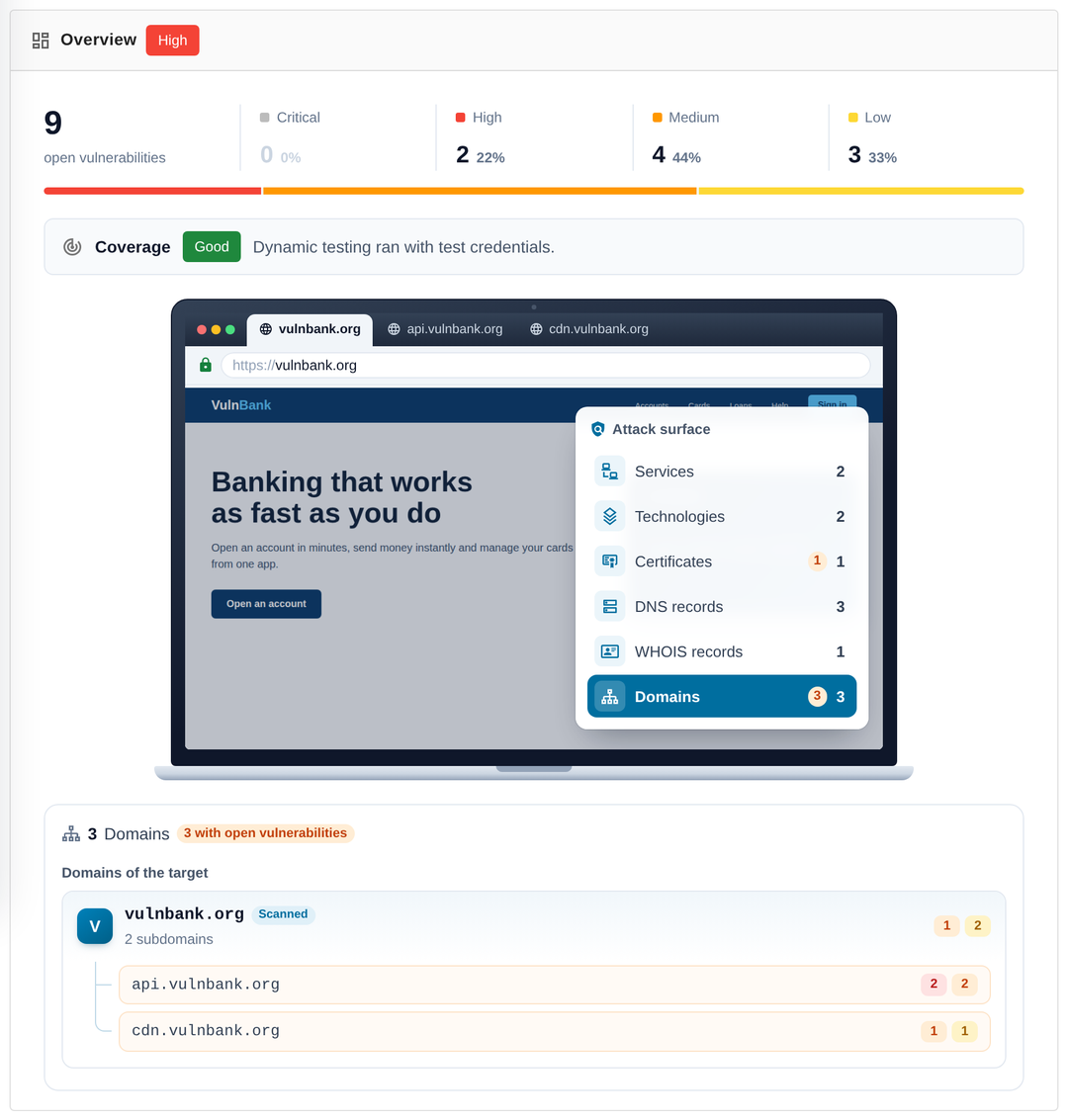
Actual application screenshot with demonstration data.
Risk lineage: see what a risk is built from
Open a risk and its reasoning now shows the findings behind it: the vulnerabilities an attack chain combines, or the finding a validation checked. You can follow a high-severity chain back to the medium and low findings that make it possible.
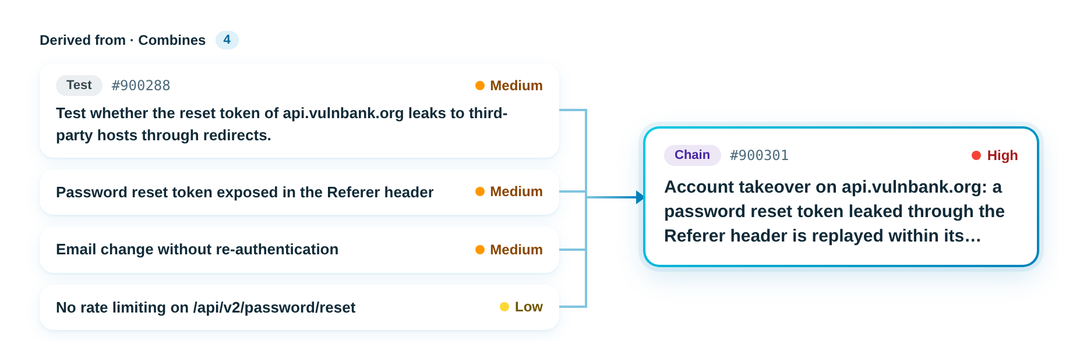
Actual application screenshot with demonstration data.
Taint analysis now covers iOS apps
Full and fast mobile scans now run taint analysis on iOS apps too. The engine loads real iOS binaries, including arm64e, and follows data through Swift and Objective-C code, from user input to the call where it causes harm. Native taint findings show the call trace and the source and sink in readable form.
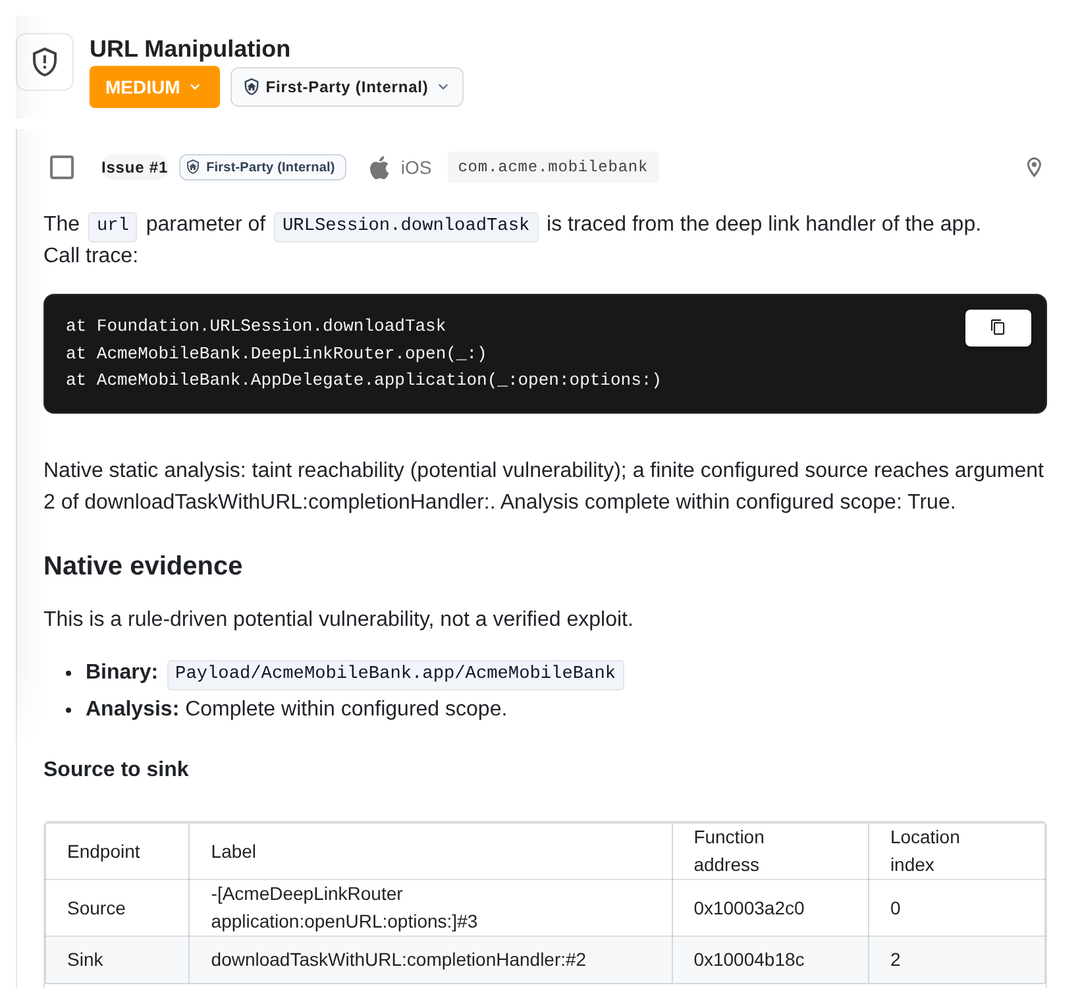
Actual application screenshot with demonstration data.
Choose which networks can reach your organisation
Admins can limit their organisation to a list of trusted IP addresses and ranges. Once the allowlist is on, Ostorlab refuses requests from anywhere else, on the web app, the API, API keys and the MCP server. Shared links stay reachable. The IP allowlist is available on enterprise plans.
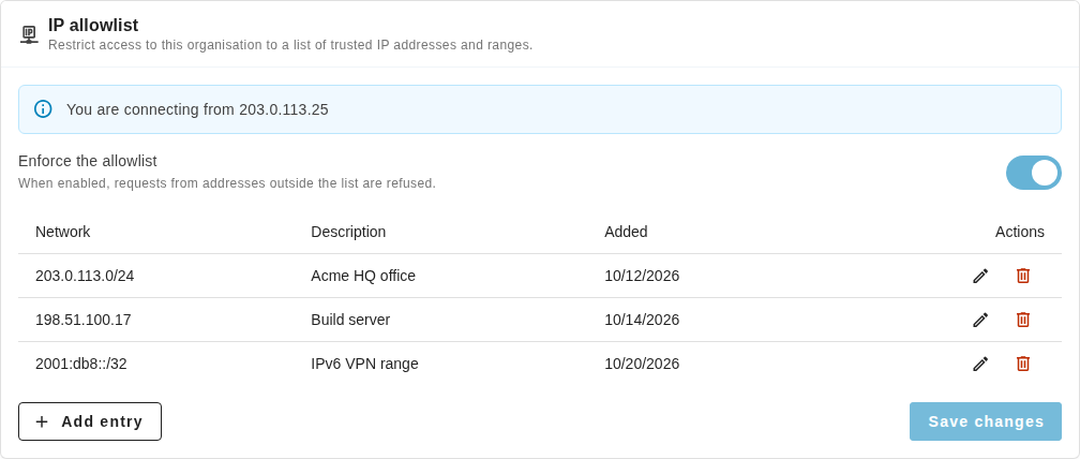
Actual application screenshot with demonstration data.
- Security auditor API key: a read-only key for your SSPM or security posture tool. It reads your security settings, members, keys and shared links, and can't change anything or read a secret. See the security auditor key.
- Audit log over the API: the
auditActionsquery returns logins, MFA checks, password changes, exports and setting changes, each with its client IP. Read it page by page, or poll it from your SIEM. See the audit log.
Read the IP allowlist guide to set it up.
See what each AI agent is working on
A new Agents view on the dashboard shows each agent's current ticket, its latest comment and how its recent runs went. Agents whose last run failed are listed under Needs attention, so you can open the run and see what went wrong.
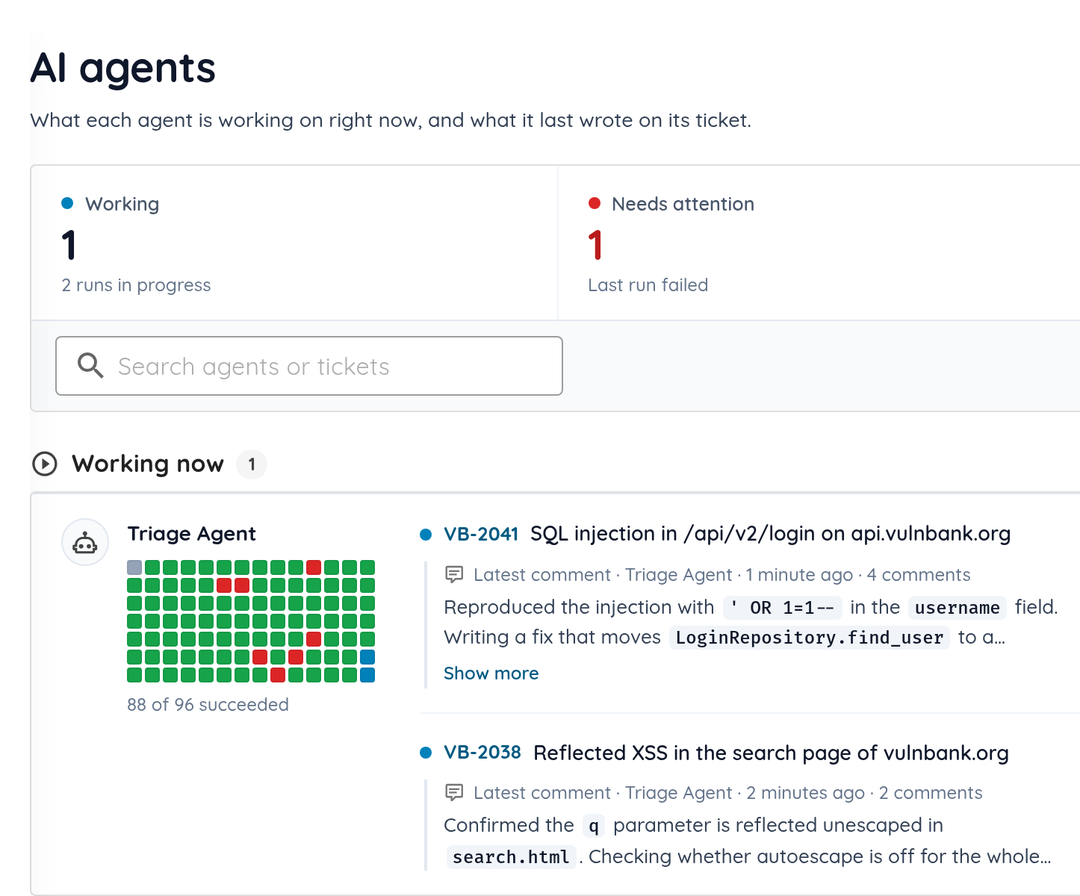
Actual application screenshot with demonstration data.
- Run an agent now: start a Ticket Agent from its page without waiting for its trigger.
- Edit uploaded skills: browse, edit and download the files of a skill you uploaded.
- Every run on the ticket: each Ticket Agent run posts its outcome and the pull requests it opened on the ticket.
More changes
| Area | What changed |
|---|---|
| API scans | API scans test every request of a Postman collection (v2.0 and v2.1). |
| Scan scope | The crawler, Nuclei and the other agents receive the scan's scope, and hosts outside it only get passive checks. |
| Known exploited vulnerabilities | About 255 new checks for known exploited vulnerabilities. |
| Finding accuracy | Fewer false positives in secret detection and mobile static analysis. |
| Appcircle | Run Ostorlab as a step of your Appcircle workflow. |
| Case study | How a regional bank tests behind its SMS login. |