
How Much Does an Application Penetration Test Cost in 2026?
Manual app pentests cost $3,000–$50,000+ in 2026; published AI pentests run $499 to about $8,000. What drives price, what quotes exclude, how to compare.
Two pentest quotes land on your desk: $4,000 and $40,000. Both say "web application penetration test." They are rarely the same test.
Short answer: A manual application penetration test in 2026 costs roughly $3,000–$18,000 for a single web app or API and $18,000–$50,000+ for multi-surface scope (web, API, mobile, cloud). Published AI pentest packages cost $499 to about $8,000 per scoped assessment. Price depends on user roles, authentication, connected assets, testing depth, and retesting.
This guide is for security leads, CTOs, and procurement teams who need to budget for a pentest or compare quotes that do not look alike. Prices are as of September 2026.
How much does an application penetration test cost in 2026?
Manual pentests are priced by tester days; AI pentests are priced per assessment, subscription, or credits. The table below summarizes the planning ranges.
| Testing model | What to budget | How it is commonly priced | When to choose |
|---|---|---|---|
| AI or autonomous pentest | $499 to about $8,000 for published scoped packages; enterprise pricing is custom | Per assessment, subscription, asset allowance, or credits | Frequent testing, release validation, and runtime evidence |
| Manual pentest, single web app or API | About $3,000 to $18,000 | Tester days, fixed scope, or project fee | Complex logic, formal assurance, a named human tester |
| Manual pentest, multi-surface scope | About $18,000 to $50,000+ | Tester days across several specialists | Web, API, mobile, and cloud assessed together |
| Pentest as a Service (PTaaS) | Usually custom or credit-based | Annual subscription, prepaid credits, or individual engagements | Organizations running several tests each year |
| Hybrid AI and human testing | Custom | Automated platform plus expert review | Recurring coverage with human assurance for critical scope |
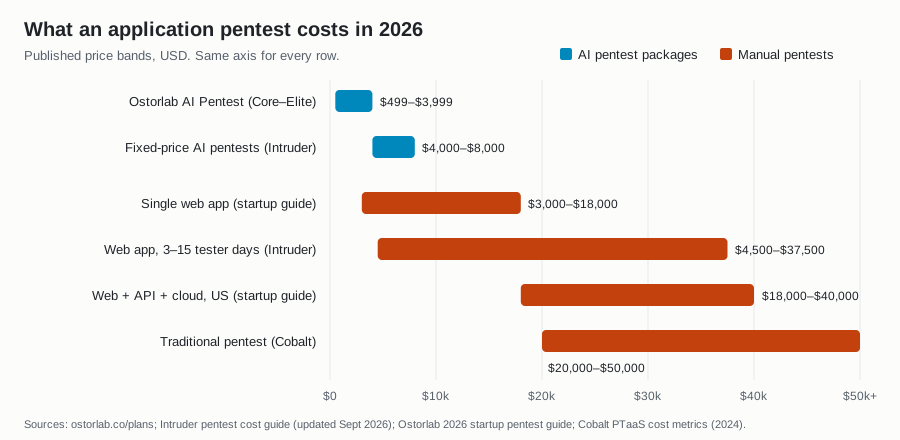
These are planning ranges, not universal rates. For regional day rates in North America, Europe, APAC, and LATAM, see our 2026 guide to penetration testing for startups.
Where do these price ranges come from?
The ranges come from public pricing guides and published package prices reviewed in September 2026:
- Intruder estimates manual day rates of $1,500–$2,500, which puts a web application test at $4,500 (3 junior days) to $37,500 (15 senior days). It puts fixed-price AI pentests at $4,000–$8,000 (Intruder, updated September 2026).
- Cobalt puts a traditional pentest at $20,000–$50,000 and reports that PTaaS was about 31% cheaper on average (Cobalt, February 2024).
- Ostorlab's startup guide puts a web application pentest at $3,000–$18,000, and a US web, API, and cloud assessment at $18,000–$40,000 (Ostorlab, August 2026).
- XBOW publishes no price: its pricing is usage-based and scoped to each environment (XBOW pricing). Its $4,000 Pentest On-Demand offer was retired on 16 July 2026.
- Ostorlab publishes AI Pentest tiers from $499 (Ostorlab plans).
Disclosure: Ostorlab publishes this blog and sells AI Pentest packages. Many providers disclose prices only after scoping, so the AI pentest range reflects published packages, not the whole market. This post is reviewed quarterly; prices change.
What does an application pentest price include?
A quote reflects three things: the target, the testing depth, and the evidence you receive.
What counts as "one application"?
"One application" can be a single website, or it can include:
- A web frontend
- REST, GraphQL, or other APIs
- Android and iOS applications
- Administrative portals
- Source-code repositories
- Cloud services, identity providers, and third-party integrations
A proposal should name every included asset. If it says only "application," ask what is excluded.
Does testing depth matter more than application size?
Often, yes. Some assessments apply broad checks across reachable functionality. Others spend time following workflows, comparing users, testing state changes, and chaining weaknesses.
A short payment, approval, or account-recovery workflow can require more investigation than hundreds of public content pages.
Why does evidence quality change the price?
A list of suspected weaknesses is cheaper to produce than a report with reproducible requests and responses, proof of impact, human validation, remediation guidance, and a retest. That difference decides whether developers can act on a finding without repeating the investigation.
How is a manual application pentest priced?
Manual pentests are scoped around the number of tester days required:
Manual test cost = (tester days × day rate) + project overhead + optional services
Project overhead covers scoping, environment setup, project management, report writing, quality review, readout meetings, and remediation verification.
A single web application with standard authentication typically costs $3,000–$18,000. A complex ecosystem spanning web, APIs, mobile clients, and cloud, assessed by several specialists, typically costs $18,000–$50,000+. A stable test environment with clear scope reduces effort. Broken credentials or missing test data burn paid tester days without adding coverage.
How is an AI or autonomous pentest priced?
AI pentesting is testing run by a platform that explores the application, observes responses, chooses its next actions, and attempts to validate exploitable behavior. Buyers usually see four pricing models:
- Per assessment: One price for a defined target and testing window.
- Subscription: Monthly or annual access with limits on applications, tests, or depth.
- Asset-based: Pricing tied to applications, APIs, repositories, hosts, or workspaces.
- Consumption credits: Routine scanning is included; deeper autonomous investigation consumes credits.
Lower per-test pricing does not prove equivalent coverage. Ask what the system reached, which identities it used, which findings it validated, and what remained unexplored. We cover how to check that in Can you trust AI pentesting results?
What does Ostorlab charge for an AI Pentest?
Ostorlab AI Pentest is a one-time, exploit-validated assessment built on Ostorlab's Deep Agentic Scan engine. It has four published tiers (ostorlab.co/plans):
| Tier | Price |
|---|---|
| Core | $499 |
| Advanced | $1,999 |
| Elite | $3,999 |
| Hyperscale | Custom, tailored to scope |
Every tier includes a working exploit for each finding the AI agents confirm, multi-asset support for connected web, API, and mobile assets, and a retest window. Human validation is not included. Retest window length is stated in the quote.
Updated 5 October 2026: AI Pentest findings are exploit-validated by the AI agents; human validation is not included (see plans).
Updated 6 October 2026: XBOW retired its $4,000 Pentest On-Demand offer on 16 July 2026; XBOW now publishes no price.
For ongoing programs, Ostorlab also offers AppSec, a subscription covering one connected app workspace with monthly AI credits, and Enterprise, a custom annual agreement with pooled credits, governance, integrations, Attack Surface, and App Vetting. These should not be compared with the price of one assessment: a one-time AI Pentest answers a scoped question, while AppSec and Enterprise run continuously.
What factors determine application pentest cost?
Cost scales with the number of workflows, roles, and connected assets, and with how hard the application is to reach and exercise. The largest drivers are:
- Workflow complexity: More unique workflows, endpoints, state transitions, and trust boundaries require more testing.
- User roles and tenants: Each role or tenant adds authorization boundaries to test.
- Connected assets: APIs, mobile clients, source repositories, cloud services, and identity systems expand the assessment.
- Authentication: SSO, MFA, device binding, rotating tokens, and short sessions increase setup effort.
- Business logic: Approvals, transactions, account recovery, and multistep workflows need contextual investigation.
- Human validation and reporting: Expert review, formal reports, readouts, and attestations add delivery work.
- Retesting: Some providers include remediation verification; others charge separately.
How does the application type affect pentest cost?
Application type changes the tools, specialists, test environments, and evidence required. A quote should name the asset class instead of treating every target as a generic application.
| Assessment type | Additional work that changes the price | Specialist capability required |
|---|---|---|
| Web application | Roles, workflows, tenant boundaries, business logic, admin functions | Web and authorization testing |
| API | Endpoint inventory, schemas, object relationships, tokens, rate limits, async operations | API and authorization testing |
| Mobile application | APK/IPA review, physical devices, runtime instrumentation, certificate-pinning bypass, local storage, mobile APIs | Android/iOS reverse engineering and runtime testing |
| Cloud-connected application | IAM, storage, serverless functions, queues, secrets, cloud configuration | Cloud and identity security |
| Desktop application | Native binaries, local privileges, IPC, update channels, backend trust | Reverse engineering and OS security |
| AI application | Prompt injection, retrieval, model access, tools, agent permissions, data leakage | AI/ML and application-security testing |
Hardware, firmware, IoT, and smart-contract assessments are priced separately by specialist firms because they need lab equipment, device teardown, or economic-attack analysis. They are outside the scope of an application pentest quote. For mobile tooling, see our top mobile pentesting tools for 2026.
What is the difference between an AI pentest and a vulnerability scan?
A vulnerability scanner applies predefined checks. An AI pentest plans its next step from what the application returns and tries to prove impact. An AI feature does not automatically turn a scanner into a pentest.
| Capability | Vulnerability scanner | AI or autonomous pentest |
|---|---|---|
| Testing logic | Predefined rules and heuristics | Goal-directed planning based on target responses |
| Workflow exploration | Usually crawler-led | Adapts to application state, roles, and multistep flows |
| Validation | Signature or response match per check, sometimes with a built-in proof | Attempts to reproduce impact in context, such as reading another user's data with a second identity |
| Evidence | Finding details and scan traces | An execution record: what was observed, what was tried next, and the request and response that proved it |
| Coverage style | Broad and repeatable | Adaptive; depth depends on target and controls |
Ask to see the execution record. For a longer treatment, read When does an AI scanner become an AI pentest? and how evidence flows through AI pentesting workflows.
Which providers serve each part of the market?
Providers do not all test the same layer of the stack. The examples below are representative, not a ranking. Descriptions follow each vendor's public site as of September 2026.
AI and autonomous application testing
- Ostorlab offers one-time, exploit-validated AI Pentest packages and ongoing plans across connected mobile, web, and API assets.
- XBOW describes autonomous testing of web applications and APIs; it publishes no price, as its pricing is usage-based and scoped to each environment. See our Ostorlab vs. XBOW comparison.
AI plus human PTaaS
- Cobalt describes "human-led, AI-powered pentesting" delivered as Agentic PTaaS.
- Synack combines Sara AI Pentesting with the Synack Red Team of human researchers.
- HackerOne offers H1 Agentic Pentest, pairing AI agents with human experts.
Confirm whether a quote covers a fixed pentest, a managed researcher engagement, or a broader platform subscription.
Mobile application specialists
- NowSecure focuses on mobile, with binary and real-device runtime analysis of iOS and Android apps plus expert-led penetration testing. Mobile scope should state which binaries, OS versions, devices, and backend APIs are included.
Infrastructure and attack-path validation
- Horizon3.ai NodeZero centers on autonomous internal, external, identity, cloud, and Kubernetes pentesting, with web app testing listed as a separate solution. Check which of these a quote includes before comparing it with an application assessment.
For a broader market view, see the best AI pentesting platforms in 2026.
What is normally excluded from a quoted price?
Unless the proposal says otherwise, confirm whether the price excludes:
- Backend APIs, administrative portals, or additional environments
- Additional user roles, tenants, or test accounts
- Android and iOS binaries, source code, and desktop clients
- Cloud configuration, identity infrastructure, and third-party integrations
- Social engineering, phishing, denial-of-service, or destructive actions
- Remediation work and developer support
- Findings outside the agreed asset or severity scope
- Retests beyond the included window
Exclusions are not a problem on their own. They become one when two quotes are compared as if the same assets, identities, evidence, and retesting were included.
What do realistic application pentest scenarios cost?
Scope multipliers matter more than a provider's starting price. Two common scenarios:
SaaS web application with an API and three roles
- Typical manual quote: about $8,000–$25,000 in North America, €6,000–€18,000 in Western Europe, and $3,000–$10,000 in APAC and LATAM (startup guide regional table).
- Specialists: A web tester and an API or authorization specialist.
- Inputs: Workflows, endpoint inventory, three test identities, tenant boundaries, sensitive actions, and test data.
- Scope multipliers: Complex approval flows, many tenants, asynchronous jobs, and separate admin portals.
- Expected evidence: Reproducible requests, authorization comparisons across roles, proof of impact, and a retest report.
A quote limited to unauthenticated crawling is not comparable with a role-aware business-logic assessment.
iOS and Android apps with certificate pinning and a shared API
- Typical manual quote: usually above the single-app band, because two binaries and a shared API are in scope; treat it as multi-surface.
- Specialists: Mobile reverse engineering, runtime instrumentation, and API authorization testing.
- Inputs: Both binaries, supported OS versions, pinning behavior, local storage, deep links, and the shared API.
- Scope multipliers: Root or jailbreak detection, device binding, MFA, multiple roles, and separate release trains.
- Expected evidence: Binary and runtime observations, API requests, exploitability proof, affected versions, and retest guidance.
A web-only API quote cannot be compared with a full binary-and-backend assessment.
How should buyers compare application pentest quotes?
Two quotes with the same price may describe completely different assessments. Ask every provider the same ten questions:
- Which applications, APIs, mobile clients, repositories, and environments are included?
- How many roles and tenants will be tested?
- Is business-logic testing included?
- Which findings are validated, and what proof is provided?
- What functionality may remain unreachable?
- Is the work performed by humans, agents, scanners, or a combination?
- Is human review included?
- How are destructive or state-changing actions controlled?
- Is retesting included, and for how long?
- Can the report be used for the intended audit, customer, or procurement process?
Then require the answers in writing: scope, exclusions, depth, identities, evidence, retesting terms, and timeline.
What are the hidden costs of a penetration test?
The quote is only part of the cost. Internal teams still prepare environments and test accounts, fix authentication failures, reproduce and route findings, fix vulnerabilities, and answer auditor questions.
A cheap test with weak evidence can become expensive during triage. An expensive one wastes money too if key workflows stay unreachable.
Does an AI pentest replace a manual pentest?
Not in every situation. AI pentesting fits when frequency, repeatability, portfolio coverage, and runtime validation matter. Manual testing remains valuable for unusual business logic, specialist protocols, novel architecture, or assurance that expects an independent human tester.
Many teams combine them:
- Continuous scanning for baseline coverage
- AI pentests after important changes
- Human testing for critical applications and unusual risks
- Human review when a customer, auditor, or regulator requires it
For a side-by-side view, read autonomous pentesting vs. traditional penetration testing.
Will an application pentest satisfy compliance requirements?
It depends on the standard and on who accepts the report.
- SOC 2 and ISO 27001 do not prescribe a specific pentest product or price. In ISO/IEC 27001:2022, the relevant Annex A controls are 8.8 (management of technical vulnerabilities) and 8.29 (security testing in development and acceptance). The evidence must satisfy your auditor and customers. See how to get an audit-ready pentest report for SOC 2.
- PCI DSS v4.0.1 Requirement 11.4 requires internal and external penetration testing at least every 12 months and after significant changes. Confirm with your Qualified Security Assessor (QSA) whether an AI-assisted assessment meets it.
Before buying, confirm whether the recipient requires a human-led engagement, specific provider certifications, a signed attestation, a named methodology, retest evidence, or a clear list of tested and untested scope.
Frequently asked questions
How much does an application penetration test cost in 2026?
A manual application pentest costs about $3,000–$18,000 for a single web app or API and $18,000–$50,000+ for multi-surface scope covering web, API, mobile, and cloud. Published AI pentest packages range from $499 to about $8,000 per scoped assessment.
How much does an AI penetration test cost?
Published AI pentest packages start at $499 (Ostorlab Core). Intruder puts fixed-price AI pentests at $4,000–$8,000, and XBOW publishes no price, as its pricing is usage-based and scoped to each environment. Many vendors price only after scoping, and ongoing enterprise programs are usually subscription-based or custom.
How much does an Ostorlab AI Pentest cost?
Ostorlab AI Pentest costs $499 (Core), $1,999 (Advanced), or $3,999 (Elite); Hyperscale is custom-priced. Every tier includes a working exploit for each finding the AI agents confirm, multi-asset support for connected web, API, and mobile assets, and a retest window; human validation is not included.
How long does an application penetration test take?
A manual web application test typically takes 3 to 15 tester days, depending on size and complexity, according to Intruder's estimates. Add time for scoping, environment setup, reporting, and retesting on top of the testing days.
How often should you run an application penetration test?
At least once a year and after significant changes; PCI DSS v4.0.1 Requirement 11.4 sets that minimum for in-scope environments. Teams that release often add AI pentests between annual tests so new features are covered before the next manual engagement.
Which companies provide AI and autonomous penetration testing?
Ostorlab (connected mobile, web, and API assessments) and XBOW (web applications and APIs) offer autonomous application testing. Cobalt, Synack, and HackerOne combine AI with human testers. Horizon3.ai NodeZero centers on infrastructure, identity, and cloud. These are not direct substitutes.
What is Pentest as a Service (PTaaS)?
Pentest as a Service (PTaaS) delivers penetration testing through a software platform. Teams request engagements, follow findings as they are reported, collaborate with testers, push issues to ticketing systems, and manage retests alongside formal reports.
Do mobile apps cost more to penetration test than web apps?
Usually. A mobile test can cover the compiled binary (APK or IPA), the backend APIs it calls, or both, so state API inclusion explicitly in the scope. Client-side protections such as root detection and certificate pinning add setup time compared with a standard web application.
How is API penetration testing priced?
API tests are scoped by operations or routes, schemas, roles, authorization boundaries, authentication, and business logic. For GraphQL, one endpoint can expose many operations, so endpoint count alone is misleading. Sharing a complete OpenAPI or GraphQL specification during scoping produces a more accurate quote.
What is the difference between a vulnerability assessment and a penetration test?
A vulnerability assessment identifies and prioritizes weaknesses broadly. A penetration test investigates whether selected weaknesses can be exploited, and what impact they create, within an authorized scope.
What is the bottom line on application pentest cost?
Do not choose a pentest from the headline price alone. Make sure the quotes cover the same assets, roles, workflows, evidence, and retesting; otherwise the numbers are not comparable. For a larger program, compare the annual cost of covering your real portfolio, including release frequency and human validation.
To scope an assessment for your web apps, APIs, and mobile clients, see Ostorlab AI Pentest packages and pricing.