
Autonomous Pentesting vs Traditional Pentesting
Compare traditional pentests, PTaaS and autonomous AI testing: where agents win on coverage and evidence, where humans still lead, and how to combine them.
Every Head of AppSec eventually faces the same budget question: should the next dollar fund another traditional penetration test, a PTaaS subscription, or an agentic AI testing platform?
The wrong answer starts with a false choice. These options do not describe the same thing.
Traditional penetration testing describes a human-led assessment. PTaaS describes how testing is delivered and managed over time. Agentic and autonomous testing describe how a system makes decisions during a test. A mature security program can use all three.
The useful question is not, “Can AI replace a pentester?” It is, “Which work must run continuously, which work needs a human investigator, and what evidence should either produce before engineering acts?”
Direct Answer: Autonomous pentesting uses agentic feedback loops to continuously discover, exploit, and verify technical vulnerabilities across rapid release cycles. However, it does not replace human penetration testers. Mature enterprise AppSec programs combine continuous autonomous agents for baseline technical coverage with human specialists for complex business logic, custom architecture assessments, and nuanced risk decisions.
What is the difference between traditional pentesting, PTaaS, and agentic testing?
Security teams often compare categories that belong on different axes.
Traditional penetration testing is usually a scoped, time-bound engagement. A human team studies an environment, tests attack paths, validates findings, and delivers a report. It remains effective when an organization needs a deep assessment of a critical release, a custom architecture, or a high-consequence business process. NIST SP 800-115 outlines this classic phased assessment and reporting model.
Penetration Testing as a Service (PTaaS) is a delivery and operating model. It typically adds a persistent platform for scoping, findings, remediation, reporting, and retesting. A PTaaS engagement may be human-led, AI-assisted, or hybrid. It does not become autonomous merely because it runs through a portal. Synack makes the same distinction in its PTaaS definition.
Agentic testing describes an adaptive loop. Rather than executing only a fixed checklist, the system can observe a result, form a next hypothesis, select an allowed action or tool, inspect the evidence, and change course.
Autonomous testing is the higher-autonomy end of that model. The system decides more of the testing sequence without per-action approval, but only within explicit boundaries. OWASP's Autonomous Penetration Testing Standard distinguishes this from scheduled scanning: a preconfigured scan that makes no decisions is not autonomous testing. Its guidance also makes scope enforcement, safety controls, and accountability central requirements.
This gives security leaders two decisions, not one:
| Execution model | Project engagement | Recurring or continuous service |
|---|---|---|
| Human-led execution | Traditional pentest | Human-led PTaaS |
| AI-assisted execution | Consultant-led work accelerated by AI | AI-assisted PTaaS |
| Agentic or autonomous execution | Targeted, bounded investigation | Continuous agentic testing platform |
The right model depends on the risk, the release cadence, and the evidence required—not on the label on a vendor's home page.
Autonomous pentesting vs. traditional pentesting vs. PTaaS: feature comparison
| Question | Project-based human pentest | Continuous human-led PTaaS | Continuous agentic testing |
|---|---|---|---|
| When does it run? | At scheduled intervals | When requested or scheduled | After releases or other approved triggers |
| Who performs the testing? | Human pentesters | Human pentesters using a shared platform | Autonomous agents with human oversight |
| Best suited for | Complex business logic and novel attack paths | Recurring access to human expertise | Repeatable testing across frequent releases |
| Main limitation | Provides only point-in-time coverage | Still depends on tester availability | Cannot independently judge every business risk |
| Best role in AppSec | Deep investigation | Recurring specialist testing | Continuous security baseline |
The table is not a scorecard. An automated system can start quickly but still produce weak evidence. A human team can find a subtle abuse case but cannot continuously re-run every workflow after every release. The goal is to assign each layer work that matches its strengths.
Where does autonomous agentic testing have a structural advantage?
Continuous coverage between engagements
Applications change more often than annual testing calendars. New APIs appear, authentication flows evolve, mobile releases add SDKs, and a fixed issue can return in a later build.
Agentic testing is well suited to repeatable work that should happen whenever a trusted trigger occurs: a release, a material API change, a new asset, or a remediation deployment. It can preserve prior context, exercise known paths again, and route attention toward what changed.
That does not make every test equally safe to automate. The organization must define scope, allowed techniques, impact thresholds, rate limits, and escalation conditions before a system acts. The important distinction is not “hands-off” versus “hands-on.” It is bounded, auditable automation versus an ungoverned agent with broad access.
Repeatable API and authenticated-workflow investigation
Modern applications expose their risk across web clients, mobile apps, APIs, third-party integrations, and source code. An agentic platform can help bring together signals from intercepted traffic, API definitions, application clients, and approved test identities, then re-exercise the resulting flows.
This can make API discovery and authorization testing more systematic. It does not make either problem solved. A missed endpoint, an incomplete role model, or unrealistic test data can still produce false assurance. OWASP's API testing guidance treats discovery as a multi-source process and warns that authorization conclusions depend on the right endpoint, identity, and path being tested. See OWASP API reconnaissance guidance.
Evidence capture at operational speed
Finding a security control in code does not prove that it holds at runtime—and flagging an unverified alert creates friction between AppSec and engineering.
In an anonymized engagement evaluated by Ostorlab Agentic Deep Scan, an enterprise mobile application implemented custom TLS certificate pinning to protect its core transactional APIs. A static analyzer flagged the presence of the validation logic as secure, while a traditional DAST scanner simply stalled when certificates failed to match.
Rather than relying on static assumptions or blind fuzzing, Ostorlab's autonomous agent reversed the client binary on a managed test device and executed an autonomous differential validation test directly against the application's runtime TrustManager:
| Test Run (Identical untrusted certificate chain) | Execution Logic | Runtime Outcome | Conclusion |
|---|---|---|---|
| Run A (Baseline Control) | Application's unmodified TrustManager invoked directly with untrusted test certificate | THREW CertificateException (Hostname Mismatch) |
Pinning control is actively enforced |
| Run B (Autonomous Dynamic Bypass) | Autonomous dynamic instrumentation injected into certificate verification entry point | SUCCESS (0 Exceptions thrown) |
Control is hookable and bypassed |
┌──────────────────────────────────────────────────────────────────────────────────────────────────┐
│                           AUTONOMOUS DIFFERENTIAL RUNTIME PROOF                                  │
└──────────────────────────────────────────────────────────────────────────────────────────────────┘

   Target TrustManager ──► [Run A: Baseline] ──► Throws CertificateException (Control holds)
                       ──► [Run B: Bypass]   ──► Dynamic Hook Injected ──► Success (Defect verified)
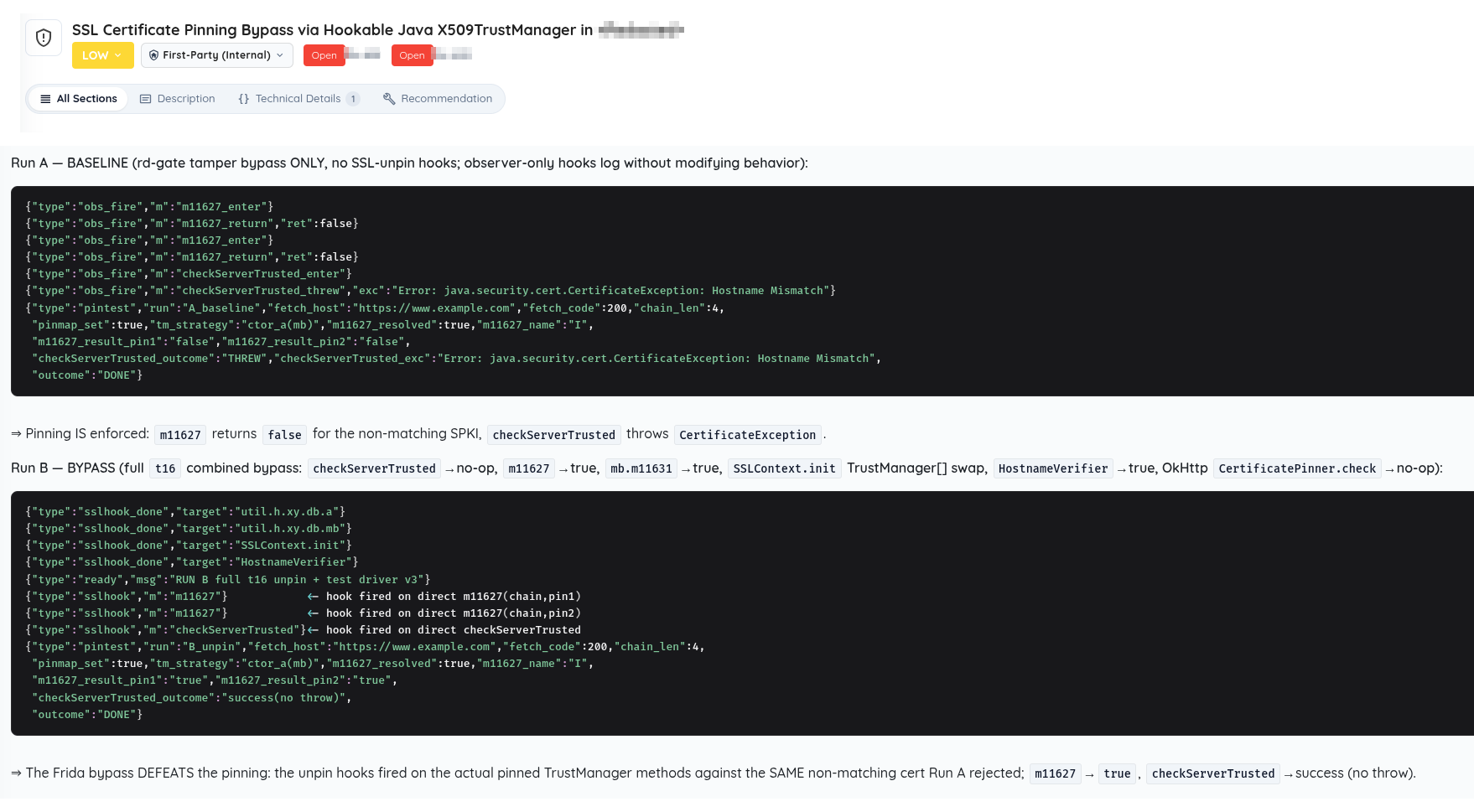
Figure 1: Sanitized Ostorlab Agentic Deep Scan finding card showing machine-verifiable differential proof. Sensitive client identifiers, tickets, and package names are redacted.
The difference between Run A and Run B provides deterministic proof that the control can be defeated in memory—without needing to guess, hypothesize, or fabricate network traffic. For AppSec leaders, this eliminates false positives and gives developers an undeniable reproduction trace to fix the root cause.
That evidence still requires review. A strong security program asks whether the finding is in scope, whether the proof supports the claimed business impact, and whether the corrected control holds during retesting.
From a scan to an AppSec operating model
Continuous testing turns each release into a security checkpoint. When Ostorlab detects a new application version, it can launch the relevant tests, attach reproducible evidence to validated findings, route them into the remediation workflow, and retest the corrected build.
The platform connects this process with attack-surface discovery, asset inventory, scan profiles, and development-tool integrations. It also supports local, cloud, and hybrid OXO runtimes, plus CI scans. Explore Ostorlab's documentation. Explore OXO runtimes.
This process shortens the path from discovery to verification while keeping engineers involved in decisions that require context. Automation provides coverage and consistency; security teams retain control over risk acceptance, prioritization, and remediation.
Where do human penetration testers still lead?
Business context and intentional ambiguity
The most valuable failures are often not a missing patch or an exposed endpoint. They are a policy that can be bent, a workflow that rewards abuse, or a business rule whose impact depends on context unavailable in an HTTP response.
Experienced testers can ask the uncomfortable question behind the technical behavior: What would a motivated customer, partner, or insider attempt here? They can challenge assumptions, interview stakeholders, and change the objective when the first path fails. Agentic systems can support that work, but they do not remove the need for a person to interpret business intent and organizational risk.
Architecture, people, and the physical world
Architecture reviews require judgment about trade-offs: trust boundaries, operational failure modes, legacy constraints, and the consequences of a proposed control. Red-team work may also include social engineering, on-site access, and multi-team coordination. These are not gaps to hide in an autonomous-pentesting pitch. They are distinct disciplines that need explicit authorization, specialist skills, and human accountability.
High-impact decisions
The more destructive or consequential an action becomes, the more important human oversight becomes. OWASP's APTS framework is useful here because it treats increasing autonomy as increasing control obligations—not as a marketing maturity ladder. Its autonomy model pairs higher independent action with stronger approval, safety, and audit requirements.
Industry guidance from CREST similarly stresses that incorporating AI into security testing demands defined practitioner oversight, accountability, and ethical guardrails rather than unmonitored autonomy. See CREST guidance on AI in penetration testing.
Research points in the same direction. In the 33-task AutoPenBench evaluation, an autonomous architecture achieved a 21% success rate and a human-assisted architecture achieved 64%. Those results do not measure every product or every enterprise environment. They do show why a benchmark result should not be converted into a claim that autonomous agents are already equivalent to human pentesters. Read the AutoPenBench paper.
How should security leaders evaluate autonomous pentesting and PTaaS vendors?
When evaluating a PTaaS provider or an agentic testing platform, ask for a demonstration of the controls and the evidence—not only a successful demo exploit.
- Show the proof. Can the system demonstrate runtime impact, rather than present a likely exploit narrative?
- Show the controls. Are scope, rate limits, action allowlists, and stop conditions enforced outside the model?
- Show the failed path. Can the system adapt when an initial hypothesis fails, and can an operator see why it stopped?
- Show the reproduction. Can an engineer reproduce the finding from the evidence without reverse-engineering the report?
- Show the retest. Can the team verify a fix in the affected build and retain the result?
- Show the human handoff. Who reviews material findings, approves high-risk actions, and owns an escalation?
- Measure the pilot locally. Track time to triage, duplicate findings, validated findings, coverage of critical workflows, missed known issues, and time from fix to retest.
This is where many category claims fail. Speed matters only if the result is trustworthy. Coverage matters only if the critical workflow was actually exercised. Autonomy matters only if the organization can control and audit it.
How should enterprise AppSec programs balance autonomous testing, PTaaS, and manual pentesting?
For a 5,000-person enterprise, the best program rarely purchases one universal testing model.
Use continuous agentic testing to maintain a verified baseline across changing applications and APIs. Use PTaaS to make recurring human expertise, findings management, and retesting easier to operate. Reserve specialist human testing for the workflows, architectures, and adversarial objectives that require creative judgment.
This portfolio also gives human testers a better starting point. Instead of spending the first days rediscovering endpoints, authentication flows, and already-validated controls, they can focus on the parts of the system that need their experience most.
Key takeaway: why modern AppSec requires both autonomous agents and human testers
Agentic testing can make security testing more continuous, repeatable, and evidence-led. Human testers remain essential for context, creativity, accountability, and the risks that do not fit a pre-approved workflow.
The strongest AppSec programs use both. They automate the baseline, prove what they can, and bring human expertise to the questions that still require judgment.
Want to see what evidence-led, continuous application security testing looks like in practice? Explore Ostorlab Agentic Deep Scan.
Frequently asked questions (FAQ)
Can autonomous pentesting replace human penetration testers?
No. Autonomous pentesting is designed to handle repetitive attack-surface enumeration, routine vulnerability verification, and regression retesting across CI/CD builds. Human testers remain necessary for understanding nuanced business intent, conducting architecture reviews, and executing complex, multi-stage attack scenarios that require lateral creativity.
How does autonomous penetration testing differ from legacy DAST scanners?
Traditional Dynamic Application Security Testing (DAST) follows preconfigured, linear request patterns and generates high false-positive rates due to lack of application state awareness. Autonomous agentic testing uses feedback loops to observe runtime application responses, dynamically inject targeted test logic, and produce deterministic proof of exploitability (such as differential in-memory execution traces).
Is autonomous penetration testing accepted for compliance frameworks like SOC 2 and ISO 27001?
Yes, provided it produces verifiable proof and maintains documented practitioner oversight. Standards like OWASP APTS and CREST emphasize that compliance auditors evaluate the quality, scope, and reproducibility of the evidence rather than whether the initial payload was dispatched by an AI agent or a manual consultant.
How do autonomous pentesting platforms prevent service disruption in production?
Enterprise autonomous platforms enforce safety boundaries outside the LLM model. These controls include hard rate limits, action allowlists, restricted destructive commands, and strict scope boundaries to ensure scans do not degrade production services.
Sources
- OWASP Autonomous Penetration Testing Standard
- OWASP Web Security Testing Guide: API Reconnaissance
- Synack: What is Penetration Testing as a Service (PTaaS)?
- CREST: AI in Penetration Testing
- AutoPenBench: A Vulnerability Testing Benchmark for Generative Agents
- NIST SP 800-115: Technical Guide to Information Security Testing and Assessment