The Fastest Way to Get an Audit-Ready Pentest Report for SOC 2 Compliance
Learn how B2B SaaS startups bypass the 4-week consultancy delay to generate audit-ready SOC 2 pentest reports and Letters of Attestation in days rather than weeks.
The fastest way to get an audit-ready pentest report for SOC 2 compliance is through an on-demand AI penetration testing platform that pairs autonomous exploration with exploit validation. Startups test web, APIs, and mobile together, receive deterministic exploit proof, and obtain a Letter of Attestation; a Core assessment is estimated at 5–7 days, with larger scopes taking 10–20 days.
Closing an enterprise sales deal is one of the most demanding milestones for an early-stage B2B SaaS company. Your team spends months demonstrating product value, aligning stakeholders, and negotiating commercial terms. Then, at the final approval gate, enterprise procurement halts the entire process. Their Third-Party Risk Management (TPRM) team sends a vendor security assessment demanding an independent penetration test report and a formal Letter of Attestation dated within the past twelve months.
Traditional security consulting firms require three to five weeks of scheduling lead time and invoice between $15,000 and $40,000 for a point-in-time assessment. For a startup with limited operational runway and an urgent quarterly sales quota, waiting a month for a scheduled testing slot stalls revenue momentum. Conversely, running a basic automated vulnerability scanner and submitting the resulting PDF leads to immediate rejection by enterprise procurement and SOC 2 auditors alike.
┌─────────────────────────────────────────────────────────────────────────────────────────┐
│                           FAST-TRACK AUDIT EVIDENCE PIPELINE                            │
└─────────────────────────────────────────────────────────────────────────────────────────┘

   [Target Assets] ──► [Agentic Deep Scan] ──► [Deterministic Proof] ──► [Developer Remediation]
      • Web Apps          • Autonomous Agents     • HTTP Request/Resp        • Actionable Curl PoCs
      • REST/GraphQL      • Contextual Chaining   • Differential Baseline    • Zero Triage Friction
      • iOS & Android     • Logic & Auth Checks   • Low False Positives
                               │
                               ▼
   [1-Click Re-Test] ──► [Finding Review] ────► [Audit Package Export] ──► [Unblock Sales]
      • Risk Rerun Pass     • Named Sign-off      • Attestation Letter (LoA)   • Pass SIG / CAIQ
      • Verified Retest     • Quality Review      • Executive Summary (NDA)    • Close Deals Fast
What Do Enterprise TPRM Teams Actually Check in a Pentest Report?
Enterprise Third-Party Risk Management (TPRM) teams check four primary criteria in a pentest submission: an independent Letter of Attestation dated within 12 months, comprehensive multi-asset scoping (web, APIs, and mobile), zero unresolved High or Critical findings, and testing mapped to recognized frameworks (OWASP and NIST SP 800-115).
When enterprise security teams evaluate vendor risk, they rely on standardized frameworks such as Shared Assessments SIG Lite (v2024/2025), the Cloud Security Alliance Consensus Assessments Initiative Questionnaire (CSA CAIQ v4), and Whistic vendor profiles. These assessments focus on strict validation rules under Threat and Vulnerability Management (TVM).
Enterprise procurement teams rarely review your internal application code or sensitive vulnerability reproduction details. Sharing raw proof-of-concept exploits introduces intellectual property risks and operational hazards. Instead, buyers evaluate two external verification documents under non-disclosure agreements:
- The Independent Letter of Attestation (LoA): A signed declaration on testing provider letterhead confirming assessment dates, defined testing scope, standardized methodology, and overall risk posture.
- The Executive Summary Report: A sanitized management overview summarizing testing coverage, vulnerability distribution by severity, and remediation status without exposing raw exploit payloads.
┌─────────────────────────────────────────────────────────────────────────────────────────┐
│                           ENTERPRISE TPRM EVALUATION WORKFLOW                           │
├─────────────────────────────────────────────────────────────────────────────────────────┤
│                                                                                         │
│   Enterprise Prospect                                     Startup / Vendor              │
│  ┌────────────────────┐   Sends Questionnaire (SIG / CAIQ) ┌─────────────────────────┐  │
│  │ Procurement & TPRM │ ─────────────────────────────────► │ Sales & Security Team   │  │
│  └─────────┬──────────┘                                    └────────────┬────────────┘  │
│            │                                                            │               │
│            ▼ Verifies Attached Evidence                                 ▼ Evidence      │
│  ┌───────────────────────────────────────────────────────────────────────────────────┐  │
│  │ 1. Independent Third-Party Letter of Attestation (LoA) (Signed, < 12 months)      │  │
│  │ 2. Scoping Document (Production Web, APIs, Mobile Apps, Cloud Boundaries)          │  │
│  │ 3. Remediation Verification (Zero unresolved Critical / High findings)             │  │
│  │ 4. Recognized Methodology (OWASP Top 10, OWASP WSTG, NIST SP 800-115, PTES)        │  │
│  └───────────────────────────────────────────────────────────────────────────────────┘  │
│            │                                                                            │
│            ├─► Raw Scanner Export (Nessus/ZAP) ──────────► REJECTED (Deal Blocked)      │
│            │                                                                            │
│            └─► AI Pentest Attestation + PoC Traces ──────► APPROVED (Deal Unblocked)    │
└─────────────────────────────────────────────────────────────────────────────────────────┘
To clear enterprise procurement, your penetration testing package must satisfy four non-negotiable criteria:
- Third-Party Structural Independence: Self-assessments, internal engineering reviews, and raw tool outputs run by your own developers fail inspection immediately. Buyers require an external, objective evaluation.
- Comprehensive Scope Alignment: The testing scope must mirror the production boundaries storing customer data. If your architecture includes web dashboards, backend REST or GraphQL microservices, and mobile applications (iOS/Android), testing only the web marketing domain triggers audit exceptions.
- Standardized Testing Methodology: The assessment must cite recognized industry frameworks, including NIST SP 800-115, OWASP Web Security Testing Guide (WSTG), OWASP API Security Top 10, and OWASP Mobile Application Security Verification Standard (MASVS).
- Documented Remediation and Retest Verification: Enterprise buyers disqualify vendors with open Critical or High severity vulnerabilities. If flaws are identified during initial testing, your package must include verified retesting documentation showing successful closure.
Why Do SOC 2 Auditors Reject Automated Vulnerability Scans?
SOC 2 auditors reject automated vulnerability scans as a substitute for penetration testing because AICPA Trust Services Criteria separate vulnerability detection (CC7.1) from operational control evaluation (CC4.1). While automated scanning satisfies the requirement to identify known vulnerabilities (CC7.1), auditors and enterprise security teams require separate evaluations that actively probe whether internal controls function under adversary pressure (CC4.1)—a standard that isolated scanner checks cannot satisfy.
Founders frequently ask whether running an automated vulnerability scanner like Nessus, Qualys, or OWASP ZAP fulfills the penetration testing requirement for SOC 2 compliance. In practice, SOC 2 auditors distinguish automated vulnerability scanning from penetration testing: scanning identifies potential flaws based on known signatures, whereas penetration testing requires actively probing whether controls can be bypassed and demonstrating exploit viability.
The explanation lies in the exact language of the American Institute of Certified Public Accountants (AICPA) Trust Services Criteria under TSP Section 100.
┌─────────────────────────────────────────────────────────────────────────────────────────┐
│                       AICPA TRUST SERVICES CRITERIA & AUDIT MAPPING                     │
├──────────────────────────────────────────┬──────────────────────────────────────────────┤
│ CC7.1: Vulnerability Identification      │ CC4.1: Monitoring & Separate Evaluations     │
├──────────────────────────────────────────┼──────────────────────────────────────────────┤
│ • Goal: Detect vulnerabilities & patches │ • Goal: Evaluate if controls actually WORK   │
│ • Tooling: Vulnerability Scanners        │ • Tooling: Penetration Testing               │
│   (Nessus, Qualys, Trivy, Dependabot)    │   (Autonomous Agents + Human Validation)     │
│ • Mechanism: Version checks & signatures │ • Mechanism: Active Adversary Simulation     │
│ • Artifact: Scan summaries, patch logs   │ • Artifact: Proof of Concept (PoC), LoA      │
│ • Audit Role: Core Evidence for CC7.1    │ • Audit Role: Industry Benchmark for CC4.1   │
└──────────────────────────────────────────┴──────────────────────────────────────────────┘
The Difference Between CC7.1 and CC4.1
The Trust Services Criteria separate vulnerability management from operational control testing:
- CC7.1 (System Operations - Vulnerability Management): Requires an entity to implement detection procedures to identify configuration changes and system vulnerabilities. Automated vulnerability scans, dependency checks, and container image scans satisfy CC7.1 by proving that your team scans for known software flaws.
- CC4.1 (COSO Principle 16 - Ongoing and Separate Evaluations): Demands separate evaluations to ascertain whether internal control components are present and functioning under active pressure. Checking a security policy confirms that a rule exists on paper; attacking the running application confirms that the control actually withstands unauthorized access. While AICPA criteria do not mandate penetration testing by name, auditors and enterprise TPRM teams treat independent penetration testing as the standard control activity to substantiate CC4.1 evaluations.
Four Structural Flaws of Raw Vulnerability Scans
Raw vulnerability scans fail the CC4.1 threshold for four distinct reasons:
- Zero Proof of Exploitation: Scanners match software banners and regex patterns to emit speculative hypotheses (such as "Potential Apache flaw"). They do not execute an attack to confirm whether the endpoint is reachable, executable, or protected by upstream firewalls.
- Inability to Test Business Logic Flaws: Scanners send isolated HTTP requests. They cannot evaluate multi-step authorization workflows, such as Broken Object Level Authorization (BOLA/IDOR), multi-tenant data leaks, or privilege escalation across authenticated roles.
- High False Positive Rates: Automated scanners regularly produce 20% to 50% false-positive noise. CPA auditors refuse to triage unverified alerts, forcing the vendor to prove validity manually.
- Lack of Adversarial Context: Auditors require evidence that an attacker cannot chain multiple low-severity issues into a critical data exfiltration path. Scanners evaluate parameters in isolation and cannot chain attack steps.
The Role of Named Accountability in Audit Acceptance
Auditors do not judge assessments by whether AI tooling was utilized during execution. They evaluate evidence credibility, methodology transparency, and named human accountability. A report generated purely by an unverified automated script without human oversight reads as an unvalidated self-assessment.
To satisfy audit standards, an assessment package requires: * Verifiable request/response proof showing real impact. * Documented, inspectable methodology mapping to established standards. * Named, qualified human review validating the accuracy of findings and signing the attestation. * Clear scope boundaries mapped directly to the SOC 2 system description.
Evaluating Your Options: Traditional Consultancies vs. Scanners vs. Ostorlab AI Pentest
Startups evaluating penetration testing options face three distinct delivery models. Understanding their structural differences helps teams select the right approach for sales velocity and compliance rigor.
| Evaluation Dimension | Traditional Boutique Consultancy | Raw Automated Vulnerability Scanner | Ostorlab AI Pentest (Agentic Deep Scan) |
|---|---|---|---|
| Turnaround Time | 3 to 5 weeks (scheduling and reporting) | 1 to 4 hours | Estimated 5–7 days (Core); 10–20 days for larger scopes |
| Typical Cost | $15,000 to $40,000+ per assessment | $2,000 to $8,000 annual license | Starting at $499 (Core package; scales with asset scope) |
| Auditor Acceptance | Accepted (legacy default) | Rejected (fails CC4.1 criteria) | Accepted by major auditors (PoC proof + validated LoA) |
| Exploit Verification | Manual notes and screenshots | None (hypothetical pattern matches) | Deterministic proof of exploit |
| False Positive Rate | Low (filtered manually) | High (20% to 50%+) | Low (verified via proof-of-exploit) |
| Scope Coverage | Often restricted to web or single API | Surface-level parameter fuzzing | Unified Multi-Asset: Web, APIs, Mobile, Cloud |
| Remediation Re-testing | Delayed by 1 to 3 weeks (additional fees) | Fast but unverified | Instant 1-click Risk Reruns |
| Human Validation | Included (manual testing) | None (pure software output) | Exploit-validated by AI agents; check plans for human validation options |
| SOC 2 Type 2 Suitability | Single static point-in-time snapshot | Frequent scans, shallow depth | Continuous testing across release cycles |
How Ostorlab Delivers Audit-Grade Rigor Without Consulting Delays
Ostorlab combines autonomous Agentic Deep Scan technology with exploit validation. Rather than generating hypothetical alerts, autonomous agents explore application state, formulate contextual attack hypotheses, and execute verified exploits, and each confirmed finding ships with a working exploit.
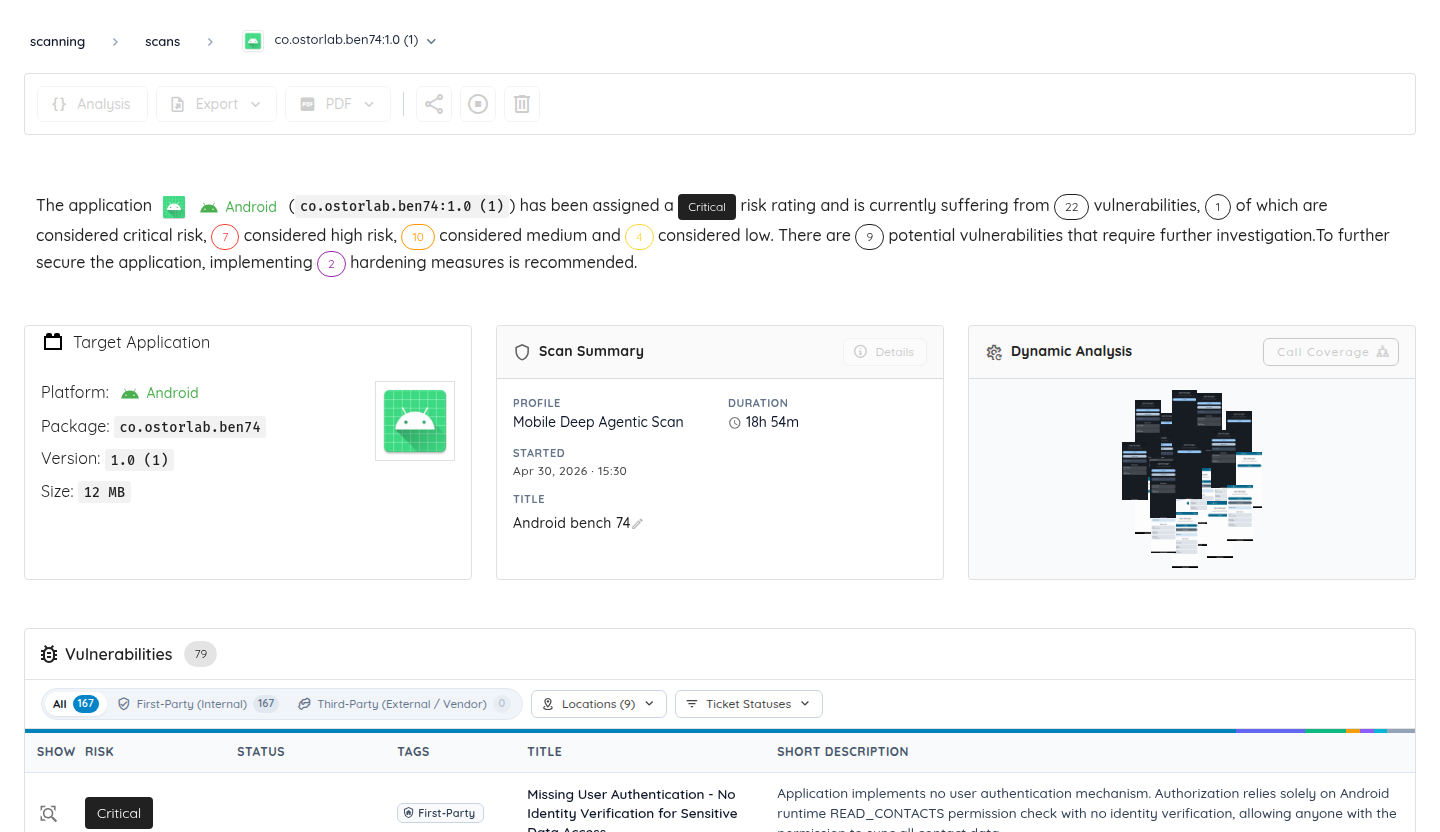
Figure 1: Ostorlab Agentic Deep Scan assessment report overview. The dashboard displays the overall risk rating, target architecture scope, scan duration, and categorized vulnerability breakdown ready for auditor inspection.
1. Deterministic Proof of Exploitability (PoC)
Auditors and enterprise reviewers demand verifiable evidence. Ostorlab findings do not rely on subjective confidence scores. Every reported finding provides deterministic proof tailored to the target asset—complete HTTP request and response pairs with curl commands for web and APIs, IPC triggers and runtime logs for mobile applications, and verified execution paths for code-level issues—alongside precise root-cause analysis.
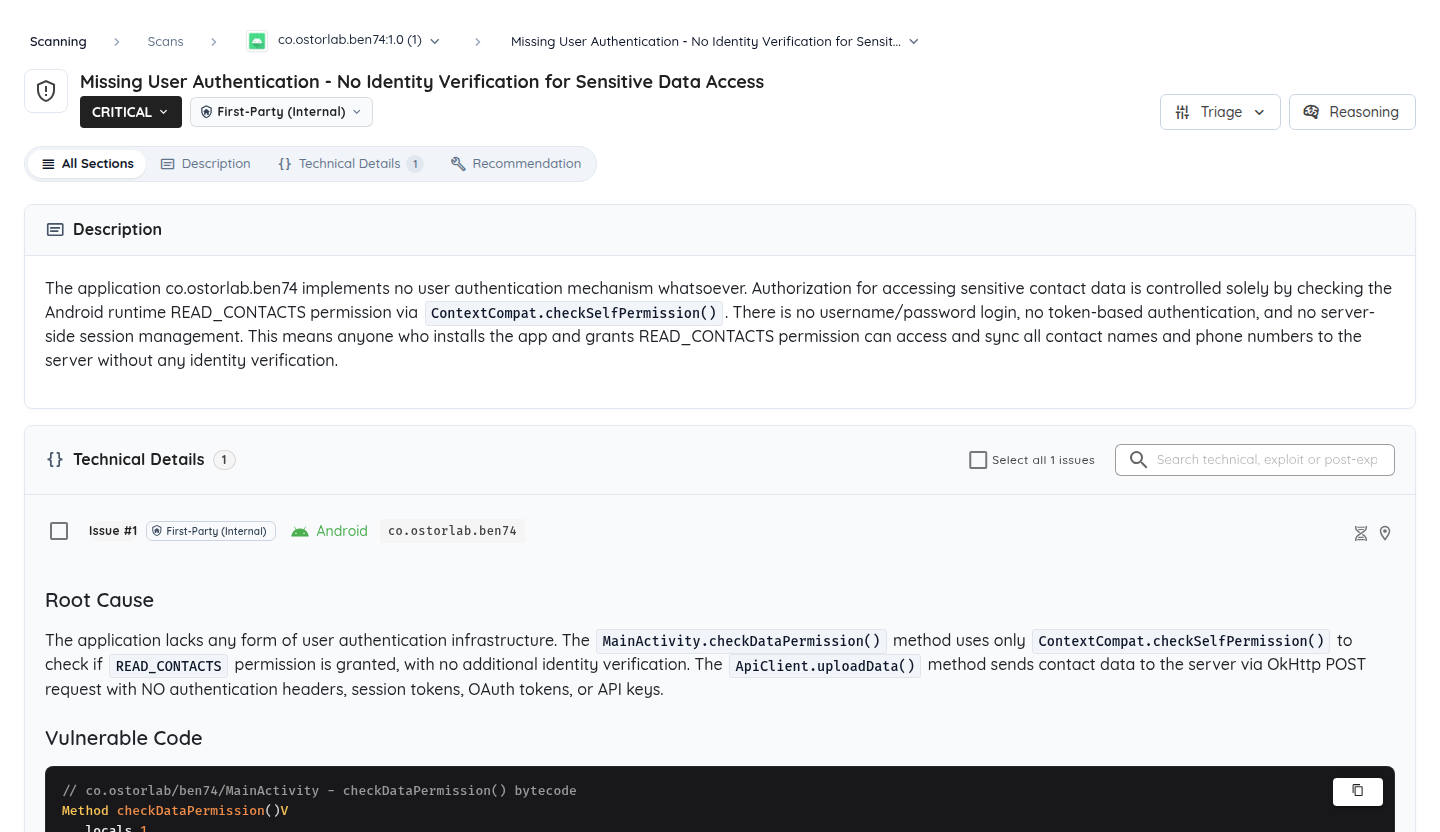
Figure 2: Detailed finding view within the Ostorlab platform. The report establishes severity, root-cause confirmation, affected code paths, and clear reproduction steps so developers fix the underlying defect without ambiguity.
Consider this sanitized Broken Object Level Authorization (BOLA) finding discovered during an authenticated API assessment:
POST /api/v2/workspaces/ws_89234/billing/invoices HTTP/1.1
Host: target-api.internal-saas.com
Authorization: Bearer eyJhbGciOiJIUzI1NiIsInR5cCI6IkpXVCJ9...
Content-Type: application/json

{
  "target_tenant_id": "tenant_enterprise_7710",
  "request_export": true
}
The server response confirms tenant data exfiltration across organizational boundaries:
HTTP/1.1 200 OK
Content-Type: application/json
Date: Fri, 11 Sep 2026 14:22:04 GMT

{
  "status": "success",
  "tenant_id": "tenant_enterprise_7710",
  "invoices": [
    {
      "invoice_id": "inv_99812",
      "amount_usd": 124500.00,
      "billing_contact": "finance@fortune500-client.com",
      "payment_method": "ACH_****8812"
    }
  ]
}
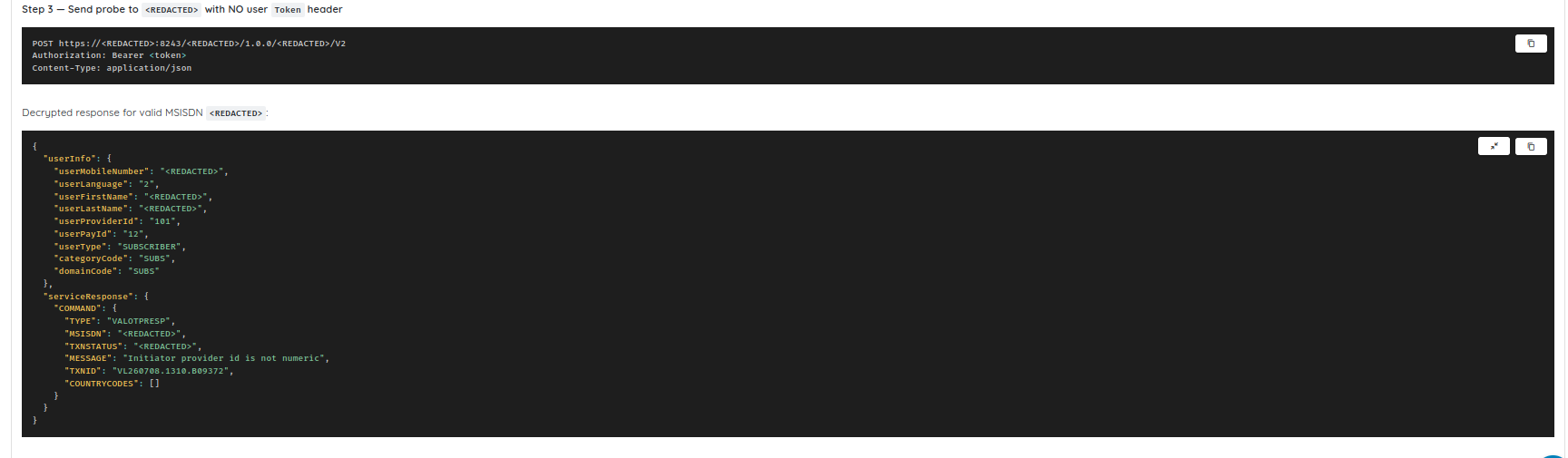
Figure 3: Runtime exploitation proof generated by the agent. The decrypted response demonstrates actual data exposure, giving auditors indisputable proof of compromise rather than a theoretical heuristic.
The finding is accompanied by a differential baseline check proving that non-vulnerable endpoints enforce strict tenancy checks. Developers receive an actionable reproduction command, while auditors receive indisputable proof of exploitation.
2. Unified Multi-Asset Stack: Web, APIs, and Mobile
Modern SaaS architectures extend beyond traditional web applications. Backend microservices, GraphQL gateways, and native mobile clients (iOS and Android) interact directly with enterprise customer data.
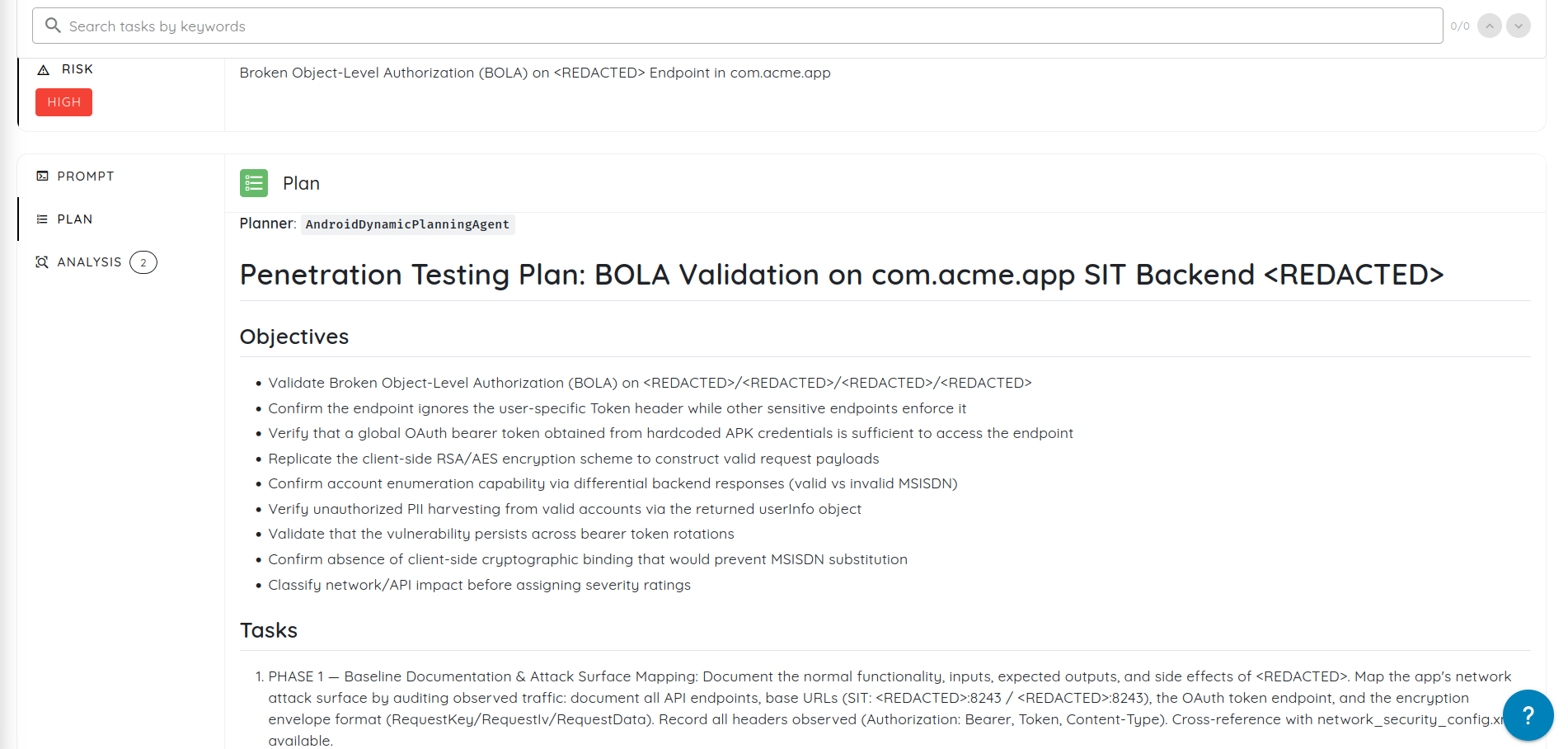
Figure 4: Inspectable testing methodology from an Ostorlab Agentic Deep Scan. Auditors can inspect the named planning agent, explicit objectives, and phased execution tasks, proving compliance with formal penetration testing standards.
Single-purpose web scanners cannot decompile mobile binaries or bypass certificate pinning. Ostorlab provides unified multi-asset testing: * Web and API Deep Scanning: Autonomous state exploration, OpenAPI and Postman collection ingestion, and dynamic testing of authorization controls. * Mobile Dynamic Instrumentation: Automated testing of Android (APK) and iOS (IPA) applications utilizing the Monkey dynamic testing framework, runtime instrumentation, and local storage risk detection. * Cross-Asset Pivot Analysis: Discovering hardcoded mobile secrets and chaining them to extract unauthorized backend API resources.
3. One-Click Remediation Retesting via Risk Reruns
In a traditional penetration test, fixing a vulnerability is only half the battle. Verifying the fix requires contacting the consultancy, waiting for an available tester, and often paying an additional retesting fee.
Ostorlab eliminates this operational friction through Risk Reruns and Single Vulnerability Assessment (SVA): 1. Developers inspect the exact reproduction payload and push a code fix to staging or production. 2. With one click, engineering triggers a targeted Risk Rerun directly against the affected endpoint. 3. The autonomous agent re-executes the exact exploit chain using fresh session credentials. 4. If the attack is successfully blocked, the platform updates the finding status to "Remediated" and records a timestamped verification entry in the audit log.
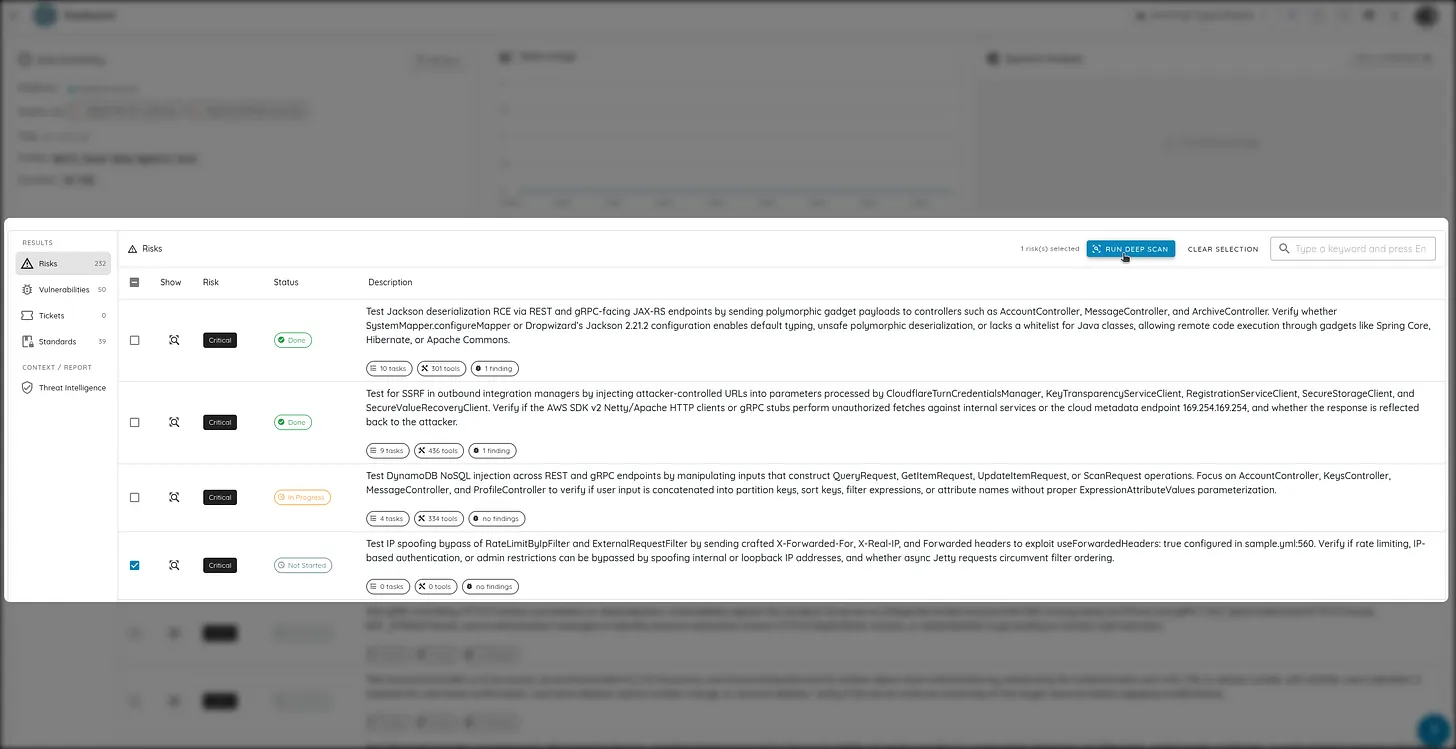
Figure 5: One-click Risk Reruns interface. Developers re-test patched vectors instantly, producing cryptographically timestamped verification records that auditors accept for clean remediation sign-off.
4. Validation and Accountable Attestation
Each AI Pentest package includes a working exploit for every finding the agents confirm and a retest window. Human validation is not part of every package; see the plan comparison for where it is included or available as an add-on. The final report package includes: * Executive Summary with high-level risk metrics for leadership and enterprise buyers under NDA. * Comprehensive technical scope and methodology mapping (NIST SP 800-115, OWASP WSTG). * Verified remediation log proving zero open Critical or High vulnerabilities. * Formal, signed Letter of Attestation accepted by major compliance platforms (Vanta, Drata, Secureframe).
How Startups Get an Audit-Ready Pentest Report in About a Week
Startups can move from initial scoping to a signed, audit-ready Letter of Attestation in an estimated 5–7 days for a Core assessment (10–14 days for Advanced, 15–20 days for Elite) by following a 4-phase pentest workflow. The phases below show the order of work, not guaranteed durations:
Updated 1 October 2026: turnaround and human-validation statements in this article were corrected to match the current plans page. Updated 5 October 2026: removed the security badge, which is not offered.
- Phase 1: Scope Intake and Seed Credentials: Define the customer data boundaries documented in your SOC 2 system description. Ingest web URLs, API schemas, and mobile binaries, supplying two distinct user credentials to test multi-tenant authorization controls.
- Phase 2: Autonomous Agentic Deep Scan: Autonomous agents map application state, discover unindexed endpoints, and execute exploit chains across authentication, authorization, and logic workflows.
- Phase 3: Targeted Developer Remediation: Developers review prioritized Critical and High findings. Because each finding ships asset-specific reproduction evidence—HTTP traces and curl commands for web/APIs, IPC triggers and runtime logs for mobile applications, and verified execution paths for code-level findings—engineers fix the root cause without triage ambiguity.
- Phase 4: 1-Click Retest and LoA Export: Engineering triggers Risk Reruns on patched vectors within the included retest window. The verified closures are recorded, and the Letter of Attestation and audit package are delivered to unblock procurement.
Frequently Asked Questions About SOC 2 Pentesting
Will a SOC 2 auditor accept an AI-driven penetration test report?
Yes. AICPA Trust Services Criteria (TSP Section 100) specify testing rigor and evidence standards, not the biological identity of the tester. Major CPA auditing firms accept agentic penetration tests provided the assessment follows established methodologies (such as NIST SP 800-115 and OWASP WSTG), includes deterministic proof of exploitation, provides a defined testing scope, and includes an independent, human-reviewed Letter of Attestation confirming remediation.
How does an on-demand agentic pentest differ from an automated vulnerability scan?
Automated vulnerability scanners rely on static pattern matching, isolated payload checks, and version banner inspections, producing high false-positive rates without confirming exploitability. An agentic penetration test actively interacts with application workflows, generates dynamic exploits, chains multiple weaknesses together, validates authorization boundaries across distinct accounts, and provides verified proof-of-concept evidence.
Does enterprise procurement require a full technical report or only an attestation letter?
Enterprise buyers standardly require a signed Letter of Attestation (LoA) and a sanitized Executive Summary under a non-disclosure agreement. Sharing raw technical vulnerability reports exposes sensitive application endpoints and exploitation instructions, which enterprise risk teams do not require. The Letter of Attestation confirms third-party independence, scope completeness, and the absence of unmitigated High or Critical vulnerabilities.
How does Ostorlab pricing compare to traditional penetration testing?
Traditional penetration testing consultancies quote between $15,000 and $40,000 for point-in-time assessments with weeks of delay. Ostorlab provides transparent tiered pricing, with scoped Core AI Pentest packages starting at $499 on-demand (scaling transparently with application scope and complexity), including multi-asset support and a retest window. Human validation depends on the plan; see the plan comparison.
Can agentic penetration testing support SOC 2 Type 2 observation periods?
Yes. SOC 2 Type 2 audits require proof of continuous control effectiveness across a three to twelve month window. Traditional annual pentests leave months of code changes unevidenced. On-demand agentic testing allows security teams to execute recurring assessments across major releases, establishing an uninterrupted evidence trail throughout the entire audit window.
Standards and Primary References
- American Institute of Certified Public Accountants (AICPA). Trust Services Criteria for Security, Availability, Processing Integrity, Confidentiality, and Privacy (TSP Section 100).
- National Institute of Standards and Technology (NIST). Technical Guide to Information Security Testing and Assessment (NIST SP 800-115).
- Open Web Application Security Project (OWASP). Web Security Testing Guide (WSTG v4.2).
- Open Web Application Security Project (OWASP). API Security Top 10.
- Shared Assessments. Standardized Information Gathering (SIG Lite) Questionnaire.
- Cloud Security Alliance (CSA). Consensus Assessments Initiative Questionnaire (CAIQ v4).