
When Does an AI Scanner Become an AI Pentest?
Learn what separates AI-powered scanning from AI pentesting and how Ostorlab Deep Agentic Scan follows evidence to validate real attack paths.
An AI-powered scanner is often presented as an AI pentest. The logic is easy to follow: if it uses AI to detect vulnerabilities, explain the risk, and recommend a fix, what else would it be?
But this confuses better analysis around a finding with a different way of testing an application.
An AI scanner becomes an AI pentest when the result of one test determines what it investigates next.
The difference becomes clear after the first finding.
Imagine a scanner discovers a hardcoded credential inside an iOS application. It identifies the secret, assigns a severity, and adds it to the report. Useful, but the most important question remains unanswered: Does the credential work?
During a Deep Agentic Scan assessment, the agent tested hardcoded Auth0 machine-to-machine credentials instead of reporting them immediately.
They worked and issued production JWTs. That confirmed the credential was active, but introduced a more interesting question: What could the token access?
The agent inspected its scopes, audience, and signing information. This revealed that the same credentials could authenticate to the Auth0 Management API.
The API accepted them, but that answer opened another question: What permissions did this access provide?
Further testing revealed administrative capabilities and access to sensitive user information across the tenant. The investigation had moved from one suspicious string to a demonstrated attack path:
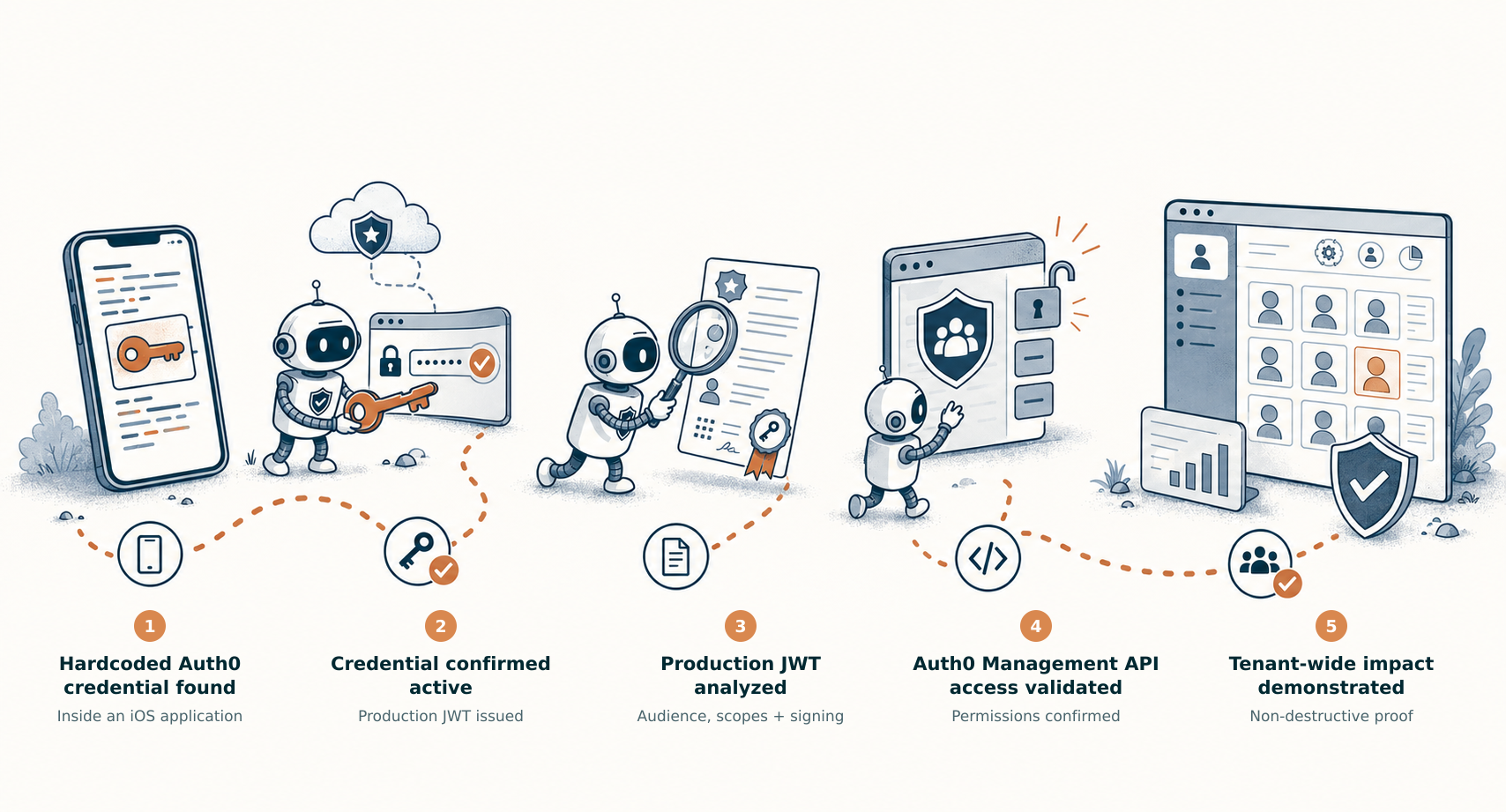
Hardcoded credential → production JWT → Management API → tenant-wide user data
A conventional scanner could have found the first step. The value of the AI pentest came from allowing each result to shape the next test.
The finding is not the finish line
This is what separates AI penetration testing from simply adding AI to a scanner. Deep Agentic Scan studies the application, forms a hypothesis, selects a security tool, observes the result, and uses that result to decide what deserves investigation next.
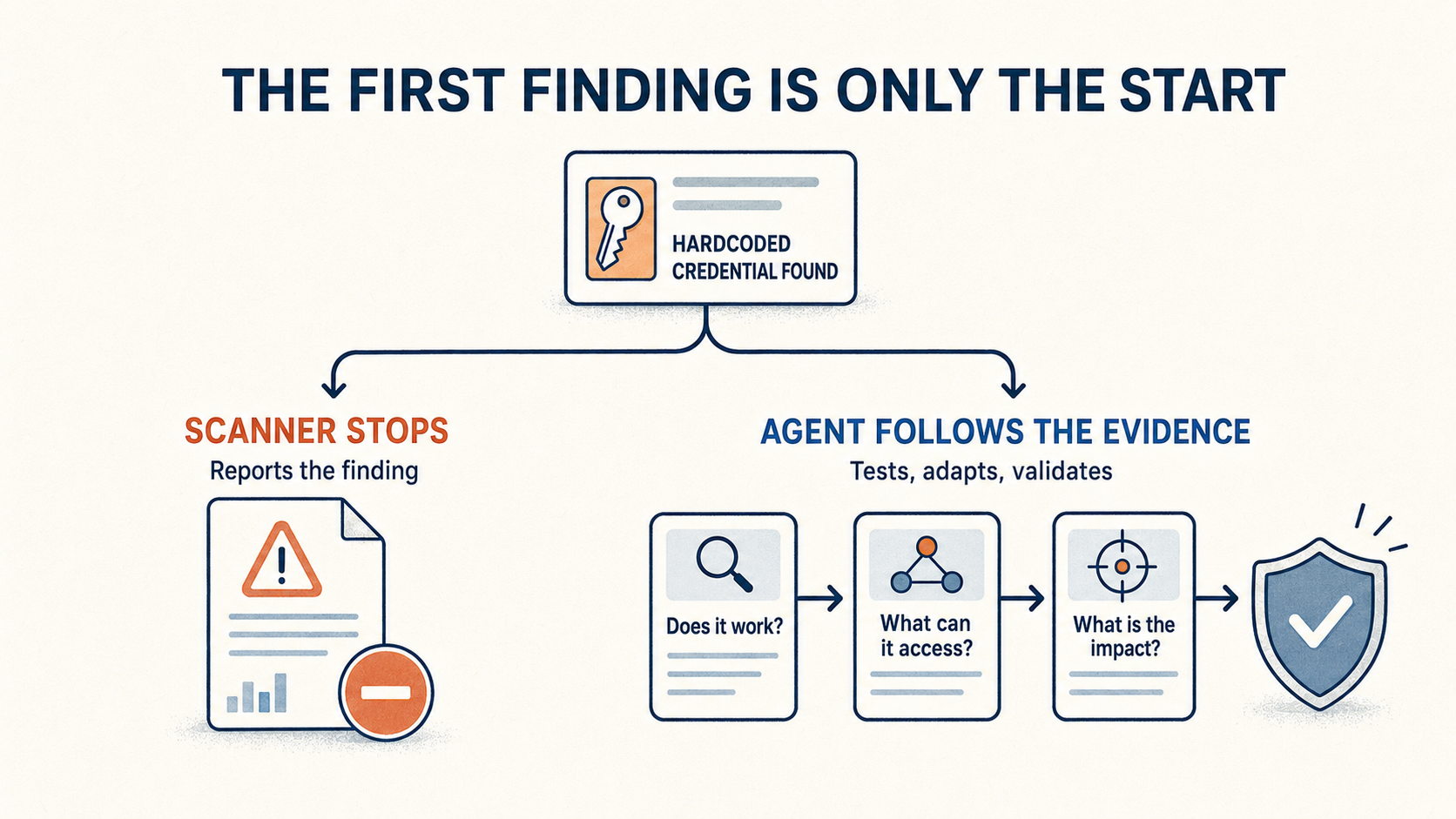
It also treats suspicious signals as hypotheses rather than confirmed vulnerabilities. When safe and possible, Deep Agentic Scan validates findings before reporting them and supports the conclusion with evidence such as requests and responses, screenshots, reproduction steps, and the demonstrated attacker path. This exploitability-focused process is designed to reduce false positives and keep reports low-noise, without claiming that false positives can never occur.
The same reasoning matters when an attack crosses components. A credential found in a mobile application may unlock an API, which may issue a token trusted by another service. Instead of treating each weakness as an isolated alert, Deep Agentic Scan can preserve the relationship between them and show the resulting impact.
This investigative approach can be applied to web applications and APIs and Android and iOS applications, including supported authenticated workflows and connected components.
What about human penetration testers?
AI pentesting does not remove the need for human testers. People still bring business context, creative judgment, and the ability to investigate unusual situations outside an automated scope.
What changes is how much of the investigative process can be repeated. An AI penetration testing solution can follow leads, validate suspicious behavior, document evidence, and retest fixes, leaving human experts to focus on the decisions that require deeper context.
This gives security leaders a better way to evaluate AI pentesting tools. Instead of asking only whether a product uses AI, ask whether the target’s response can change the system’s plan.
Ostorlab’s product remains Deep Agentic Scan. AI pentesting describes the methodology behind it.
That is when an AI scanner becomes an AI pentest: not when AI improves the report, but when every answer changes the investigation.