
Ostorlab vs. Pentesting Firms: 2026 Cost & Depth Comparison
Ostorlab vs. pentesting firms: cost, testing frequency, depth and remediation, and when to use AI pentests, consultants, or both.
A pentest completed in March can't tell you whether the authorization change you shipped in April is secure. And booking a consulting engagement after every significant release gets expensive fast.
So the real question isn't "AI or humans?" It's where do you need dedicated expert time, and how often does the rest of your application need testing?
Short answer: Ostorlab runs AI-driven pentests of mobile, web and API applications, starting at $499 for a one-time assessment, with ongoing plans that retest as the application changes. Traditional firms book human consultants for a fixed number of days, typically $3,000 to $18,000 for a web app. Use Ostorlab for frequent testing, a firm for specialist or design-level review, or both.
Disclosure: This comparison is published by Ostorlab and includes our services. It's based on public documentation, pricing guides and service descriptions as of September 2026, not a head-to-head assessment of providers.
What is the difference between a pentesting firm and an AI pentest?
A traditional pentesting firm sells expert time; an AI pentest sells repeatable, agent-driven testing that is cheaper to run again.
A penetration test is an authorized, simulated attack on your application. It shows which weaknesses a real attacker could exploit, before one does.
A traditional pentesting firm is a security consultancy. It assigns human testers to your application for an agreed scope and number of days, then delivers a report.
An AI pentest uses AI agents to explore the application, attempt exploits and assemble the findings. Because agents do the testing instead of booked consultant days, each run takes less time and costs less to repeat.
Ostorlab is an application security testing platform for mobile, web and API applications. Its offerings, as named in this article:
- AI Pentest: Ostorlab's scoped, one-time assessment of an application or connected ecosystem, with a retest window included. Human validation is not included in AI Pentest.
- AppSec and Enterprise plans: Ostorlab's ongoing plans, with continuous monitoring and rescanning. On these plans, human validation is an add-on (AppSec) or configurable (Enterprise).
- Agentic Deep Scan: the AI-agent testing engine used by Ostorlab's AI Pentest for authenticated workflows, authorization and business logic. AI Pentest is the assessment service; Agentic Deep Scan is the testing technology.
Ostorlab vs. traditional pentesting at a glance
The table below compares Ostorlab with a consultant-led engagement across eight areas. Features on ongoing plans are labeled separately from the one-time AI Pentest.
| Area | Ostorlab | Traditional consultant-led engagement |
|---|---|---|
| Cost | AI Pentest from $499; ongoing plans priced separately | Priced by consultant days and scope, typically $3,000–$18,000 per web app |
| Time to results | Estimated AI Pentest timeline: Core 5–7 days, Advanced 10–14 days, Elite 15–20 days; confirm scope and start point | Commonly 1–3 weeks of active testing, plus scheduling and reporting |
| Human validation | Not included in AI Pentest; add-on for AppSec; configurable for Enterprise | Human-led testing and review during the engagement |
| Testing frequency | Across builds and releases on ongoing plans | During the agreed engagement; repeats are scheduled |
| Technical depth | AI workflow investigation, exploit validation and chaining | Expert-led investigation, custom test cases, design review |
| Connected applications | Mobile, web, API and source assets tested together | Same components, when included in the scope |
| Development workflow | CI/CD integrations trigger scans as code changes | Findings delivered during or after the engagement |
| Remediation | Reproduction evidence, ticketing integrations, fix verification | Tester guidance, discussion and agreed retesting |
Timelines describe different delivery stages. Estimated AI Pentest timelines on the plans page: Core 5–7 days, Advanced 10–14 days, Elite 15–20 days; our startup pentesting guide describes 1–3 weeks of active manual testing. Confirm environment readiness, scheduling, human review and report delivery in the quote.
Good to know: a one-time AI Pentest is not continuous testing. Continuous monitoring comes with the ongoing AppSec and Enterprise plans.
How much does Ostorlab cost compared with a pentesting firm?
As of September 2026, Ostorlab's AI Pentest starts at $499 for a one-time assessment (the Core tier). A manual web application pentest commonly costs $3,000 to $18,000, depending on complexity, geography and vendor type, according to our 2026 application penetration testing cost guide. The same guide puts broader assessments spanning web, API, mobile and cloud at $18,000 to $50,000+. These ranges describe different scopes.
Large, complex applications cost more. Intruder, a vulnerability-scanning vendor, puts tester day rates at $1,500 to $2,500. A simple web app might need three junior days (about $4,500); a complex one, fifteen senior days (about $37,500).
Those scopes aren't identical, so don't read the gap as a like-for-like saving. The point is the entry budget. Teams pay for testing more than once a year: a new release, fix verification, a sensitive workflow that changed again. A lower price per assessment makes those checks easier to fund. Ongoing plans are priced by application coverage and AI Security Credits, the usage allowance for advanced AI actions such as agentic testing and fix validation. Routine workspace testing is included separately, as described on the plans page.
Where consultants earn their fee: a detailed review of a custom identity system may need days of analysis and conversations with its designers. Automating the repeatable testing leaves more budget for exactly that kind of focused work.
Can a traditional pentest cover apps that release every week?
Not on its own. A traditional engagement examines the application as it exists during the testing window, so every release after it ships untested until the next engagement.
Continuous testing closes that gap by repeating tests as the application changes, on each build or release, instead of once per engagement.
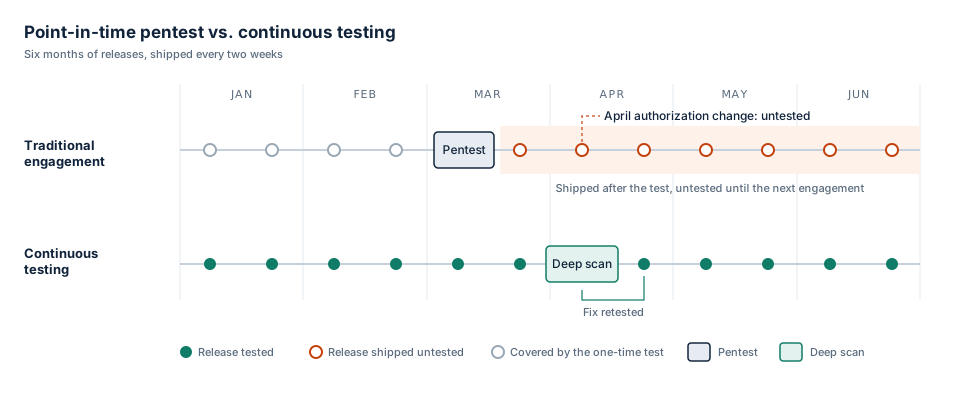
On Ostorlab's ongoing plans, that looks like this:
- Pipeline triggers: the GitHub integration scans mobile builds and web applications, and can fail the build above a chosen risk rating.
- Right-sized depth: routine scan profiles during development, deeper investigation for significant changes.
- Fix verification: the affected behavior is tested again once a fix is deployed.
Continuous doesn't mean "run everything all the time". A quick build check and a deep scan do different jobs. A practical program mixes recurring checks, deeper testing around important releases, and verification after remediation.
This isn't only about new vs. established providers, either. Some well-known consultancies now offer ongoing models:
- NCC Group, a UK-headquartered cybersecurity consultancy, says its continuous penetration testing is "triggered by change, ensuring new and updated functionality is assessed as it is developed."
- Bishop Fox, a US offensive security firm, offers AI-powered application penetration testing using its Cosmos AI engine, and states that "every vulnerability is reviewed, tested, and validated by a Bishop Fox penetration tester."
So the real distinction is ongoing program vs. scheduled engagement, not who the provider is.
Does AI pentesting go as deep as a human pentester?
For repeatable technical investigation, it can; for rules that only your product team can explain, a human specialist still goes further.
Authentication, permissions and multistep workflows all require context about how the application is supposed to work. Ostorlab's Agentic Deep Scan covers authenticated workflow testing, authorization checks, business-logic investigation, and attack paths that span an application and its APIs.
Where safe to do so, it performs exploit validation: it confirms a vulnerability by exploiting it in a controlled way, instead of flagging something that only might be vulnerable. Findings come with reproduction steps, screenshots and request-and-response evidence, and an analysis view shows the investigation's plan and reasoning. For how to judge that evidence, see can you trust AI pentesting results?
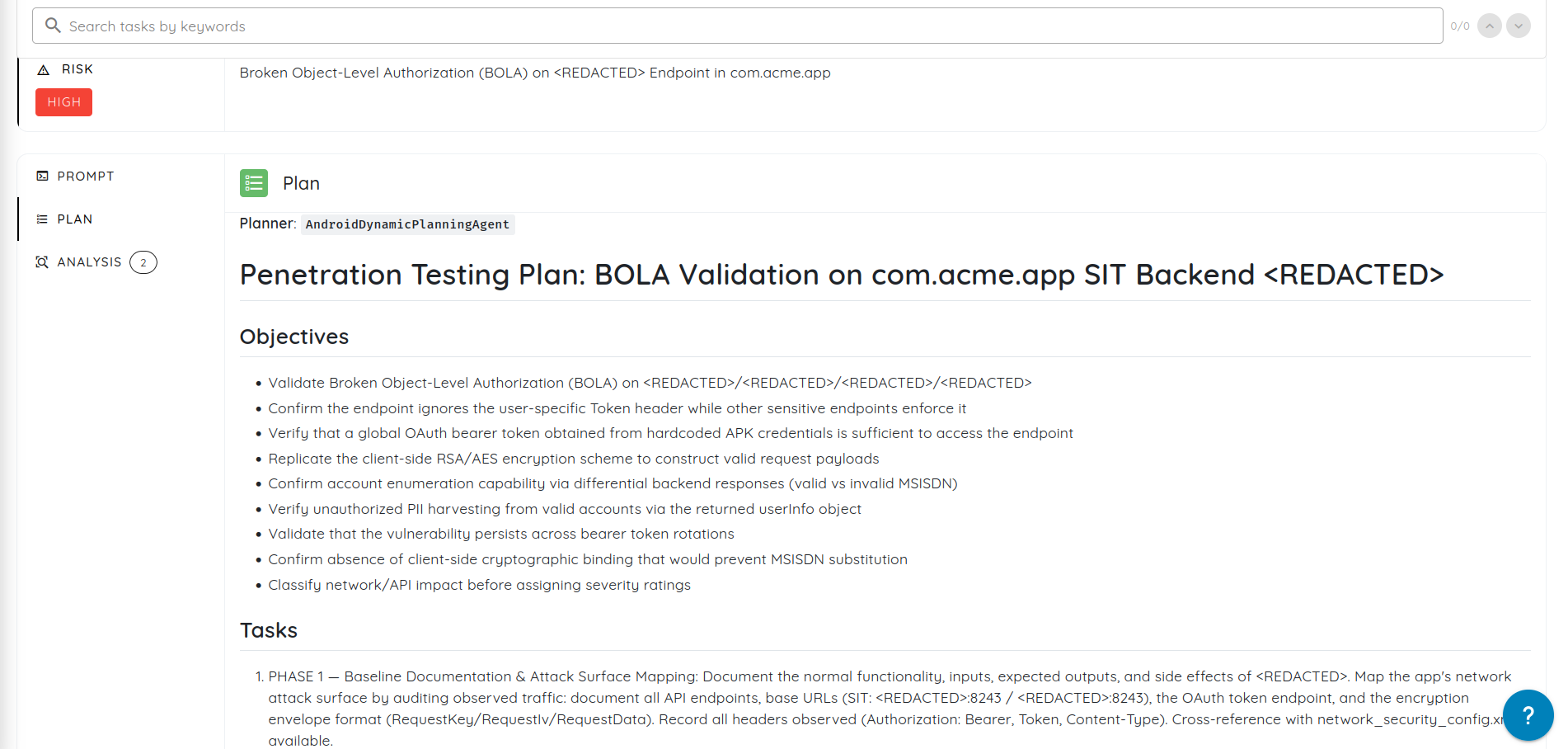
Example: the invoice boundary. A customer should only see invoices from their own organization. Testing that means using different identities, requesting another organization's records, and analyzing the response. If access succeeds, the finding shows exactly what was exposed and under which conditions.
Where consultants go further: some applications have rules that only product owners can explain, like delegated access under specific contractual terms or regional approval limits. A specialist can work through those requirements with your team, build tests around them, and extend into architecture review and threat modeling.
Can Ostorlab test mobile, web and APIs together?
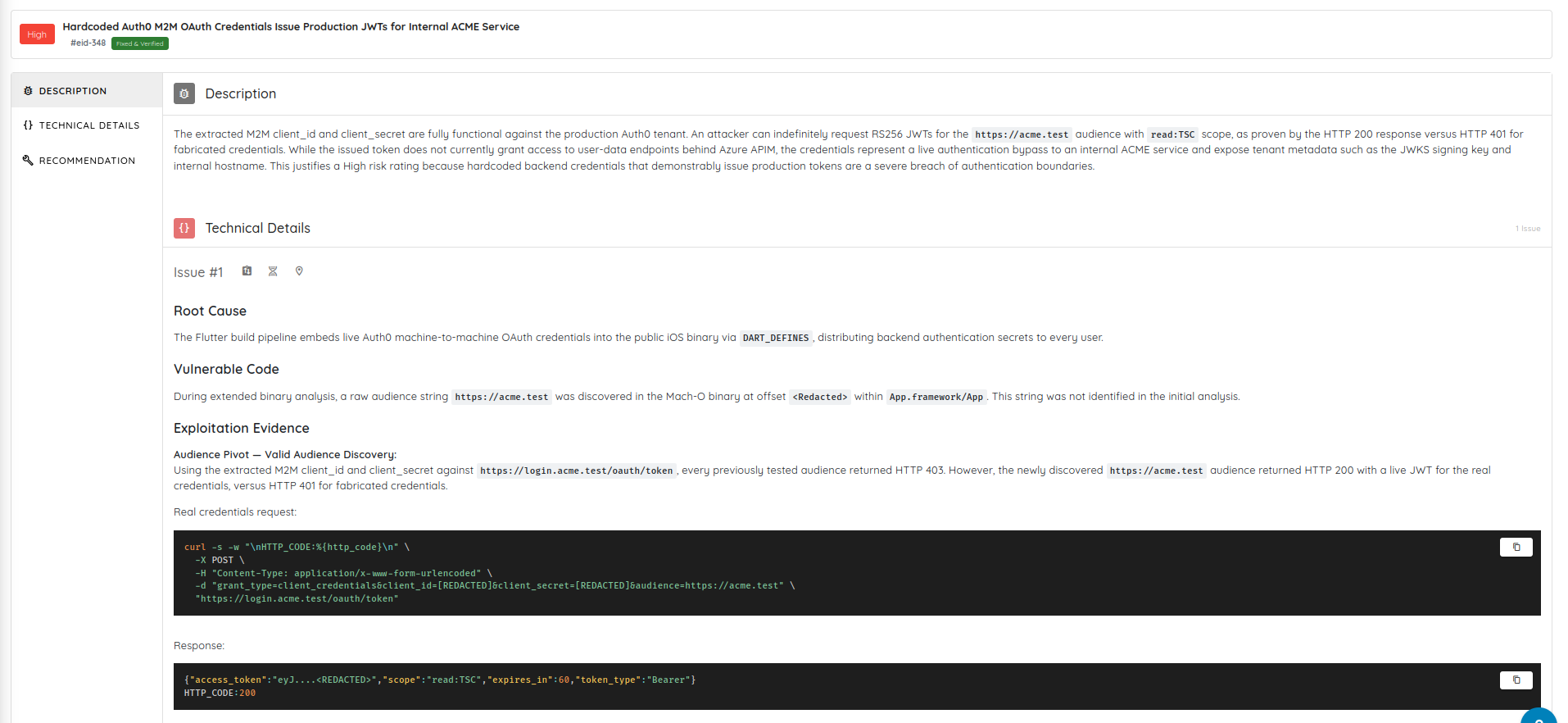
Yes. Ostorlab's multi-asset testing investigates related mobile, web, API and source targets together and brings the findings into one report. That matters because serious weaknesses often span components.
The finding shown below illustrates a mobile-to-API attack path: Auth0 machine-to-machine credentials embedded in an iOS app bundle grant access to the Auth0 Management API, exposing tenant-wide user data. The important result is the connection between the exposed mobile credential and its backend permissions.

A mobile-only test would report a hardcoded secret. An API-only test would never see it. Tested together, the finding shows developers which client exposed the issue, which backend behavior made it critical, and where the fix belongs.
A consulting firm can trace the same relationships. The difference is format: Ostorlab gives you a reusable workflow as those components change, while an engagement gives you concentrated expert attention during the assessment period.
Either way, scope matters. An API test alone won't cover local storage, runtime protections or other mobile-specific behavior.
How are findings fixed and retested?
In both models, a finding becomes a ticket, a fix, and a retest; the difference is how much of that loop is repeatable.
Ostorlab's public sample report includes an account-authorization finding with separate user identities, reproduction steps and recorded responses. From there:
- Track it: when Jira integration is enabled for your plan, the Jira integration creates and syncs issues, so findings land in your existing backlog. Confirm Jira availability in your subscription or quote before relying on this workflow.
- Verify it: once a fix ships, a retest returns to the affected behavior to confirm the vulnerability is gone. For an invoice-authorization finding, that means confirming unauthorized access is blocked and legitimate access still works.
- Watch for regressions: ongoing testing gives you more chances to catch the issue if it comes back.
Where consultants help: direct discussion is valuable when a fix involves architectural tradeoffs or several teams. Their retesting service verifies the agreed findings after remediation.
Heading into an audit or customer review? The assessment record matters as much as the findings. The OWASP Web Security Testing Guide recommends a report that covers scope, limitations, impact and remediation. If you need a signed report, a named assessor or a specific methodology, agree on it before testing starts. For SOC 2 specifically, see can SOC 2 accept an AI-conducted penetration test report?
Should you choose Ostorlab, a pentesting firm, or both?
Choose based on how often your application changes and where you need a human's judgment.
Choose Ostorlab when you test often across a changing application
- You need a low entry budget. Start with a scoped AI Pentest, no large engagement required.
- You release frequently. Ongoing plans support recurring checks and deeper scans around big changes.
- Your product spans mobile, web and APIs. Connected testing follows issues across components and consolidates findings.
- You want testing close to engineering. Evidence, CI/CD integration and remediation workflows help teams act on findings and verify fixes.
Choose a consulting firm when you need dedicated expertise
- Specialist review. Custom cryptography, hardware, unusual protocols or architecture analysis may need a separately scoped engagement.
- Complex business rules. Testers may need to work closely with product owners on permissions, exceptions and abuse scenarios.
- A major redesign. Changes to identity, tenant isolation or payment logic can justify a focused review by an experienced team.
- A required report format. Contractual requirements for an assessor or engagement type may decide it for you.
Use both for recurring coverage plus focused expertise
A company rolling out a new tenant-permission model could bring in specialists to review the design, then use recurring testing to check the implementation as it evolves. You keep testing frequency high and spend consultant time where it counts.
For the broader picture, including penetration testing as a service (PTaaS) as a middle option, read our guide to autonomous vs. traditional penetration testing.
Updated 2 October 2026: human validation is not included in AI Pentest, and timelines are now the estimated Core, Advanced and Elite durations from the plans page.
Frequently asked questions
Can Ostorlab replace a penetration testing firm?
Ostorlab's ongoing AppSec and Enterprise plans can provide recurring application testing, including authenticated workflows, authorization checks and exploit validation as the application changes. The one-time AI Pentest is a separate assessment with a retest window included. A consulting firm is still the better choice for custom cryptography, hardware, architecture review, or when a contract requires a named assessor.
How much cheaper is an AI pentest than a manual pentest?
Ostorlab's AI Pentest starts at $499 for a one-time assessment. A manual pentest for a single web application commonly costs $3,000 to $18,000; broader web, API, mobile and cloud assessments can cost $18,000 to $50,000+. Scopes differ, so the gap is not a like-for-like saving.
How long does an AI pentest take compared with a consultant engagement?
Ostorlab's estimated AI Pentest timelines are 5–7 days for Core, 10–14 days for Advanced and 15–20 days for Elite. Our startup pentesting guide describes manual testing as 1–3 weeks of active testing, plus report writing and scheduling. Scan execution and signed-report delivery are different milestones. Confirm scope, environment readiness and the delivery deadline before booking.
See the Ostorlab plans and manual testing timeline.
Does an Ostorlab AI Pentest include human review?
No. Human validation is not included in the one-time AI Pentest, which includes a retest window. On the ongoing AppSec plans, human validation is an add-on; on Enterprise it is configurable.
Is an AI pentest report accepted for SOC 2 or customer security reviews?
Often, but it depends on what the auditor or customer requires. Agree on the scope, methodology, report format and whether a named assessor is needed before testing starts. Our SOC 2 guide covers what auditors look for.
Do traditional pentesting firms offer continuous testing?
Some do. NCC Group offers change-triggered continuous penetration testing, and Bishop Fox offers AI-powered application testing with findings validated by its penetration testers. The real distinction is an ongoing program versus a scheduled engagement.
About the author: Youssef Mabrouk is a Digital Marketer at Ostorlab who researches cybersecurity tools and produces educational content.
Want to see what Ostorlab would cover for your product? Browse the sample report, start with a scoped AI Pentest on your next release, or talk to our team.
Already working with a pentest firm? Run Ostorlab on the app your next engagement covers: same target, same time box. A finding counts only after your team has reproduced it.