
n0n's Claims Against Visa, Mastercard and JPMorgan: What the Evidence Shows
n0n listed Visa, Mastercard and JPMorgan Chase with a 48-hour leak clock. Visa points to an APAC provider, Chase to a software bug, and no card data is confirmed.
TL;DR
- On 2026-11-16, the n0n extortion group listed Visa, Mastercard and JPMorgan Chase on its leak site and started a 48-hour countdown before publishing alleged data.
- Visa confirmed an incident at a third-party service provider in the Asia-Pacific region, said its own systems were not involved, and said there is no indication that card numbers were affected.
- JPMorgan Chase blamed a software bug in on-premises hardware for the same-day outage at Chase and other banks, and said there was no evidence the outage was cyber-related. It has not confirmed the n0n claim.
- The evidence reviewed here does not establish that n0n breached Visa, Mastercard or JPMorgan Chase. A leak-site listing is a claim, and the Chase listing describes marketing and cardmember records, not payment-processing systems.
- n0n is a credential-driven, AI-assisted extortion crew that reached the top three published ransomware actors within a month. Its locker uses one hardcoded 32-byte AES key per build, and two builds share the same key, so one victim's decryptor would likely unlock another's files.
- Treat the claims as unverified, protect customers from the phishing wave the outage invites, and close the access paths n0n is documented to use: FortiGate SSL-VPN, RDP and WinRM, long-lived AWS keys and exposed administrative sessions.
Am I affected?
An organisation is in scope when any of these hold:
- It uses a payment-network programme, marketing or analytics vendor in the Asia-Pacific region that holds cardmember data.
- It exposes FortiGate SSL-VPN, RDP or WinRM to the internet without phishing-resistant MFA.
- It stores long-lived AWS keys with list, read and delete rights, or keeps administrative browser sessions on a shared workstation.
- It received an extortion email from
notice@n0n-cases[.]netor found its name on n0n's leak site.
A cardholder is in scope when both hold:
- You hold a Visa, Mastercard or Chase product whose programme emails use the address n0n claims to hold.
- You receive an unsolicited message about the breach that asks you to click, call or pay.
What happened on November 16?
The public sequence starts with a leak-site post and ends with two different explanations for two different problems. It does not prove that the problems are connected.
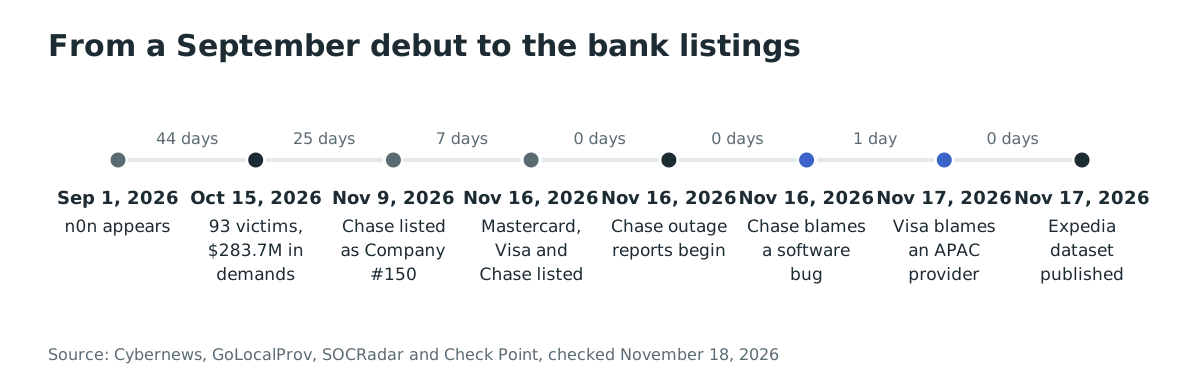
- 2026-11-09: n0n added a victim it labelled "Company #150" to its extortion site, according to Jay Longley's reconstruction for GoLocalProv, which cites the ransomware.live tracker.
- 2026-11-16 07:07 EST: ransomware.live recorded n0n listing Mastercard, then Visa at 07:08, then naming "Company #150" as "JPMorgan Chase & Co." at 07:09, the same reconstruction says.
- 2026-11-16 09:53 EST: Downdetector began showing reports of problems at Chase. More than 2,000 users had filed reports by 11:04, and the Chase chart showed more than 4,500 reports by the afternoon. Users also reported problems at Bank of America, U.S. Bank, Wells Fargo, Truist and Zelle.
- 2026-11-16: Chase told Reuters the bank had experienced a "temporary issue related to a software bug in on-premise hardware systems" and that "there is no evidence it is cyber-related." Other banks, the spokesperson said, may have been affected "only to the extent that they were a party to a transaction with us."
- 2026-11-17 09:48 UTC: Cybernews published Visa's response: the incident originated with a third-party service provider in the Asia-Pacific region, Visa's systems "were not involved and were not impacted," and there is "no indication that payment data such as card numbers have been affected."
- 2026-11-17 13:03 UTC: Cybernews reported that JPMorgan Chase had not confirmed whether the outage had any connection to the ransomware group's claims.
- 2026-11-17 14:23 UTC: Cybernews reported that a dataset of more than 500 MB allegedly from Expedia had been published. n0n had listed Expedia in early October and claimed a billion records.
The reporting reviewed for this article described a 48-hour countdown. No public report of a Visa or JPMorgan Chase data leak had appeared as of the morning of 2026-11-18.
What did n0n claim about each company?
n0n gave few details about the Visa and Mastercard listings. The Chase listing is more specific, and its subject matter matters: it describes marketing and programme records, not the systems that move money.
According to GoLocalProv's account of the listing, n0n said it would publish three sets of data if no settlement was reached:
- Engagement records for "a premium Reserve program of a global bank," which the listing says include hundreds of thousands of campaign interactions and tens of thousands of cardmember email addresses.
- The member directory behind those records, with programme labels and postal codes.
- Campaign emails "whose subjects and sender addresses carry the bank's own branding."
The listing was marked "not paid" and carried a clock counting down the hours "until leak," the same account says. On that Monday, ransomware.live recorded n0n naming 59 organisations, including Walmart, Airbnb, Visa, Mastercard and AARP.
That is a claim about a marketing dataset, not a claim of access to card authorisation, settlement or the core banking ledger. It is still sensitive: cardmember emails, programme membership and postal codes are exactly the material a convincing phishing campaign needs.
Was the Chase outage a cyberattack?
Chase's public position is that the outage was a software bug, not a cyberattack. Cybernews reports that position as the bank's stated explanation, and it does not provide evidence that n0n caused the outage.
The timing is the reason the question persists. The Chase listing appeared two hours and 44 minutes before Downdetector began recording Chase reports. A coincidence is not a cause, and a leak-site claim is not proof of a breach. The two facts can both be true: a criminal group can claim a company on the same day that the company has an unrelated outage.
Chase's statement is also narrower than a denial of the n0n claim. It denies that the outage was cyber-related. It does not say that n0n holds no Chase data. Cybernews reported that Chase had not confirmed whether the outage had any connection to the group's claims.
Who is n0n and how does it operate?
n0n is a financially motivated data-exfiltration and destructive-extortion group that appeared in September 2026. SOCRadar's threat research unit, which found an exposed operator staging server, describes a crew that exfiltrates data, encrypts or destroys infrastructure, and then runs victims through keyed negotiation rooms, per-victim Bitcoin wallets and a public leak site branded "n0n | no js | no mercy."
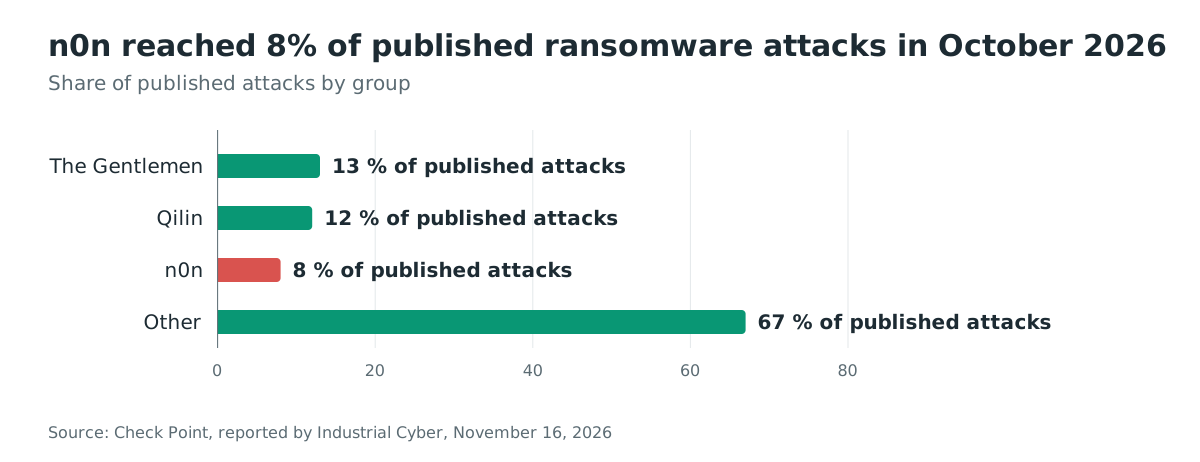
The group scaled quickly. SOCRadar counted 93 listed victims by 2026-10-15, across 27 countries, with the heaviest concentration in the United States and South Korea. By 2026-10-19, the listed demands totalled $283.7 million. Check Point, in its October 2026 threat landscape, counted more than 170 victims by early November and put n0n in the top three published ransomware actors, with 8% of published attacks in October.
The extortion model has three stages, according to SOCRadar:
- Attack: exfiltrate data and encrypt or destroy systems while the incident stays private.
- Public exposure: list the victim on the leak site to raise pressure through media and search visibility.
- Files leaked: publish archives through ZIP downloads and web-seeded torrents.
In the October wave, n0n dropped negotiation. Victims had to pay the listed address in full or face automatic publication when the countdown expired, SOCRadar says: 96 hours for mid-October listings and seven days for a maritime batch. Earlier, the group charged a 10% upfront fee just to access its negotiation portal, which prevented victims from inspecting the stolen files before paying.
The payment trail is thin. n0n is Bitcoin-only and derives a unique address per victim from a single BIP84 seed. SOCRadar collected 55 addresses and found no transactions, balances or pending mempool activity on any of them as of 2026-10-16.
How does the extortion flow work?
n0n turns one set of stolen credentials into a public countdown: access, exfiltration, encryption or destruction, listing, and publication.
FortiGate, RDP, AWS"] --> B["Exfiltration
1-110 GB per bucket"] B --> C["Encryption or destruction
shadow copies wiped"] C --> D["Leak-site listing
48-hour to 7-day clock"] D --> E["Publication
ZIP and torrent"] D --> F["Payment
Bitcoin address"]
How does n0n get in?
n0n's documented intrusions start with credentials, not exploits. SOCRadar found no exploit payloads or CVE references in the operator workspace. The access paths it describes are ordinary and familiar:
- FortiGate SSL-VPN credential stuffing through residential proxy pools, against an index of 305 appliances, with a 15-thread routine and the header
Cookie: APBSID=n0n. - RDP and WinRM sweeps for default or weak passwords, driven by OCR-assisted scripts.
- Long-lived AWS IAM keys with list, read and delete rights.
- Stored administrative browser sessions for hosting-provider management, billing and monitoring portals.
- API tokens and cloud credentials harvested from source code and CI/CD pipelines.
After access, the operator creates hidden administrator accounts disguised as services, such as svc_upd and svc_reg, resets root through GRUB init=/bin/bash on OCR-driven consoles, runs a gost SOCKS5 proxy as a scheduled task, and starts OpenSSH on port 2222. Exfiltration runs through dedicated per-victim pipelines with byte budgets from 1 GB to 110 GB per cloud bucket, ending in Base64-encoded ZIP POSTs, SigV4 requests over Tor and SSH-tunnelled TAR archives.
What is the weakness in n0n's encryption?
The locker's main weakness is key reuse. SOCRadar recovered the original C++ source of the locker from the staging server. It describes a lightweight AES-256-CBC file encryptor with no network capability, no key exchange, no per-victim keys, no ransom-note logic, no persistence and no anti-analysis. All of that comes from external wrapper scripts.
Each build uses a single hardcoded 32-byte key. The nenc.cpp build and the PowerShell encryptor used against FinSoft share an identical key, so a decryptor obtained by one victim would likely unlock the other's files. SOCRadar's conclusion is blunt: the paid "decryptors" are that static key.
That does not make every n0n victim recoverable. The wrapper scripts delete shadow copies, wipe free space and overwrite the original files, so a static key helps only when an encrypted copy survives. The reliable recovery path remains an offline or immutable backup.
The Windows wrapper stages tooling in C:\Users\Public\n0n\, stops MSSQL, MySQL and W3SVC, disables Symantec Endpoint Protection, runs vssadmin delete shadows /all /quiet, wipes free space with cipher /w, and reruns encryption every five minutes as a SYSTEM scheduled task. It drops n0n_READ_ME.txt across roots, shares and desktops, and sets a Run key that opens the note at logon. The Linux variant is more careful: it writes to a .n0n.tmp file, decrypts and verifies the result against an MD5 checksum, and only then renames the file.
Why is n0n technically interesting?
Two things separate n0n from a conventional ransomware crew: it runs an AI coding agent as part of its tooling, and its own staging server was exposed.
SOCRadar found the operator working with opencode, an open-source AI coding agent, configured with 154 model entries across seven providers. The configuration includes commercial gateways, "uncensored" and "abliterated" models with safety training removed, and a self-hosted Qwen 27B model on a rented GPU server. Billing records showed more than $7,216 in API spending as of 2026-10-22, concentrated on the safety-removed models.
The agent produced hundreds of numbered, iteratively patched scripts, stored encryption keys in its own memory file, and drove the command-and-control panel through saved session cookies. SOCRadar describes a human-directed operation supported by AI, not a fully autonomous attack system. The AI sits behind the door, not in front of it: the entry vector was still a password.
The staging server at 185.157.161[.]148:8877 exposed the live working directory across two snapshots on 2026-09-25 and 2026-09-26. It held 1,719 files, including 829 scripts, five C++ encryptor sources and the AI-agent configuration. The files covered 23 organisations across 14 countries and an operational window from 2026-09-10 to 2026-09-28. The exposure is why SOCRadar's profile can describe n0n's methods in this detail.
What can an attacker do with the claimed data?
The claimed Chase data is a marketing and cardmember dataset, not a payment-card dump. On its own, it supports targeted social engineering rather than card fraud.
- Phishing and account takeover. Cardmember emails, programme labels and postal codes let an attacker write a message that looks like it came from the bank's own programme. The same data supports credential-stuffing attempts against the bank and against other services where customers reused passwords.
- Business email compromise. Campaign emails with the bank's branding give an attacker ready-made subjects, sender patterns and templates to imitate.
- Profile building. Combined with other breaches, the records can confirm a person's bank relationship, approximate location and programme membership. That is enough to make a fraud call or a password-reset attempt more convincing.
- Outage-themed lures. A bank outage is a natural pretext. Messages that say an account is locked, a transaction failed or a refund is waiting are more believable during a disruption, even when the disruption is unrelated to the data claim.
In public reporting at publication, the claimed data shows no card numbers, expiry dates or CVVs. Visa says there is no indication that payment data such as card numbers was affected. That is a statement about Visa's own systems and the third-party incident it described, not a guarantee about every dataset n0n may hold.
What should defenders do?
Treat the listing as an unverified claim, preserve the evidence, and close the access paths n0n is documented to use. The defensive work splits into incident response and the controls that would have blocked the intrusion.
- Preserve the listing, the extortion email headers, the wallet addresses and the timeline before they change. Do not engage the group through its own portal.
- Enforce phishing-resistant MFA on SSL-VPN, RDP, WinRM and every administrative portal. Monitor
/remote/logincheckfor credential stuffing and invalidate credentials found in infostealer logs. - Restrict FortiManager and FMC interfaces with IP allow-lists and MFA. Remove shared and default credentials, require approval for policy changes, and flag REST token creation from unknown IPs.
- Replace long-lived cloud keys with short-lived roles. Keep list, read and delete S3 permissions off a single identity, enable Object Lock and versioning, and alert on high-volume
DeleteObjectscalls. - Keep an offline or immutable backup. n0n deletes shadow copies, zero-fills free space and deletes provider-hosted backups, so a backup that the domain administrator can delete is not a recovery plan.
- Isolate administrative browsers. Hosting and SaaS operators should run management portals from dedicated workstations with hardware-backed session controls, and keep MFA passcodes out of local admin mailboxes.
- Hunt for the published behaviour:
C:\Users\Public\n0n\,.n0nrenames after MSSQL, W3SVC or MySQL stops, SYSTEM tasks such as SvcSync or NetAssist, Chrome launched with--remote-debugging-port,svc_updandsvc_regaccounts, OpenSSH on port 2222, agostSOCKS5 proxy, and mail fromnotice@n0n-cases[.]net. - Map the third-party data flow. If a marketing, analytics or programme vendor in the Asia-Pacific region holds cardmember emails, ask what it holds, who can reach it, and how it would notify you.
Use Ostorlab's attack surface discovery to map your external assets before reviewing which remote-access services are exposed.
What should customers do?
Visa's statement says there is no indication that card numbers were affected. The practical response is to watch for phishing, not to cancel a card because of an unverified leak-site claim.
- Use the bank's official app or the number on the back of the card. Do not use a link or phone number from an email, text or social-media post about the breach.
- Treat messages that mention the outage, a locked account, a failed transaction or a refund as suspicious until verified independently.
- Enable two-factor authentication on banking and email accounts, and use a unique password for each.
- Check statements and alerts. If you see a transaction you do not recognise, contact the issuer through its published channel.
- If you reused the password on the account tied to the leaked email, change it everywhere it was reused.
- A credit freeze or fraud alert is a reasonable precaution if your identity data, not just an email address, may be exposed. It does not stop card fraud on an existing card.
What is still unconfirmed?
Several questions remain open at publication. They belong in the risk assessment, not in a headline.
- Which Asia-Pacific third-party provider Visa is describing, and whether it also serves Mastercard or JPMorgan Chase.
- Whether the data n0n listed for Visa, Mastercard or Chase is genuine, and how much of it exists.
- Whether the 48-hour deadline produced a publication, and what was published.
- Mastercard's response. No public statement from Mastercard was available at publication.
- The exact scope of the Chase listing, including whether the "premium Reserve program" data came from Chase directly or from a vendor.
- Whether the Chase outage and the n0n listing have any causal connection. The public evidence does not establish one.
Timeline
The timeline below separates the extortion claims from the outage and the company statements. It is not a causal chain.
FAQ
Did n0n breach Visa's core payment network?
Visa says its systems were not involved and were not impacted. It says the incident originated with a third-party service provider in the Asia-Pacific region and that there is no indication payment data such as card numbers was affected. That is Visa's statement, not an independent audit.
Was the Chase outage caused by n0n?
Chase says the outage was a software bug in on-premises hardware and that there is no evidence it was cyber-related. The public timeline shows the n0n listing two hours and 44 minutes before the first Downdetector reports, but timing alone does not establish causation. Chase has not confirmed the n0n claim.
Are my card details exposed?
Visa says there is no indication that card numbers were affected. The Chase listing described marketing and cardmember records, not card numbers, expiry dates or CVVs. No reporting reviewed for this article shows a card dump. Treat any message that claims otherwise as a phishing attempt until the issuer confirms it.
Has the data been published?
No public report of a Visa or JPMorgan Chase data leak had appeared as of the morning of 2026-11-18. A dataset allegedly from Expedia was published on 2026-11-17, which shows that at least some of the group's deadlines end in publication.
Is there a CVE or a KEV entry?
No. n0n is a threat actor and an extortion campaign, not a software vulnerability, so there is no CVE to assign and no CISA KEV entry for the campaign. The KEV catalog lists exploited vulnerabilities, not ransomware groups.
What is the weakness in n0n's encryption?
Each build uses one hardcoded 32-byte AES key, and two builds recovered by SOCRadar share the same key. A decryptor from one victim would likely unlock the other's files. The paid "decryptors" are that static key. The wrapper scripts still delete shadow copies and wipe free space, so a surviving encrypted copy and an offline backup remain the reliable recovery paths.
What should I do if I receive an email from n0n?
Do not reply, do not open the negotiation portal, and do not pay. Preserve the message and its headers, notify your legal and incident-response teams, and report it to law enforcement. The group's published address is notice@n0n-cases[.]net; a message from it is a lead for investigators, not a channel for the victim.
References
- Cybernews, "Visa confirms cyberattack as hackers claim JPMorgan was hit too", 2026-11-17 (checked November 18, 2026). https://cybernews.com/security/visa-jpmorgan-data-breach/
- Cybernews, "Major US Banks Outage Blamed on JPMorgan Software Bug", 2026-11-17 (checked November 18, 2026). https://cybernews.com/security/jpmorgan-bug-causes-major-bank-outage/
- Cybernews, "Expedia data leak exposes millions of travel records", 2026-11-17 (checked November 18, 2026). https://cybernews.com/security/expedia-customer-data-leak/
- OODA Loop, "Visa Confirms Third-Party Cyberattack as Ransomware Gang 'n0n' Targets Financial Giants", 2026-11-17 (checked November 18, 2026). https://oodaloop.com/briefs/cyber/visa-confirms-third-party-cyberattack-as-ransomware-gang-n0n-targets-financial-giants/
- SOCRadar, "Dark Web Profile: n0n Ransomware", 2026-11-12, updated 2026-11-17 (checked November 18, 2026). https://socradar.io/blog/dark-web-profile-n0n-ransomware/
- Crypto Briefing, "N0n ransomware group spends $7K on AI tools, then leaves its own server wide open", 2026-10-30 (checked November 18, 2026). https://cryptobriefing.com/n0n-ransomware-ai-tools-exposed-server/
- Industrial Cyber, "Check Point finds ransomware at record levels as n0n rises into top three and high-risk GenAI prompts increase", 2026-11-16 (checked November 18, 2026). https://industrialcyber.co/ransomware/check-point-finds-ransomware-at-record-levels-as-n0n-rises-into-top-three-and-high-risk-genai-prompts-increase/
- GoLocalProv, "Hours Before the Chase Outage, a Ransomware Group Listed Chase as a Victim", 2026-11-17 (checked November 18, 2026). https://www.golocalprov.com/news/hours-before-the-chase-outage-a-ransomware-group-listed-chase-as-a-victim-jay-longley
- CISA Known Exploited Vulnerabilities catalog, checked November 18, 2026. https://www.cisa.gov/known-exploited-vulnerabilities-catalog