
VMware vCenter Auth Bypass Exploited in the Wild (CVE-2026-123890)
An unauthenticated vCenter Directory Service flaw yields administrator@vsphere.local; exploited as a zero-day, fixed in 9.1.1.0200, 9.0.2.0200 and 8.0 U3m.
TL;DR
- A flaw in the vCenter Directory Service lets an unauthenticated attacker recover an SRP session key and open an administrator session as
administrator@vsphere.local. Broadcom rates it CVSS v3.1 9.8 Critical (CWE-288). - VMware vCenter 9.1.x before 9.1.1.0200, 9.0.x before 9.0.2.0200 and 8.0 before 8.0 U3m are affected. VMware Cloud Foundation 5.x needs both vCenter 8.0 U3m and SDDC Manager 5.2.5, and vCenter 7.0 is affected under extended support.
- Google Threat Intelligence Group and Mandiant report that the suspected China-nexus actor ARMORY CASTLE exploited the flaw in early September 2026. CISA's Vulnrichment record still says Exploitation: none, and the CVE is not in KEV as of 2026-11-20.
- Apply the fixed vCenter build for your branch. Broadcom lists no workaround, so isolating the management network only reduces exposure.
Am I affected?
All of these must hold:
- The environment runs an affected vCenter build.
- An attacker can reach the vCenter management network, including TCP port 2012 for the Directory Service RPC interface.
- The environment has not applied the fixed build for its branch.
vCenter is the control plane for vSphere. A vCenter that is reachable from a user VLAN, a compromised application server or an internal Linux host gives an attacker the network position this flaw needs. Isolation helps, but the flaw needs no credentials and no user interaction.
| Product and branch | Affected versions | Fixed version |
|---|---|---|
| VMware vCenter 9.1.x | 9.1.x before 9.1.1.0200 | 9.1.1.0200 |
| VMware vCenter 9.0.x | 9.0.x before 9.0.2.0200 | 9.0.2.0200 |
| VMware vCenter 8.0 | 8.0 before 8.0 U3m | 8.0 U3m |
| VMware Cloud Foundation 5.x | vCenter below 8.0 U3m | vCenter 8.0 U3m and SDDC Manager 5.2.5 |
| VMware vCenter 7.0 | all releases | no public build; contact Broadcom under extended support |
| VMware Telco Cloud Platform 3.0, 4.x, 5.0.x, 5.1.x and 5.2 | per Broadcom KB463116 | per Broadcom KB463116 |
| VMware Telco Cloud Infrastructure 3.0 | per Broadcom KB463116 | per Broadcom KB463116 |
Check the running version and build with PowerCLI:
Connect-VIServer -Server vcenter.example.com
$global:DefaultVIServer.Version
$global:DefaultVIServer.Build
The same values appear in the vSphere Client Summary tab and in the VAMI interface at https://vcenter.example.com:5480. Then confirm whether the Directory Service port is reachable from an untrusted network:
nc -vz vcenter.example.com 2012
On Windows, use Test-NetConnection -ComputerName vcenter.example.com -Port 2012. A successful connection from a host that should not manage vCenter is the condition to remove first.
How do I fix it?
Upgrade vCenter to the fixed build for its branch: 9.1.1.0200 for 9.1.x, 9.0.2.0200 for 9.0.x, and 8.0 U3m for 8.0. VMware Cloud Foundation 5.x customers apply vCenter 8.0 U3m through the asynchronous patching process in Broadcom KB88287 and update SDDC Manager to 5.2.5.
- Download the fixed vCenter build from Broadcom's patch portal.
- Back up the vCenter configuration and take a snapshot according to your change policy.
- Apply the update through VAMI or the standard vSphere update mechanism. The vCenter Quick Patch path is not eligible for this advisory.
- Reboot if the update requires it, then confirm the new build with PowerCLI.
- Update SDDC Manager, VMware Tools for Windows and any Telco Cloud component that the advisory lists.
- Restrict TCP ports 2012, 443 and 5480 to management jump hosts after the update.
Broadcom publishes no workaround. The available compensating controls are network controls. Allow only known management hosts to reach vCenter, block east-west access to port 2012, and forward vCenter and VAMI logs to a remote collector. Those controls reduce exposure, but they do not remove the flaw.
Google's Mandiant recommends its VCSA hardening tool for organizations that need a default-deny posture at the appliance level. The tool writes iptables rules and forwards blocked connections to a SIEM. Treat it as an additional layer, not as a replacement for the fixed build.
Organizations on vCenter 7.0 need an active extended support contract. Broadcom does not publish a public 7.0 build for this advisory. The same applies to the Telco Cloud versions, which Broadcom covers through KB463116.
What is the root cause?
The flaw is in the vCenter Directory Service, vmdird, which exposes an authentication interface over DCE/RPC on TCP port 2012. The service implements Secure Remote Password (SRP-6a), a password-authenticated key exchange. In SRP, the client and the server derive a shared session key from the password verifier and from ephemeral values that each side sends.
Google Threat Intelligence Group describes the defect as predictable UUIDv1 timestamp generation in the SRP authentication interface. A UUIDv1 value contains a timestamp and a node identifier. When the server uses those values where the protocol expects unpredictable data, an attacker can reproduce the values that feed the key derivation. The attacker then recovers the SRP session key without knowing any password.
The recovered key is enough to establish an authenticated session as administrator@vsphere.local. GTIG's wording is precise. The flaw "enables unauthenticated Secure Remote Password session key disclosure by exploiting predictable UUIDv1 timestamp generation in the SRP authentication interface, enabling the compromise of the SRP session key without knowing any passwords."
The vulnerable code is closed source. Broadcom publishes the advisory and the fixed builds, but not the vmdird source or a patch diff. The public root-cause material is therefore the Mandiant and GTIG analysis, which names the service, the interface and the predictable value. The exact line that generates the UUID is not public.
The flaw is distinct from CVE-2026-59309, the vCenter vmdir LDAP issue disclosed on 2026-07-29. That flaw used malformed authorization tokens over LDAP on ports 389 or 636. CVE-2026-123890 uses the DCE/RPC SRP interface on port 2012 and recovers the session key.
How is it exploited?
The attack needs network access to the vCenter management interface and no credentials. GTIG reconstructed the following path from the BONESAW utility and from forensic evidence:
- Scan the internal network for vCenter management ports. The observed scans targeted 443, 2012, 5480 and 9080.
- Send crafted SRP authentication messages to the
rpc_srp_verifierservice over DCE/RPC on port 2012. The predictable UUIDv1 values expose the shared session key. - Use the recovered key to create an authenticated session as
administrator@vsphere.local. - Call the
vmdirdbcpDirectory Service interface to run commands and read files, including/storage/db/vmware-vmdir/data.mdb. - Extract the SAML Security Token Service signing key from the directory database and create an SSO administrator account with BONESAW, then forge SAML assertions with SAWSNAKE.
- Enable SSH through the VAMI API with a PUT request to
/rest/appliance/access/ssh, then log in with the new administrator account. - Read the vCenter master key and the PostgreSQL credentials, authenticate to ESXi as
vpxuser, and reach the ESXi host over SSH.
The advisory, the CVE record and the GTIG report do not link to any public exploit code for CVE-2026-123890. GTIG describes BONESAW, the Golang utility it recovered, but does not publish the binary. The utility supports subcommands to create an SSO administrator, stream the LMDB database and extract the SAML signing key. Its build timestamp is 2026-07-13T09:21:24Z.
The campaign used the flaw after a separate compromise of a BeyondTrust Remote Support appliance. That first stage is CVE-2026-102764, which GTIG described in an earlier report. The vCenter exploitation is a later step in the same intrusion, not a second initial-access path.
How does the attack flow?
An attacker who can reach port 2012 recovers the SRP session key, becomes administrator@vsphere.local, and uses the directory database and SAML keys to persist and move to ESXi.
What can an attacker do?
An attacker who completes the chain holds an authenticated vCenter administrator session. That session can read and change the virtual infrastructure: inventory, hosts, clusters, virtual machines, datastores and permissions. It can also read files through the Directory Service interface and download the directory database.
The directory database contains the SSO identity data and the SAML token-signing material. With the signing key, an attacker can forge assertions for any user, including administrators, and bypass multi-factor authentication at vCenter. GTIG observed the actor create a local SSO account named sps-<redacted>@vsphere.local and use it to log in over SSH.
From vCenter, the attacker can reach ESXi. GTIG observed authentication to the ESXi Host Client as vpxuser and an SSH key added to the ESXi root account. It also observed the extraction of guest disk contents, including Windows NTDS.dit and registry hives. The advisory states that ESXi itself is not affected by this VMSA, and the Q&A says none of the five issues is a VM escape.
The conditions are network reach to vCenter, an affected build and no fixed version applied. The attacker needs no account, no password and no interaction from a vCenter user. A management network that is reachable from a compromised application server is enough.
Why does the fix work?
Broadcom does not publish the vmdird source or a patch diff, so the exact code change is not public. The fixed builds replace the Directory Service implementation that derives the SRP session key from predictable UUIDv1 values. Without that predictability, an attacker cannot reproduce the key from observed messages, and the unauthenticated administrator session is no longer possible.
The advisory's response matrix is the authoritative statement of what to install. The patches are cumulative, so a fixed build also contains earlier vCenter security fixes. Broadcom lists no workaround and no configuration switch that removes the exposure.
Because the diff is not public, this section cannot show the changed lines. The evidence that the fix closes the issue is Broadcom's advisory, the fixed build numbers and GTIG's report that the flaw is the SRP key disclosure in vmdird.
How do I check if I was compromised?
Start with the build and the SSO accounts. GTIG published indicators from the campaign, but none of them is specific to the vCenter exploitation alone.
Connect-VIServer -Server vcenter.example.com
$global:DefaultVIServer.Build
Get-VIAccount | Where-Object { $_.Name -like 'sps-*' }
In the vSphere Client, open Administration, then Single Sign On, then Users and Groups, and look for an account whose name starts with sps-. The PowerCLI query lists accounts that hold vCenter permissions. The Single Sign On page lists every directory account, including one that has not been given a role yet.
On the Linux appliances in the management path, check for the webshell files, the BONESAW and SAWSNAKE utilities, the BEARBONES listener and the LAZYBONES binary:
ls -l /tmp/123 /tmp/sss /tmp/dbr /usr/bin/vmtoolscs
find / -name 'ActiveSer.jsp' -o -name 'u.jsp' 2>/dev/null
ss -ltnp | grep -E ':(53|33992)\b'
grep -R "SSH-2.0-pulsesecure_23345" /var/log/ 2>/dev/null
Check whether SSH was enabled through VAMI around the time of the suspected activity:
grep -R "access/ssh" /var/log/vmware/ 2>/dev/null
GTIG lists these network indicators, which it describes as suspected obfuscation infrastructure:
103.147.251.5
103.190.38.3
118.174.128.34
118.174.128.36
118.174.128.38
176.9.89.66
185.71.15.109
220.121.128.41
222.108.77.44
61.216.56.127
81.45.89.43
A hit is a lead, not proof. The ActiveSer.jsp and u.jsp names could be created by other tooling, and a blocked connection attempt may leave no trace. GTIG also published YARA rules for SLIMSAVAGE, CAGEMATCH, SAWSNAKE, BONESAW, BEARBONES and LAZYBONES. Apply them to appliance disk images and to retained evidence, not only to the live vCenter.
Timeline
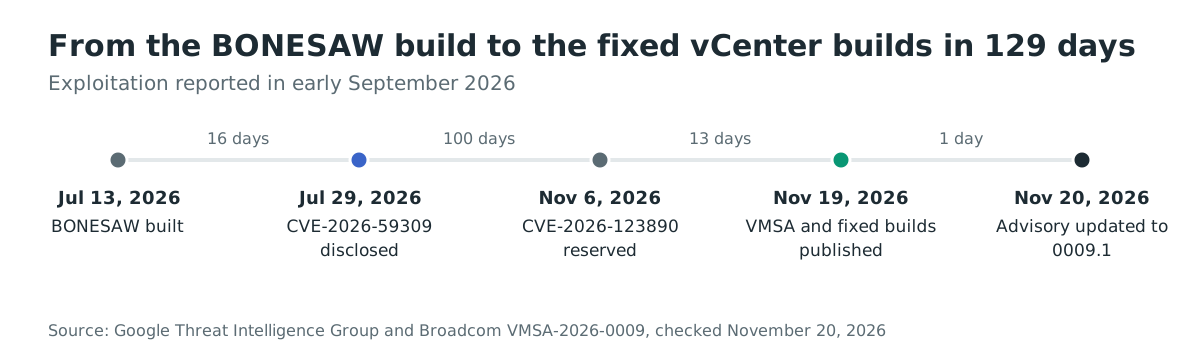
- 2026-07-13: The recovered BONESAW binary carries this build timestamp.
- 2026-07-29: Broadcom disclosed CVE-2026-59309, a different vCenter directory flaw.
- 2026-09-01 to 2026-09-30: GTIG and Mandiant place the exploitation of CVE-2026-123890 in early September 2026.
- 2026-11-06: Broadcom reserved CVE-2026-123890.
- 2026-11-19: Broadcom published VMSA-2026-0009 and the fixed builds; GTIG published its analysis.
- 2026-11-20: Broadcom updated the advisory to VMSA-2026-0009.1, and CISA's Vulnrichment record was updated with Exploitation: none.
FAQ
- Is CVE-2026-123890 exploited in the wild? Google Threat Intelligence Group and Mandiant report that ARMORY CASTLE exploited it in early September 2026. CISA's Vulnrichment record still lists Exploitation: none, and the CVE is not in the KEV catalog as of 2026-11-20. The exploitation claim rests on Mandiant's forensic evidence.
- Is it in CISA KEV? No. The catalog version checked on 2026-11-20 is 2026.11.18, and CVE-2026-123890 is not in it.
- Is this a VM escape? No. Broadcom's Q&A says none of the issues in VMSA-2026-0009 permits code execution on an ESXi host from a virtual machine. The impact is on vCenter and, from there, on the management access to ESXi.
- Does it affect ESXi? Broadcom says ESX is not affected by this VMSA. ESXi access in the observed campaign came through vCenter credentials and SSH keys, not through a separate ESXi flaw.
- Is there a workaround if I cannot patch today? Broadcom lists no workaround. Restrict TCP 2012, 443 and 5480 to trusted management hosts, block lateral access from application and user networks, and forward logs. Those controls reduce exposure but do not fix vmdird.
- Is there a public proof of concept? None is linked from the advisory, the CVE record or the GTIG report. GTIG describes the BONESAW utility but does not publish it.
Find exposed vCenter management interfaces with Ostorlab
Ostorlab's attack surface discovery inventories internet-facing management interfaces, including vCenter, VAMI and SSO endpoints. It shows which hosts answer on the management ports so you can patch them first: https://ostorlab.co/product/attacksurface_discovery
References
- Broadcom advisory VMSA-2026-0009: https://support.broadcom.com/web/ecx/support-content-notification/-/external/content/SecurityAdvisories/0/39495 (checked November 20, 2026)
- Broadcom VMSA-2026-0009 questions and answers: https://brcm.tech/vmsa-2026-0009-qna (checked November 20, 2026)
- CVE-2026-123890 record: https://www.cve.org/CVERecord?id=CVE-2026-123890 (checked November 20, 2026)
- Google Threat Intelligence Group and Mandiant, "ARMORY CASTLE Exploits vSphere": https://cloud.google.com/blog/topics/threat-intelligence/armory-castle-exploits-vsphere (checked November 20, 2026)
- Google Threat Intelligence Group and Mandiant, "ARMORY CASTLE Exploits BeyondTrust": https://cloud.google.com/blog/topics/threat-intelligence/armory-castle-exploits-beyondtrust (checked November 20, 2026)
- Broadcom asynchronous patching guide, KB88287: https://knowledge.broadcom.com/external/article?legacyId=88287 (checked November 20, 2026)
- Mandiant VCSA hardening tool: https://github.com/mandiant/vcsa-hardening-tool (checked November 20, 2026)
- CISA KEV catalog: https://www.cisa.gov/known-exploited-vulnerabilities-catalog (checked November 20, 2026)
- The Hacker News coverage of the campaign: https://thehackernews.com/2026/11/china-linked-hackers-exploit-critical.html (checked November 20, 2026)