
Tomcat Cluster Auth Bypass: Rogue Nodes Join (CVE-2026-133325)
Tomcat 11.0.28-11.0.29, 10.1.62 and 9.0.124 accept a TLS 1.3 cluster peer that ignores the PSK; the fixed builds are unreleased, so use TLS 1.2.
TL;DR
- A Tomcat member using TLS 1.3 with a pre-shared key accepts a rogue TLS server that ignores the offered key and presents a certificate, allowing an unauthenticated node to join.
- Clusters on 11.0.28 through 11.0.29, 10.1.62 or 9.0.124 are affected when the Channel sets
pskIdentityandpskKeyand leavespskProtocolat its TLS 1.3 default. - Apache rates the flaw Critical and classifies it as CWE-322. No CVSS score is published, no working proof of concept is public, and the CVE is not in CISA KEV as of 2026-11-22.
- The fixed releases 11.0.30, 10.1.63 and 9.0.125 are not out yet. Set
pskProtocol="TLSv1.2"on every Channel and restart. See "How do I fix it?".
Am I affected?
All of these must hold:
- The node runs Apache Tomcat 11.0.28 or 11.0.29, 10.1.62, or 9.0.124.
- A
<Cluster>element is configured, and its<Channel>sets bothpskIdentityandpskKey. - The Channel's
pskProtocolisTLSv1.3, or the attribute is absent, which selects TLS 1.3 by default. - An attacker can run a node on the network segment used for membership multicast, and cluster members can initiate TLS connections to the rogue node's advertised receiver port.
Tomcat added TLS pre-shared key support to Apache Tribes in the 11.0.28 tag and shipped it in 11.0.29, 10.1.62 and 9.0.124. A cluster that sets pskProtocol="TLSv1.2" is not affected by this CVE, because the TLS 1.2 PSK cipher suite requires the pre-shared key. A cluster without TLS is outside this CVE, but it sends cluster traffic in clear text and has its own exposure.
| Branch | Affected versions | Fixed version |
|---|---|---|
| 11.0.x | 11.0.28, 11.0.29 | 11.0.30 (not yet released) |
| 10.1.x | 10.1.62 | 10.1.63 (not yet released) |
| 9.0.x | 9.0.124 | 9.0.125 (not yet released) |
| 8.5.x and earlier | Not affected, the TLS-PSK feature is absent | Not applicable |
Check the running version and the cluster configuration:
# Tomcat version of the running installation
"$CATALINA_HOME/bin/version.sh" | grep "Server version"

# Cluster TLS-PSK settings in the active configuration
grep -nE 'pskIdentity|pskKey|pskProtocol|secure=' "$CATALINA_BASE/conf/server.xml"

# Docker: the version and configuration inside the running container
docker exec <container> /usr/local/tomcat/bin/version.sh | grep "Server version"
docker exec <container> grep -nE 'pskIdentity|pskKey|pskProtocol|secure=' /usr/local/tomcat/conf/server.xml
A pskProtocol line with TLSv1.3 is affected. If the attribute is missing while pskIdentity and pskKey are present, the default is TLS 1.3 and the cluster is affected. A line with pskProtocol="TLSv1.2" removes the exposure described here.
How do I fix it?
The fixed releases are not published yet, so the immediate fix is to move every cluster member to TLS 1.2 with the same pre-shared key. Apache lists 11.0.30, 10.1.63 and 9.0.125 as the corrective releases and says to switch to TLS 1.2 until they are available.
- Open
conf/server.xmlon every cluster member and find each<Channel>that setspskIdentityandpskKey. - Add
pskProtocol="TLSv1.2"to that Channel. KeeppskIdentity,pskKeyandpskDigestunchanged. - Restart every member, not only one, so no member still offers TLS 1.3.
- Confirm the attribute is present in the configuration read by the running process, then confirm the cluster still forms and replicates sessions.
- When 11.0.30, 10.1.63 or 9.0.125 is published, replace the distribution or bump the managed dependency. The property for a Spring Boot build is
tomcat.version. Remove the TLS 1.2 pin after the upgrade if you want TLS 1.3 back.
Restrict cluster transport to approved peers in both directions and restrict access to the membership multicast group (228.0.0.4 on port 45564 by default). Network access controls are useful additional controls, but they do not replace the TLS 1.2 setting or the upgrade.
Do not switch back to EncryptInterceptor. Apache deprecated it in favour of TLS-PSK, and its own advisory CVE-2026-95517 lists integrity and confidentiality flaws that remain unaddressed.
What is the root cause?
Tribes, the Tomcat cluster communication library, authenticates peers only with the pre-shared key, and TLS 1.3 lets a peer decline that key and authenticate with a certificate instead. Tomcat configures no certificate trust for the cluster transport, so the certificate is accepted and the peer is treated as a member.
The TLS-PSK support is configured on the cluster Channel. The documentation lists pskIdentity and pskKey as the pair that enables TLS, pskProtocol with a default of TLSv1.3, and pskDigest for TLS 1.3. The transport is implemented by org.apache.catalina.tribes.transport.nio.TlsChannel in java/org/apache/catalina/tribes/transport/nio/TlsChannel.java. Its constructor at 11.0.29 (lines 44 to 56) starts the handshake and returns as soon as the engine reports that the handshake is finished:
TlsChannel(Socket socket, SSLEngine engine) throws IOException {
    this.socket = socket;
    input = socket.getInputStream();
    output = socket.getOutputStream();
    this.engine = engine;
    // ...
    engine.beginHandshake();
    handshake();
}
Nothing after handshake() inspects how the peer authenticated. In TLS 1.2 with a PSK cipher suite, the key is mandatory. In TLS 1.3, the member acts as the client and offers the PSK as one option; a rogue server may ignore it and complete a certificate-based handshake. Tomcat does not configure certificate verification for this transport, so the member accepts the server certificate and the connection carries cluster messages.
The fix commit describes the same gap in one paragraph. Tribes authenticates peers solely through the pre-shared key, and TLS 1.3 lets the peer ignore it. Certificate verification is not configured, and a PSK handshake never includes a peer certificate. That last property is what the patch uses.
How is it exploited?
An attacker announces a rogue node through membership multicast so legitimate members initiate TLS connections to it. The rogue TLS 1.3 server ignores the offered pre-shared key and presents its own certificate, which vulnerable members accept without verification. No public exploit code demonstrates the full join, and Apache publishes no request sequence.
- The rogue node announces itself through the cluster membership multicast group, advertising its receiver address and port so members initiate TLS connections to it.
- The legitimate member acts as the TLS client and offers the pre-shared key. The rogue TLS 1.3 server ignores it and presents its own certificate.
TlsChannelon the member completes the handshake without requiring PSK authentication or verifying the rogue server's certificate.- The connection is treated as a peer connection, and the rogue node takes part in cluster communication.
- The rogue node can receive replicated cluster traffic and send messages that other members process.
The regression test added with the fix reproduces the decisive step. It runs a TLS 1.3 server that knows nothing about the PSK and therefore presents a certificate, then checks that a client using the Tomcat transport refuses to send data. The test comment states that a TLS 1.3 server is free to ignore the offered PSK and authenticate with a certificate.
How does the attack flow?
A rogue node advertises itself through membership multicast, prompting a legitimate member to connect as a TLS client. The rogue TLS 1.3 server ignores the offered pre-shared key and presents a certificate. The member accepts the connection because it neither requires PSK authentication nor verifies the server certificate.
What can an attacker do?
A rogue node can join a Tomcat cluster without the pre-shared key, receive the traffic members replicate, and send cluster messages that other members process. Apache states the impact as an unauthenticated node joining the cluster.
The cluster carries session replication, so a member can receive the session attributes that other members replicate. A joined node also takes part in the membership protocol and can send messages to the group. Apache's advisory does not describe code execution, does not publish the messages a rogue member can send, and does not confirm that any cluster was compromised.
The conditions are the ones in "Am I affected?": an affected release, a Channel with pskIdentity and pskKey, TLS 1.3 selected, and an attacker able to advertise a rogue node through membership multicast whose receiver members can reach. A cluster bound to a private segment that no attacker can reach is exposed only if that segment is compromised first.
Why does the fix work?
The fix rejects any cluster handshake that ends with a peer certificate, because a handshake authenticated with the pre-shared key never includes one. The check runs after the handshake and before any application data is written.
         applicationInput.flip();
         engine.beginHandshake();
         handshake();
+        verifyPskAuthentication();
+    }
+
+    private void verifyPskAuthentication() throws IOException {
+        Certificate[] peerCertificates;
+        try {
+            peerCertificates = engine.getSession().getPeerCertificates();
+        } catch (SSLPeerUnverifiedException e) {
+            // No peer certificate. Expected when the PSK was used.
+            return;
+        }
+        if (peerCertificates != null && peerCertificates.length > 0) {
+            try {
+                engine.closeOutbound();
+                engine.closeInbound();
+            } catch (IOException ignore) {
+                // Closing anyway
+            }
+            throw new SSLHandshakeException(sm.getString("tlsChannel.pskNotUsed"));
+        }
     }
getPeerCertificates() throws SSLPeerUnverifiedException when the session has no peer certificate, which is the expected state for a PSK-authenticated TLS 1.3 handshake. When a certificate is present, the transport closes both directions and throws SSLHandshakeException with the message "The TLS handshake completed with a peer certificate rather than the pre-shared key. The connection has been rejected."
The check is in TlsChannel, which wraps both the client and the server engine, so both sides of a cluster connection apply it. The same change was committed to the 11.0, 10.1 and 9.0 branches as 2e6c85ba, 8dcddccc and 8dac862e. It does not add certificate verification and does not change TLS 1.2 behaviour.
How do I check if I was compromised?
No indicators of compromise are published for this CVE, and a successful join may leave no trace at the default log level. The checks in this section look for unexpected cluster membership and for TLS connections that cluster members initiate to receiver addresses outside the expected peer list.
- Enable FINE logging for
org.apache.catalina.tribeson every member and review member add and remove events against the expected host list. - Read the current membership through the JMX
ChannelMBean and compare it with the members you expect. - Review flow logs for TLS connections initiated by cluster members to receiver addresses and ports outside the expected peer list.
- After the fix is applied, search the logs for
tlsChannel.pskNotUsed. The message records a rejected certificate-based peer, so it is evidence of an attempt, not of a successful join.
A cluster that accepts a rogue node may show it as an ordinary member, so a missing alert is not proof that no join happened. Treat an unexpected member as a lead and check what session data that member could read.
Timeline
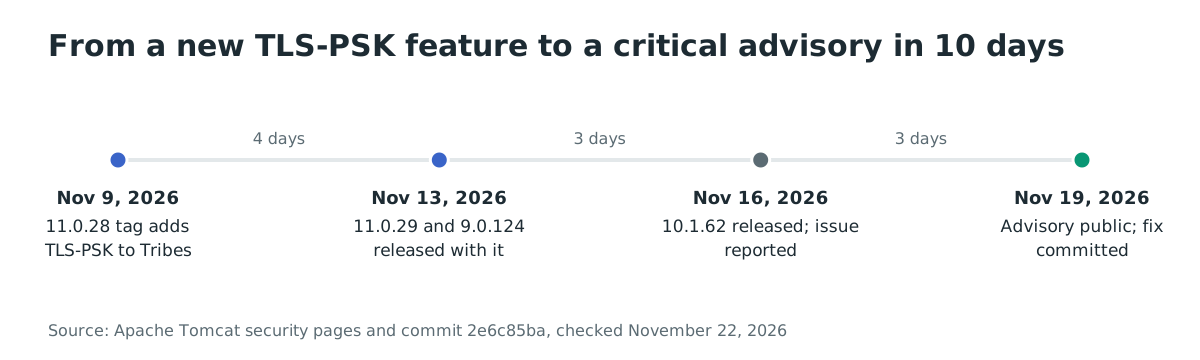
- 2026-11-09: the 11.0.28 tag adds TLS 1.2 and TLS 1.3 pre-shared key support to Apache Tribes.
- 2026-11-13: Tomcat 11.0.29 and 9.0.124 are released with the feature.
- 2026-11-16: Tomcat 10.1.62 is released; the issue is reported to the Tomcat security team the same day.
- 2026-11-19: the advisory and CVE-2026-133325 are published, and the fix commits 2e6c85ba, 8dcddccc and 8dac862e are made public.
- 2026-11-22: the fixed releases 11.0.30, 10.1.63 and 9.0.125 are still unpublished.
The feature reached a release on 2026-11-13 and the public advisory followed six days later, ten days after the 11.0.28 tag.
FAQ
Does this affect a default Tomcat installation?
No. A default installation has no cluster and no TLS-PSK Channel. The flaw needs a configured cluster whose Channel sets pskIdentity and pskKey and selects TLS 1.3.
Is TLS 1.2 with a pre-shared key safe from this flaw?
Yes, for this CVE. The TLS 1.2 PSK cipher suite that Tomcat configures requires the pre-shared key, and the fix leaves the TLS 1.2 path unchanged. Apache recommends TLS 1.2 with the same key until the fixed releases ship.
Are the fixed versions available?
No, not as of 2026-11-22. Apache lists 11.0.30, 10.1.63 and 9.0.125 as the fixed releases, and the download pages still offer 11.0.29, 10.1.62 and 9.0.124 as the newest builds.
Can a rogue node execute code on the cluster?
Apache states unauthorized cluster membership as the impact and does not describe code execution. No public source demonstrates code execution through a rogue member. The confirmed exposure is that the node joins the cluster, receives replicated data and can send cluster messages.
Is there a public proof of concept?
No working proof of concept is published. The fix commit includes a regression test that demonstrates the certificate-based handshake, but it is a test of the rejection, not an exploit.
Does the EncryptInterceptor fix this?
No. Apache deprecated the EncryptInterceptor in favour of TLS-PSK, and CVE-2026-95517 records integrity and confidentiality flaws in it that remain unaddressed. Use TLS 1.2 with the pre-shared key until the upgrade.
References
- Apache Software Foundation, "Apache Tomcat 11 vulnerabilities", https://tomcat.apache.org/security-11.html (checked November 22, 2026)
- Apache Software Foundation, "Apache Tomcat 10 vulnerabilities", https://tomcat.apache.org/security-10.html (checked November 22, 2026)
- Apache Software Foundation, "Apache Tomcat 9 vulnerabilities", https://tomcat.apache.org/security-9.html (checked November 22, 2026)
- CVE Program, "CVE-2026-133325", https://www.cve.org/CVERecord?id=CVE-2026-133325 (checked November 22, 2026)
- Apache Tomcat, "When using TLS-PSK with TLS 1.3 require peers to use PSK", commit 2e6c85ba, https://github.com/apache/tomcat/commit/2e6c85ba0937f3dc9877dadd433167fcd45f8dbc (checked November 22, 2026)
- Apache Tomcat, "When using TLS-PSK with TLS 1.3 require peers to use PSK", commit 8dcddccc, https://github.com/apache/tomcat/commit/8dcddccc600c2cc315e649df2244bdc902e8801e (checked November 22, 2026)
- Apache Tomcat, "When using TLS-PSK with TLS 1.3 require peers to use PSK", commit 8dac862e, https://github.com/apache/tomcat/commit/8dac862e720a9b2ce681ee160e87666aba796192 (checked November 22, 2026)
- Apache Tomcat, "The Cluster Channel", https://tomcat.apache.org/tomcat-11.0-doc/config/cluster-channel.html (checked November 22, 2026)
- Apache Tomcat, "The Cluster Membership object", https://tomcat.apache.org/tomcat-11.0-doc/config/cluster-membership.html (checked November 22, 2026)
- Apache Tomcat, "The Cluster Receiver object", https://tomcat.apache.org/tomcat-11.0-doc/config/cluster-receiver.html (checked November 22, 2026)
- Apache Tomcat, "Apache Tomcat 11.0.28 changelog", https://github.com/apache/tomcat/blob/11.0.28/webapps/docs/changelog.xml (checked November 22, 2026)
- Cybersecurity and Infrastructure Security Agency, "Known Exploited Vulnerabilities Catalog", https://www.cisa.gov/known-exploited-vulnerabilities-catalog (checked November 22, 2026)