
Sophos UTM Remote Root by Email (CVE-2026-118633)
An email to a Sophos UTM with scanning enabled can win a race and run commands as root; Sophos published a manual patch (CVE-2026-118633, 9.2 Critical).
TL;DR
- A crafted email to a Sophos UTM with email scanning enabled can plant a cron file and run commands as root. Intruder published the analysis on 2026-11-17.
- Every Sophos UTM version is affected when the email proxy scans inbound mail, even when the admin panel is not exposed.
- The CVE record scores it CVSS v4.0 9.2 Critical. No exploitation in the wild is known, and it is not in CISA KEV as of 2026-11-21.
- Install the manual patch from Sophos or migrate to Sophos Firewall. If neither is immediately possible, remove the UTM SMTP proxy from the inbound mail path. See "How do I fix it?".
Am I affected?
All of these conditions must hold for a Sophos UTM to be exposed:
- The appliance is a Sophos UTM, also sold as SG UTM. Every version is affected, including 9.724-2, the build Intruder tested.
- The email proxy is used with scanning enabled, so inbound SMTP reaches the appliance.
- The appliance accepts mail from an untrusted network. A sender does not need a valid mailbox, and the recipient address does not need to exist.
- The appliance is not a Sophos Firewall running SFOS. SFOS devices are not affected.
The admin panel does not need to be reachable. The flaw is in the mail scanning path, which is designed to accept external email. Intruder says Shodan finds many UTM appliances, but that count only covers exposed admin panels, so it undercounts the exposed population.
| Branch | Affected versions | Fixed version |
|---|---|---|
| Sophos UTM (SG UTM) | All versions, including 9.724-2 | Manual patch per Sophos KBA-000049692 |
| Sophos Firewall (SFOS) | None | Not affected |
Sophos UTM reached end-of-life on 2026-06-30. Extended support runs until 2026-12-31 according to Intruder, and Sophos still released a patch. The patch must be installed by hand.
Check the firmware version in WebAdmin under Management and System Status. On the appliance console, the same build string is in /etc/version:
cat /etc/version
Then check that email protection is enabled. In WebAdmin, open Email Protection and confirm that the SMTP proxy is active and that scanning is on. If the appliance does not scan inbound mail, this flaw is not reachable.
How do I fix it?
Install the manual patch or move to a supported Sophos Firewall. While preparing either fix, route inbound mail through another security gateway so the UTM SMTP proxy no longer handles it.
- If the appliance can be replaced, migrate to a supported Sophos Firewall. Sophos publishes the migration path in KBA-000003353.
- If it stays in service, download and install the patch from Sophos KBA-000049692. The advisory says the patch must be installed manually and calls the action urgent.
- Confirm the new build in WebAdmin or with
cat /etc/version. - For temporary containment, move inbound mail and its malware and phishing checks to another gateway. Disable the SMTP proxy in WebAdmin under Email Protection > SMTP > Global and verify that it no longer accepts inbound mail.
Sophos lists no supported workaround. Intruder recommends disabling inbound scanning, but a change to scanning settings alone leaves inbound mail reaching the proxy. Verify that the UTM is out of the inbound mail path before relying on this containment. The vulnerable code runs before a scan verdict is available.
If the UTM must keep receiving mail before you can patch it, restrict SMTP access to the mail servers that need it and monitor the appliance for unexpected cron files.
The patch closes the vulnerability the advisory describes. Sophos publishes no patch-level detail, so the fix cannot be checked against the source. Treat the vendor statement as the source for the remediation and verify the build after installation.
What is the root cause?
Sophos UTM builds a file path from the attacker-supplied Message-ID header and writes the scanned email there, and the header value can escape the intended directory.
The email proxy hands a message to the cssd daemon, which interfaces with the anti-malware backends.
cssd reads the Message-ID header and parses it with the open-source libgmime library. It then uses the header value to build the path where the message body is written for scanning. The validation of that value is incomplete, so the path can contain directory traversal characters and leave the intended directory. The file content is the email body, which the attacker also controls.
The write opens the file with O_EXCL, so the attacker can create a new file but cannot overwrite an existing one. The file is a temporary scan file and is normally deleted within a fraction of a second. That limits the naive attack, because a file written into a configuration directory does not replace the existing file and does not stay.
The exploitable target is cron. The appliance's cron daemon reads /etc/cron.d/ for new configuration files every 60 seconds. If the attacker writes a cron file during that window, cron runs it.
Intruder sent many emails and raced the cron daemon, and it says the shell landed reliably. In its test it took about 15,000 emails over 10 minutes. It also says a weaponized exploit would likely send in bursts around the minute boundaries and use fewer messages.
The traversal is reached before authentication, and the recipient address does not need to exist. The flaw is in the mail path, not in the admin interface.
How is it exploited?
An unauthenticated sender delivers mail to the appliance, writes a cron file through the traversal, and waits for cron to run it as root.
- The attacker connects to the appliance's SMTP service and sends a message with a crafted
Message-IDthat contains a traversal path into/etc/cron.d/. - The message body contains the cron entry and the command the attacker wants to run.
cssdparses theMessage-IDwith libgmime, builds the path from it and writes the body there withO_EXCL.- The file is created in
/etc/cron.d/during the short time it exists. - The cron daemon reads the new file on its next pass, within 60 seconds, and runs the entry as root.
- The attacker receives a root shell or the command's result, and can then read or change the appliance configuration.
The attacker repeats steps 1 to 3 to win the race. Intruder says the shell is reliable at about 15,000 emails over 10 minutes in its environment, and that it withheld the tricks that make the race more reliable. The exact number needed against another appliance depends on its mail rate and cron timing.
No public exploit script is available. Intruder deliberately did not release its proof of concept.
How does the attack flow?
An email header escapes the scan directory into cron, and the cron daemon turns the attacker's file into root code execution.
to any address"] --> B["Message-ID contains
a traversal path"] B --> C["cssd builds the scan path
from the header"] C --> D["File write escapes
the scan directory"] D --> E["Cron file exists
for under a second"] E --> F["Cron reads /etc/cron.d
every 60 seconds"] F --> G["Entry runs as root"]
What can an attacker do?
An attacker who wins the race runs commands as root on the UTM, the appliance that sits at the edge of the network.
- Read and change the firewall, VPN and email configuration.
- Add accounts, keys or rules that survive a reboot.
- Intercept or redirect traffic that passes through the appliance.
- Pivot into the internal network that the UTM protects.
- Disable logging or security controls before other activity.
The attack needs no account, no session and no user interaction. It needs the email proxy to scan inbound mail and a sender that can reach the SMTP service. The race condition adds time and volume, but it does not need a privileged position on the network.
The demonstrated impact is root command execution on the appliance. The advisory does not describe a compromise of the internal hosts behind it, and no victim report is public.
Why does the fix work?
Sophos says the patch prevents the unauthenticated attack that leads to root command execution, but it publishes no diff or code-level detail.
A path traversal fix normally canonicalizes the constructed path and checks that it stays inside the intended directory. It can also reject the characters that let the Message-ID value escape, or stop using the header value as a path component. The advisory does not say which change Sophos made, and the product is closed source, so this post cannot show the patched code.
The vendor states that the remediation prevents the attack, and that the patch must be installed manually. That is the whole public fix record.
The absence of a diff means the fix cannot be checked independently. It also means a scanner cannot confirm the patch from a version string alone for an appliance that reports the same base version. Follow the Sophos installation instructions and confirm the build after the patch.
How do I check if I was compromised?
Sophos and Intruder publish no indicators of compromise. A successful attack leaves a cron entry, but cron removes nothing by itself, so a file that ran may still be on disk.
- List the cron files and look for one that does not belong to the appliance configuration:
ls -la /etc/cron.d/
- Read every file in that directory and look for a command that downloads or runs a script:
grep -R -i -E 'curl|wget|python|bash|sh -c' /etc/cron.d/
- Check the mail logs for a burst of messages with malformed or unusually long
Message-IDvalues, especially messages to addresses that do not exist. - Check for unexpected outbound connections, new local accounts and changes to the firewall or VPN configuration.
A hit on the cron check is a lead, not proof. Legitimate packages install cron files, and a failed attempt may leave no file at all. Compare the directory with a known-good baseline, and if a file contains an unknown command, treat the appliance as compromised and rebuild it.
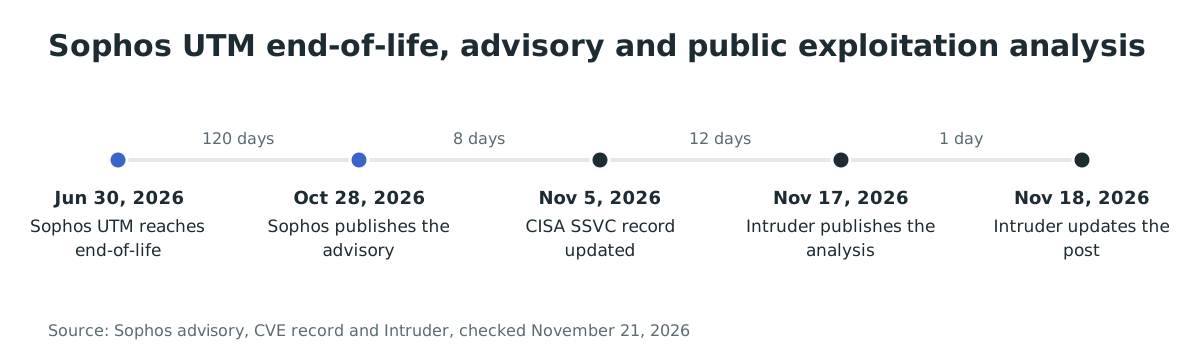
Timeline
- 2026-06-30: Sophos UTM reaches end-of-life. Extended support runs until 2026-12-31.
- 2026-10-28: Sophos publishes the advisory and CVE-2026-118633.
- 2026-11-05: CISA's Vulnrichment record is updated with the SSVC assessment.
- 2026-11-17: Intruder publishes its research and says the patch is available.
- 2026-11-18: Intruder updates the post.
FAQ
Does this need access to the admin panel?
No. The flaw is in the email scanning path. An attacker only needs to send mail to an address that the appliance scans. The admin panel can be closed to the internet and the appliance is still exposed.
Is the appliance still supported?
No. Sophos UTM reached end-of-life on 2026-06-30, and extended support ends on 2026-12-31 according to Intruder. Sophos still published a patch for this flaw and says customers should apply it manually.
Is there a public exploit?
No. Intruder published the mechanism and the race description, and it deliberately withheld the proof-of-concept script and the tricks that make the race reliable. The advisory confirms the impact but gives no code.
Does disabling the admin panel reduce the risk?
No. The attack uses the SMTP service and the mail scanner, not the WebAdmin interface. Restricting the admin panel is good hygiene, but it does not close this path.
How many emails does the attack need?
About 15,000 over 10 minutes in Intruder's test. The firm says a weaponized exploit would likely send in bursts around the cron minute boundaries and use fewer messages. The number depends on the appliance's mail rate and cron timing.
What score does the CVE carry?
CVSS v4.0 9.2 Critical, vector CVSS:4.0/AV:N/AC:L/AT:P/PR:N/UI:N/VC:H/VI:H/VA:H/SC:N/SI:N/SA:N, and CVSS v3.1 8.1 High. The v4.0 score treats the race as an attack requirement. CISA's SSVC record marks Exploitation as none.
Are SFOS-based Sophos Firewalls affected?
No. The advisory says SFOS-based devices are not affected. The flaw is in the Sophos UTM email proxy, which is a different product line.
Patch the mail gateway or take it off the internet
Install the Sophos patch on every UTM that scans inbound mail, or migrate the appliance before extended support ends. If neither is possible, stop scanning inbound mail on the UTM and put another mail security layer in front of it.
References
- Sophos, "Resolved Pre-Auth RCE Vulnerability in Sophos UTM (CVE-2026-118633)": https://www.sophos.com/en-us/security-advisories/sophos-sa-20261028-utm-rce (checked November 21, 2026)
- CVE Program, CVE-2026-118633: https://www.cve.org/CVERecord?id=CVE-2026-118633 (checked November 21, 2026)
- Intruder, "Sophos UTM: Remote root by sending an email (CVE-2026-118633)": https://www.intruder.io/research/sophos-utm-remote-root-by-email (checked November 21, 2026)
- Sophos, patch installation instructions, KBA-000049692: https://support.sophos.com/support/s/article/KBA-000049692?language=en_US (checked November 21, 2026)
- Sophos, UTM Administration Guide, SMTP > Global. https://docs.sophos.com/nsg/sophos-utm/utm/9.708/help/en-us/Content/utm/utmAdminGuide/EmailProtSMTPGlobal.htm
- Sophos, migration path to Sophos Firewall, KBA-000003353: https://support.sophos.com/support/s/article/KBA-000003353?language=en_US (checked November 21, 2026)
- CISA, Known Exploited Vulnerabilities catalog, version 2026.11.20: https://www.cisa.gov/known-exploited-vulnerabilities-catalog (checked November 21, 2026)