
REDCap Unauthenticated RCE, Exploited in the Wild (CVE-2026-90817)
A public survey hash can expose an unpatched REDCap server to unauthenticated code execution. Fixed releases include 16.0.49, 17.3.10 and 17.4.4.
TL;DR
- An unauthenticated attacker who knows a valid public survey hash can reach REDCap's Data Import controller and execute code on the server. The flaw is CVE-2026-90817, rated CVSS v3.1 9.8 Critical.
- The advisory describes the flaw from 13.3.0 onward. The fixed releases it names are 16.0.49 LTS, 17.3.10 LTS and 17.4.4 Standard.
- CISA added CVE-2026-90817 to the Known Exploited Vulnerabilities catalog on 2026-11-18, with a federal due date of 2026-11-21. That listing records known exploitation.
- Upgrade to the fixed release for your branch, or disable public surveys and block survey-context access to the Data Import, Parcel and root dispatcher routes until you can.
Am I affected?
All of these must hold:
- The REDCap server runs 13.3.0 or later, before the fixed release for its branch.
- At least one public survey is active, or an attacker can obtain a valid public survey hash.
- The web server exposes the REDCap application to the attacker.
A valid public survey link identifies the survey and allows participants to open it without an account. Treat that link as public when assessing exposure.
| Branch | Affected versions | Fixed version |
|---|---|---|
| 17.4.x Standard | 17.4.0 to 17.4.3 | 17.4.4 |
| 17.3.x LTS | 17.3.0 to 17.3.9 | 17.3.10 |
| 16.0.x LTS | 16.0.0 to 16.0.48 | 16.0.49 |
| Other branches from 13.3.0 onward | Check the installed release against the vendor advisory | Move to a supported branch with a published fix |
Check which version is installed:
# REDCap keeps each installed version in its own directory
ls -d /var/www/html/redcap/redcap_v* 2>/dev/null | sort -V | tail -5

# The running version is also shown at the bottom of the REDCap Control Center
The 2026-11-18 KEV record says the attacker needs knowledge of a valid public survey hash. It does not say the survey must be the default template, and it does not say the attacker needs a REDCap account, a project role or a session cookie.
REDCap reports 8,539 institutions in 167 countries, 2.9 million projects and 4.7 million users on its project site. That is the size of the installed base the vendor describes, not the number of servers exposed to the internet.
How do I fix it?
Upgrade to the fixed release for your branch. There is no source patch to apply separately, because REDCap is distributed as a release archive rather than an open repository.
- Back up the database, the upload directory and the current application directory.
sudo -u apache mysqldump --single-transaction --routines redcap > /backup/redcap-2026-11-19.sql
sudo -u apache tar czf /backup/redcap-files-2026-11-19.tar.gz /var/www/html/redcap
-
Install the fixed release over the application directory, following the vendor's upgrade instructions for your branch. The release directories use the
redcap_vX.Y.Znaming, so keep the old directory until the upgrade page completes. -
Open
/redcap/upgrade.phpand run the database upgrade, then remove the old versioned directory. -
Confirm the Control Center footer shows 16.0.49, 17.3.10 or 17.4.4, or a later release on the same branch.
If you cannot upgrade immediately, disable every public survey and block survey-context access to the root dispatcher, DataImportController and ParcelController at the web server or the application's routing layer. That removes the documented entry point. It does not repair a server that already ran the chain, and it leaves the underlying faults in place, so treat it as temporary.
The same release also carries other security fixes. Read the vendor's release notes and test the upgrade on a staging copy before you run it on a production server.
What is the root cause?
REDCap failed to keep public survey requests separate from administrative data-import operations. A participant could reach functionality that should require an authenticated administrative session.
What can an attacker do?
The attacker can run code as the PHP or web-server user on the REDCap host. That account can read the REDCap database credentials, the application configuration and the uploaded research data that the web server can reach.
- The attacker can read and modify REDCap projects and survey responses within the database permissions of the application.
- The attacker can write files the web-server user can reach, including the template cache and the application tree.
- The attacker can use the host as a base for further access to the research network, depending on how the server is segmented.
The KEV entry does not name victims, and the public analysis does not report one. Treat the exploitation claim as CISA's: the catalog records known exploitation, but the public record does not say which institutions were hit or how many.
Why does the fix work?
The vendor's solution is explicit: upgrade to 16.0.49 LTS, 17.3.10 LTS or 17.4.4 Standard, as applicable. The CVE record lists those three versions as unaffected and 13.3.0 as affected. The same record gives no per-file patch, and the project does not distribute a public source tree, so this post cannot show a diff.
That makes the upgrade the only complete fix. Disabling public surveys removes the entry point the analysis used, but it does not repair the rights calculation or the Data Import write. On a previously compromised server, files or persistence mechanisms installed by the attacker may survive the upgrade.
How do I check if I was compromised?
Preserve the web, reverse-proxy and application logs covering the period when the vulnerable release was reachable. Check whether survey traffic coincided with unexpected administrative imports. Compare application and template-cache files against a trusted backup, and review historical process events for unexpected children of the web service.
Record timestamps, source addresses and affected projects so that incident responders can correlate activity. Logs may omit request bodies or query strings. If you find signs of compromise, preserve a host image and review access to credentials and research data.
Timeline
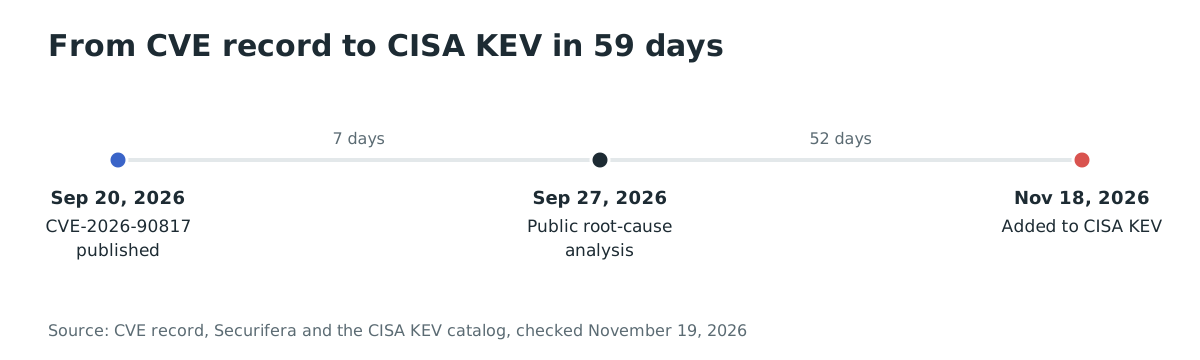
- 2026-09-20: the CVE record for CVE-2026-90817 is published.
- 2026-09-27: Securifera publishes the full chain analysis.
- 2026-11-18: CISA adds CVE-2026-90817 to KEV, with a federal due date of 2026-11-21.
FAQ
Is it unauthenticated?
Yes, with one precondition: the attacker must know a valid public survey hash. The attacker does not need a REDCap account, a project role, a session cookie or a CSRF token. The KEV record describes the same precondition.
Which versions are affected?
The advisory describes the flaw from 13.3.0 onward. The fixed releases it names are 16.0.49 LTS, 17.3.10 LTS and 17.4.4 Standard. If your branch has no documented fix, migrate to a supported branch with a fixed release.
Was it exploited in the wild?
CISA added the CVE to KEV on 2026-11-18, which records known exploitation. The KEV entry does not name victims or give a count, and the public analysis does not report a compromised institution.
Does disabling public surveys fix it?
It removes the entry point the published chain uses, so it is a useful containment step. It does not repair the rights calculation, the Data Import write or the template cache. Upgrade to the fixed release as well.
Why does a survey hash matter if the survey is public?
A valid public survey link identifies the survey and allows participants to open it without an account. Treat that link as public when assessing exposure.
Find exposed REDCap servers with Ostorlab
Ostorlab's Web Agentic Deep Scan inventories and tests the web applications you expose. For a REDCap installation, it maps the reachable survey and administrative surfaces so you can see which hosts need the upgrade first.
References
- CVE record, CVE-2026-90817: https://www.cve.org/CVERecord?id=CVE-2026-90817 (checked November 19, 2026)
- CISA Known Exploited Vulnerabilities catalog, CVE-2026-90817: https://www.cisa.gov/known-exploited-vulnerabilities-catalog (checked November 19, 2026)
- Securifera, "Survey Says…. Remote Code Execution: CVE-2026-90817", 2026-09-27: https://www.securifera.com/blog/2026/09/27/survey-says-remote-code-execution-cve-2026-90817/ (checked November 19, 2026)
- REDCap project site, institution and user counts: https://projectredcap.org/ (checked November 19, 2026)
- NVD record, CVE-2026-90817: https://nvd.nist.gov/vuln/detail/CVE-2026-90817 (checked November 19, 2026)