
Etherpad Pre-Auth File Read to RCE (CVE-2026-114516)
Etherpad before 3.3.3 lets an unauthenticated attacker read any file through /static and escalate to admin code execution; fixed in 3.3.3.
TL;DR
- Etherpad's
/static/*handler converts encoded backslashes to slashes after its path check. A crafted request escapes the plugin directory and reads any file the server user can read. - Etherpad 1.8.14 through 3.3.2 are affected. The fix shipped in 3.3.3 on 2026-07-29, and the current release is 3.3.19.
- The advisory rates the flaw CVSS v3.1 9.8 Critical. No exploitation in the wild is known and it is not in CISA KEV as of 2026-11-20. The advisory includes a public proof of concept.
- Upgrade to 3.3.3 or later, and use 3.3.19 today. No vendor workaround is published, so restrict the HTTP port until the upgrade lands.
Am I affected?
All of these must hold:
- The server runs Etherpad 1.8.14 through 3.3.2.
- An attacker can reach the Etherpad HTTP port, directly or through a proxy.
- The Etherpad process can read the files that matter, such as
settings.json,credentials.jsonor/proc/self/environ.
A reverse proxy does not mitigate the traversal by itself. The advisory says the encoded backslash passes through unchanged. The flaw was reported by @gcm-explo1t. The GitHub advisory was published on 2026-11-20, and the CVE record was published on 2026-11-19.
| Release line | Affected versions | Fixed version |
|---|---|---|
| Etherpad | 1.8.14 through 3.3.2 | 3.3.3 (current 3.3.19) |
Check the installed version and test the documented path against your own host:
node -p "require('./package.json').version"
docker exec <container> node -p "require('/opt/etherpad-lite/package.json').version"
curl --path-as-is -s -o /dev/null -w '%{http_code}\n' \
  'http://127.0.0.1:9001/static/plugins/ep_etherpad-lite/static/..%5C..%5C..%5C..%5Cetc/passwd'
A fixed server returns 404 for the crafted request. A vulnerable server returns 200 because the request resolves to /etc/passwd. Run the test only against a host you own.
How do I fix it?
Upgrade to Etherpad 3.3.3 or later. The current release is 3.3.19, published on 2026-11-17.
For the official Docker image, pull the fixed image and recreate the container:
docker pull etherpad/etherpad:3.3.19
docker rm -f <container>
# Recreate the container with your normal docker run or Compose configuration.
For a source install:
git fetch --tags
git checkout v3.3.19
pnpm install
pnpm run build:etherpad
pnpm run build:ui
- Upgrade every instance, including staging and internal deployments.
- Recreate containers. Pulling a new image does not change a running container.
- Restart the service and confirm the new version with the checks in "Am I affected?".
Etherpad has no single upgrade path for every deployment. The official image, a Git checkout and a distribution package can lag each other, so check each instance separately. A load balancer or proxy tier that was upgraded does not protect a backend that still runs 3.3.2.
No vendor workaround is published. If you cannot upgrade immediately, restrict the Etherpad port to trusted networks or put an authenticated proxy in front of the whole application.
A proxy rule that rejects %5C in /static/ requests blocks the documented payload, but it is a stopgap. The advisory says a reverse proxy alone does not mitigate the traversal, and a rule that matches only one encoding is easy to bypass. Upgrade is the fix.
What is the root cause?
The vulnerable route is reachable before authentication. Etherpad serves plugin assets through Minify.ts, a small static handler that resolves a plugin name and a path below the plugin's installation directory. src/node/hooks/express/static.ts:38 registers app.all('/static/*filename', minify) on the expressPreSession hook. src/node/hooks/express.ts:244-247 runs that hook before sessionMiddleware and webaccess.checkAccess, so any client that reaches the port can call the handler.
Minify.ts calls sanitizePathname() on the requested filename at src/node/utils/Minify.ts:150-156. The function itself is defined in src/node/utils/sanitizePathname.ts:11-19. On POSIX, a backslash is an ordinary filename byte, so ..\..\.. contains no .. path component and the sanitizer deliberately leaves it alone. The sanitizer converts backslashes to slashes only on Windows:
p = pathApi.normalize(p);
if (pathApi.isAbsolute(p)) throw new Error(`absolute paths are forbidden: ${p}`);
if (p.split(pathApi.sep)[0] === '..') throw new Error(`directory traversal: ${p}`);
// THIS CONVERSION MUST ONLY BE DONE ON WINDOWS, otherwise on POSIXish systems '..\\' in the input
// pathname would not be normalized away before being converted to '../'.
if (pathApi.sep === '\\') p = p.replace(/\\/g, '/');
That is correct on POSIX. The bug is that Minify.ts then repeats the Windows-only conversion unconditionally, after the sanitizer has run (src/node/utils/Minify.ts:171-186):
filename = path.join(pluginPath, libraryPath);
// ...
filename = filename.replace(/\\/g, '/');
path.join returns an absolute path. The replacement turns the previously harmless ..\..\.. bytes into ../../... The result goes to fs.stat and fs.readFile at Minify.ts:248 and Minify.ts:315 with no second normalization or containment check. Because path.join produced an absolute path, the later path.resolve(ROOT_DIR, filename) discards ROOT_DIR, and POSIX collapses surplus .. at /. The payload therefore does not need to know the installation depth.
The advisory's example is GET /static/plugins/ep_etherpad-lite/static/..%5C..%5C..%5C..%5C..%5C..%5C..%5Cetc/passwd. Express decodes the wildcard once, so %5C becomes a backslash. A %2F would decode to a slash, be re-split and be rejected by the .. guard. The core pseudo-plugin ep_etherpad-lite is always registered with package.realPath = <root>/src, so the plugin branch is always taken.
How is it exploited?
- The attacker sends the crafted
/static/...%5C...request. No session, account or configuration change is needed. - The response returns the requested file. The attacker reads
settings.json,credentials.jsonor/proc/self/environ. On a Docker Compose deployment, the admin password can be in the environment. - The attacker sends the admin password to
/admin-auth/with HTTP Basic authentication and receives an admin session cookie. - With that cookie, the attacker connects to the
/pluginfw/installerSocket.IO namespace. The namespace checks onlysession.user.is_admin. - The attacker installs an
ep_*plugin. Etherpadrequire()s the plugin in process duringplugins.update(), so the plugin code runs as the Etherpad user.
The advisory publishes the curl requests for the file read and the admin login, and describes the plugin step. It does not publish a malicious plugin. You can verify the file read without installing anything.
How does the attack flow?
The chain is a path traversal that survives one post-sanitizer conversion, a file read that exposes the admin password, and the admin plugin installer that turns that password into code execution.
What can an attacker do?
An unauthenticated attacker can read any file that the Etherpad process can read. That includes settings.json and credentials.json, which hold the admin password, the session key, database credentials and single sign-on secrets. It also includes /proc/self/environ, where Docker and Kubernetes often place secrets, and TLS private keys, the pad database and operating-system files.
The read becomes a full server compromise when the admin password or an environment secret is exposed. The admin session lets the attacker install a plugin, and plugin code runs in the Etherpad process.
The installer is part of the normal admin interface, so an attacker does not need a second vulnerability or a write primitive on disk. Without such a secret, the read is still a complete confidentiality breach for every file the service user can open.
Etherpad's own documentation recommends running the service behind a reverse proxy and limiting administrative access. Neither control stops the file read, because the request is a normal-looking /static/ GET. The advisory says the route is exploitable regardless of requireAuthentication, requireAuthorization or the users configuration.
The conditions are network reachability to the HTTP port, an affected version and a target file readable by the Etherpad user. No account, user interaction or configuration change is needed.
Why does the fix work?
The fix guards the conversion to Windows:
-      filename = filename.replace(/\\/g, '/');
+      if (path.sep === '\\') filename = filename.replace(/\\/g, '/');
On POSIX, path.sep is /, so the replacement no longer runs. The sanitized backslash bytes stay literal and do not become traversal components, and fs.stat and fs.readFile receive a literal path that does not exist. On Windows, path.sep is \, so the conversion still runs where a backslash is a path separator.
The commit also adds a backend regression test. The test requests ..%5C and expects 404, requests /proc/self/cwd/settings.json and expects 404, and checks that a legitimate plugin asset still returns 200. The change closes the path documented in the advisory. It does not remove the /static route, so keep the usual hardening for exposed Etherpad instances.
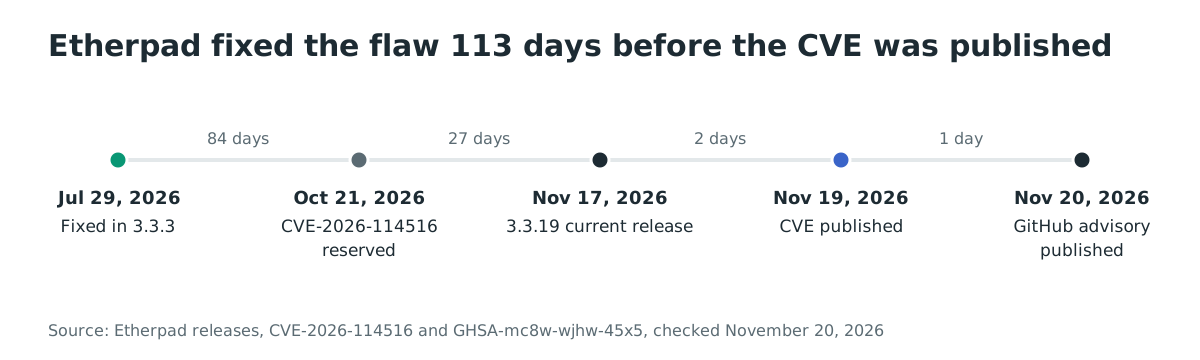
The fix shipped in a security release on 2026-07-29, but the advisory and the CVE arrived in November. An operator who only watches CVE feeds has had no public identifier to match against the July release. That gap matters for inventory: the affected range starts at 1.8.14, so old installations that never followed the 3.3.x releases are the ones most likely to remain exposed.
How do I check if I was compromised?
The advisory publishes no indicators of compromise. These checks look for the documented request and the escalation steps:
# Requests with an encoded backslash under /static, case-insensitive
grep -Ei '/static/.*(%5c|%255c)' /var/log/nginx/access.log /var/log/apache2/access.log

# Requests for the files the advisory names
grep -Ei '/static/.*(settings\.json|credentials\.json|proc/self/(environ|cwd))' /var/log/nginx/access.log /var/log/apache2/access.log

# Admin authentication requests from unexpected sources
grep -Ei 'POST /admin-auth/' /var/log/nginx/access.log /var/log/apache2/access.log
Then compare the installed plugins with your baseline:
# Docker image
docker exec <container> sh -c 'cd /opt/etherpad-lite && pnpm list --depth 0' 2>/dev/null

# Source install
pnpm list --depth 0 | grep 'ep_'
A hit on a path that legitimate clients also use is a lead, not proof. A failed attempt may leave no trace beyond the access-log line, and the advisory publishes no indicators.
Timeline
- 2026-07-29: Etherpad 3.3.3 released with the fix (commit 9c8d16d, PR #8081).
- 2026-10-21: CVE-2026-114516 reserved.
- 2026-11-17: Etherpad 3.3.19, the current release, published.
- 2026-11-19: CVE-2026-114516 published.
- 2026-11-20: GitHub advisory GHSA-mc8w-wjhw-45x5 published.
FAQ
- Does the flaw affect Etherpad 3.3.3 and later? No. The fix shipped in 3.3.3. The current release is 3.3.19. The advisory lists 1.8.14 through 3.3.2 as affected.
- Is 3.3.19 newer than 3.3.3? Yes. Semantic versioning compares the numeric parts, so 3.3.19 is newer than 3.3.3 and both contain the fix. Do not read 3.3.3 as the latest 3.x release.
- Do I need an account or a pad? No. The
/static/*route is registered before the session and access middleware. - Does a reverse proxy stop it? Not by itself. The advisory says the encoded backslash passes through unchanged. A proxy rule that rejects backslashes in
/static/is a stopgap, and the upgrade is the fix. - Is the file read enough to run code? It can be. If
settings.json,credentials.jsonor the environment exposes the admin password, the admin plugin installer gives in-process code execution. Without that secret, the read is still a full confidentiality breach. - Was it exploited in the wild? No exploitation is known, and the CVE is not in CISA KEV as of 2026-11-20. The advisory publishes no indicators, so a quiet attempt would not be visible in public data.
- Will a version scanner flag it? A scanner that compares the installed package with the advisory range can flag 1.8.14 through 3.3.2 after its feed updates. The July fix predates the November CVE, so scan results and feed dates can disagree for a few days.
Find exposed Etherpad instances with Ostorlab
Ostorlab's Web Agentic Deep Scan maps the reachable web surface of an application, so you can inventory the Etherpad instances you need to upgrade: https://www.ostorlab.co/product/web_agentic_deep_scan
References
- Etherpad advisory GHSA-mc8w-wjhw-45x5: https://github.com/ether/etherpad/security/advisories/GHSA-mc8w-wjhw-45x5 (checked November 20, 2026)
- CVE-2026-114516 record: https://www.cve.org/CVERecord?id=CVE-2026-114516 (checked November 20, 2026)
- Fix commit: https://github.com/ether/etherpad/commit/9c8d16d50e2fdfd9693ab35c43280410cb4db2fc (checked November 20, 2026)
- Fix pull request: https://github.com/ether/etherpad/pull/8081 (checked November 20, 2026)
- Release 3.3.3: https://github.com/ether/etherpad/releases/tag/v3.3.3 (checked November 20, 2026)
- Release 3.3.19: https://github.com/ether/etherpad/releases/tag/v3.3.19 (checked November 20, 2026)
sanitizePathname.tsat v3.3.2: https://github.com/ether/etherpad/blob/v3.3.2/src/node/utils/sanitizePathname.ts (checked November 20, 2026)Minify.tsat v3.3.2: https://github.com/ether/etherpad/blob/v3.3.2/src/node/utils/Minify.ts (checked November 20, 2026)- Docker Hub pulls: https://hub.docker.com/r/etherpad/etherpad (checked November 20, 2026)
- CISA KEV catalog: https://www.cisa.gov/known-exploited-vulnerabilities-catalog (checked November 20, 2026)