
Copeland XWEB EVO Unauthenticated RCE as Root (CVE-2026-124010)
Copeland XWEB EVO controllers through 5.8.8 are exposed to root command execution and predictable credentials; the line is end-of-support, with no fix.
TL;DR
- Copeland XWEB EVO is a supermarket refrigeration supervisor. One unauthenticated request to its setuid-root
xwconsole.cgiruns a shell command asrootand returns the output. - The injection flaws affect legacy
.luafirmware from 5.2.3 through before 5.7.0, depending on the CVE. The current 5.6.2 to 5.8.8 build still derives the Administrator password from the device MAC and the date. - CVE-2026-124010 is CVSS v3.1 9.8 Critical. VulnCheck's canary sensors recorded exploitation attempts on it and on CVE-2026-124014 within hours of disclosure, and neither is in CISA KEV as of 2026-11-22.
- Remove every controller from the public internet, put it behind a VPN or a firewall allow-list, and plan migration. Copeland ended software support on 2026-03-16, so no patch will ship. See "How do I fix it?".
Am I affected?
All of these conditions must hold for a controller to be exposed:
- The device is a Copeland or Dixell XWEB EVO refrigeration supervisor. It drives refrigeration setpoints, alarms and defrost cycles for a store.
- Its web interface is reachable from a network you do not fully trust. That includes the public internet and a flat store network shared with other systems.
- The firmware is one of the affected builds. The union of the 14 records is 4.3.0 through 5.8.8, and each CVE has a narrower range in the table in this section.
| Branch | Affected versions | Fixed version |
|---|---|---|
Legacy .lua firmware |
5.2.3 through before 5.7.0, depending on the CVE; CVE-2026-124010 reaches before 5.6.2 | None; end of software support 2026-03-16 |
| Current firmware | 4.3.0 through 5.8.8 | None; end of software support 2026-03-16 |
Copeland declared the XWEB EVO family end of software support in March 2026, with no fixes after 2026-03-16. That bulletin is the only public statement on the product's lifetime, so a device that answers on the web interface has no fixed release to move to.
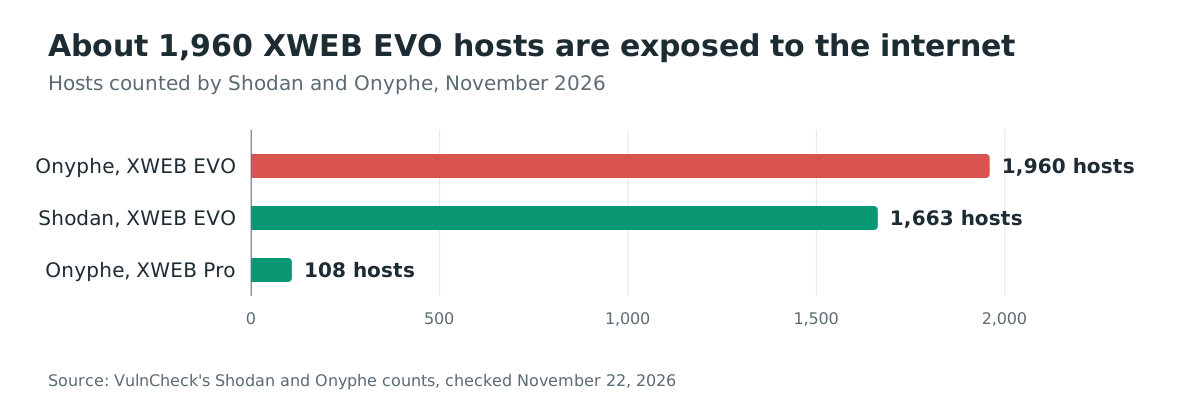
Exposure is large: VulnCheck counted about 1,960 internet-facing XWEB EVO hosts on Onyphe and 1,663 on Shodan, against 108 for the audited XWEB Pro line.
The table lists the 14 records and the range each one gives.
| CVE | CVSS v4.0 | Affected versions | What it does |
|---|---|---|---|
| CVE-2026-124002 | 9.3 Critical | 5.2.3 to before 5.7.0 | Username command injection before the password check |
| CVE-2026-124003 | 8.5 High | Before 5.6.2 | Setuid-root wlua runs an unsanitized argument |
| CVE-2026-124004 | 9.3 Critical | Before 5.6.2 | Hardcoded Administrator password |
| CVE-2026-124005 | 9.2 Critical | 4.3.0 to 5.8.8 | Daily Administrator password derived from the MAC and date |
| CVE-2026-124006 | 9.2 Critical | Through 5.8.8 | Linux root password built from a fixed prefix and the daily password |
| CVE-2026-124007 | 9.2 Critical | Before 5.6.2 | Password-field command injection |
| CVE-2026-124008 | 8.6 High | 5.2.3 to 5.8.8 | Authenticated command injection in devices.lua |
| CVE-2026-124009 | 8.6 High | 5.2.3 to 5.8.8 | Authenticated root command injection in backup.lua |
| CVE-2026-124010 | 9.3 Critical | Before 5.6.2 | Unauthenticated root command injection in xwconsole.cgi |
| CVE-2026-124011 | 6.9 Medium | 5.6.2 to 5.8.8 | Unauthenticated MAC address and clock disclosure |
| CVE-2026-124012 | 9.2 Critical | 5.6.2 to 5.8.8 | Administrator account uses the daily password with no stored secret |
| CVE-2026-124013 | 8.7 High | 5.6.2 to 5.8.8 | Authenticated root command injection in api.lua |
| CVE-2026-124014 | 8.8 High | 4.3.0 to 5.8.8 | Unauthenticated write of /etc/xwebconfig.json |
| CVE-2026-124015 | 8.2 High | 5.6.2 to 5.8.8 | Password reset without session validation |
Check what the device answers before you trust a label on the cabinet:
# The unauthenticated sysinfo endpoint returns the release and the eth0 MAC
curl -s http://<controller>/cgi-bin/sysinfo.lua

# The body marker that separates an XWEB EVO from other XWEB products
curl -s http://<controller>/ | grep -i "XWEB EVO Client"
The first command returns JSON with release, such as 5.8.8.STANDARD, and id, the MAC address. A 200 response also proves the web interface answers without a session. If both commands return nothing, the host may be a different product or the interface may be behind a proxy; confirm the model on the appliance label.
How do I fix it?
No vendor patch exists, so the fix is to remove the exposure and move to a supported platform. The network controls in this section follow CERT-FR's guidance for these controllers.
- Delete every internet-facing rule that publishes the controller's web interface. CERT-FR tells operators to remove the internet exposure of the affected units and of every unit on a public IP address.
- Give the refrigeration provider access through a VPN or a firewall allow-list of their source addresses. Do not place the web interface directly on the internet as a shortcut.
- Put the controller on a dedicated VLAN and block outbound traffic except to the endpoints the store and the provider need. The appliance holds the store's cold-chain configuration.
- Plan the migration to a supported platform. Copeland's bulletin declares the line end of support on 2026-03-16, so no firmware release will close these flaws.
- Watch the access logs for the indicators in "How do I check if I was compromised?" during and after the change.
No configuration workaround is published. Blocking /cgi-bin/xwconsole.cgi at a reverse proxy removes one request path, but login.lua, the other compiled CGIs and the MAC-derived credential remain. Treat network isolation as the control and migration as the remediation.
What is the root cause?
XWEB EVO never treats request parameters as data: the login and console handlers concatenate them into shell commands, and the appliance runs the handlers through a setuid-root interpreter.
The appliance is a Linux box with an Apache web server and a set of Lua and compiled CGIs. It sits in a supermarket back office and drives the refrigeration estate. Valentin Lobstein of VulnCheck recovered the application rootfs from the vendor's firmware, rebuilt two appliance labs, and reproduced every finding against them. The code in this section is the source it recovered.
The login handler resolves the submitted username by shelling out to find, before it checks the password:
-- login.lua, action=login
for filename in io.popen('find /opt/setup/users/ -maxdepth 2 -type f -name "'..tostring(username)..'"'):lines() do
CGI.parse only URL-decodes. A username that closes the quote and starts a command runs that command on the path to the INVALID_USERNAME branch. No session or credential is needed.
The single-request root path is a compiled setuid CGI. xwconsole.cgi reads the raw sh parameter and passes it to popen with no session check:
// xwconsole.cgi, a SUID-root compiled CGI, no auth
char *cmd = cgi_param("sh");   // the raw sh request parameter
popen(cmd, "r");               // executed as root, output streamed back to the client
What turns the Lua injections into root is the interpreter. /opt/xweb/bin/tools/wlua is setuid root, and its main calls system on an argument string it does not quote:
// /opt/xweb/bin/tools/wlua, SUID root
setuid(0);                        // honoured when wlua is execve'd directly
system("/usr/bin/lua " + argv);   // argv concatenated unsanitised, via /bin/sh
Through the Apache CGI shebang the setuid bit is dropped, so the login injection lands as www-data. A payload that re-invokes wlua on a temporary Lua file keeps the setuid bit and runs as root.
The current firmware removed the .lua CGI sinks in a 2021 rewrite. It kept a second design problem. The Administrator "code of the day" is a CRC-16 over the date, seeded by the device MAC, with no server secret. sysinfo.lua hands that MAC and the clock to any unauthenticated caller.
The same daily value drives the SSH-enable action and the Linux root password. The root password is the fixed prefix xwebdix followed by the daily value, which a daily cron job writes into /etc/shadow.
How is it exploited?
An attacker who can reach the web interface needs no account for the root command injection, and only the public MAC for the credential path.
- The attacker reaches the controller's web server, over the internet or from the store network.
- For CVE-2026-124010, the attacker sends one request to the setuid CGI. The response contains the command output and
uid=0(root).
GET /cgi-bin/xwconsole.cgi?sh=id HTTP/1.1
Host: target
- For CVE-2026-124002, the attacker injects into the username. The command runs as
www-data, and a short Lua payload that re-invokeswluatakes root.
GET /cgi-bin/login.lua?action=login&password=x&username=%22;id;echo%20%22 HTTP/1.1
Host: target
- On the current branch, the attacker reads the MAC and clock from
sysinfo.lua. The attacker computes the daily password offline and logs in asAdministrator. A request withaction=ssh&password=<daily>&target=startstarts the SSH daemon, and the root login isxwebdix<daily>. - On the legacy branch, CVE-2026-124014 writes
/etc/xwebconfig.jsonthroughconfig.luawithaction=set, without a session.
VulnCheck published a go-exploit module for the login chain in its public Initial Access Community repository. The module fingerprints the UI and fires the login.lua injection. It then re-invokes wlua and catches a root reverse shell. The commands in this section come from that public analysis; this article adds no new exploit code.
How does the attack flow?
One unauthenticated HTTP request reaches a handler that passes the parameter to a root shell, and the appliance returns the command output.
login.lua reads username"] B --> C["No escaping and no session check"] C --> D["SUID-root CGI or wlua runs the command"] D --> E["Command executes as uid=0(root)"] E --> F["Root shell or inline command output"]
What can an attacker do?
An attacker with root on the supervisor controls the refrigeration estate for that store and can change the physical process, not only read data.
- Change setpoints, defrost schedules and alarm thresholds for the cabinets the controller manages.
- Read and modify the configuration in
/etc/xwebconfig.json, including provider and network settings. - Enable SSH, add users, and use the appliance as a foothold on the store network.
- Reach the provider or monitoring endpoints the controller is allowed to contact.
The conditions matter. CVE-2026-124010 and CVE-2026-124014 need no authentication. The credential chain needs the MAC and the clock, both available without a session on 5.6.2 to 5.8.8. CVE-2026-124008, CVE-2026-124009 and CVE-2026-124013 need an authenticated session first.
The October campaign is a separate event from the canary scanning. France attributes the campaign to Iran's IRGC unit Shahid Kaveh and reports more than 700 supermarket sites, fires and food losses in the tens of millions of euros. VulnCheck says its canary hits were opportunistic scanners, not that campaign.
Why does the fix work?
No vendor fix exists; the 2021 rewrite shows what one would look like, and it did not go far enough. The rewrite removed the .lua CGI surface and the hardcoded Administrator password from the modern branch, which closes the command-injection class on that branch. It left the MAC-derived daily credential, so the current 5.8.8 build remains exposed through CVE-2026-124005, CVE-2026-124006 and CVE-2026-124012.
The vendor's March 2026 bulletin declares the family end of software support, so there is no patch to diff and no release that will close the remaining flaws. Isolation removes the network path an attacker needs. Migration removes the device.
How do I check if I was compromised?
VulnCheck publishes two source addresses and two request patterns, and both are worth a search in the web server and firewall logs.
202.61.138.117, AS152194, sent 125 requests toconfig.luafrom 2026-11-12 22:00 UTC to 2026-11-13 06:16 UTC.177.4.12.11, AS140227, sent fourxwconsole.cgi?sh=idprobes from 2026-11-13 03:41 UTC to 04:09 UTC.- Any unauthenticated
POSTto/cgi-bin/config.luawithaction=set. - Any unauthenticated
GETto/cgi-bin/xwconsole.cgicarrying theshparameter. - The canary rules
VULNCHECK CVE-2026-124014 Copeland XWEB EVO Unauthenticated config.lua Configuration Write AttemptandVULNCHECK CVE-2026-124010 Copeland XWEB EVO xwconsole.cgi Unauthenticated Root Command Execution Attempt.
Search the access log case-insensitively, because a proxy or an attacker may vary the path casing:
grep -Ei 'config\.lua.*action=set|xwconsole\.cgi.*[?&]sh=' /var/log/apache2/access.log
Also check the appliance for an SSH daemon you did not enable and accounts you did not create. Look for a changed /etc/xwebconfig.json and for defrost or setpoint changes that do not match the store's schedule.
The canary traffic was limited to configuration writes and id probes, so a hit on those addresses is a probe, not proof of a root shell. A failed attempt may leave only one access-log line.
Timeline
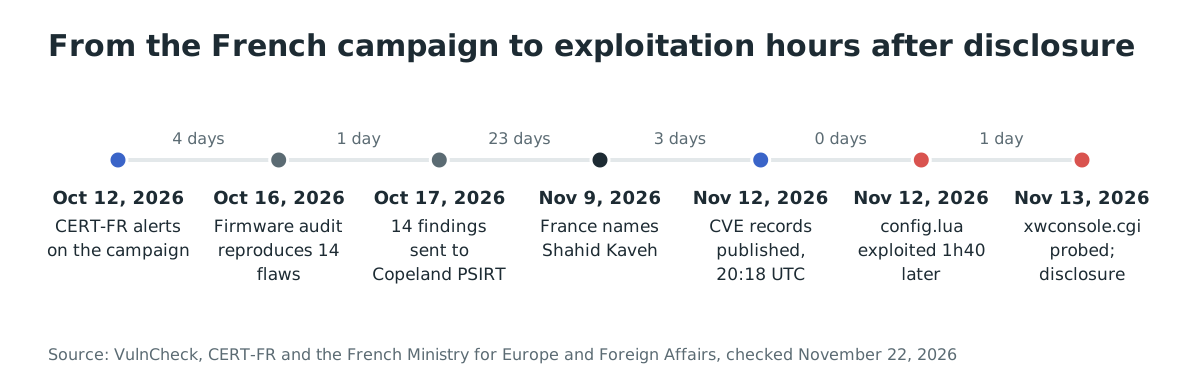
- 2026-10-11 to 2026-10-12: attackers force refrigeration controllers at more than 700 French supermarket sites into defrost, with fires in at least 15 stores.
- 2026-10-12: CERT-FR publishes alert CERTFR-2026-ALE-012 and names the Copeland and Dixell XWEB families among the compromised controllers.
- 2026-10-16: VulnCheck rebuilds the 5.2.3 and 5.8.8 firmware and reproduces 14 findings to
uid=0(root). - 2026-10-17: VulnCheck submits the 14 findings to Copeland PSIRT.
- 2026-11-09: France attributes the campaign to Iran's IRGC unit Shahid Kaveh.
- 2026-11-12 20:18 UTC: the 14 CVE records are published, with descriptions only and no exploit.
- 2026-11-12 22:00 UTC: VulnCheck canaries record exploitation attempts on CVE-2026-124014, one hour and forty minutes after publication.
- 2026-11-13 03:41 UTC: a second source probes CVE-2026-124010. VulnCheck publishes its analysis later that day.
FAQ
Is there a patch?
No. Copeland declared the XWEB EVO family end of software support in March 2026, with no fixes after 2026-03-16. The only remediation is to remove the device from the network path and migrate to a supported platform.
Does the current 5.8.8 firmware have the same command injection?
No for the .lua command injections, which the 2021 rewrite removed. Yes for the credential design: CVE-2026-124005, CVE-2026-124006 and CVE-2026-124012 reach 5.8.8 and let an attacker derive the Administrator and root passwords from the public MAC and the date.
Was the October supermarket attack caused by these flaws?
France says the campaign compromised Copeland and Dixell XWEB controllers, among other families, but neither CERT-FR nor the French declaration names a CVE. VulnCheck says its canary hits were opportunistic scanners, not the campaign, so the two events should not be merged.
Do I need a password to exploit it?
No for CVE-2026-124010 and CVE-2026-124014. For the credential chain, the attacker needs the MAC and the device clock, which sysinfo.lua returns without a session on 5.6.2 to 5.8.8.
Is it in CISA KEV?
No. CVE-2026-124010 and CVE-2026-124014 are not in the CISA Known Exploited Vulnerabilities catalog as of 2026-11-22, whose newest version is 2026.11.20. VulnCheck added both to its own KEV list on 2026-11-12 and 2026-11-13.
Can I block the vulnerable paths at a proxy?
Blocking /cgi-bin/xwconsole.cgi removes the single-request path. It leaves login.lua and the 26 other compiled CGIs that reach system, popen or exec. The credential chain also remains. No configuration workaround closes the class; isolate the device and migrate.
Find exposed XWEB EVO controllers with Ostorlab
Ostorlab's attack surface discovery inventories the internet-facing hosts your organisation owns and fingerprints the services they expose. It helps you find the controllers that answer on the XWEB interface and isolate them first.
References
- VulnCheck, "Code of the Day: Unauthenticated Root in Copeland XWEB EVO", 2026-11-13: https://www.vulncheck.com/blog/copeland-xweb-evo-unauthenticated-root (checked November 22, 2026)
- VulnCheck advisory, CVE-2026-124010: https://console.vulncheck.com/cve/CVE-2026-124010 (checked November 22, 2026)
- VulnCheck advisory, CVE-2026-124014: https://console.vulncheck.com/cve/CVE-2026-124014 (checked November 22, 2026)
- VulnCheck Initial Access Community repository, public
go-exploitmodule: https://github.com/vulncheck-oss/initial-access-community (checked November 22, 2026) - CERT-FR, "Incident de sécurité ciblant les contrôleurs à distance des installations de réfrigération", CERTFR-2026-ALE-012: https://cert.cyber.gouv.fr/alerte/CERTFR-2026-ALE-012/ (checked November 22, 2026)
- French Ministry for Europe and Foreign Affairs, "Déclaration d'attribution à l'Iran de cyberattaques visant la France", 2026-11-09: https://www.diplomatie.gouv.fr/fr/presse-et-ressources/decouvrir-et-informer/actualites/declaration-d-attribution-a-l-iran-de-cyberattaques-visant-la-france (checked November 22, 2026)
- Copeland, XWEB EVO end-of-software-support product bulletin, March 2026: https://webapps.copeland.com/dixell/Content/Pages/AdvertisingMaterials/ProductNews/XWEB%20EVO%20EoS%20-%20Product_Bulletin_March_2026.pdf (checked November 22, 2026)
- CVE Program, CVE-2026-124002: https://www.cve.org/CVERecord?id=CVE-2026-124002 (checked November 22, 2026)
- CVE Program, CVE-2026-124003: https://www.cve.org/CVERecord?id=CVE-2026-124003 (checked November 22, 2026)
- CVE Program, CVE-2026-124004: https://www.cve.org/CVERecord?id=CVE-2026-124004 (checked November 22, 2026)
- CVE Program, CVE-2026-124005: https://www.cve.org/CVERecord?id=CVE-2026-124005 (checked November 22, 2026)
- CVE Program, CVE-2026-124006: https://www.cve.org/CVERecord?id=CVE-2026-124006 (checked November 22, 2026)
- CVE Program, CVE-2026-124007: https://www.cve.org/CVERecord?id=CVE-2026-124007 (checked November 22, 2026)
- CVE Program, CVE-2026-124008: https://www.cve.org/CVERecord?id=CVE-2026-124008 (checked November 22, 2026)
- CVE Program, CVE-2026-124009: https://www.cve.org/CVERecord?id=CVE-2026-124009 (checked November 22, 2026)
- CVE Program, CVE-2026-124010: https://www.cve.org/CVERecord?id=CVE-2026-124010 (checked November 22, 2026)
- CVE Program, CVE-2026-124011: https://www.cve.org/CVERecord?id=CVE-2026-124011 (checked November 22, 2026)
- CVE Program, CVE-2026-124012: https://www.cve.org/CVERecord?id=CVE-2026-124012 (checked November 22, 2026)
- CVE Program, CVE-2026-124013: https://www.cve.org/CVERecord?id=CVE-2026-124013 (checked November 22, 2026)
- CVE Program, CVE-2026-124014: https://www.cve.org/CVERecord?id=CVE-2026-124014 (checked November 22, 2026)
- CVE Program, CVE-2026-124015: https://www.cve.org/CVERecord?id=CVE-2026-124015 (checked November 22, 2026)
- CISA Known Exploited Vulnerabilities catalog: https://www.cisa.gov/known-exploited-vulnerabilities-catalog (checked November 22, 2026)