
Cisco Expressway Root RCE Exploited in the Wild (CVE-2026-76466)
An unauthenticated attacker can join a clustered Cisco Expressway database and run commands as root; exploited in the wild, fixed in X15.5.20.
TL;DR
- A static maintenance identity and cookie in the database service of a clustered Cisco Expressway let an unauthenticated attacker run commands as root. Cisco rates the flaw CVSS v3.1 9.8 Critical (CWE-798).
- Expressway-C and Expressway-E, virtual and appliance, are affected in a cluster on X15.5.3 and earlier. X14 and earlier must migrate to a fixed release, and X15.5.20 is the first fixed release.
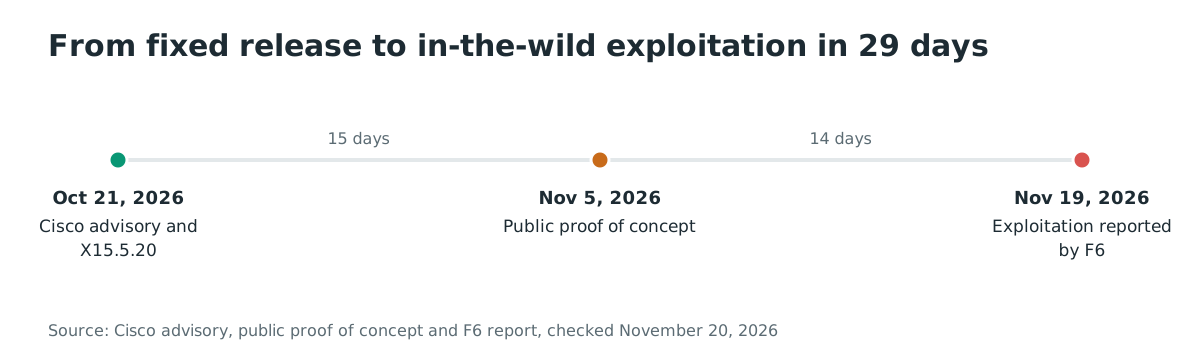
- F6 reported in-the-wild exploitation on 2026-11-19, after a public proof of concept appeared on 2026-11-05. The CVE is not in CISA KEV as of 2026-11-20.
- Upgrade to X15.5.20. Cisco lists no workaround; until every node is upgraded, restrict TCP ports 4371 and 4372 to cluster peers.
Am I affected?
All of these must hold:
- The deployment runs Expressway-C or Expressway-E, virtual or appliance, in a cluster.
- The release is X15.5.3 or earlier, including X14 and earlier.
- An attacker can reach the cluster database service on TCP port 4372 from a network that should not manage the cluster.
A standalone Expressway is outside the advisory's vulnerable set. The flaw is in the database service that cluster nodes use to replicate state. Cisco describes it as the use of persistent cookies plus insufficient validation of client certificates when TLS Verify Mode is set to Enabled for clustering.
Expressway-C and Expressway-E are the collaboration edge and core nodes for mobile and remote access, business-to-business calls and firewall traversal. Organizations often place Expressway-E in a perimeter network so remote endpoints can register, and keep Expressway-C on the internal side.
A cluster spreads registrations and call state across nodes, which is why the database service is reachable between them. The same design means a compromised edge node can reach the core nodes over the cluster link.
| Expressway release | Affected | First fixed release |
|---|---|---|
| X15.5.3 and earlier | Yes | X15.5.20 |
| X14 and earlier | Yes | Migrate to a fixed release |
| X15.5.20 and later | No | Fixed |
Check the running release in the web interface of each node under System > Status. The same page shows the cluster peers, so an unexpected peer is visible there too. Then test whether the cluster database ports are reachable from a host that should not manage the cluster:
nc -vz expressway-c.example.com 4372
nc -vz expressway-c.example.com 4371
A successful connection from a workstation, a user VLAN or an application network is the exposure to remove first. Ports 4371 and 4372 carry the cluster database traffic, so peers need them and other networks do not.
How do I fix it?
Upgrade every node in the cluster to X15.5.20 or later. X14 and earlier have no fixed release on their branch and must migrate.
- Download X15.5.20 from Cisco and follow the Expressway upgrade guide for a cluster. Upgrade the nodes in the order the guide gives, because a mixed cluster is not a fixed cluster.
- Confirm that each node reports X15.5.20 under System > Status.
- Restrict TCP 4371 and 4372 to the cluster peers on the network and host firewalls. Cisco lists no workaround, so this is exposure reduction, not a fix.
- If the upgrade has to wait, isolate the cluster database ports and alert on connections from non-peer addresses. The public proof of concept's author recommends the same restriction.
- Treat the Expressway management and cluster interfaces as a management plane. Do not expose them to user networks or to the internet.
What is the root cause?
Cisco Expressway uses Erlang/OTP for its cluster database. Each node runs an Erlang distribution listener on TCP port 4372, protected by TLS and authenticated with a shared cookie. A node that knows the cookie can join the distribution mesh and invoke remote procedure calls on its peers.
The cluster manager, cm_server, admits a maintenance node identity into the allowed-node set alongside the configured cluster peers. The public proof of concept names that identity wombat@127.0.0.1 and its cookie wombat, and says both are compiled into the module and therefore identical on every installation of the affected release. Cisco's advisory describes the same property as persistent cookies, with CWE-798 (use of hard-coded credentials) assigned to the CVE.
Cisco also says client certificates are not validated when TLS Verify Mode is set to Enabled for clustering. The proof of concept's tested scope was a two-node X15.3.2 cluster in TLS Permissive mode, where the distribution listener accepts the static identity. Both descriptions point at one weakness: the cluster service authenticates a node with a value that is not unique to the deployment.
An Erlang distribution cookie is normally a secret that an administrator sets per cluster, and it is the only authentication on the distribution port. A cookie compiled into the product is not a secret. Anyone who can read the public proof of concept, a firmware image or the module on one device knows the value for every deployment of that release.
TLS protects the connection in transit, but it does not make the identity unique. If the listener accepts a client certificate without validating it, the attacker only has to know the node name and the cookie.
The proof of concept publishes the chain in its README:
TLS 1.3 connect to target:4372
  → Erlang dist handshake with node name "wombat@127.0.0.1"
    → cm_server admits the identity (add_allowed_wombat_node)
      → challenge-response with cookie "wombat"
        → distribution session established (ping = pong)
          → rpc:call(Target, os, cmd, ["id -u"]) → 0
The final call runs an operating-system command through Erlang's os module. Because the distribution node runs as root, the command runs as root.
How is it exploited?
- The attacker reaches TCP 4372 on a node in the cluster. No credential is needed for this step.
- The attacker completes the TLS 1.3 handshake and starts an Erlang distribution handshake with the node name
wombat@127.0.0.1. cm_serveradmits the maintenance identity to the allowed-node set, and the attacker answers the cookie challenge withwombat.- The distribution session is established. The attacker invokes
rpc:callagainst the node'sosmodule and receives command output. - The command runs as root on the Expressway operating system. The attacker can read the configuration, change it, and use the node to reach its cluster peers.
- F6 reported that the attackers used this position to move laterally. The company observed custom Python scripts scanning SMB resources, interacting with SQL Server and WinRM, and reading GitLab repositories to collect credentials.
The public proof of concept performs the handshake and the command call and was tested against X15.3.2 in TLS Permissive mode. Its author reports that id -u returned 0. F6's report is the first public account of the same path being used against production devices.
How does the attack flow?
One unauthenticated connection to the cluster database port joins the Erlang distribution mesh with a static identity, and the resulting remote procedure call runs as root.
TCP 4372"] --> B["TLS 1.3 and Erlang
distribution handshake"] B --> C["cm_server admits
wombat@127.0.0.1"] C --> D["Cookie check accepts
the static cookie"] D --> E["Distribution session
as a cluster node"] E --> F["rpc:call runs
os commands as root"] F --> G["Pivot to peers
and internal network"]
What can an attacker do?
A successful attacker runs commands as root on the Expressway operating system. From that position the attacker can read and change the device configuration, read stored credentials and keys, reach the other nodes in the cluster, and use the appliance as a foothold on the internal network.
Every condition has to hold:
- The device is clustered.
- The attacker can reach TCP 4372 on a node.
- The node runs an affected release.
- Client-certificate validation does not stop the static identity, which is the condition Cisco describes.
F6 reported that the attackers first breached two internet-facing Expressway devices, then pivoted to two other cluster nodes on the internal network, four devices in total. The company also reported network scanning, SMB and SQL Server access, WinRM use and GitLab repository access, with credentials and data taken from the environment. F6 did not attribute the activity to a known group.
The blast radius is larger than one appliance. A cluster node holds the configuration and credentials it needs to talk to the other nodes, the call-control systems and the directory.
An attacker who reaches one edge node can use the cluster link to reach the core, and from the core can reach the internal services the collaboration stack trusts. That is why the F6 report describes lateral movement rather than a single compromised host.
Why does the fix work?
Cisco does not publish the Expressway source or a patch diff. X15.5.20 is the fixed release, and the advisory says it addresses the persistent cookies and the client-certificate validation gap.
The public mechanism implies that the fixed build no longer accepts the static maintenance identity and cookie, or that it enforces certificate validation for the cluster service. That is an inference from the advisory and the proof of concept, not a verified diff.
Because Cisco lists no workaround, the upgrade is the only supported fix. Restricting the cluster ports reduces exposure but does not remove the static identity from an unpatched node.
How do I check if I was compromised?
F6 published three indicators: the two IP addresses, the node name in the Erlang log, and the directory where the attackers staged Python scripts. Search the Expressway log bundle for the node name:
grep -R "wombat@127.0.0.1" /var/log/ 2>/dev/null
Search for the staged scripts. F6 describes paths under /mnt/harddisk/ that match i followed by four digits and an optional letter:
find /mnt/harddisk -maxdepth 3 -type f -name '*.py' 2>/dev/null | grep -E '/i[0-9]{4}[A-Za-z]?/'
Search firewall, proxy and NetFlow records for the two addresses:
grep -E '66\.179\.31\.32|18\.130\.47\.116' /var/log/firewall.log
Also compare the cluster peer list on each node with the expected peers. An unexpected node is a lead to investigate. A hit on any of these checks is a lead, not proof of compromise, and an attempt that failed may leave no trace.
Timeline
- 2026-10-21: Cisco publishes the advisory and the X15.5.20 fixed release.
- 2026-11-05: A public proof of concept is published.
- 2026-11-19: F6 reports in-the-wild exploitation against a Russian organization, reaching four nodes.
- 2026-11-20: Cisco's advisory still says its product security team is not aware of malicious use, and CISA KEV has no entry for the CVE.
FAQ
Is a standalone Expressway affected? No. Cisco's vulnerable set is Expressway-C and Expressway-E devices configured in a cluster. A standalone device does not run the cluster database service that carries the flaw.
Does the attacker need credentials? No. The attacker needs network access to TCP 4372 and the static node identity and cookie, which are public in the proof of concept. The advisory assigns no privileges required.
Is there a workaround? No. Cisco lists no workaround. Restricting TCP 4371 and 4372 to cluster peers reduces exposure until the upgrade, but it does not remove the static identity.
Is the CVE in CISA KEV? No. CISA's catalog has no entry for CVE-2026-76466 as of 2026-11-20.
Which release fixes it? X15.5.20 fixes X15.5.3 and earlier. X14 and earlier have no fixed release on their branch and must migrate to a supported release.
Was it exploited before the proof of concept? Cisco said at publication that it was not aware of public announcements or malicious use. F6's report is the first public exploitation account, and it followed the proof of concept.
Why does clustering matter? The vulnerable database service is part of the cluster replication path. A standalone Expressway does not expose the same listener, so it is outside Cisco's vulnerable set. A cluster member that accepts the static identity gives an attacker a path to every peer.
Can I detect the handshake? The public indicators are the node name in the Erlang log and connections to TCP 4372 from addresses that are not cluster peers. A network sensor that sees the distribution port can log the connection, but the handshake is TLS-protected, so the node name may appear only in the device log. Absence of a log entry is not proof that no attempt happened.
Find exposed Expressway appliances with Ostorlab
Ostorlab's attack surface discovery inventories internet-facing hosts and services, so you can find the Expressway management and cluster interfaces that should not be reachable before you patch them. See how Ostorlab attack surface discovery works.
References
- Cisco security advisory, "Cisco Expressway Series Remote Code Execution Vulnerability" (2026-10-21). https://sec.cloudapps.cisco.com/security/center/content/CiscoSecurityAdvisory/cisco-sa-vcs-static-cred-hr7EWZ8t (checked November 20, 2026)
- CVE record CVE-2026-76466. https://www.cve.org/CVERecord?id=CVE-2026-76466 (checked November 20, 2026)
- Public proof of concept, "CVE-2026-76466: Cisco Expressway Cluster Database Root RCE" (repository created 2026-11-05). https://github.com/dinosn/cve-2026-76466 (checked November 20, 2026)
- F6 press release, "Cisco vulnerability exploitation" (2026-11-19). https://f6.security/media-center/press-releases/cisco-vulnerability-exploitation/ (publisher page; report covered by The Hacker News, checked November 20, 2026)
- The Hacker News, "Hackers Exploit Critical Cisco Expressway Flaw, Breach Four Devices and Reach Internal Network" (2026-11-20). https://thehackernews.com/2026/11/hackers-exploit-critical-cisco.html (checked November 20, 2026)
- CISA Known Exploited Vulnerabilities catalog, catalog version 2026.11.18. https://www.cisa.gov/sites/default/files/feeds/known_exploited_vulnerabilities.json (checked November 20, 2026)
- Cisco Expressway Series product page. https://www.cisco.com/c/en/us/products/unified-communications/expressway-series/index.html (checked November 20, 2026)