
Broadcom AutoSys Unauthenticated RCE (CVE-2026-126551)
Three unauthenticated flaws in Broadcom AutoSys WCC let an attacker run commands on the scheduler or its agents; fixed in 24.2.01.
TL;DR
- Three unauthenticated flaws in AutoSys Workload Automation's Workload Control Center let an attacker run commands on the WCC server or on managed System Agent hosts.
- The worst is a hard-coded cryptographic key, CVE-2026-126551, which Broadcom rates CVSS v4.0 9.3 Critical. CVE-2026-126552 and CVE-2026-126553 are also 9.3 Critical.
- Broadcom published CA20261117-01 on 2026-11-17. No exploitation is known, and none of the three is in CISA KEV as of 2026-11-18.
- Upgrade to AutoSys 24.2.01 or later. Releases 24.1.00 and later already remove the two vulnerable endpoints.
Am I affected?
Affected versions and exposure conditions differ by CVE:
- You run Workload Control Center (WCC) 12.1.x through 24.2.00.
- The WCC web tier is reachable from a network an attacker can use.
- For CVE-2026-126552 and CVE-2026-126553, the WCC release is 12.1.x through 24.0.01. The 24.1.00 platform migration removed both endpoints.
- For CVE-2026-126551, code execution affects the System Agent hosts managed by WCC.
AutoSys is Broadcom's enterprise workload automation product for Windows and Linux. It schedules batch jobs and runs commands on managed hosts, so a flaw in the WCC web tier reaches beyond the console. The advisory does not give a deployment count for the product.
| Branch | Affected versions | Fixed version |
|---|---|---|
| WCC 24.2 | 24.2.00 (CVE-2026-126551 only) | 24.2.01 |
| WCC 24.1 | 24.1.00 and later 24.1.x (CVE-2026-126551 only) | 24.2.01 |
| WCC 24.0 | 24.0.00 to 24.0.01 (all three CVEs) | 24.2.01 |
| WCC 12.1 | 12.1.00 to 12.1.01 Cum 06 (all three CVEs) | 24.2.01 |
Read the WCC version in the About dialog of the AutoSys Web UI, including the cumulative level. Read the engine version on the scheduler and client hosts with the autoflags utility.
autoflags -a version
The same advisory covers two engine-client issues, CVE-2026-126556 and CVE-2026-126557. They are local or client-side, not part of the three unauthenticated web flaws, and the advisory gives them separate fixes.
How do I fix it?
Upgrade WCC and the AutoSys engine to 24.2.01, then remove the deprecated password options from scripts. The upgrade is the only fix for the hard-coded key.
- Upgrade AutoSys Workload Automation to 24.2.01 on the WCC server and the engine hosts.
- If you are on 12.1.x or 24.0.x and cannot reach 24.2.01 yet, move to 24.1.00 or later. That release removes the endpoints behind CVE-2026-126552 and CVE-2026-126553, but it does not fix CVE-2026-126551.
- Replace
-pwand-pwxin native-client commands with theASPASSWORDenvironment variable. Broadcom deprecated the options in 24.2.01 and says no release removes them yet. - Restrict the WCC web tier and the engine ports to the networks that need them. The console should not answer on the open internet.
- Confirm the new version in the WCC About dialog and with
autoflags -a version.
# Confirm the engine build after the upgrade
autoflags -a version
The workaround for a console that cannot be upgraded is network isolation: allow only the administrators and integration hosts that need WCC, and block the rest. That reduces exposure to all three flaws, but the hard-coded key remains valid, so it is not a fix.
What is the root cause?
Broadcom's notice describes three separate weaknesses in the WCC web tier. Each one lets an unauthenticated request reach a privileged operation, and Broadcom does not publish the code or the patch diff.
CVE-2026-126551 is the use of a hard-coded cryptographic key in WCC. Broadcom says an unauthenticated remote attacker can achieve remote code execution on managed System Agent hosts. The notice does not disclose the key, credential format or exact request sequence.
CVE-2026-126552 is a WCC configuration endpoint that was reachable without authentication in older releases. The endpoint executed operating-system commands, so an unauthenticated request could run a command on the WCC server. Broadcom says the 24.1.00 platform migration removed the route.
CVE-2026-126553 is a WCC endpoint that deserialized untrusted data in older releases. An unauthenticated request could supply a serialized object that ran commands on the WCC server. The same 24.1.00 migration removed the endpoint.
The advisory gives the affected components and the flaw classes, not the vulnerable lines. AutoSys is closed source, so there is no public patch to read.
How is it exploited?
The three flaws have separate paths, and each starts with a request to the WCC web tier that needs no login.
- For CVE-2026-126551, the attacker abuses the hard-coded key to reach code execution on managed System Agent hosts. Broadcom does not publish the intermediate authentication steps.
- For CVE-2026-126552, the attacker sends a request to the configuration endpoint on WCC 12.1.x through 24.0.01. The endpoint runs the supplied operating-system command on the WCC server.
- For CVE-2026-126553, the attacker sends a serialized object to the affected endpoint on WCC 12.1.x through 24.0.01. The server deserializes it and runs the resulting command on the WCC server.
- In all three cases, the attacker needs network access to the WCC web tier. No account, token or user interaction is required.
Broadcom has published no proof of concept and no request capture. The advisory names the affected endpoints only by function, so the exact URLs are not public.
How does the attack flow?
An unauthenticated request reaches the WCC web tier, one of three missing checks lets it through, and the attacker runs commands on the WCC server or on the managed agents.
to the WCC web tier"] --> B["Hard-coded key
CVE-2026-126551"] A --> C["Config endpoint
CVE-2026-126552"] A --> D["Deserializer
CVE-2026-126553"] B --> E["Forged session
and agent control"] C --> F["OS command on
the WCC server"] D --> G["Serialized object runs
on the WCC server"] E --> H["Commands on managed
System Agent hosts"]
What can an attacker do?
An attacker who reaches the WCC web tier can run commands on the WCC server or on the hosts it manages, depending on which flaw is used.
- CVE-2026-126551 reaches code execution on managed System Agent hosts, as the account the agent runs under. Those hosts execute the jobs the scheduler sends.
- CVE-2026-126552 runs operating-system commands on the WCC server.
- CVE-2026-126553 runs commands on the WCC server through a deserialized object.
- The attacker needs network access to the WCC web tier. No authentication is required for any of the three.
- Broadcom's notice describes command execution. It does not enumerate the data or the accounts an attacker can reach after that.
- The advisory does not state whether the forged credential survives a restart, so treat a forged session as an active compromise until the console is rebuilt.
The advisory reports no exploitation. The impact statements come from Broadcom's own descriptions.
Why does the fix work?
The fix is a version upgrade, not a configuration change. AutoSys 24.2.01 is the first release not affected by the hard-coded key, and it contains the fixes for the rest of the batch. Releases 24.1.00 and later already removed the two endpoints behind CVE-2026-126552 and CVE-2026-126553.
Broadcom does not publish the patch diff. Its notice lists 24.2.01 as the solution and gives the affected and non-affected ranges for every CVE. The 24.1.00 platform migration removed the routes as a side effect, which is why 24.1.00 and later are not affected by the two endpoint flaws.
For CVE-2026-126556, the fix is behavioral: use the ASPASSWORD environment variable instead of -pw or -pwx. Broadcom deprecated the options in 24.2.01 but has not removed them, so a script that still passes the password on the command line stays exposed.
How do I check if I was compromised?
Look for requests to the WCC endpoints, new administrator sessions and unexpected processes on the WCC and agent hosts. Broadcom publishes no indicators, so these are leads rather than a complete check.
- Review WCC and web-server logs for requests to configuration or export endpoints from addresses that never used the console.
- Review administrator sessions and audit records for logins you cannot attribute, especially sessions created without a matching authentication event.
- Check the WCC server and the System Agent hosts for unexpected processes, scheduled tasks and outbound connections.
- Review AutoSys job definitions for jobs you did not create, and for changes to jobs that run commands.
- Check for new local accounts or changed service credentials on the WCC and agent hosts.
- If you find a forged session or an unexpected command, rebuild the WCC server from a known-good image and rotate the credentials the scheduler stores.
No public indicator list exists for this batch. An attempt that failed may leave only a request line in the log.
Timeline
Broadcom published the notice and the CVE records on the same day.
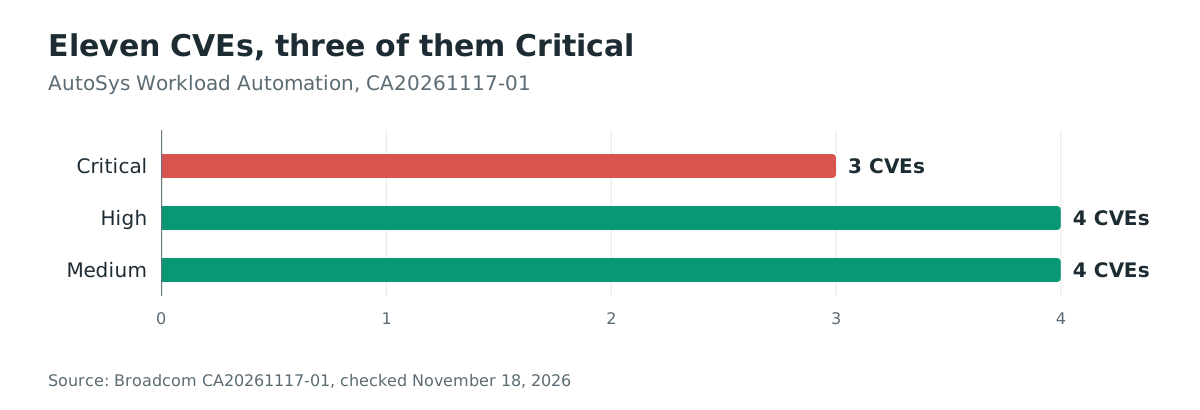
- 2026-11-17: Broadcom publishes CA20261117-01 and the eleven CVE records.
- 2026-11-18: No exploitation is known, and none of the CVEs is in CISA KEV.
FAQ
Are the three flaws really unauthenticated?
Yes. Broadcom describes CVE-2026-126551, CVE-2026-126552 and CVE-2026-126553 as reachable by an unauthenticated remote attacker. The only precondition the notice states is network access to the WCC web tier.
Which release fixes all three?
AutoSys 24.2.01 fixes all three and the rest of the batch. Releases 24.1.00 and later remove the two endpoints behind CVE-2026-126552 and CVE-2026-126553, but they do not fix the hard-coded key in CVE-2026-126551.
Is there a public proof of concept?
No. Broadcom's notice names the affected components and the impact, and it publishes no request, exploit code or indicator.
Is the flaw exploited in the wild?
No exploitation is known as of 2026-11-18, and none of the CVEs is in CISA KEV. That can change, so check the catalog before you plan the upgrade.
Does the batch affect the AutoSys engine clients too?
Yes, but those are separate issues. CVE-2026-126556 exposes the product password to local users when it is passed with -pw or -pwx, and CVE-2026-126557 crashes an engine client on a crafted batch file. Both are covered by 24.2.01, and CVE-2026-126556 also needs the ASPASSWORD change.
Can I mitigate without upgrading?
Only by restricting network access to the WCC web tier. That reduces exposure to all three flaws, but the hard-coded key stays valid and the endpoints stay present. Treat the restriction as a stopgap, not a fix.
Find exposed AutoSys consoles with Ostorlab
Ostorlab's attack surface discovery inventories the internet-facing hosts an organisation exposes, so you can find AutoSys WCC consoles and scheduler hosts that answer on untrusted networks and patch them first. Start at https://ostorlab.co/product/attacksurface_discovery
References
- Broadcom, "CA20261117-01: Security Notice for AutoSys Workload Automation", 2026-11-17 (checked November 18, 2026). https://support.broadcom.com/web/ecx/support-content-notification/-/external/content/SecurityAdvisories/0/39615
- CVE Program, "CVE-2026-126551", 2026-11-17 (checked November 18, 2026). https://www.cve.org/CVERecord?id=CVE-2026-126551
- CVE Program, "CVE-2026-126552", 2026-11-17 (checked November 18, 2026). https://www.cve.org/CVERecord?id=CVE-2026-126552
- CVE Program, "CVE-2026-126553", 2026-11-17 (checked November 18, 2026). https://www.cve.org/CVERecord?id=CVE-2026-126553
- CISA, "Known Exploited Vulnerabilities Catalog", 2026-11-18 (checked November 18, 2026). https://www.cisa.gov/known-exploited-vulnerabilities-catalog