
Best API Security Testing Tools in 2026: 4 Compared
The best API security testing tools in 2026: StackHawk, 42Crunch, Escape, and Ostorlab compared on DAST, BOLA/BFLA testing, API discovery, and CI/CD.
Picking an API security testing tool is harder than it looks. Most vendors claim the same checklist, and the differences only show up when you point them at your own APIs. We compared four tools that take very different approaches: StackHawk, 42Crunch, Escape, and Ostorlab.
Executive Summary (TL;DR)
- StackHawk suits teams that want Dynamic Application Security Testing (DAST) in every pull request. 42Crunch suits teams that run their APIs from OpenAPI contracts.
- Escape suits API-first teams with GraphQL-heavy backends. Ostorlab suits products where mobile apps, web frontends, and code all call the same backend.
- The biggest gap between tools is authorization testing: Broken Object Level Authorization (BOLA) and Broken Function Level Authorization (BFLA). Check it first in any trial.
What is API security testing? API security testing checks that an API only does what it is supposed to do, for the users who are supposed to do it. It covers injection and misconfiguration, but also authorization flaws such as Broken Object Level Authorization (BOLA), where a valid, logged-in request returns another user's data. BOLA is API1 in both the 2019 and 2023 editions of the OWASP API Security Top 10.
What are the best API security testing tools in 2026?
The four tools each approach the problem from a different angle, so the right choice depends on how your APIs are built:
| If your priority is… | Start with | Why |
|---|---|---|
| DAST on every pull request, run by developers | StackHawk | The scanner runs locally or in CI against a running app, and findings land in the PR |
| Governing APIs through OpenAPI contracts | 42Crunch | It audits the spec before code ships, then checks that the live API matches it |
| Business-logic testing for GraphQL and REST without maintaining specs | Escape | Multi-user authorization tests and schema generation from code |
| Testing APIs together with the mobile and web clients that call them | Ostorlab | It pulls tokens and routes out of clients and code, then tests them against the live API |
How did we evaluate these API security testing tools?
We compared the four platforms on eight criteria. They double as questions to ask any vendor during a trial:
| Criterion | What good looks like |
|---|---|
| Protocol coverage | Tests (not just discovers) every API style you run: REST, GraphQL, gRPC, SOAP, WebSockets, and increasingly Model Context Protocol (MCP) servers |
| Spec dependency | Works with an incomplete or missing spec, and can generate or infer one |
| Authentication handling | Handles your real login flow (OAuth2 flows, scripted logins, MFA, token refresh) without pasting tokens by hand |
| Authorization testing | Automated BOLA and BFLA tests with several identities, not only single-user scans |
| Discovery | Finds undocumented endpoints from code, traffic, or clients |
| Client-side context | Can use what mobile apps, SPAs, and repositories expose (keys, routes, request formats) as test input |
| Developer workflow | CI/CD integrations, PR feedback, IDE support, and a way to fail builds on new findings |
| Private targets | Can reach staging and internal APIs through a local runner, private agent, or on-prem scanner |
How we sourced the facts: every capability below comes from each vendor's public documentation and product pages, checked in September 2026. Links point to the pages we used. This comparison was written by Ostorlab, which is one of the four vendors covered, so we kept each profile to the same structure and flagged anything we couldn't confirm.
What types of API security testing tools are there?
"API security testing" covers several techniques, and most tools combine two or three of them:
- API DAST (dynamic testing): sends live requests to a running API to find injection, server-side request forgery (SSRF), misconfigurations, and authentication flaws. It needs a reachable environment and test credentials.
- Contract and schema testing: audits an OpenAPI or GraphQL definition for weak security settings. It then generates requests from it, malformed ones included, to check the live API matches the contract.
- Business-logic and authorization testing: uses two or more user identities. It checks that one user can't read or change another user's objects (BOLA) or call functions above their role (BFLA).
- API discovery and inventory: finds APIs nobody documented, using source code, traffic, DNS, or cloud accounts, so they can be tested at all.
- Agentic or AI pentesting: an AI agent explores the application, forms hypotheses, chains findings, and backs each exploit with evidence.
- Runtime protection: API firewalls and gateways block attacks in production. They complement testing; they don't replace it.
StackHawk: developer-first DAST
Focus: continuous DAST in the development workflow.
StackHawk's scanner, HawkScan, runs as a CLI or Docker container, on a laptop or in CI, against a running application. It supports REST (OpenAPI), GraphQL, gRPC, JSON-RPC, and SOAP. The docs also cover testing remote MCP servers and LLM security checks.
Authorization testing runs through Business Logic Testing. HawkScan crawls the API under multiple user profiles, logs resource IDs, and replays them across profiles to detect BOLA and Broken Object Property Level Authorization (BOPLA, API3). Profiles flagged as privileged drive the BFLA checks. The feature requires an OpenAPI spec and at least two test accounts.
For discovery, StackHawk connects to GitHub, GitLab, Azure Repos, and Bitbucket to find APIs in code, and it can generate OpenAPI specs from them.
Criteria coverage:
- Authentication: form login, cookies and bearer tokens, OAuth client credentials and password flows via scripts, plus custom JavaScript or Kotlin auth scripts.
- Developer workflow: GitHub Actions, GitLab CI, Jenkins, and Azure Pipelines, plus integrations for AI coding assistants.
- Deployment: local CLI, Docker, or StackHawk's cloud-hosted scanning.
- Strengths: findings returned in the pull-request check that gates the merge, REST/GraphQL/gRPC/JSON-RPC/SOAP support, multi-user authorization tests, and API discovery from code.
- Limitations: it needs a running environment, and the docs recommend running it where data changes are acceptable. Business Logic Testing depends on a spec. WebSocket endpoints are detected in code but not scanned. Mobile binary analysis isn't part of the product.
42Crunch: API contract security and governance
Focus: OpenAPI contract quality and conformance.
42Crunch begins with the API definition. API Audit runs over 200 static checks against an OpenAPI (v2, 3.0, 3.1) file and gives it a score from 0 to 100, which a CI pipeline can use as a gate. API Scan then sends generated requests to the live API to confirm it behaves as the contract specifies. That includes requests that should be rejected.
Scan v2 adds scenarios (chained requests) and authorization tests. You pick BOLA or BFLA, give one credential that should succeed and one that should be denied, and attach the operations to test.
Beyond testing, API Protection is a small, contract-based API firewall that runs as a Kubernetes sidecar or on ECS and OpenShift. 42Crunch also lists MCP server discovery, audit, scanning, and runtime protection.
Criteria coverage:
- Protocols: OpenAPI, plus GraphQL SDL in Audit and Scan as a separate subscription (not yet in API Protection or the IDE extensions).
- Developer workflow: VS Code, JetBrains, and Eclipse extensions that run Audit and Scan. CI integrations include GitHub Actions, GitLab, Azure Pipelines, Jenkins, and Bitbucket, with SARIF output.
- Deployment: scans run from the 42Crunch platform or on-premises with the
scand-agentDocker image. - Strengths: pre-commit contract auditing, conformance testing, explicit BOLA/BFLA test setup, and a runtime firewall that enforces the same contract.
- Limitations: anything missing from the spec is out of scope, so undocumented routes go untested. Its "discovery" finds OpenAPI files already in your repositories; it doesn't infer APIs from code or traffic. gRPC and SOAP aren't documented as scan targets.
Escape: business-logic DAST and API discovery
Focus: API-first business-logic testing, especially for GraphQL.
Escape's DAST tests REST and GraphQL APIs and web apps. It includes LLM-specific checks, such as prompt injection and system prompt leakage, for endpoints that wrap a model. Its login presets cover OAuth flows, AWS Cognito, cURL sequences, browser-driven logins, and MFA/TOTP, which helps with flows that break simpler scanners.
For authorization, multi-user testing treats one account as the victim. The other accounts try to reach its data through ID enumeration and request replay, which covers both tenant isolation and privilege escalation.
For discovery, Escape's attack surface management finds shadow APIs through DNS and certificate logs, fingerprinting, and traffic. It can also generate schemas from source code in GitHub, GitLab, or Bitbucket.
Criteria coverage:
- Developer workflow: GitHub Actions, GitLab CI, Jenkins, CircleCI, a CLI, and a public API.
- Deployment: SaaS by default. Private location agents (Docker, Kubernetes, or a binary) reach internal targets.
- Strengths: multi-user business-logic testing, GraphQL depth, a wide set of login presets, and spec generation from code.
- Limitations: gRPC and SOAP appear on Escape's discovery pages, but its DAST docs cover REST and GraphQL, so confirm other protocols in a trial. Mobile binary analysis isn't listed.
Ostorlab: API testing across mobile, web, and code
Focus: APIs tested together with the mobile apps, web frontends, and source code that call them.
Ostorlab tests REST, GraphQL, and SOAP/WSDL APIs live. GraphQL is mapped through introspection or an uploaded schema, then tested with generated queries and mutations. gRPC services are analyzed from .proto definitions, without live calls. It imports OpenAPI, GraphQL schemas, WSDL, or protobuf definitions, but a spec is optional: without one, it finds endpoints in mobile packages, web bundles, source maps, and code, captures traffic from apps running on instrumented devices, and probes well-known Swagger locations. The same platform scans Android (APK/AAB) and iOS (IPA) apps, web applications, networks, and source code.
Its Multi-Asset Deep Agentic Scan puts all of these into a single assessment. One scan can cover a mobile app alongside web apps and APIs, code repositories, and documentation like OpenAPI files or Postman collections. The agent decompiles the app and extracts credentials, routes, and request-signing logic. It then uses them to test the backend.
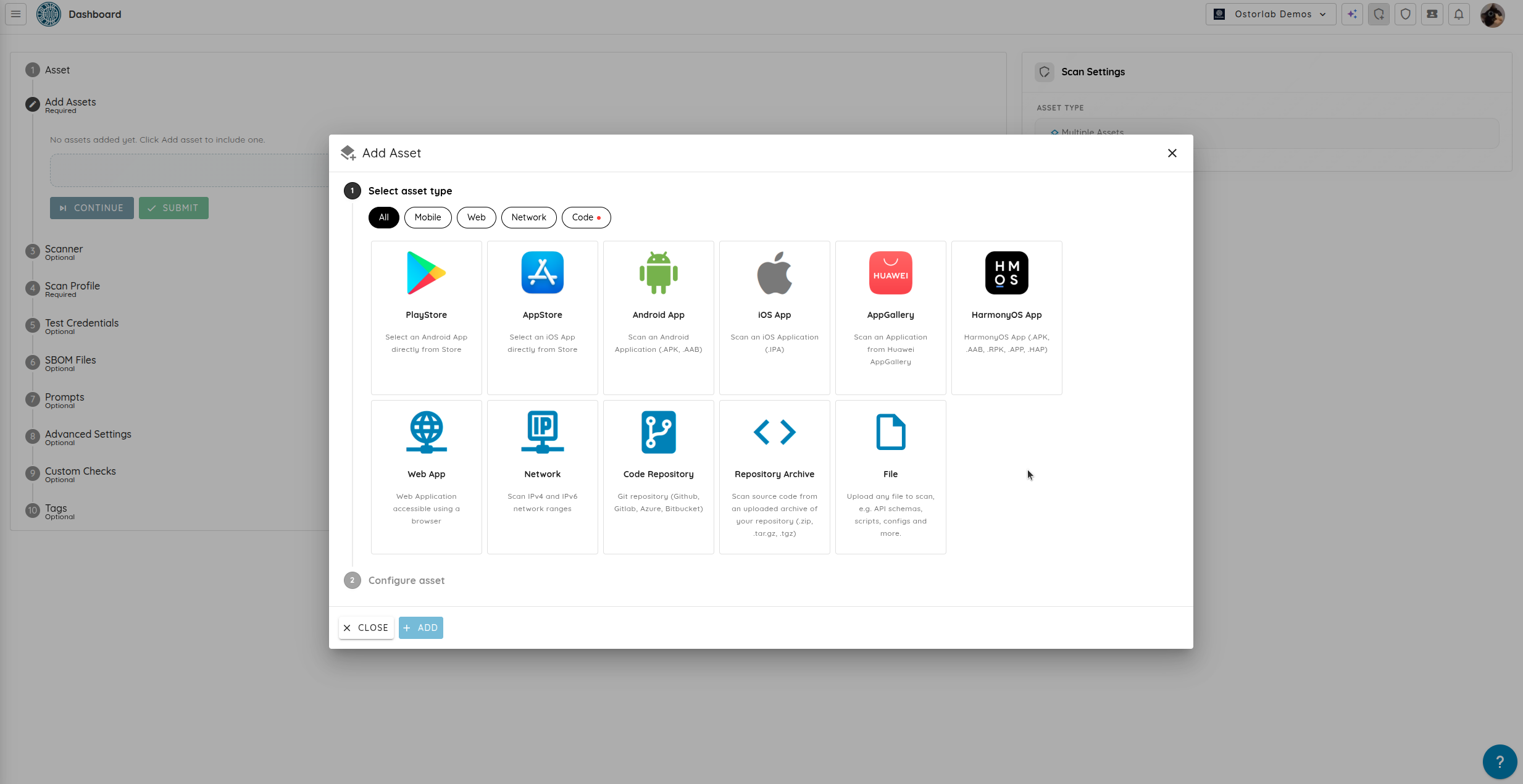
In one assessment, the agent found an Auth0 machine-to-machine credential compiled into an iOS app. It then discovered that the same credential was also authorized for the Auth0 Management API, and a single read-only request returned the tenant's 1,000-record user directory. We describe the full chain in How AI Catches Complex Vulnerabilities.
A scanner that only reaches the API couldn't have extracted that credential, because it existed only in the compiled iOS binary. We walk through this chain and another one in Why API Security Testing Alone Fails.
Criteria coverage:
- Authorization testing: the agent finds object identifiers and tests access across users and roles. It shows a BOLA or BFLA flaw with an unauthorized read rather than by changing data.
- Developer workflow: GitHub, GitLab, Jenkins, CircleCI, Bitbucket, Azure DevOps, Bitrise, and other CI integrations, plus Jira, Linear, Slack, and an MCP server.
- Deployment: cloud scanners (allowlist their published IP addresses for targets behind a WAF or IP allowlist), or an on-premises scanner that runs inside your network and only opens outbound connections. On-prem scanners can be grouped so scans run on whichever one is available.
- Safety: agents demonstrate impact with the smallest safe action and check tokens with read-only requests. A separate monitoring agent can stop a scan, scan traffic is firewalled, and request rates are capped at the scanner host.
- Strengths: context from mobile binaries, web bundles, and code feeds the API tests. It needs no spec, and chained findings come with request and response evidence.
- Limitations: a multi-asset assessment takes longer than a CI DAST pass, so it fits release cycles better than every commit, and each scan covers one mobile app. Live gRPC calls, WebSocket transports (including GraphQL subscriptions), and mTLS client certificates aren't supported yet. Teams that want pre-commit OpenAPI linting will still want a spec-governance tool.
How do StackHawk, 42Crunch, Escape, and Ostorlab compare?
This table lines up the four tools on the same capabilities, using each vendor's public documentation:
| Capability | StackHawk | 42Crunch | Escape | Ostorlab |
|---|---|---|---|---|
| Primary approach | Developer CI/CD DAST | Contract audit and conformance | Business-logic DAST | Multi-asset agentic testing |
| REST / OpenAPI | ✅ | ✅ | ✅ | ✅ |
| GraphQL | ✅ | ✅ (separate subscription) | ✅ | ✅ |
| gRPC / SOAP | ✅ / ✅ | Not documented | Discovery only (per docs) | .proto analysis, no live calls / ✅ |
| MCP server testing | ✅ Remote MCP testing | ✅ Audit, scan, runtime protection | Not documented for DAST | Not documented (ships its own MCP server for automation) |
| Spec required | No for DAST; yes for Business Logic Testing | Yes (OpenAPI or GraphQL SDL) | No (can generate from code) | No (discovers endpoints) |
| BOLA / BFLA testing | Multi-profile replay | Configured source/target credentials | Multi-user victim/attacker model | Agentic, across users and assets |
| Shadow API discovery | From code repositories | Finds spec files in repos | DNS, traffic, fingerprinting, code | From mobile apps, web traffic, and code |
| Mobile binary analysis | ❌ | ❌ | ❌ | ✅ APK / AAB / IPA |
| Client-to-API chain testing | ❌ | ❌ | ❌ | ✅ In the same scan |
| IDE and developer tooling | AI coding assistant integrations | VS Code, JetBrains, Eclipse | Not documented | Via MCP server |
| Private targets | Local CLI / Docker | On-prem Docker agent | Private location agents | On-prem scanner |
| Runtime protection | ❌ | ✅ Micro API firewall | ❌ | ❌ |
Based on each vendor's public documentation as of September 2026. "Not documented" and ❌ mean the capability isn't listed, not that a vendor has confirmed it is absent.
Which OWASP API Top 10 risks can each testing technique find?
This table maps the OWASP API Security Top 10 (2023) against four testing techniques: contract testing, DAST, multi-user logic testing, and agentic or multi-asset testing. Ratings apply to each technique, not to any specific tool. Coverage within a technique varies with the tool and its configuration.
| OWASP API risk | Contract testing | DAST | Multi-user logic testing | Agentic / multi-asset |
|---|---|---|---|---|
| API1: Broken Object Level Authorization | Partial (configured tests) | ❌ | ✅ | ✅ |
| API2: Broken Authentication | Partial | ✅ | ✅ | ✅, including leaked client credentials |
| API3: Broken Object Property Level Authorization | Partial (schema violations) | Partial | ✅ | ✅ |
| API4: Unrestricted Resource Consumption | Partial (spec limits) | ✅ | Partial | Partial (depends on rate-limit test design) |
| API5: Broken Function Level Authorization | Partial (configured tests) | ❌ | ✅ | ✅ |
| API6: Unrestricted Access to Sensitive Business Flows | ❌ | ❌ | Partial | Partial (needs business-flow context) |
| API7: Server Side Request Forgery | ❌ | ✅ | ❌ | ✅ |
| API8: Security Misconfiguration | ✅ | ✅ | ✅ | ✅ |
| API9: Improper Inventory Management | ❌ (spec only) | Partial | Partial (with discovery) | ✅, from clients and code |
| API10: Unsafe Consumption of APIs | ❌ | Partial | Partial | Partial |
These ratings are our editorial assessment of what each testing technique can detect, not verified coverage of any specific vendor.
Two patterns stand out. Authorization risks (API1 and API5) require more than one identity, so a single-user DAST scan misses them outright and only partially catches API3 through schema violations. Inventory risks (API9) require discovery. A tool that only tests the spec it receives can't see what that spec leaves out.
Which API security testing platform fits your architecture?
Your architecture matters more than any feature list. These are the setups we see most often:
- A monolith or a few REST services, with a strong CI culture: StackHawk in every pull request covers most of the surface. Add multi-user profiles early so BOLA gets tested from day one.
- A spec-first organization with an API governance program: 42Crunch enforces contract quality before code ships and at runtime. Pair it with a DAST or agentic tool for routes that never made it into the spec.
- A GraphQL-heavy backend or many microservices: Escape's GraphQL depth, schema generation, and shadow API discovery fit well. Confirm coverage for any gRPC or SOAP services in the trial.
- Mobile apps or SPAs calling the same backend: Ostorlab tests the backend with the credentials, routes, and request formats the clients actually ship. That catches chains that start in the client.
- Several of the above: most mature teams run two layers, a fast CI tool on every change and a deeper agentic or multi-asset assessment on each release.
What should you test in an API security tool trial?
Feature lists all look the same. A two-week trial on your own APIs shows where the tools actually differ. Use this checklist:
- Bring a known bug. Plant (or reuse) a BOLA issue in staging and see which tools find it, and how much setup that takes.
- Use your real login. Point each tool at your actual authentication flow, including token refresh and MFA, not a pasted bearer token.
- Hide part of the spec. Remove a few routes from the OpenAPI file and see which tools still find and test them.
- Include a secondary channel. If you use WebSockets, gRPC, or webhooks, check whether they get tested or only listed.
- Include a client. Give your mobile app or SPA to the tools that support it, and check whether what they extract is used in API tests.
- Measure the noise. Count the findings your team rejects as false positives or not exploitable, and time the triage.
- Check the evidence. A good finding includes the exact request and response, the identity used, and a fix tied to code.
- Test the pipeline. Run the tool in CI on a real pull request and time it. Check that it can fail the build on new high-severity findings only.
- Reach a private target. Deploy the runner or agent inside your network and confirm it can scan an internal staging API, including one behind mTLS if you use it.
- Ask about safety. Find out how the tool avoids destructive actions, what it does with discovered credentials, and how it limits request rates against your systems.
Frequently Asked Questions (FAQ)
What is the best API security testing tool in 2026?
It depends on the architecture. StackHawk suits developer-run DAST in CI/CD, 42Crunch suits OpenAPI contract governance, Escape suits business-logic testing of GraphQL and REST APIs, and Ostorlab suits applications where mobile apps, web frontends, and source code share a backend API. Many teams pair a CI tool with a deeper periodic assessment.
What is the difference between API DAST and API fuzzing?
API DAST sends live requests to a running API to find vulnerabilities such as injection, SSRF, and misconfigurations. Schema-driven fuzzing uses an API definition, such as an OpenAPI or GraphQL schema, to generate mutated, malformed, or boundary-breaking inputs that expose validation failures and parser errors.
How is Broken Object Level Authorization (BOLA) tested?
BOLA testing checks whether one user can read or change objects that belong to another. Common approaches are multi-profile replay (StackHawk Business Logic Testing), configured source and target credentials per operation (42Crunch Scan v2), a victim-and-attacker multi-user model (Escape), and agentic testing that discovers object identifiers and tests access across users (Ostorlab).
Is an OpenAPI specification required for API security testing?
Not always. Contract-based tools such as 42Crunch need an OpenAPI or GraphQL definition. DAST and agentic tools can discover endpoints by crawling, analyzing traffic, or reading source code, and some can generate a spec. Providing a spec usually improves route coverage.
Which API security tools can test APIs behind mobile apps?
Most API security tools test the backend only. Ostorlab analyzes the mobile binary (APK, AAB, or IPA) and uses the credentials, endpoints, and request formats it finds to test the backend API in the same scan. StackHawk, 42Crunch, and Escape don't list mobile binary analysis.
How do API security tools test APIs on private networks?
For internet-reachable APIs behind a firewall or WAF, allowlisting the vendor's scanner IP addresses is usually enough. For internal networks or local staging environments, vendors provide a local CLI or Docker runner (StackHawk, 42Crunch), private location agents (Escape), or an on-premises scanner (Ostorlab).
Can API security testing tools test MCP servers?
Some can. StackHawk documents testing remote MCP servers for injection, SSRF, and prompt injection, and 42Crunch lists MCP discovery, audit, scanning, and runtime protection. Coverage is new and changing quickly, so confirm transports (HTTP versus stdio) and authentication support in a trial.
How should you choose an API security testing tool?
Start from how your APIs are built and who calls them, not from the feature list. If mobile apps or single-page apps call your APIs, test the path an attacker would take, not only the endpoints in the spec. You can launch a Multi-Asset Deep Agentic Scan yourself, or book a demo to walk through the results with our team.
Tags:
API Security, DAST, Fuzzing, BOLA, BFLA, GraphQL, REST, gRPC, Agentic Discovery, AppSec, Mobile Security