
Linux Kernel TCP Handshake Race RCE (CVE-2026-98432)
A race in Linux IPv4 TCP handshakes since 4.4 frees socket options in use; the kernel team scores 9.8 and RHEL, Ubuntu and other distributions ship fixes.
TL;DR
- A race condition in the Linux kernel's IPv4 TCP handshake frees a socket's IP options while another CPU still reads them. The kernel's CVE team rates it CVSS v3.1 9.8, and Anthropic researcher Xinyang Ge reported it; Eric Dumazet fixed it on 2026-10-01.
- Every Linux kernel since 4.4 is affected, for any IPv4 TCP service an attacker can reach. Go services built with Go 1.24 or later listen with Multipath TCP by default, which is the configuration Anthropic's exploit used.
- Anthropic says its AI model wrote an exploit that ran commands as root, with no credentials, on Linux servers with an MPTCP listener. No attacks are reported and the flaw is not in CISA's KEV catalog as of 2026-11-04.
- Install a fixed kernel: 5.10.272, 5.15.223, 6.1.190, 6.6.159, 6.12.113, 6.18.56, 7.2.10 or 7.3, or your distribution's fixed package. Debian, Oracle, Amazon, SUSE, RHEL and Ubuntu now ship fixes; Ubuntu moved its LTS kernels from the -proposed testing pocket to its regular channels on 2026-11-10. See "How do I fix it?" for the interim mitigations.
Am I affected?
You are exposed when all of these hold:
- Your host runs a Linux kernel from Linux 4.4 (January 2016) onward that predates the fixed stable versions. Containers do not add their own kernel: a service inside a container uses the host's kernel, so the host's version decides.
- An IPv4 TCP service on that host is reachable by the attacker. Red Hat states that a remote attacker who can reach an exposed TCP service could trigger the race.
- The race needs a retransmitted SYN and IP options on the connection request. The kernel team's scoring says an attacker sends a request carrying IPv4 Record Route or Timestamp options, then resends it, and that both sides of the race are attacker-induced.
Two configuration paths widen exposure. A server with a Multipath TCP listener is the configuration Anthropic exploited, and every Go program built with Go 1.24 or later opens listen sockets with MPTCP by default on Linux. Separately, request-socket migration, enabled by net.ipv4.tcp_migrate_req=1 or a BPF reuseport migration program, exposes the same use-after-free through a second path.
| Distribution or kernel | Affected versions | Fixed version |
|---|---|---|
| Mainline and stable, self-built | All since 4.4 | 5.10.272, 5.15.223, 6.1.190, 6.6.159, 6.12.113, 6.18.56, 7.2.10, 7.3 |
| Debian 13 trixie | linux before 6.12.113-1 | linux 6.12.113-1 (2026-10-16) |
| Debian 12 bookworm | linux before 6.1.190-1; linux-6.12 before 6.12.113-1~deb12u1 | 6.1.190-1 (2026-10-17); 6.12.113-1~deb12u1 (2026-10-22) |
| Oracle Linux 7, 8, 9, 10 (UEK) | Kernels before the 2026-10-16 errata | ELSA-2026-500397, ELSA-2026-500398, ELSA-2026-500399 (2026-10-16) |
| Amazon Linux 2023 (kernel6.18) | Before 6.18.56-125.164 | 6.18.56-125.164.amzn2023 (2026-10-24) |
| Amazon Linux 2023 (kernel6.12) | Before 6.12.113-138.209 | 6.12.113-138.209.amzn2023 (2026-10-29) |
| SUSE Linux Micro 6.2, openSUSE Leap 16.0 | Before kernel-default 6.12.0-160000.40.1 | kernel-default 6.12.0-160000.40.1 or later |
| SLES 15 SP4 to SP6 LTSS, SLES 16.0, SLE Micro 5.3 to 5.5 | Before the fixed kernel-default | kernel-default 5.14.21-150400.24.246.1 (SP4, Micro 5.3/5.4), 5.14.21-150500.55.195.1 (SP5, Micro 5.5), 6.4.0-150600.23.143.1 (SP6), 6.12.0-160000.40.1 (SLES 16.0) |
| SLES 15 SP7 | All current kernels | Fix in progress, none released |
| AlmaLinux 8, 9, 10 | Kernels before the October 30 testing builds | kernel-4.18.0-553.180.2.el8_10, kernel-5.14.0-687.61.2.el9_8, kernel-6.12.0-211.69.2.el10_2 (testing repository, October 30, 2026) |
| Ubuntu 22.04, 24.04, 26.04 LTS (jammy, noble, resolute) | All current kernels | 5.15.0-203.213, 6.8.0-149.149, 7.0.0-43.43, released in the security notices from 2026-11-10 (CVE page updated 2026-11-13) |
| Ubuntu 26.10 (stonking) | All current kernels | 7.3.0-10.10 (listed as fixed on the CVE page and in Canonical's blog) |
| Ubuntu 16.04, 18.04, 20.04 | All current kernels | 20.04: work in progress in 5.4.0-247.267; 16.04 and 18.04: no fix announced |
| RHEL 8, 9, 10, every stream including kernel-rt | Kernels before the November 1 to 4 errata | kernel-5.14.0-687.64.1.el9_8 with kernel-rt (RHSA-2026:93412, 2026-11-01, RHEL 9.8), kernel-6.12.0-211.72.1.el10_2 with kernel-rt (RHSA-2026:93413, 2026-11-01, RHEL 10.2), kernel-4.18.0-553.182.1.el8_10 (RHSA-2026:93414, 2026-11-01, RHEL 8.10), kernel-5.14.0-427.161.1.el9_4 with kernel-rt (RHSA-2026:94109, 2026-11-02, RHEL 9.4 E4S), kernel-4.18.0-477.178.1.el8_8 (RHSA-2026:94303, 2026-11-03, RHEL 8.8 E4S/TUS), kernel-4.18.0-305.218.1.el8_4 (RHSA-2026:94623, 2026-11-03, RHEL 8.4), kernel-5.14.0-284.202.1.el9_2 (RHSA-2026:94477, 2026-11-03, RHEL 9.2), kernel-6.12.0-55.117.1.el10_0 with kernel-rt (RHSA-2026:94508, 2026-11-03, RHEL 10.0), kernel-5.14.0-570.154.1.el9_6 with kernel-rt (RHSA-2026:94438, 2026-11-03, RHEL 9.6), kernel-rt-5.14.0-284.202.1.rt14.487.el9_2 (RHSA-2026:94558, 2026-11-03, RHEL 9.2 RT), kernel-4.18.0-372.227.1.el8_6 (RHSA-2026:94996, 2026-11-04, RHEL 8.6), kernel-4.18.0-553.182.1.rt7.523.el8_10 (RHSA-2026:93415, 2026-11-01, RHEL 8.10 RT/NFV), kernel-6.12.0-265.31.el10nv (RHSA-2026:93775, 2026-11-02, Nvidia 10) |
Twelve of the 14 distribution rows carry a fix, one of them only in a testing channel: AlmaLinux's testing repository. The other 2 rows, SLES 15 SP7 and Ubuntu 16.04 to 20.04, have none. Red Hat's advisory file lists 2,044 fixed kernel products across its November 1 to 4 errata.
Every kernel-rt stream now has a released fix. The advisory file lists only the RHEL CoreOS images of OpenShift 4 and 5 as still known affected. AlmaLinux's kernels sit in its testing repository, which the project asks operators to help verify before they move to production.
AWS's October 31 bulletin reports fixed packages for Amazon Linux 2 and all Amazon Linux 2023 kernel branches, including the default kernel. Canonical's November 2 announcement covered the generic kernel. The CVE page now lists the general-purpose LTS kernels as fixed, along with the aws, azure, gcp, ibm, oracle, raspi, lowlatency and realtime flavors. The FIPS kernels are fixed on 22.04 in 5.15.0-203.213+fips1 and still in progress on 24.04 in 6.8.0-149.149+fips2.
Check what runs on each host:
# Host kernel version
uname -r
# Compare against the fixed versions above; Ubuntu's package
# versions differ from upstream tags, so match them on the pocket.

# Debian: installed kernel packages and status
dpkg -l 'linux-image*' | grep '^ii'

# RHEL, Oracle Linux, Amazon Linux: installed kernels
rpm -q kernel kernel-uek kernel6.12 kernel6.18 2>/dev/null

# Which Go toolchain built a service (Go 1.24+ enables MPTCP by default)
go version -m /path/to/service | head -1
How do I fix it?
-
If you run Ubuntu 22.04, 24.04 or 26.04 LTS, or Ubuntu 26.10, install the fixed kernel from the regular updates and security pockets and reboot:
sudo apt update
sudo apt install --only-upgrade linux-generic
sudo reboot
On hosts running the aws, azure, gcp, ibm, oracle, raspi, lowlatency or realtime flavors, upgrade that flavor's meta package instead, for example
sudo apt install --only-upgrade linux-aws, or runsudo apt update && sudo apt upgradeto upgrade every installed kernel meta, then reboot.After reboot,
uname -ridentifies the flavor and ABI, for example5.15.0-203-generic; it omits the package upload number.213. Usecat /proc/version_signatureto read the full running Ubuntu build, for example5.15.0-203.213-generic, as described in Canonical's kernel guide. Compare the package version before the flavor suffix with the CVE page's fixed version for your exact Ubuntu release and kernel flavor. The Ubuntu LTS row in "Am I affected?" lists general-purpose kernel fixes; cloud and real-time flavors have their own fixed versions.Canonical published the LTS kernels in its security notices from November 10, 2026, 36 days after the upstream fix. Ubuntu 20.04 remains work in progress in 5.4.0-247.267; 16.04 and 18.04 have no fix, and their coverage runs through Ubuntu Pro and Expanded Security Maintenance.
If you run RHEL, update to the November 2026 erratum kernel for your minor release and reboot. On RHEL 9.8,
sudo dnf update kernel && sudo rebootpicks up kernel-5.14.0-687.64.1.el9_8. RHEL 9 kernel-rt fixes ship in RHSA-2026:93412 for 9.8 (2026-11-01), RHSA-2026:94109 for 9.4 (2026-11-02), and RHSA-2026:94438 for 9.6 and RHSA-2026:94558 for 9.2 (2026-11-03). The kernel command does not update the separate kernel-rt package: on kernel-rt hosts, runsudo dnf update kernel-rt && sudo reboot, which on RHEL 9.2 RT picks up kernel-rt-5.14.0-284.202.1.rt14.487.el9_2 and on RHEL 8.10 RT/NFV kernel-rt-4.18.0-553.182.1.rt7.523.el8_10.Red Hat's packet-filter procedure in RHSB-2026-016 remains the stopgap where no fix applies yet. Filtering reduces exposure and cannot fully prevent exploitation.
-
Install your distribution's fixed package and reboot. On Debian:
apt update && apt install linux-image-amd64, then reboot. On Oracle Linux:dnf update kernel-uek, then reboot. On Amazon Linux 2:sudo yum update kernel && sudo reboot; Amazon Linux 2023:sudo dnf update kernel --releasever=latest && sudo reboot. - On SUSE Linux Micro 6.2 or openSUSE Leap 16.0:
zypper in 'kernel-default>=6.12.0-160000.40.1', then reboot. - On AlmaLinux 8, 9 or 10, the fixed kernels are in the testing repository. Enable it with
dnf install -y almalinux-release-testing, update withdnf update 'kernel*' --enablerepo=almalinux-testing, reboot, and disable the repository again withdnf config-manager --disable almalinux-testing. AlmaLinux asks operators to report problems in its chat or on its bug tracker while the kernels are verified. - If you build your own kernel, move to one of the fixed stable versions. The kernel CVE team recommends updating to the latest stable kernel and states the community does not support cherry-picking individual fixes.
The Go security team offers one real workaround for Go 1.24 or later services, with its own words of caution. Set GODEBUG=multipathtcp=0 in the program's environment to disable MPTCP at runtime, or put godebug multipathtcp=0 in the main module's go.mod to disable it at build time. Programs can also call net.ListenConfig.SetMultipathTCP(false) per socket. The team calls disabling MPTCP program by program a fragile mitigation: one remaining MPTCP listener still leaves the system vulnerable, and it assumes every viable exploit depends on MPTCP. The team strongly recommends upgrading to a patched kernel instead.
Two stopgaps remain for systems that cannot take a fixed kernel: AlmaLinux's nftables rule below and Red Hat's packet-filter procedure in RHSB-2026-016, described in step 1. Both narrow the attack, and neither fixes the race. AlmaLinux publishes an nftables rule that drops incoming IPv4 TCP packets carrying IPv4 options, which blocks the trigger the race needs:
sudo nft -f - <<'EOF'
add table ip cve_2026_98432
delete table ip cve_2026_98432
table ip cve_2026_98432 {
    chain prerouting {
        type filter hook prerouting priority -300; policy accept;
        meta l4proto tcp ip hdrlength > 5 counter drop
    }
}
EOF
The rule works alongside firewalld and is safe to run more than once. AlmaLinux tested it on AlmaLinux 8, 9 and 10 and lists three limits: it does not survive a reboot, it does not cover traffic between containers on the same host, and it must not be used on networks that rely on CIPSO security labels, which travel in IPv4 options. Check the counter with sudo nft list table ip cve_2026_98432 and remove the rule with sudo nft delete table ip cve_2026_98432.
Rui Sousa proposed the init_on_free=1 boot parameter on oss-security on October 31, and Sultan Alsawaf of the CIQ kernel team refuted it as a mitigation on November 3.
Zeroing on free only affects free slots. The KASLR leak reads pointers from live slab objects neighboring the freed slot after it is reused, and the setting never touches live memory. Alsawaf calls the setting harmless but says it should not carry weight in advisories. Use the packet filter alone, not this parameter, as the stopgap on systems without a fixed kernel.
Only a fixed kernel closes the race. Red Hat's packet filter reduces exposure but cannot fully prevent exploitation; test its effects on your traffic before deployment.
What is the root cause?
The kernel frees the IP options attached to a TCP connection request while a second CPU is still reading them, because the free uses kfree() instead of waiting for RCU readers.
The IP layer stores options from an incoming IPv4 connection request, such as Record Route or Timestamp, with the request socket. When the handshake completes, tcp_v4_syn_recv_sock() in net/ipv4/tcp_ipv4.c hands that options pointer to the new child socket instead of copying it. Since commit 079096f103fa ("tcp/dccp: install syn_recv requests into ehash table"), request sockets are processed without holding the listener lock.
The fix author's commit message describes the two colliding CPUs. Another CPU can concurrently process a retransmitted SYN for the same request socket and send a SYNACK from tcp_check_req(). tcp_v4_send_synack() and inet_csk_route_req() read ireq->ireq_opt under rcu_read_lock() only, and ip_build_and_send_pkt() and ip_options_build() then read opt->optlen twice. Nothing prevents the child socket from being freed while that SYNACK is still being built.
// net/ipv4/af_inet.c, inet_sock_destruct(), before the fix
void inet_sock_destruct(struct sock *sk)
{
    ...
    WARN_ON_ONCE(sk->sk_wmem_queued);
    WARN_ON_ONCE(sk->sk_forward_alloc);

-   kfree(rcu_dereference_protected(inet->inet_opt, 1));
+   kfree_rcu(rcu_dereference_protected(inet->inet_opt, 1), rcu);
inet_sock_destruct() frees the child socket's options with a plain kfree(). TCP child sockets do not have SOCK_RCU_FREE, so the free is immediate. A second CPU still inside rcu_read_lock() then reads the freed options in ip_options_build(): a use-after-free.
// net/ipv4/tcp_ipv4.c, tcp_v4_reqsk_destructor(), before the fix
static void tcp_v4_reqsk_destructor(struct request_sock *req)
{
-   kfree(rcu_dereference_protected(inet_rsk(req)->ireq_opt, 1));
+   kfree_rcu(rcu_dereference_protected(inet_rsk(req)->ireq_opt, 1), rcu);
}
The second path is request-socket migration, enabled by net.ipv4.tcp_migrate_req=1 or a BPF_SK_REUSEPORT_SELECT_OR_MIGRATE program. reqsk_timer_handler() clones the request socket with inet_reqsk_clone(), so the old socket and its clone share the same ireq_opt. When the clone is freed, tcp_v4_reqsk_destructor() frees the options with kfree() while another CPU holding a reference on the old socket can still be using them.
IPv6 is not affected by the first path, because tcp_v6_syn_recv_sock() duplicates the options. The commit notes that tcp_v6_reqsk_destructor() has the same migration issue for CALIPSO-set options and says that will be addressed in a separate patch.
How is it exploited?
No exploit code is public. Anthropic describes the attack its internal AI model built, in four steps:
- The attacker sends an IPv4 TCP connection request carrying IP options to a reachable service, then resends the request to win the race, as the kernel team's scoring describes.
- The race makes the kernel read a length field the attacker controls and copy extra bytes back to the attacker. Once one such over-read returns a kernel pointer, the attacker has defeated KASLR, the kernel's address randomization.
- The same use-after-free then overflows a buffer and overwrites a callback pointer with the address of a payload the attacker staged in kernel memory through an ordinary protocol feature.
- The kernel invokes the callback. The payload chains calls to existing kernel functions and ends with an attacker-chosen shell command running as root.
A lost race only fails that one connection attempt and does not crash the system, so a determined attacker can retry indefinitely. In Anthropic's proof of concept, leaking a kernel pointer took 48 minutes and reaching the shell command took 5 more minutes.
How does the attack flow?
One sentence: an attacker wins the IPv4 TCP handshake race so the kernel frees the request's IP options while a second CPU still reads them in the SYNACK path, then turns the use-after-free into a KASLR leak and a hijacked callback that runs a root command.
IP options"] --> B["Request socket stores
ireq_opt"] B --> C["Handshake completes:
options move to child
without copy"] C --> D["Resent SYN:
second CPU builds SYNACK
reading same options"] D --> E["Child socket freed:
kfree() frees options
still in use"] E --> F["Use-after-free in
ip_options_build()"] F --> G["Info leak or
memory corruption
or crash"] G --> H["Anthropic demo:
root shell on
MPTCP listeners"]
What can an attacker do?
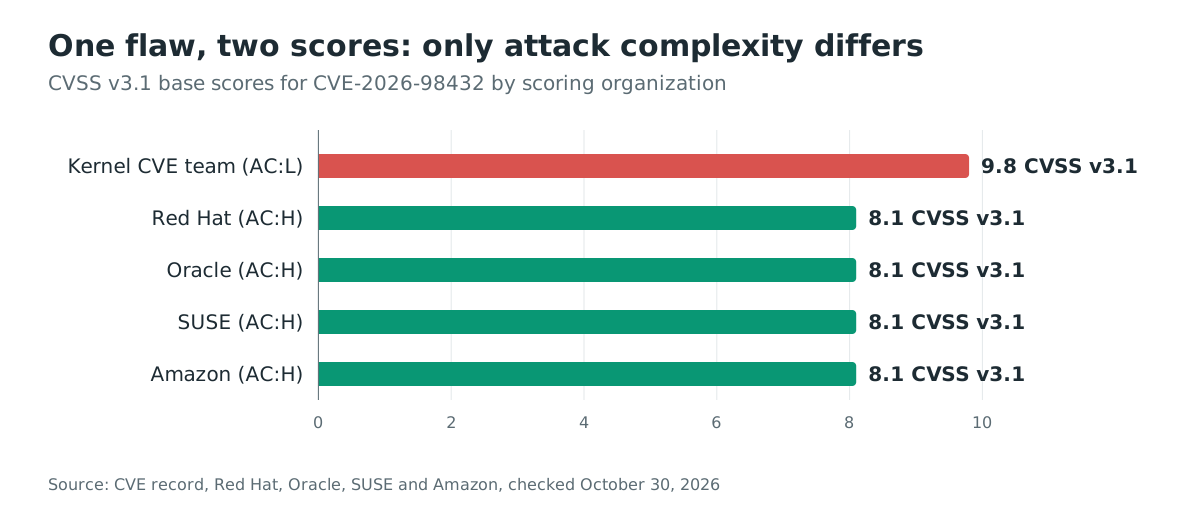
The kernel team's 9.8 score assumes network access, no privileges and no user interaction, with high impact on confidentiality, integrity and availability (CVSS:3.1/AV:N/AC:L/PR:N/UI:N/S:U/C:H/I:H/A:H). In that scenario the bug could send nearby kernel memory back to the attacker, corrupt kernel memory, or crash the system.
Anthropic demonstrated the strongest outcome: arbitrary commands as root, no credentials and no user interaction, on servers exposing an MPTCP listener. Its post does not name the kernel version or configuration tested, and does not say whether servers without an MPTCP listener can be taken over the same way.
Red Hat raised its rating to Critical, CVSS v3.1 9.8, on October 30, 2026. Its current vector is CVSS:3.1/AV:N/AC:L/PR:N/UI:N/S:U/C:H/I:H/A:H, matching the kernel CVE team's low attack complexity. Oracle, SUSE and Amazon's cited advisories rate attack complexity high and score the flaw 8.1. Red Hat's bulletin also publishes an interim packet-filter mitigation; a fixed kernel remains the complete remedy.
Why does the fix work?
The fix, commit e3f33b0a1d89d738e2b913dab519226eaf76e15b, replaces kfree() with kfree_rcu() in the two destructors, inet_sock_destruct() and tcp_v4_reqsk_destructor(). kfree_rcu() delays the reclaim until an RCU grace period passes, so every CPU that holds rcu_read_lock() around the options finishes reading them before the memory is freed. Readers already used RCU, and the other paths that replace inet_opt, such as do_ip_setsockopt(), already used kfree_rcu().
The two-line change is complete for both IPv4 paths named in the commit: the SYNACK race through inet_sock_destruct() and the migration race through tcp_v4_reqsk_destructor(). The commit itself flags one adjacent item it does not touch: the equivalent IPv6 destructor issue for CALIPSO-set options, which it says a separate patch will address.
How do I check if I was compromised?
No exploitation has been reported anywhere as of 2026-11-04, and no indicators or detection rules have been published. An exploitation attempt that loses the race only fails that connection attempt, so probing can leave little trace.
The mechanism implies what heavy probing would look like: many short-lived IPv4 connection attempts carrying Record Route or Timestamp options, followed by retransmitted requests to the same listening port. Treat that pattern as a lead to investigate, not as proof of compromise; no published source documents observed traffic of this shape.
Timeline
- 2016-01-10: Linux 4.4 ships. The Hacker News reports the flaw was introduced in this release, with the request-socket change that later removed the listener lock from the racing path.
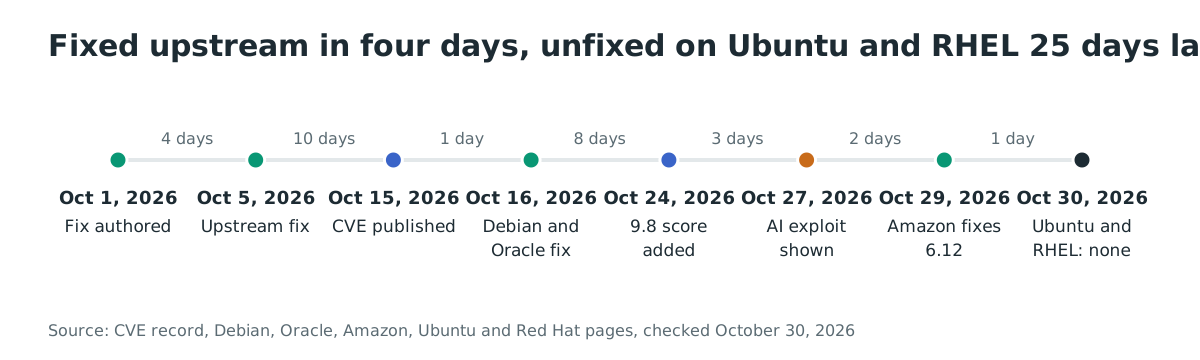
- 2026-10-01: Eric Dumazet authors the fix, "ipv4: free inet_opt and ireq_opt after an RCU grace period", reported by Xinyang Ge of Anthropic.
- 2026-10-05: Kernel developers apply the fix upstream, ten days before the CVE is published.
- 2026-10-11 to 2026-10-15: The fix is backported to the 5.10, 5.15, 6.1, 6.6, 6.12, 6.18 and 7.2 stable branches.
- 2026-10-15: The kernel CVE team publishes CVE-2026-98432.
- 2026-10-16: Debian trixie and Oracle Linux ship fixed kernels (DSA-6568-1; ELSA-2026-500397 to 500399).
- 2026-10-17 to 2026-10-22: Debian 12 bookworm receives fixed kernels in two advisories (DLA-4841-1, DLA-4850-1).
- 2026-10-24: The kernel CVE team adds the 9.8 score to the record, nine days after publishing the CVE. Amazon fixes its kernel6.18 package (ALAS2023-2026-3251).
- 2026-10-27: Anthropic publishes its post describing the AI-written exploit that reached root on MPTCP-listener servers.
- 2026-10-29: Amazon fixes its kernel6.12 package (ALAS2023-2026-3335). Red Hat's CVE page and advisory file move to Important, 8.1. SUSE releases fixed kernels for SLES 15 SP4 to SP6 LTSS and SLE Micro 5.3 to 5.5. The Hacker News publishes the distribution status table.
- 2026-10-30: AlmaLinux publishes fixed kernels for AlmaLinux 8, 9 and 10 in its testing repository, plus an nftables rule that blocks the packet trigger. Ubuntu and RHEL still list no fixed kernel.
- 2026-10-30: Red Hat raises its rating to Critical, 9.8, and publishes the packet-filter mitigation in RHSB-2026-016.
- 2026-10-31: Rui Sousa publishes the init_on_free=1 boot parameter on oss-security as additional hardening for systems without a fixed kernel.
- 2026-11-01: Ubuntu still lists no fixed kernel and gives no release date.
- 2026-11-01 to 2026-11-03: Red Hat releases fixed kernels for RHEL 8.4, 8.8, 8.10, 9.2, 9.4, 9.6, 9.8, 10.0, 10.2 and related product streams (RHSA-2026:93412 to 93415, 93775, 94109, 94303, 94438, 94477, 94508, 94558, 94623). Sultan Alsawaf of CIQ refutes init_on_free=1 as a mitigation on oss-security on November 3.
- 2026-11-02: Canonical publishes fixes for Ubuntu 22.04 LTS, 24.04 LTS and 26.04 LTS in the -proposed pocket, 28 days after the upstream fix.
- 2026-11-04: Red Hat's advisory file revision of this date lists 2,044 fixed kernel products across 13 errata, including every kernel-rt stream; only the OpenShift 4 and 5 RHEL CoreOS images remain known affected.
- 2026-11-10: Ubuntu publishes the fixed LTS kernels in its security notices, 36 days after the upstream fix.
FAQ
Does my Go service need the kernel fix even if it never calls MPTCP APIs?
Yes. Go 1.24 and later enable MPTCP by default for listen sockets on Linux, so a plain net.Listen already uses it without any MPTCP call in your code. Check the build with go version -m, and see "How do I fix it?" for the GODEBUG stopgap.
Are containers affected?
The flaw is in the host kernel, so a container does not escape exposure by packaging. Any IPv4 TCP service reachable from the attacker on an affected host, inside or outside a container, gives the attacker the network position the race needs. The fix is the host's kernel package.
Can attackers target IPv6 listeners too?
Not through the first path. The kernel copies the options for IPv6 connections, so the handshake race is IPv4-only. The fix commit notes an IPv6 request-migration issue for CALIPSO-set options that a separate patch will address.
Why do the kernel team and Red Hat say 9.8 while other vendors say 8.1?
The kernel team and Red Hat rate attack complexity low. The cited Oracle, SUSE and Amazon advisories rate it high, producing 8.1 instead of 9.8 with the same high confidentiality, integrity and availability impact. Red Hat raised its score on October 30, 2026; older comparisons showing 8.1 for Red Hat are out of date.
Is the flaw being exploited in the wild?
No source reports attacks as of 2026-11-04. The flaw is not in CISA's KEV catalog, checked against the catalog's JSON feed on that date. Anthropic's exploit and its test remain the only demonstrated execution.
I cannot reboot this month. What is my best move?
Until you can reboot into a fixed kernel, use the Go team's MPTCP stopgap for Go 1.24 or later services and the packet filter in "How do I fix it?", knowing their limits. Restart the affected Go services for the environment change to take effect. Keep exposed IPv4 services behind strict network access lists and follow your vendor's advisories. The init_on_free=1 boot parameter does not mitigate this flaw and is not part of the stopgaps.
Find the Linux hosts you need to patch first with Ostorlab
Ostorlab's attack surface discovery inventories your internet-facing hosts and the services they expose, so you can list the Linux servers that carry reachable IPv4 TCP listeners and check their kernels first.
References
- CVE-2026-98432 record, kernel.org CNA, published 2026-10-15, updated 2026-10-30, CVSS v3.1 9.8 and the stable backport commits: https://cveawg.mitre.org/api/cve/CVE-2026-98432 (checked October 30, 2026)
- Fix commit e3f33b0a1d89d738e2b913dab519226eaf76e15b, "ipv4: free inet_opt and ireq_opt after an RCU grace period", Eric Dumazet, 2026-10-01: https://git.kernel.org/pub/scm/linux/kernel/git/torvalds/linux.git/commit/?id=e3f33b0a1d89d738e2b913dab519226eaf76e15b (checked October 30, 2026)
- Anthropic, "Discovering and exploiting vulnerabilities in critical, real-world software with Claude", October 27, 2026, chapter 5: https://www.anthropic.com/research/discovering-vulnerabilities-with-claude (checked October 30, 2026)
- The Hacker News, "Linux Kernel TCP Flaw With 9.8 CVSS Score Affects Ubuntu, Red Hat and Other Distributions", October 29, 2026, the distribution status table and the scoring rationale: https://thehackernews.com/2026/10/linux-kernel-tcp-flaw-with-98-cvss.html (checked October 30, 2026)
- Go security team, "[security] Protecting against CVE-2026-98432", golang-announce, October 29, 2026: https://groups.google.com/d/msgid/golang-announce/0c2926bc-e90f-4cdb-97c3-300fff6d8885n%40googlegroups.com (checked October 30, 2026)
- The same Go guidance forwarded to oss-security, October 29, 2026: https://www.openwall.com/lists/oss-security/2026/10/30/1 (checked October 30, 2026)
- Ubuntu CVE-2026-98432 page, now listing the 22.04, 24.04 and 26.04 LTS kernels as fixed (page updated November 13, 2026): https://ubuntu.com/security/CVE-2026-98432 (checked November 13, 2026)
- Ubuntu security notice USN-9018-1 for the 26.04 kernel, published November 10, 2026, with the related LTS notices: https://usn.ubuntu.com/USN-9018-1 (checked November 13, 2026)
- Canonical, "Fixes available in -proposed pocket for CVE-2026-98432", Luci Stanescu, November 2, 2026, the per-release fix table, the pocket-enable commands and the 2,000 certified servers and devices statement: https://ubuntu.com/blog/fixes-available-in-proposed-pocket-for-cve-2026-98432 (checked November 3, 2026)
- Debian DSA-6568-1, linux 6.12.113-1, October 16, 2026: https://lists.debian.org/debian-security-announce/2026/msg00482.html (checked October 30, 2026)
- Oracle Linux CVE-2026-98432 errata page, ELSA-2026-500397 to 500399, released 2026-10-16: https://linux.oracle.com/cve/CVE-2026-98432.html (checked October 30, 2026)
- Amazon Linux 2023 advisory ALAS2023-2026-3251, kernel6.18-6.18.56-125.164, released 2026-10-24: https://alas.aws.amazon.com/AL2023/ALAS2023-2026-3251.html (checked October 30, 2026)
- Amazon Linux 2023 advisory ALAS2023-2026-3335, kernel6.12-6.12.113-138.209, released 2026-10-29: https://alas.aws.amazon.com/AL2023/ALAS2023-2026-3335.html (checked October 30, 2026)
- SUSE CVE-2026-98432 page, Important 8.1, per-package fix status: https://www.suse.com/security/cve/CVE-2026-98432.html (checked October 30, 2026)
- NVD entry for CVE-2026-98432, showing the kernel team's 9.8 score: https://nvd.nist.gov/vuln/detail/CVE-2026-98432 (checked October 30, 2026)
- Kernel CVE team's published record for CVE-2026-98432, recommending the latest stable kernel: https://kernel.googlesource.com/pub/scm/linux/security/vulns/+/refs/heads/master/cve/published/2026/CVE-2026-98432.mbox (checked October 30, 2026)
- Kernel documentation on Multipath TCP: https://docs.kernel.org/networking/mptcp.html (checked October 30, 2026)
- Go issue tracking the discussion, go.dev/issue/82717: https://go.dev/issue/82717 (checked October 30, 2026)
- CISA Known Exploited Vulnerabilities catalog JSON feed, checked for CVE-2026-98432 on November 4, 2026 (not listed): https://www.cisa.gov/sites/default/files/feeds/known_exploited_vulnerabilities.json (checked November 4, 2026)
- AlmaLinux, "CVE-2026-98432: Patched kernels available in testing", October 30, 2026, the testing-repository kernels for AlmaLinux 8, 9 and 10 and the nftables mitigation with its limits: https://almalinux.org/blog/2026-10-30-cve-2026-98432/ (checked November 1, 2026)
- Rui Sousa, "CVE-2026-98432: init_on_free=1 as an additional interim mitigation", oss-security, October 31, 2026: https://www.openwall.com/lists/oss-security/2026/10/31/5 (checked November 1, 2026)
- Sultan Alsawaf, CIQ, "Re: CVE-2026-98432: init_on_free=1 as an additional interim mitigation", oss-security, November 3, 2026, the refutation of init_on_free=1 as a mitigation: https://www.openwall.com/lists/oss-security/2026/11/03/1 (checked November 3, 2026)
- Red Hat CSAF advisory file for CVE-2026-98432, revision 3 of November 4, 2026, 05:07 UTC, with 2,044 fixed kernel products across 13 errata (RHSA-2026:93412 to 93415, 93775, 94109, 94303, 94438, 94477, 94508, 94558, 94623, 94996), every kernel-rt stream fixed, and the OpenShift 4 and 5 RHEL CoreOS images still known affected: https://security.access.redhat.com/data/csaf/v2/vex/2026/cve-2026-98432.json (checked November 4, 2026)
- Red Hat errata RHSA-2026:94438 (RHEL 9.6 kernel and kernel-rt), RHSA-2026:94558 (RHEL 9.2 kernel-rt) and RHSA-2026:94996 (RHEL 8.6 kernel), all issued November 3 to 4, 2026: https://access.redhat.com/errata/RHSA-2026:94438, https://access.redhat.com/errata/RHSA-2026:94558, https://access.redhat.com/errata/RHSA-2026:94996 (checked November 4, 2026)
- Red Hat errata RHSA-2026:93412, kernel-5.14.0-687.64.1.el9_8, issued November 1, 2026: https://access.redhat.com/errata/RHSA-2026:93412 (checked November 3, 2026)
- Red Hat errata RHSA-2026:93413, kernel-6.12.0-211.72.1.el10_2, issued November 1, 2026: https://access.redhat.com/errata/RHSA-2026:93413 (checked November 3, 2026)
- Red Hat errata RHSA-2026:93414, kernel-4.18.0-553.182.1.el8_10, issued November 1, 2026: https://access.redhat.com/errata/RHSA-2026:93414 (checked November 3, 2026)
- Red Hat current CVE rating and mitigation; checked November 3, 2026: https://access.redhat.com/security/cve/cve-2026-98432
- Red Hat packet-filter mitigation, RHSB-2026-016; checked November 3, 2026: https://access.redhat.com/security/vulnerabilities/RHSB-2026-016
- AWS bulletin, fixed Amazon Linux 2 and 2023 packages, updated October 31; checked November 1, 2026: https://aws.amazon.com/security/security-bulletins/2026-160-aws/