
Inside Ostorlab’s Open-Source RASP for Mobile Apps
A mobile app can run in a hostile environment even when its binary is intact. Ostorlab’s open-source RASP lets teams inspect the Android and iOS runtime behind Mobile ADR and see what it reports after an app ships.
Imagine a customer opening their banking app, logging in and checking their balance. The login looks normal to the customer and to the bank. But the app is running inside another app, where malware can observe what the customer does. That is the pattern behind FjordPhantom, an Android banking trojan that ran genuine banking apps inside a virtual environment. In 2023, Promon reported that one customer lost about $280,000.
The bank’s own app could be part of the attack without anyone changing its original code. That makes the environment around a running app as important to inspect as the file you shipped.
Your App Leaves Your Hands the Day You Ship It
Anyone can download an APK or IPA and examine how it works. AI assistants can now help make sense of decompiled code. OWASP’s Mobile Top 10 calls out this exposure in M7, Insufficient Binary Protections, which covers reverse engineering and tampering.
Some attackers distribute modified apps. In 2022, Kaspersky found Triada in a WhatsApp mod called YoWhatsApp and reported more than 3,600 users targeted in two months. In 2023, ESET found trojanized copies of Telegram and WhatsApp that swapped cryptocurrency wallet addresses in chats. And in 2024, Group-IB reported that GoldPickaxe for iOS collected face scans and identity documents that could be used in fraud.
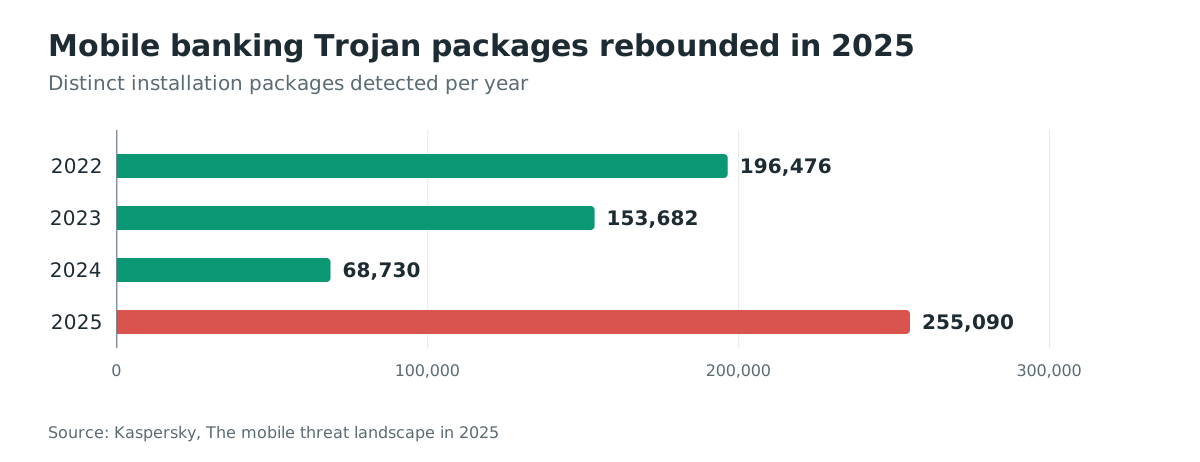
The supply of Android banking malware can change quickly. In its 2025 mobile threat report, Kaspersky recorded 255,090 distinct mobile banking Trojan installation packages in 2025, up from 68,730 in 2024. Each count represents distinct malicious packages detected by Kaspersky.
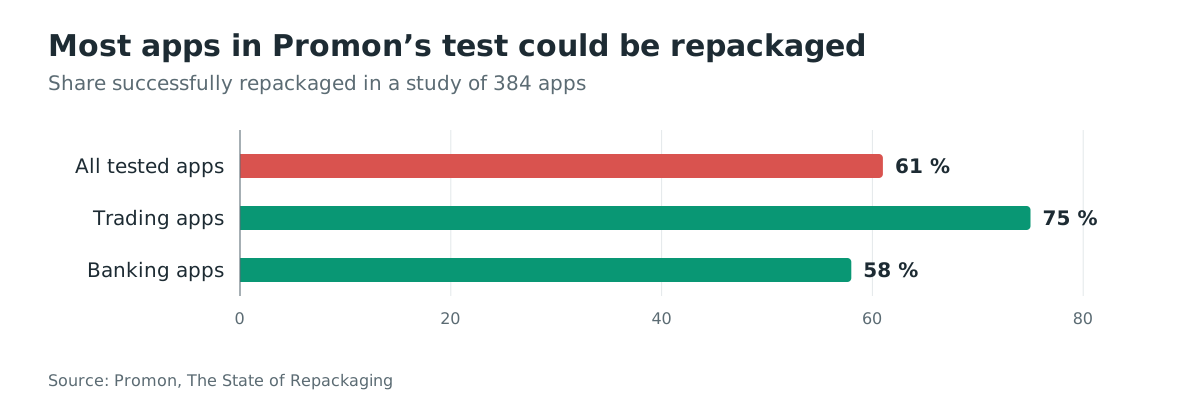
How often will a modified app still run? In a study of 384 financial-services apps across eight markets, Promon successfully repackaged 61% of the sample. The rate was 75% among trading apps and 58% among banking apps.
FjordPhantom illustrates another problem. A genuine binary can end up in an unexpected runtime environment. Ordinary API requests give the backend limited visibility into what is happening on the phone.
For strong customer authentication on multipurpose devices, Article 9 of the EU’s PSD2 regulatory technical standards calls for measures that include checking whether software or the device has been altered. Signals collected inside the running app can give the bank more context about the session.
What RASP Sees From Inside Your App
RASP (runtime application self-protection) is security code that runs inside the app and observes its environment. The runtime behind Mobile ADR checks for signals such as root or jailbreak, emulation, debuggers, hooking tools, VPNs and proxies. It also looks at app identity and signing information. On Android, it can check the integrity of its own code in memory.
Mobile ADR adds that runtime to an APK, AAB or IPA you already build, without requiring application source code or an SDK integration. The runtime reports what it sees from individual installs, and Mobile ADR groups the results by app and build so your team can investigate them.
Adding protection puts third-party code inside your app on your users’ phones. That code runs with the app’s permissions. Your team should be able to inspect it before it ships.
Why We Published the Code
The runtime is available on GitHub under Apache-2.0. Security teams can read the checks, build the runtime and use that work in supplier due diligence, including reviews under DORA. The repository’s TODO.md documents known limitations.
A shipped app already carries its runtime code onto every device. Publishing the source lets defenders inspect it directly and assess the design, including how the runtime collects multiple observations and repeats checks while the app is active. Teams can use the reported observations alongside other signals when deciding how to respond.
We use AI-assisted testing as one way to evaluate runtime defenses during development. Our work on Mobile Shielding Scan also showed us why visibility after detection matters. A team needs to learn what happened on the device in time to investigate it. The RASP runtime follows OXO, our open-source security scanning orchestrator, which has been public since 2021.
Try It
The runtime is free. Clone it, read it and try it with a test app.
git clone https://github.com/Ostorlab/rasp
The README has the build steps, and SECURITY.md explains how to report a vulnerability. Issues and pull requests are welcome.
For teams that want a managed workflow, Mobile ADR packages the runtime into the APK, AAB or IPA you upload and gives you one place to investigate what each protected install reports.