Mitel MiCollab AWV Command Injection Exploited (CVE-2026-133323)
CISA added five Mitel MiCollab AWV flaws to KEV after active exploitation, led by an unauthenticated 10.0 command injection fixed by a 10.3.0.18 patch.
TL;DR
- CISA added five Mitel MiCollab flaws in the Audio, Web and Video Conferencing component to its Known Exploited Vulnerabilities catalog on 2026-11-25. The lead flaw is an unauthenticated command injection rated CVSS v3.1 10.0.
- MiCollab 10.3 (10.3.0.18) and earlier are affected. Mitel shipped a patch for 10.3.0.18; upgrading to that release without the patch leaves the flaws in place.
- Mitel says the five can be combined to amplify their impact. CISA's federal due dates are 2026-11-28 for four of them and 2026-12-09 for CVE-2026-133311.
- Apply the 10.3.0.18 patch or move to a later release, then restrict external access to the AWV component. No source code or patch diff is public.
Am I affected?
You are exposed when a Mitel MiCollab server at 10.3 (10.3.0.18) or earlier exposes the Audio, Web and Video Conferencing component to a network the attacker can reach.
All of these conditions must hold:
- You run MiCollab 10.3 (10.3.0.18) or an earlier release. Later releases include the fixes.
- The AWV component is enabled and reachable. Mitel's mitigation is to restrict external access to AWV, which confirms that the flaws sit in that component.
- The server has not received the patch Mitel published for 10.3.0.18. The advisory lists 10.3.0.18 as affected and offers a patch on top of it.
| Product | Affected versions | Fixed versions |
|---|---|---|
| MiCollab | 10.3 (10.3.0.18) and earlier | 10.3.0.18 with patch KB000129195, or a later release |
The five CVEs are not one flaw:
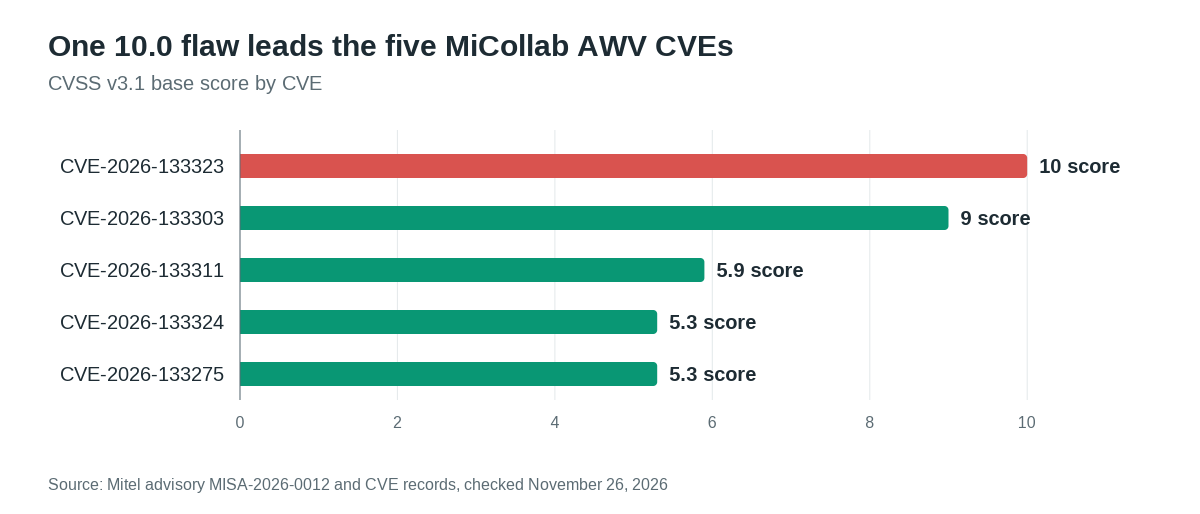
- CVE-2026-133323: unauthenticated blind command injection, CVSS v3.1 10.0.
- CVE-2026-133303: unauthenticated XML injection, CVSS 9.0; needs pre-staged content.
- CVE-2026-133275: unauthenticated arbitrary file upload, CVSS 5.3.
- CVE-2026-133324: unauthenticated authentication bypass, CVSS 5.3.
- CVE-2026-133311: weak authentication, CVSS 5.9; needs a system-generated identifier or pre-staged content.
MiCollab is an enterprise communications and collaboration platform. A researcher counted more than 20,000 internet-exposed MiCollab instances with Shodan in June 2025. That count is not a count of vulnerable servers, but it shows why an unauthenticated flaw in this product is reachable at scale. MiCollab has been exploited before: CISA added CVE-2024-41713 and CVE-2024-55550, two path traversal flaws, to KEV on 2025-01-07 and records known ransomware use for both.
MiCollab does not expose a supported shell command for its version. Read the MiCollab version in the administrator interface, and confirm whether the AWV component is installed and enabled. To confirm that the server answers from a given network, request its landing page:
curl -k -s -o /dev/null -w '%{http_code}\n' https://<micollab-address>/
A 200 or a redirect means the server answered. A timeout or a connection refusal means the network path is closed from where you ran the command. The -k flag tells curl to skip TLS certificate verification: this check is about reachability, not the server's identity.
How do I fix it?
Apply the patch Mitel published for 10.3 (10.3.0.18), or upgrade to a later MiCollab release that includes it.
- Open Mitel Knowledge Base article KB000129195, "MiCollab Security Update, MTLVULN-1861, MTLVULN-1862, MTLVULN-1863, MTLVULN-1864, MTLVULN-1877". Access may require a Mitel partner account.
- Apply the patch to a MiCollab 10.3.0.18 server. The advisory says a patch is available for that release, not that 10.3.0.18 is fixed by itself.
- If you are on an earlier release, upgrade to 10.3.0.18 and apply the patch, or move to a later release.
- Restart the services the patch requires, following the knowledge base article.
- Confirm the installed release and patch level in the administrator interface.
If you cannot patch immediately, restrict external access to the AWV component. Mitel names this as the mitigation. It removes the attacker's network path, but it does not fix the code, and it does not help against an attacker who is already inside the network.
What is the root cause?
The five flaws sit in the Audio, Web and Video Conferencing component, the part of MiCollab that handles web and video conferences. Mitel describes each one as a missing validation or authentication check:
- CVE-2026-133323 is a blind command injection caused by insufficient parameter sanitization.
- CVE-2026-133303 is an XML injection caused by insufficient parameter validation. It needs malicious content to be staged first.
- CVE-2026-133275 is an arbitrary file upload caused by insufficient file type validation.
- CVE-2026-133324 is an authentication bypass caused by improper handling of authentication.
- CVE-2026-133311 is a weak authentication issue where a system-generated identifier or pre-staged content is enough to reach data.
Mitel does not publish the vulnerable code or a patch diff. The advisory gives the component and the flaw class, not the function or the parameter. That is the limit of the public record: an attacker's exact request is not documented, and the vendor's descriptions are the only source for the mechanism.
The chain matters more than any single score. An authentication bypass or a weak authentication path can expose a file upload or an XML handler. Those handlers accept attacker-controlled content. The command injection then turns that content into commands in the context of the MiCollab system. Mitel states that exploiting the flaws together "can significantly amplify their impact".
How is it exploited?
An unauthenticated attacker who can reach the AWV component can use the authentication flaws to reach the content handlers, then use the command injection to run commands. The public record does not include a request sequence.
- The attacker reaches the AWV component on an exposed MiCollab server.
- For CVE-2026-133324 or CVE-2026-133311, the attacker bypasses or weakens authentication and reaches functionality that should require a session.
- For CVE-2026-133275, the attacker uploads a file that the component should reject. For CVE-2026-133303, the attacker supplies XML content that is later processed with insufficient validation.
- For CVE-2026-133323, the attacker supplies a parameter that reaches a system command without sanitization. Mitel calls the injection blind, so the attacker does not see the command output directly.
- The commands run in the context of the MiCollab system. Mitel describes potential impacts on confidentiality, integrity and availability.
CISA's SSVC assessment marks exploitation as active and automatable for CVE-2026-133323, CVE-2026-133275 and CVE-2026-133324. The other two are marked active but not automatable. The assessment does not name a campaign or a victim.
How does the attack flow?
The chain reaches the AWV component without a session. It uses an authentication or upload weakness to reach a command construction path, then runs commands in the MiCollab system.
What can an attacker do?
An unauthenticated attacker can run commands in the context of the MiCollab system through CVE-2026-133323, upload files through CVE-2026-133275, and inject XML through CVE-2026-133303. CVE-2026-133324 and CVE-2026-133311 let the attacker bypass or weaken authentication and reach data or actions that should require a session.
The conditions are listed in full here. The attacker must reach the AWV component. The server must be at 10.3.0.18 or earlier and lack the patch. CVE-2026-133303 and CVE-2026-133311 also need pre-staged content or a system-generated identifier, which raises the bar for those two. CVE-2026-133323, CVE-2026-133275 and CVE-2026-133324 need no credential.
Mitel does not say the commands run as root, so this post does not claim root. The advisory says "within the context of the system" and describes potential impacts to confidentiality, integrity and availability. A compromised MiCollab server can expose the communications metadata and user data it holds, and it can disrupt collaboration services.
Why does the fix work?
The 10.3.0.18 patch closes the five paths Mitel describes. It adds the missing parameter sanitization, file type validation and authentication checks in the AWV component, and later releases include the same changes.
Mitel does not publish the code changes, so the completeness of the patch cannot be checked against a diff. The vendor's statement that the patch addresses MTLVULN-1861 through MTLVULN-1864 and MTLVULN-1877 is the public basis for the fix. The mitigation works on the network path instead: restricting external access to AWV removes reachability, but it leaves the code unchanged.
How do I check if I was compromised?
No public indicator of compromise list is published for these five CVEs. The advisory names no log signature, file path or command, and CISA's KEV records do not add technical indicators. An attempt that failed may leave no trace.
Review the AWV component's access logs for requests that reached authentication, upload or XML handlers from unexpected sources. Correlate them with new administrator sessions, new files, service restarts, and configuration changes. Review the MiCollab administrator accounts and sessions for activity you cannot explain.
CISA's KEV entry asks federal agencies to apply forensics triage. For other operators, the practical step is to preserve logs before patching, then compare the server's configuration and accounts with a known-good baseline. If you find evidence of command execution, treat the server as compromised and rebuild it from a trusted image after rotating its credentials.
Timeline
- 2026-11-16: Mitel publishes MISA-2026-0012 revision 1.0 with the five AWV vulnerabilities.
- 2026-11-19: the five CVE records are published.
- 2026-11-24: Mitel publishes revision 2.0 of the advisory and updates the CVE numbers.
- 2026-11-25: CISA adds all five CVEs to KEV.
FAQ
Is MiCollab 10.3.0.18 itself fixed?
No. Mitel lists 10.3 (10.3.0.18) and earlier as affected and provides a patch for 10.3.0.18. You must apply the patch or move to a later release. A server that reports 10.3.0.18 without the patch is still exposed.
Which component is affected?
The Audio, Web and Video Conferencing component, usually called AWV. Mitel's mitigation is to restrict external access to that component, and the advisory names it for all five CVEs.
Did Mitel say the flaws were exploited?
Mitel's advisory describes the flaws and the fix, not an exploitation campaign. CISA's KEV listing states active exploitation, and its SSVC assessment marks the flaws as actively exploited. The public record does not name a campaign, a victim or an initial-access vector.
Are all five flaws equally urgent?
No. CVE-2026-133323 is 10.0 Critical and CVE-2026-133303 is 9.0 Critical; the other three are Medium. CISA listed all five because it assesses exploitation as active, and the vendor says the flaws can be chained. Patch the whole set rather than only the two Criticals.
Can I just block AWV at the firewall?
Blocking external access to AWV removes the attacker's path from the internet and is the mitigation Mitel recommends. It does not repair the component, and it does not protect against an attacker who is already inside the network. Patch as soon as the change window allows.
References
- Mitel advisory MISA-2026-0012: https://www.mitel.com/support/security-advisories/mitel-product-security-advisory-misa-2026-0012 (checked November 26, 2026)
- CVE-2026-133323 record: https://www.cve.org/CVERecord?id=CVE-2026-133323 (checked November 26, 2026)
- CVE-2026-133303 record: https://www.cve.org/CVERecord?id=CVE-2026-133303 (checked November 26, 2026)
- CVE-2026-133275 record: https://www.cve.org/CVERecord?id=CVE-2026-133275 (checked November 26, 2026)
- CVE-2026-133324 record: https://www.cve.org/CVERecord?id=CVE-2026-133324 (checked November 26, 2026)
- CVE-2026-133311 record: https://www.cve.org/CVERecord?id=CVE-2026-133311 (checked November 26, 2026)
- CISA Known Exploited Vulnerabilities catalog: https://www.cisa.gov/known-exploited-vulnerabilities-catalog (checked November 26, 2026)
- SecurityWeek, "Critical Vulnerability Exposes Many Mitel MiCollab Instances to Remote Hacking": https://www.securityweek.com/critical-vulnerability-exposes-many-mitel-micollab-instances-to-remote-hacking/ (checked November 26, 2026)
Keep reading