Danfoss AK-SM 800A Auth Bypass Exploited (CVE-2025-41450)
CISA added three Danfoss AK-SM 800A flaws, including a hidden code-of-the-day login bypass, to KEV after active exploitation; 4.3.1 fixes them.
TL;DR
- CISA added three Danfoss AK-SM 800A flaws to its Known Exploited Vulnerabilities catalog on 2026-11-25. One is a hidden login bypass that derives a valid administrator password from the controller's date.
- AK-SM 800A controllers earlier than firmware 3.3, 4.2 or 4.3.1 are affected, depending on the flaw. Firmware 5.4.0 still lacks the fix for a fourth, unauthenticated stack overflow.
- The CVE record rates the login bypass CVE-2025-41450 at CVSS v3.1 8.2 High; the command-execution companion CVE-2023-25915 is 9.9 Critical. The federal due dates are 2026-11-28 and 2026-12-09.
- Update to firmware 4.3.1 or later, take the controller off the internet, and enable Strict Mode. The older AK-SM 800 and AK-SC 355 are end-of-life and need replacement.
Am I affected?
You are exposed when a Danfoss AK-SM 8xxA refrigeration controller runs firmware earlier than the fixed version for a flaw in this post. The controller's web management interface must also be reachable by the attacker.
All of these conditions must hold for the network-reachable flaws:
- You operate an AK-SM 800A or another AK-SM 8xxA controller that manages refrigeration equipment.
- The controller's web interface answers on a network the attacker can reach. Team82 found 2,765 AK-SM 800A controllers exposed on the public internet through Censys.
- The firmware is older than the fixed release for the flaw. CVE-2023-25914 and CVE-2023-25915 are fixed in 3.3, CVE-2025-41450 in 4.2, and CVE-2025-41451 and CVE-2025-41452 in 4.3.1.
- For CVE-2023-25914 and CVE-2023-25915, the attacker also needs a valid session. Their CVSS vectors require low privileges. CVE-2025-41450 and CVE-2026-129713 need no login.
| Flaw | Affected firmware | Fixed firmware |
|---|---|---|
| CVE-2023-25914, CVE-2023-25915 | Earlier than 3.3 | 3.3 |
| CVE-2025-41450 | Earlier than 4.2 | 4.2 |
| CVE-2025-41451, CVE-2025-41452 | Earlier than 4.3.1 | 4.3.1 |
| CVE-2026-129713 | 5.4.0 and earlier | 5.5.x, not released |
The AK-SM 800 without the A suffix and the AK-SC 355 are a separate, older generation. Danfoss told Agence France-Presse that most of the units reached in the October 2026 French supermarket attack were older models it no longer updates.
Danfoss declared the AK-SM 800 end-of-life in May 2021 and phased out the AK-SC 355 in 2016. CERT-FR, the French government's computer emergency response team, tells operators to disconnect those controllers or filter access to them.
There is no supported shell command that prints the controller firmware. Open the web interface and read the software version on the About or System page. The model name is printed on the unit label. To confirm that the interface is reachable from a given network, request its landing page:
curl -k -s -o /dev/null -w '%{http_code}\n' https://<controller-address>/
A 200 or a redirect means the interface answered. A timeout or a connection refusal means the network path is closed from where you ran the command.
How do I fix it?
Install Danfoss software 4.3.1 or later, which carries the fixes for every flaw in this post except CVE-2026-129713, then remove the controller from the public internet.
- Download the current AK-SM 800A software package from the Danfoss AK-SM 800A download page.
- Install 4.3.1 or later. Danfoss shipped 4.3.1 to fix the three Team82 findings, and the release also carries the earlier 3.3 and 4.2 fixes.
- Confirm the new version in the web interface against the affected-version table in "Am I affected?".
- Treat CVE-2026-129713 separately. Danfoss says a 5.5.x release will address it. No fixed release was available on 2026-11-26.
- Replace an end-of-life AK-SM 800 or AK-SC 355. No firmware update will fix those models.
If you cannot update or replace the controller, apply these mitigations in order:
- Remove the controller's internet exposure and put it on a management network behind a VPN. CERT-FR calls this the first action for every affected unit.
- If a refrigeration contractor needs remote access, allow only its source addresses at the firewall. CERT-FR calls this a temporary measure, not a permanent control.
- Enable Strict Mode on the controller. The CISA advisory recommends it while the CVE-2026-129713 fix is pending.
- Change every default password and use unique credentials.
- Review the defrost schedule and temperature setpoints after any suspected access. An attacker who reaches the controller can change them.
Strict Mode reduces the attack surface but does not remove the code-of-the-day path. The network controls stop an internet attacker, but they do not fix a controller that is already compromised.
What is the root cause?
The root cause is a set of trust decisions inside the controller's HTTP handlers. For CVE-2025-41450, two undocumented request attributes send the xml.cgi login check to a hidden check_code_of_day function, which accepts a password derived from the device's date and time.
The AK-SM 800A exposes a multi-layer web service: an internet-facing nginx proxy forwards .cgi requests to sm_fcgi_app, which forwards XML requests to an internal nginx instance and the Task_Web handler. Team82 reverse-engineered the firmware and traced each flaw from an HTTP handler to the code that makes the trust decision.
CVE-2025-41450 is a hidden authentication path in the xml.cgi handler. A request with action="getauth" normally checks the supplied password against the stored user account. Two undocumented request attributes redirect that flow to a function named check_code_of_day.
Instead of comparing the configured password, the function computes a password from the device's current date and time and compares the request value against it. Team82 reconstructed the generation algorithm. An attacker who reproduces it can authenticate as an administrator for that day without knowing the real password.
CVE-2025-41451 is a command injection in the SMTP email configuration. The web application takes the value stored at item 0x1be1, the email authentication password, and formats it into an operating-system shell command without sanitizing it. A logged-in administrator can put shell directives in that field and run commands on the controller.
CVE-2025-41452 lets an authenticated user replace the headers.conf file included by the external nginx instance, which can inject routing directives and crash the web service.
The 2023 pair has the same shape at a lower level. CVE-2023-25914 is a path traversal through the XML interface that lets an authenticated attacker read files from the underlying server. CVE-2023-25915 is improper input validation that lets an authenticated attacker run arbitrary commands.
CVE-2026-129713, disclosed separately, is a stack-based buffer overflow in an unauthenticated CGI handler. A crafted HTTP or HTTPS POST overflows a stack buffer, restarts the web server, and may allow code execution with web server privileges.
Danfoss does not publish the controller source code, so none of these code paths can be read directly. Team82's firmware analysis is the public source for CVE-2025-41450, CVE-2025-41451 and CVE-2025-41452. The CISA advisory describes CVE-2026-129713 at the CWE-121 level.
How is it exploited?
An attacker who can reach the web interface can turn a single request into an administrator session, and then into commands on the refrigeration controller.
- The attacker finds an exposed AK-SM 800A management interface. Team82 used Shodan and Censys to locate them; many of these interfaces identify themselves as Danfoss StoreView.
- For CVE-2025-41450, the attacker sends
action="getauth"with the two hidden attributes set to1and a password computed from the device date. The handler accepts it as a valid administrator login. - With a session, the attacker reaches the email configuration page. The email authentication password field is passed to a shell command, so a value such as a command substitution runs on the controller (CVE-2025-41451).
- On firmware earlier than 3.3, an authenticated attacker can instead read files through the XML interface (CVE-2023-25914) or run commands through the input-validation flaw (CVE-2023-25915).
- On firmware up to 5.4.0, an unauthenticated attacker can send a crafted POST to the CGI handler and overflow the stack (CVE-2026-129713). CISA describes the demonstrated impact as memory corruption and a web server restart, with hypothetical code execution.
The October 2026 French campaign shows the operational consequence. Attackers changed refrigeration settings across hundreds of supermarkets and raised temperatures to as much as 50°C, according to Les Mousquetaires and the other retailers that reported the incident.
How does the attack flow?
The chain starts with an internet-reachable management page. It uses the hidden code-of-the-day login to obtain an administrator session, then reaches a shell through the email configuration field. On older firmware, the 2023 flaws provide file read and command execution instead.
What can an attacker do?
An unauthenticated attacker can obtain an administrator session through CVE-2025-41450, or crash the web service through CVE-2026-129713. An authenticated attacker can read files, run commands as the web server, and change refrigeration settings through CVE-2023-25914, CVE-2023-25915, CVE-2025-41451 and CVE-2025-41452.
The impact depends on conditions this post lists in full. The attacker must reach the management interface. For the 2023 pair, the attacker must hold a valid session. For CVE-2025-41451 and CVE-2025-41452, the attacker must be logged in as an administrator. For CVE-2025-41450, no credential is needed beyond the computed daily code.
The demonstrated impact is control of the refrigeration controller, not root on the device. Danfoss and Team82 describe commands in the web server's context. The French incident shows what that control means in a store. Attackers changed setpoints, defrost cycles and temperatures, and Les Mousquetaires estimated food losses in the tens of millions of euros across France.
Why does the fix work?
Danfoss fixed the flaws release by release, ending with the email and nginx issues in 4.3.1. Each release removes the specific path the researchers reported, and the vendor states that later releases carry the earlier fixes.
Danfoss does not publish a patch diff for its controller firmware. The completeness of the fix therefore rests on the vendor's release note and on Team82's confirmation that 4.3.1 addresses the three findings it reported. The code-of-the-day path is gone in the fixed release, and the email password field no longer reaches the shell unsanitized.
CVE-2026-129713 is not fixed by 4.3.1. Danfoss says 5.5.x will address it, and that release was not available on 2026-11-26. Until it ships, the CISA advisory's mitigations are the only controls for that flaw.
How do I check if I was compromised?
CERT-FR's incident guidance is the most concrete public check. Remove the controller from the internet, then compare its current configuration with the known-good configuration, especially the defrost ranges and temperature setpoints. If the controller was reached, CERT-FR says to restart it or restore it to factory settings, then reconfigure it before returning it to service.
No public indicator of compromise list is published for the KEV-listed flaws. No public request pattern is available for Danfoss, and the vendor has not published log signatures. An attempt that failed may leave no trace on the controller.
Where a reverse proxy or firewall logs the management interface, search for requests to the authentication and configuration handlers:
grep -Ei 'xml\.cgi.*(getauth|load_nginx_headers)' access.log
grep -Ei 'POST .*(\.cgi|headers\.conf)' access.log
A match is a lead, not proof. Legitimate administrators and maintenance tools also call those handlers. Correlate a match with a configuration change, a reboot, or an unexpected session.
Timeline
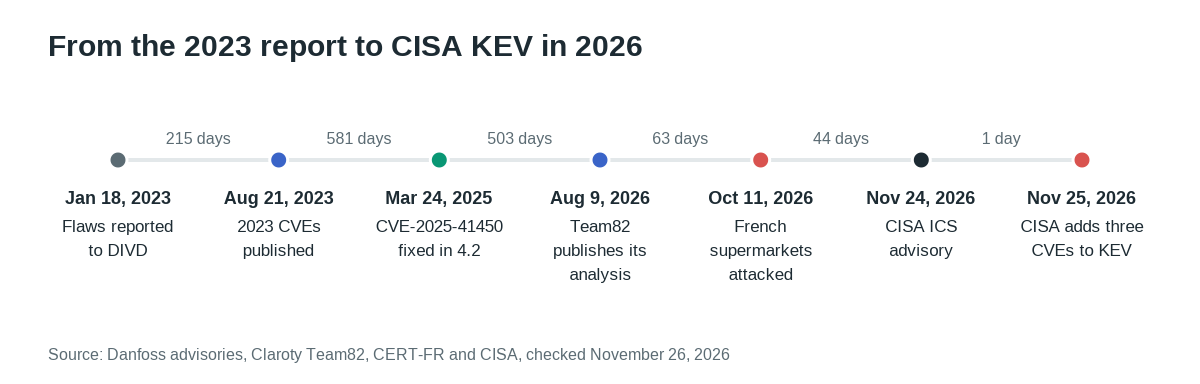
- 2023-01-18: HackDefense researchers report the AK-SM 800A flaws to DIVD, which starts the coordination.
- 2023-08-17: DIVD publishes a limited disclosure of the 2023 flaws.
- 2023-08-21: CVE-2023-25913, CVE-2023-25914 and CVE-2023-25915 are published.
- 2025-03-24: Danfoss publishes DSA-2025-03-01 for the authentication bypass CVE-2025-41450, fixed in 4.2.
- 2025-08-22: CVE-2025-41451 and CVE-2025-41452 are published for the 4.3.1 fixes.
- 2026-08-09: Team82 publishes its reverse-engineering analysis and the 2,765-device exposure count.
- 2026-10-11: attackers change refrigeration settings at hundreds of French supermarkets.
- 2026-10-12: CERT-FR publishes alert CERTFR-2026-ALE-012 and tells operators to disconnect or filter the controllers.
- 2026-11-20: CVE-2026-129713 is published for the unauthenticated stack overflow.
- 2026-11-24: CISA publishes ICS advisory ICSA-26-328-03 for CVE-2026-129713.
- 2026-11-25: CISA adds CVE-2023-25914, CVE-2023-25915 and CVE-2025-41450 to KEV.
FAQ
Does the KEV listing mean the French attack used these three CVEs?
No source ties the KEV listing to the French campaign. CISA added the three CVEs on 2026-11-25 and its records do not name a campaign or a victim.
CERT-FR's alert lists the Danfoss AK-SM and AK-SC series alongside Copeland and Dixell controllers, and Danfoss said most of the units reached were older models. Treat the KEV listing as independent evidence that the flaws have been exploited, not as attribution for the October incident.
Is the AK-SM 800 the same as the AK-SM 800A?
No. The AK-SM 800 is the older generation that Danfoss declared end-of-life in May 2021. The AK-SM 800A is the current family covered by the 3.3, 4.2 and 4.3.1 fixes. Danfoss says it no longer updates the older model, so replacement is the only remediation.
Is 4.3.1 enough?
Yes for CVE-2023-25914, CVE-2023-25915, CVE-2025-41450, CVE-2025-41451 and CVE-2025-41452. No for CVE-2026-129713, which Danfoss says will be fixed in 5.5.x. A controller on 4.3.1 still needs the CISA mitigations for the stack overflow until 5.5.x ships.
Why is a refrigeration controller a security issue?
The controller is the management plane for the equipment that keeps food cold. An attacker who changes its setpoints or defrost schedule can spoil stock, damage equipment, and in the French incident force stores to discard food. The controller is also a network device on the store network, so a compromise can be a foothold for further access.
What if I cannot update an end-of-life unit?
Disconnect it from the internet and restrict remote access to a VPN or a short source-address allowlist. CERT-FR recommends a factory reset and reconfiguration after a suspected compromise. Plan a replacement, because no firmware update will remove the flaw from the end-of-life models.
References
- Danfoss advisory DSA-2023-08-01: https://www.danfoss.com/en/service-and-support/coordinated-vulnerability-disclosure/danfoss-security-advisories/dsa-2023-08-01 (checked November 26, 2026)
- Danfoss advisory DSA-2025-03-01: https://www.danfoss.com/en/service-and-support/coordinated-vulnerability-disclosure/danfoss-security-advisories/dsa-2025-03-01 (checked November 26, 2026)
- Claroty Team82 research, "Freeze the Controller, Defrost the Food": https://claroty.com/team82/research/freeze-the-controller-defrost-the-food-uncovering-vulnerabilities-in-danfoss-refrigeration-controllers (checked November 26, 2026)
- CISA ICS advisory ICSA-26-328-03: https://www.cisa.gov/news-events/ics-advisories/icsa-26-328-03 (checked November 26, 2026)
- CISA Known Exploited Vulnerabilities catalog: https://www.cisa.gov/known-exploited-vulnerabilities-catalog (checked November 26, 2026)
- CERT-FR alert CERTFR-2026-ALE-012: https://www.cert.ssi.gouv.fr/alerte/CERTFR-2026-ALE-012/ (checked November 26, 2026)
- CVE-2023-25914 record: https://www.cve.org/CVERecord?id=CVE-2023-25914 (checked November 26, 2026)
- CVE-2023-25915 record: https://www.cve.org/CVERecord?id=CVE-2023-25915 (checked November 26, 2026)
- CVE-2025-41450 record: https://www.cve.org/CVERecord?id=CVE-2025-41450 (checked November 26, 2026)
- CVE-2025-41451 record: https://www.cve.org/CVERecord?id=CVE-2025-41451 (checked November 26, 2026)
- CVE-2025-41452 record: https://www.cve.org/CVERecord?id=CVE-2025-41452 (checked November 26, 2026)
- CVE-2026-129713 record: https://www.cve.org/CVERecord?id=CVE-2026-129713 (checked November 26, 2026)
- The Hacker News, "Attackers Heat French Supermarket Fridges Up to 50°C by Hijacking Danfoss Controllers": https://thehackernews.com/2026/10/attackers-heat-french-supermarket.html (checked November 26, 2026)
- DIVD case DIVD-2023-00025: https://csirt.divd.nl/cases/DIVD-2023-00025/ (checked November 26, 2026)
Keep reading