Juniper Session Smart Router RCE, Exploited (CVE-2026-103406)
Juniper Session Smart Router and Conductor before 7.0.5, 7.1.7 and 7.2.3 carry 18 flaws, including an exploited pre-auth root RCE.
TL;DR
- A crafted Salt minion ID injected into the Conductor's AutomatedProvisioner during key management runs commands as root. Juniper published the flaw on October 28, 2026.
- Session Smart Router and Session Smart Conductor before 7.0.5, 7.1.7 and 7.2.3 are affected. The same release fixes 17 other flaws, one of them rated 9.8.
- Juniper rates CVE-2026-103406 CVSS v3.1 9.8 Critical. Juniper SIRT reports at least one malicious exploitation, and CISA added the CVE to KEV on November 25, 2026.
- Upgrade the Conductor and every router to 7.0.5, 7.1.7 or 7.2.3. No workaround covers all 18 flaws, so see "How do I fix it?" for the interim network restriction.
Am I affected?
You are exposed if all of these conditions hold:
- You run Session Smart Router or Session Smart Conductor.
- The installed release is earlier than 7.0.5, or on the 7.1 branch earlier than 7.1.7, or on the 7.2 branch earlier than 7.2.3.
- For CVE-2026-103406, an attacker can reach the Conductor's provisioning and key-management path over the network. No credentials are needed.
- For CVE-2026-103409, the router has not yet been onboarded to Mist or a Conductor. Onboarding closes that flaw.
Session Smart Router is the software router behind Juniper's software-defined WAN product, and the Conductor is the controller that manages a group of routers. A service provider or a large enterprise can run both. Juniper lists every release before the three fixed versions as affected. It presumes releases beyond end of engineering are affected and has not assessed releases beyond end of life.
| Branch | Affected versions | Fixed version |
|---|---|---|
| 7.0 and earlier | Every release before 7.0.5 | 7.0.5 |
| 7.1 | 7.1.0 to 7.1.6 | 7.1.7 |
| 7.2 | 7.2.0 to 7.2.2 | 7.2.3 |
Read the Conductor's software version in its management interface, then read the version of each router it manages. Compare each value with the fixed version for its branch. Juniper publishes the fixed images on its support portal, and its advisory is the reference for the release matrix.
Juniper does not evaluate releases beyond end of engineering or end of life. If you run an older branch, move to a supported release.
How do I fix it?
Upgrade the Conductor first, then every router it manages, to the fixed release for the branch you run.
- Back up the Conductor configuration and record every router's current release.
- Install 7.0.5, 7.1.7 or 7.2.3 on the Conductor from the Juniper support portal.
- Upgrade the managed routers to the same fixed release with the Conductor's router upgrade function.
- Confirm that every router reports the fixed release, including standby and high-availability peers.
- Review router configurations for changes you did not make, because exploitation gives root on the Conductor.
The advisory says there is no known workaround covering all 18 issues. It refers readers to the individual CVE records for any per-flaw workaround.
If you cannot upgrade immediately, restrict the CLI and web-based management interfaces to a dedicated Layer 2 segment or VLAN. Enforce firewall policies at Layer 3 or higher on the paths to them. This is the mitigation Juniper recommends, and it reduces exposure. It does not fix the flaw. An attacker with a network path to the provisioning service can still reach the vulnerable code.
For CVE-2026-103409, completing onboarding to Mist or a Conductor closes the window, because the flaw can no longer be exploited after onboarding. Onboarding does not fix CVE-2026-103406.
CISA's KEV entry sets a federal remediation deadline of November 28, 2026. It requires forensic triage under BOD 26-04 and says to apply mitigations or discontinue use of the product when no mitigation exists.
What is the root cause?
The CVE record ties the flaw to a Salt minion ID. Salt is an automation system in which each managed node, a minion, registers with an ID. Salt's documentation says the ID defaults to the hostname and can be set explicitly in the minion configuration.
Juniper's CVE record places the flaw in the AutomatedProvisioner, a Conductor component that handles key management. The record says a remote attacker can execute arbitrary commands as root "via a specially crafted salt minion ID". That sentence names the input and the impact, but not the code.
The defect class is OS command injection, CWE-78. The minion ID is a string that the remote node supplies. During key management, the Conductor builds an operating-system command and places that string inside it. If the string is not neutralized for the command's syntax, characters in the ID are interpreted as part of the command. Because the command runs with root privileges, the injected command runs as root.
Juniper assigned the defect the internal identifier I95-65205. The CVE record says the issue was found during internal product security testing. A minion presents its ID when it connects, before the master accepts its key. That ordering is consistent with the unauthenticated network vector in the CVSS score, although Juniper has not published the sequence.
The second critical flaw, CVE-2026-103409, is a missing authentication check for a critical function, CWE-306. An endpoint that runs as root accepts crafted URL parameters and grants administrative privileges. Juniper says the endpoint can be reached only before the device is onboarded to Mist or a Conductor. The defect identifier is I95-65016.
Six more flaws are rated 8.8. Three require a low-privilege account: overwrite files as root, execute code through missing cache integrity, and delete files or run commands through audit-rule deletion. A fourth, through PKI management, reads, overwrites or deletes files with the same account. The fifth executes remote code from an adjacent network through DHCP option parsing, and the sixth escalates privileges through YANG configuration updates with a low-privilege account.
Juniper has not published the product source or a patch diff. The bulletin and the CVE records are the public material. The table lists all 18 flaws with Juniper's score and summary.
| CVE | CVSS | Juniper's summary |
|---|---|---|
| CVE-2026-103390 | 5.3 | A malformed HTTP URI crashes the service during HTTP application identification. |
| CVE-2026-103391 | 5.3 | An attacker-controlled TCP option causes an out-of-bounds write with the TCP proxy feature. |
| CVE-2026-103392 | 4.8 | A SACK option causes out-of-bounds memory access and TCP payload corruption with TCP sequence stitching. |
| CVE-2026-103393 | 4.3 | An out-of-bounds read occurs during VRRP packet processing. |
| CVE-2026-103394 | 3.7 | An incomplete operator uses incorrect encryption keys during security policy updates. |
| CVE-2026-103400 | 5.5 | Crafted directory names cause arbitrary filesystem unmounting during service cleanup. |
| CVE-2026-103401 | 8.8 | An attacker can overwrite arbitrary files as root. |
| CVE-2026-103402 | 8.8 | Missing integrity verification in cache files leads to arbitrary code execution and privilege escalation. |
| CVE-2026-103403 | 8.8 | Unvalidated input causes arbitrary file deletion and command execution when deleting audit rules. |
| CVE-2026-103404 | 6.8 | Insecure file permissions expose sensitive routing credentials on the Conductor. |
| CVE-2026-103405 | 5.8 | Unsanitized input causes HTTP response splitting. |
| CVE-2026-103406 | 9.8 | An unauthenticated attacker executes arbitrary commands during key management. |
| CVE-2026-103407 | 8.8 | Unsanitized input allows arbitrary file read, overwrite or deletion through PKI management. |
| CVE-2026-103408 | 8.8 | An attacker-controlled input causes remote code execution when parsing DHCP options. |
| CVE-2026-103409 | 9.8 | An unauthenticated internal endpoint grants administrative privileges. |
| CVE-2026-103410 | 7.5 | An integer overflow causes denial of service during TLS certificate inspection. |
| CVE-2026-103411 | 7.1 | A malicious DHCP server causes information disclosure and a service crash during DHCP option parsing. |
| CVE-2026-106079 | 8.8 | Improper validation of a field causes privilege escalation when updating the YANG configuration. |
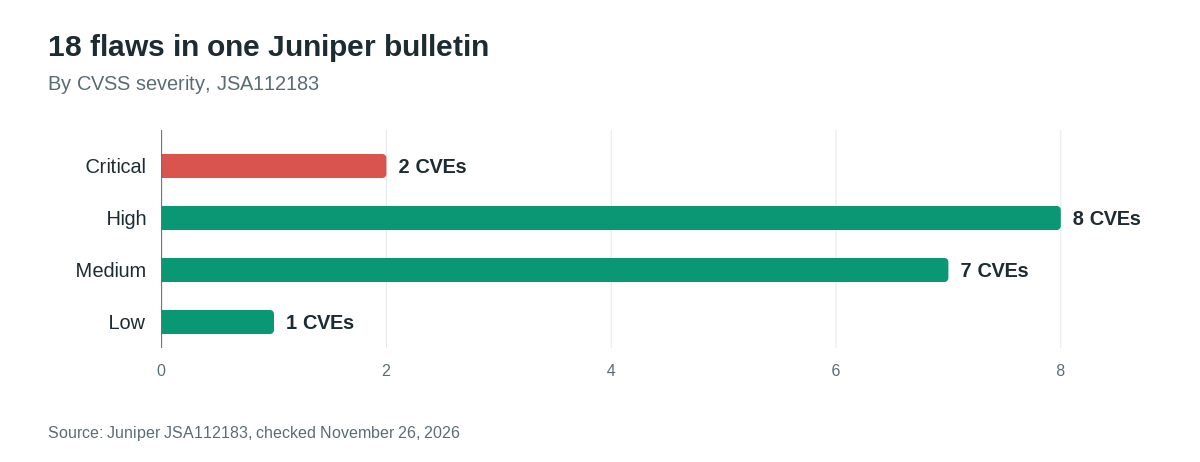
The 18 flaws split into two Critical, eight High, seven Medium and one Low on Juniper's own scores.
How is it exploited?
- The attacker reaches the Conductor's provisioning and key-management service over the network. No account is needed for CVE-2026-103406.
- The attacker presents a minion registration with a crafted ID.
- The AutomatedProvisioner builds a key-management operation and places the ID inside an operating-system command.
- The command interpreter treats characters inside the ID as command syntax, and the injected command runs as root on the Conductor.
- The attacker uses root on the Conductor to reach the routers it manages, read their configuration and change routing or security policy.
For CVE-2026-103409, the attacker sends crafted URL parameters to the unauthenticated endpoint on a router that has not been onboarded. The endpoint runs as root and returns administrative privileges.
Juniper published no request, payload or exploit script for either flaw. The advisory and the CVE records describe the input and the impact, not a working attack.
How does the attack flow?
An unauthenticated attacker supplies a crafted minion ID to the Conductor's provisioning path. The ID reaches an OS command without neutralization, and the command runs as root on the controller that manages every router.
minion ID"] --> B["Conductor's
AutomatedProvisioner"] B --> C["Key management builds
an OS command"] C --> D["No neutralization of
the minion ID"] D --> E["Command runs
as root"] E --> F["Attacker controls
managed routers"]
What can an attacker do?
Root on the Conductor gives an attacker control of the routers it manages and of the credentials the Conductor holds for them.
- Read and change every managed router's configuration, including routing and security policy.
- Reach the routing credentials and PKI material that the Conductor stores. CVE-2026-103404 separately exposes routing credentials through insecure file permissions.
- Use the Conductor's position to reach networks behind the routers, including customer or branch networks.
- Pivot to the routers themselves, because the Conductor is the management plane for the group.
The conditions are the ones in "Am I affected?": a vulnerable release, network reach to the provisioning path, and no requirement for credentials on CVE-2026-103406. CVE-2026-103409 additionally requires that the router has not been onboarded. The 8.8 file and cache flaws require an authenticated low-privilege account. The DHCP option flaw needs an adjacent network position.
Juniper reports at least one instance of malicious exploitation of CVE-2026-103406. It published no victim count, attacker identity or date for that instance. CISA's SSVC entry records exploitation as active, automatable as no and technical impact as total.
Why does the fix work?
Juniper fixed the flaws in Session Smart Router and Session Smart Conductor 7.0.5, 7.1.7 and 7.2.3. For CVE-2026-103406, the fix must stop the minion ID from reaching the command as syntax. For CVE-2026-103409, it must require authentication on the endpoint before it grants administrative privileges.
Juniper has not published a patch diff, so the exact change is not public. The fixed releases are the only public fix artifact, and the advisory marks the defects I95-65205 and I95-65016 as resolved in those releases.
Without the diff, the fix cannot be verified as complete from public sources. Juniper lists 18 flaws as resolved in the same three releases, and it says there is no workaround for all of them. Treat the fixed release as the complete remediation Juniper offers, and keep the management interfaces restricted.
How do I check if I was compromised?
Juniper and CISA published no indicators of compromise for CVE-2026-103406. An attempt that failed, or one that ran a single command, may leave no trace on the Conductor.
Check the Conductor for:
- Minion registrations and key approvals you did not perform, including IDs that do not match your routers.
- New local accounts, changed passwords and changes to the Conductor's own configuration.
- Unexpected processes, files or scheduled jobs on the Conductor host.
- Router configurations that changed outside your change process.
Check the network for:
- Connections to the Conductor's provisioning and management interfaces from networks outside the management VLAN.
- Connections to the routers' management interfaces from the Conductor at times you did not schedule.
If you find a sign of compromise, rebuild the Conductor from known good media, rotate the credentials and keys it holds, and audit every router it manages. An upgrade does not remove an attacker who already has root.
Timeline
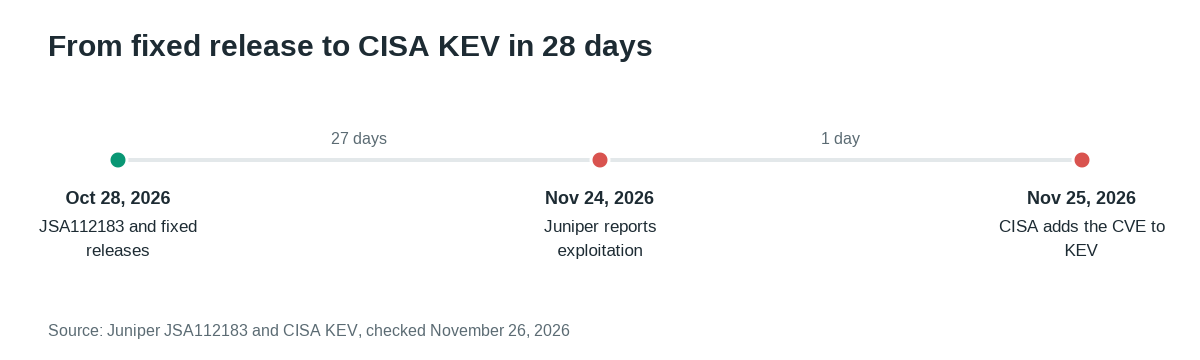
- 2026-10-28: Juniper publishes JSA112183 with fixed releases 7.0.5, 7.1.7 and 7.2.3.
- 2026-11-24: Juniper updates the bulletin to report malicious exploitation of CVE-2026-103406.
- 2026-11-25: CISA adds CVE-2026-103406 to the Known Exploited Vulnerabilities catalog with a due date of 2026-11-28.
FAQ
Is CVE-2026-103406 exploited in the wild?
Yes. Juniper SIRT reports at least one instance of malicious exploitation, and CISA added the CVE to KEV on November 25, 2026. Juniper has not published a victim count or an attack date.
Do I need credentials to exploit it?
No for CVE-2026-103406. The CVSS vector records no privileges and no user interaction. The 8.8 file and cache flaws need a low-privilege account, and the DHCP option flaw needs an adjacent network position.
Is there a workaround?
No single workaround covers all 18 flaws. Juniper recommends restricting the CLI and web-based management interfaces to a dedicated VLAN and enforcing firewall policies on the paths to them. That reduces exposure but does not fix the code.
Does CVE-2026-103409 affect routers already onboarded to Mist?
No. Juniper says the flaw can only be exploited before the router is onboarded to Mist or a Conductor. After onboarding, the endpoint can no longer be used this way.
Is there a public proof of concept?
No. Juniper published no request, payload or exploit script for CVE-2026-103406 or CVE-2026-103409. The advisory names the component, the input and the impact.
Which release should I install?
Install 7.0.5, 7.1.7 or 7.2.3 on the branch you run. Later releases on the same branch include the fixes. Juniper does not evaluate releases beyond end of engineering or end of life, so move to a supported branch.
Find exposed Session Smart Conductors with Ostorlab
Ostorlab's attack surface discovery inventories internet-facing services, including network management and provisioning interfaces. Use it to find the Conductor and router management endpoints that need the release check and the network restriction: https://ostorlab.co/product/attacksurface_discovery
References
- Juniper Networks, "2026-10 On-Demand Security Bulletin: Session Smart Router and Session Smart Conductor: Multiple internally discovered vulnerabilities resolved" (JSA112183), created October 28, 2026, updated November 24, 2026 (checked November 26, 2026): https://supportportal.juniper.net/s/article/2026-10-On-Demand-Security-Bulletin-Session-Smart-Router-and-Session-Smart-Conductor-Multiple-internally-discovered-vulnerabilities-resolved
- CVE record, CVE-2026-103406, published October 28, 2026, updated November 24, 2026 (checked November 26, 2026): https://www.cve.org/CVERecord?id=CVE-2026-103406
- CVE record, CVE-2026-103409, published October 28, 2026 (checked November 26, 2026): https://www.cve.org/CVERecord?id=CVE-2026-103409
- CISA Known Exploited Vulnerabilities catalog, CVE-2026-103406 added November 25, 2026, due November 28, 2026 (checked November 26, 2026): https://www.cisa.gov/known-exploited-vulnerabilities-catalog
- Salt Project documentation, "Configuring the Salt Minion", minion ID setting (checked November 26, 2026): https://docs.saltproject.io/en/latest/ref/configuration/minion.html
- SecurityWeek, "Critical Vulnerability Patched in Juniper Session Smart Router", published February 18, 2025 (checked November 26, 2026): https://www.securityweek.com/critical-vulnerability-patched-in-juniper-session-smart-router/
Keep reading