BusyBox tftpd Absolute Path Traversal (CVE-2026-136411)
BusyBox tftpd started without a DIR argument serves absolute paths, letting an unauthenticated client read or overwrite files; fixed in git.
TL;DR
- BusyBox tftpd confines clients only by chrooting into its optional DIR argument. Without DIR, a request for an absolute name such as
/etc/shadowis served from the real root. Ali Ahmet Memis reported the flaw on 2026-08-17. - Every BusyBox release through 1.38.0 is affected when tftpd is enabled and started without a DIR argument. The daemon usually runs as root, and TFTP has no authentication.
- The CVE record rates CVE-2026-136411 at CVSS v4.0 9.3 Critical and CVSS v3.1 9.8 Critical. No exploitation is known and the CVE is not in CISA KEV as of 2026-11-24.
- No tagged BusyBox release contains the fix. Apply commit b67f7b7d14ac or a distribution backport, or start tftpd with a DIR argument; see "How do I fix it?".
Am I affected?
A device is exposed when BusyBox runs a tftpd service, the service was started without a directory argument, and its UDP port is reachable.
All of these conditions must hold:
- The BusyBox build includes the tftpd applet (
CONFIG_TFTPD). - tftpd is started as a service by inetd, xinetd, udpsvd or a similar supervisor.
- That service line has no DIR argument, so BusyBox does not chroot or change directory.
- UDP port 69 is reachable by the attacker.
- The daemon runs as root, which is the default, or as a user that can read or write the files the attacker names.
A tftpd started with a DIR argument chroots into that directory when it runs as root. In that configuration an absolute request name is resolved inside the chroot, so this flaw is not reachable. A daemon that is not running at all is also not affected.
| Branch | Affected versions | Fixed version |
|---|---|---|
| BusyBox 1.38.x | through 1.38.0 | no tagged release; commit b67f7b7d14ac |
| BusyBox 1.37.x and earlier | all releases | no tagged release; commit b67f7b7d14ac |
| Distribution builds | any build from source without the commit | distribution backport when published |
Check whether the applet is present and running:
busybox | head -1
busybox --list | grep -x tftpd
ps w | grep '[t]ftpd'
Check the service definition for a missing directory argument:
grep -R "tftpd" /etc/inetd.conf /etc/xinetd.conf /etc/xinetd.d 2>/dev/null
A line such as tftpd dgram udp wait root /bin/busybox tftpd has no directory argument and is the exposed form. tftpd /srv/tftp passes a directory and is confined when the daemon can chroot.
How do I fix it?
No BusyBox release contains the fix as of 2026-11-24. The current release is 1.38.0, published on 2026-05-13, and the fix commit is dated 2026-11-06. Apply the commit, wait for a distribution backport, or use the workaround in the meantime.
-
If you build BusyBox yourself, apply commit b67f7b7d14ac98ca84491718d364b955d21a9cd5 to your source tree and rebuild the image. The version string does not change, so record the commit in the build metadata.
-
If a distribution or vendor supplies BusyBox, install its update when it carries the commit. Ask the vendor for the backport status when no advisory is published yet.
-
If you cannot rebuild, start tftpd with a DIR argument as root. Change the service line to pass the served directory:
tftpd /srv/tftp
- If tftpd is not needed, disable the service and block UDP port 69 at the network boundary.
The DIR workaround depends on root. In 1.38.0 a tftpd that runs as an unprivileged user cannot chroot, so the daemon exits instead of serving. The fix also makes DIR work for a non-root daemon by changing directory when chroot fails, but that behaviour is not in any release yet.
What is the root cause?
tftpd_main() takes its served directory from an optional command-line argument. When the argument is present it calls xchroot() and relies on the chroot for confinement. When the argument is absent it neither chroots nor changes directory, and it never strips a leading slash from the requested name.
This is the relevant part of networking/tftp.c at the 1.38.0 tag:
    if (argv[0]) {
        xchroot(argv[0]);
    }

    result = recv_from_to(STDIN_FILENO,
            G.block_buf, sizeof(G.block_buf) + 1,
            /* ^^^ sizeof+1 to reliably detect oversized input */
            0 /* flags */,
            &peer_lsa->u.sa, &our_lsa->u.sa, our_lsa->len);
...
    local_file = G.block_buf + 2;
    if (local_file[0] == '.' || strstr(local_file, "/.")) {
        error_msg = "dot in file name";
        goto err;
    }
local_file points at the file name inside the RRQ or WRQ packet. The only validation rejects a name that begins with . and a name that contains /.. An absolute path such as /etc/shadow passes both tests, and the later open() resolves it from the process root. The same buffer is used for uploads, so a WRQ can name an absolute destination.
The only confinement in 1.38.0 is the chroot taken when DIR is present. Without DIR there is no chroot, and nothing forces a request to be relative: the working directory does not help, because an absolute name resolves from the real root. The report describes the usual service layout: start tftpd in the served directory with no argument, and the confinement is missing without any visible error.
How is it exploited?
The attack needs one UDP packet and no credentials. TFTP carries the file name in cleartext at the start of the request.
- The attacker sends an RRQ packet to UDP port 69 with the file name
/etc/shadow. - BusyBox copies the name into
local_fileand checks only for a leading dot or a/.sequence. - The absolute name passes the check, and the daemon opens it from the real root.
- The file is transferred to the attacker in TFTP data blocks.
- For a write, the attacker sends a WRQ with an absolute name, such as a root-owned script or an SSH
authorized_keysfile, and the daemon writes it.
The public report includes a reproduction with the standard client:
cd /srv/tftp && tftpd
tftp -g -r /etc/shadow HOST
Uploads use the same name handling. A client can overwrite any existing file the daemon can write, and with the -c option it can create new files. The report states that both the read and the write were reproduced against a tftpd started without DIR.
How does the attack flow?
The traffic reaches an unauthenticated UDP service, the file name keeps its leading slash, and the daemon opens the absolute path as root.
What can an attacker do?
An unauthenticated attacker can read any file the tftpd process can read and overwrite any file it can write. Because the daemon usually runs as root, that includes /etc/shadow, root-owned scripts, cron entries and SSH authorized keys. A write to one of those paths can lead to code execution or a persistent login. The report names a root-owned script and a crontab as examples of files an upload can replace.
The impact depends on the same conditions as exposure. The service must be reachable over UDP, tftpd must have been started without a DIR argument, and the daemon's account must be able to reach the target file. A daemon confined by a successful chroot does not expose the host filesystem.
TFTP has no authentication and no integrity protection. A request that succeeds leaves the daemon with nothing to log unless it was started with the -l option, which sends messages to syslog.
No in-the-wild exploitation is known as of 2026-11-24.
Why does the fix work?
The fix strips every leading slash from the requested name and makes the DIR argument work when the daemon cannot chroot:
    if (argv[0]) {
-       xchroot(argv[0]);
+       const char *DIR = argv[0];
+       if (chroot(DIR) == 0)
+           DIR = "/";
+       xchdir(DIR);
    }
...
    local_file = G.block_buf + 2;
+
+   while (local_file[0] == '/')
+       local_file++;
    if (local_file[0] == '.' || strstr(local_file, "/.")) {
        error_msg = "dot in file name";
        goto err;
    }
Stripping the slash turns /etc/shadow into etc/shadow, which is resolved under the current directory. The existing dot check still rejects .. and any path containing /., so the change removes the absolute-path escape without adding a traversal.
The second change addresses the root requirement. With DIR, the daemon tries chroot() first. If that succeeds, it sets the directory to / inside the new root. If it fails, as it does for an unprivileged user, the daemon changes into the directory instead of exiting. That gives a non-root tftpd a working directory, though not a chroot. The advisory's fix comment says that exposing the whole filesystem now requires an explicit tftpd /.
The fix is complete for the absolute-path flaw reported here. The dot check remains the control for parent segments, and the patch does not change the TFTP protocol handling.
How do I check if I was compromised?
No indicators of compromise are published for this issue. A successful read leaves the target file unchanged, and a write may look like an ordinary configuration change.
Review the tftpd service definition first: a line without a DIR argument is the exposed configuration regardless of traffic. Then check whether request logging was enabled with -l and look for transfers of absolute paths:
grep -E "tftpd.*(/etc/|/root/|/home/)" /var/log/messages /var/log/syslog 2>/dev/null
A hit is a lead, not proof. BusyBox logs the applet name, not a full request record, and a daemon without -l logs nothing.
On a host that may have been reached, compare the modification times of files an attacker would target, such as /etc/passwd, /etc/shadow, crontabs and authorized_keys, against the last known-good image. Reflash or rebuild embedded devices whose firmware cannot be verified, because a write to a root-owned file can survive a reboot.
Timeline
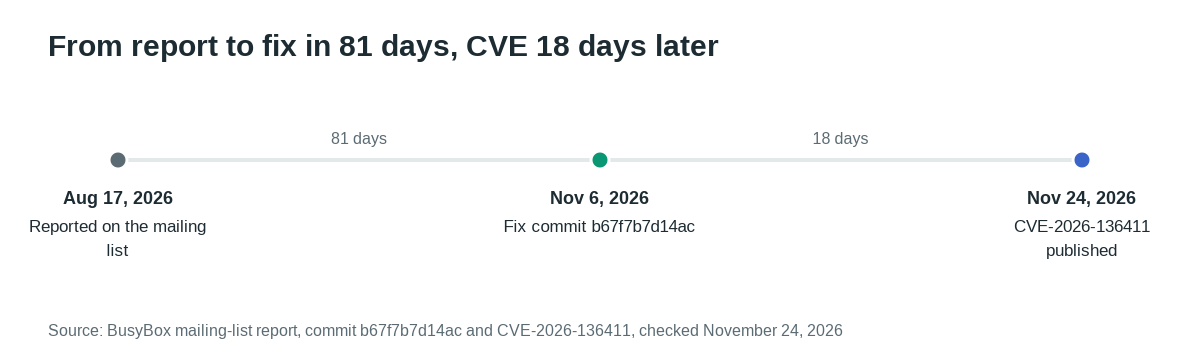
- 2026-08-17: Ali Ahmet Memis reports the flaw on the BusyBox mailing list with a read and a write reproduction.
- 2026-11-06: The fix commit b67f7b7d14ac is authored.
- 2026-11-24: VulnCheck publishes CVE-2026-136411.
FAQ
Does every BusyBox device expose this flaw?
No. The tftpd applet must be compiled in, started as a service, and started without a DIR argument. Most BusyBox deployments never run tftpd, and a service that passes a directory is confined by the chroot.
Is there a fixed BusyBox release?
No tagged release contains the fix as of 2026-11-24. The current release is 1.38.0, published on 2026-05-13, and the fix is commit b67f7b7d14ac on the development branch.
Does running tftpd as a non-root user help?
Not before the fix. Without DIR there is no confinement at all. With DIR, a non-root daemon cannot chroot in 1.38.0, so it exits instead of serving. The fix adds a directory change for that case.
Is tftpd enabled by default?
No. BusyBox builds tftpd only when CONFIG_TFTPD is selected, and the applet runs only when inetd, xinetd, udpsvd or another supervisor starts it. Routers, switches, IP cameras and PXE servers are the usual places where it is enabled.
Was CVE-2026-136411 exploited in the wild?
No exploitation is known, and the CVE is not in CISA KEV as of 2026-11-24. The public report includes reproduction commands for both a read and a write, so the flaw is easy to confirm on an exposed service.
Does the DIR workaround break PXE clients?
No. PXE clients commonly request names such as /pxelinux.0, and the fix is designed to translate those requests into the served directory. With DIR and a successful chroot, the result is unchanged from 1.38.0.
Find exposed tftpd services with Ostorlab
Ostorlab's attack surface discovery inventories the internet-facing hosts and services an organisation runs, including embedded appliances, so a team can find devices that answer on UDP 69 and check them first. Detection of CVE-2026-136411 itself is not confirmed.
References
- CVE-2026-136411 record, VulnCheck, published 2026-11-24 (checked November 24, 2026)
- BusyBox mailing-list report, 2026-08-17, "[PATCH] tftpd: strip leading slashes from the requested file name" (checked November 24, 2026)
- Fix commit b67f7b7d14ac, "tftpd: make DIR argiment work for non-root too, strip leading /" (checked November 24, 2026)
- Follow-up patch thread, 2026-11 (checked November 24, 2026)
networking/tftp.cat the 1.38.0 tag (checked November 24, 2026)- BusyBox 1.38.0 announcement, published 2026-05-13 (checked November 24, 2026)
- VulnCheck advisory (checked November 24, 2026)
- Debian popularity contest, install counts,
busyboxat 293,160 installations (checked November 24, 2026) - BusyBox project site (checked November 24, 2026)
Keep reading