VirtueMart RCE via Controller Fallback, Exploited (CVE-2026-133335)
An unauthenticated path traversal in VirtueMart's controller loader led to RCE, exploited in the wild; 4.8.10 fixes it and a PayPal flaw.
TL;DR
- An unauthenticated visitor can make VirtueMart include an arbitrary local PHP file, which becomes remote code execution when the server has a useful file such as
pearcmd.php. The Joomla CNA published CVE-2026-133335 on 2026-11-25. - Every VirtueMart 4 release from 4.0.0 through 4.8.7 is affected. The loader flaw is fixed in 4.8.8, and the bundled PayPal Checkout flaw is fixed in 4.8.10.
- The CVE record rates the flaw at CVSS v4.0 9.2 Critical with exploit maturity Attacked, which states that it has been exploited in the wild. The CVE is not in the CISA Known Exploited Vulnerabilities catalog as of 2026-11-25. No public exploit code is known.
- Install the full 4.8.10 package, or the 4.8.10 hotfix when a full update has to wait. See "How do I fix it?" for the version check and the PayPal Checkout control.
Am I affected?
You are exposed when a Joomla site runs VirtueMart 4 before 4.8.8 and the storefront reaches the component's controller loader with a view value that an attacker controls.
All of these conditions must hold:
- The site runs the
com_virtuemartcomponent at a version from 4.0.0 through 4.8.7. - The storefront is reachable over the network. The loader runs before any account check, so a shopper account is not needed.
- The server has a local PHP file that the attacker can use to turn the include into code execution. The vendor names
pearcmd.phpas an example. A writable directory with an uploaded PHP file serves the same purpose. - For the payment flaw, the store uses the bundled "VM Payment - PayPal Checkout" plugin and has it enabled.
VirtueMart 3 receives neither the fix nor the hotfix. The vendor has not said whether it is affected, so treat it as unsupported for this issue.
| Component | Affected versions | Fixed version |
|---|---|---|
| VirtueMart controller loader (CVE-2026-133335) | 4.0.0 through 4.8.7 | 4.8.8 |
| PayPal Checkout order completion (CVE-2026-133333) | 4.0.0 through 4.8.8 | 4.8.10 |
| Download Simple plugin (CVE-2026-133334) | 4.0.0 through 4.8.0 | 4.8.2 |
| VirtueMart 3 | All releases | No fix; migrate to 4.8.10 |
Read the installed version in the Joomla administrator under Extensions, Manage, Manage. The version is also stored in the component:
grep -n "RELEASE\|VERSION" administrator/components/com_virtuemart/version.php
Check whether the fixed loader helper is present:
grep -n "function filterCmd" administrator/components/com_virtuemart/helpers/vrequest.php
No output means the site carries the vulnerable request handling. A match means the fixed helper is present.
Check whether the storefront entry point still carries the old blacklist:
grep -n "strpos(\$_controller,'%')" components/com_virtuemart/virtuemart.php
A match means the site is still on the vulnerable code path.
How do I fix it?
Install the full VirtueMart 4.8.10 package, which contains both fixes, and then confirm that the component reports 4.8.10.
- Back up the site before you change anything.
- Download the full 4.8.10 package from the vendor's security notice and install it as a Joomla extension.
- When a full update has to wait, install the vendor's 4.8.10 hotfix, which the vendor says works on VirtueMart 4.0 and above. The hotfix replaces the frontend and backend entry files, the request filter and the PayPal Checkout plugin files when that plugin is installed.
- Confirm the result. A full update reports 4.8.10. A hotfixed site still reports its old version, so look for the
VirtueMart_patchercomponent at 4.8.10 under Extensions, Manage, Manage. - Compare recent orders paid with PayPal Checkout against the PayPal account and investigate any order marked paid with no matching payment.
The 4.8.10 hotfix does not move the version number. Anything that judges the site by its version, including a scanner, will treat a hotfixed site as unpatched until the full package is installed.
If the store uses PayPal Checkout and cannot update yet, disable that payment method. The order-completion task is the flaw, so disabling the plugin removes the path. The control does not cover the controller loader flaw.
What is the root cause?
The CVE record calls the mechanism a controller fallback: the storefront entry point fell back to building a controller file path from the view request value and included the file, but its filter applied only a short blacklist: values longer than 25 characters, or containing a percent sign, a space or an asterisk, so a value with . and / could traverse out of the controllers directory.
The entry point read the value with vRequest::getCmd() and then applied a short blacklist:
$_controller = vRequest::getCmd('view', 0) ;    //Old legacy, that 'view' is priorised

if(strlen($_controller)>25 or strpos($_controller,'%')!=false or strpos($_controller,' ')!=false
    or strpos($_controller,'*')!=false ){
    return false;
}
Later in the same file, the value is appended to a path and the file is required when it exists:
$_class = 'VirtueMartController'.ucfirst($_controller);
$path = $basePath.'/controllers/'.$_controller.'.php';

if (file_exists($path)) {
    if (!class_exists($_class)) {
        require ($path);
    }
}
The blacklist rejects a value longer than 25 characters, a percent sign, a space and an asterisk. It does not reject ., / or a null byte.
A value such as ../../../../tmp/upload therefore builds a path outside controllers/, and require includes that file. The .php suffix limits the target to PHP files, which is enough for the classic pearcmd.php technique and for any PHP file the attacker can place on the server.
The payment flaw is separate. The PayPal Checkout plugin's ordercompleted task called finalizeOrder() without asking PayPal whether the order had been captured:
} else if ($task == 'ordercompleted'){

    $this->finalizeOrder();
A shopper, including a guest, could return to that task and have the order set to the configured success status without a payment.
How is it exploited?
The controller flaw turns one unauthenticated storefront request into the inclusion of an attacker-chosen local PHP file. The payment flaw turns a return request into a paid order without a capture.
- The attacker sends a request to the VirtueMart storefront with a
viewvalue containing../segments. The value passes the short blacklist. - The entry point builds
controllers/<value>.phpand callsfile_exists(). - When the path resolves to a local PHP file,
requireincludes it. A file such aspearcmd.phpresponds to request parameters and writes an attacker-controlled file, which is then included for code execution. - Alternatively, the attacker first places a PHP file on the server through an upload into a writable directory, then points
viewat it without the.phpsuffix. - The included code runs with the Joomla process user and can read
configuration.php, which holds the database credentials, and write files under the web root.
The payment path needs no inclusion:
- A shopper starts a PayPal Checkout order and reaches PayPal.
- The shopper returns to the storefront and requests the
ordercompletedtask without completing a capture. - The plugin sets the order to its configured success status. The order looks paid although PayPal never captured the money.
The Joomla CNA's CVE record states that the controller flaw has been exploited in the wild. The vendor's 4.8.10 notice does not mention exploitation, and no public proof of concept is known.
How does the attack flow?
One unauthenticated storefront request carries a traversal value through a short blacklist, builds a path outside the controllers directory and includes an attacker-chosen PHP file.
What can an attacker do?
An attacker who reaches the include can run PHP with the permissions of the Joomla process and read the store's configuration, including the database credentials.
Every condition from "Am I affected?" still applies. The store must run an affected VirtueMart 4 release, the storefront must be reachable, and a local PHP file must be available for the include. The attacker needs no account.
The controller flaw gives code execution, not just file disclosure. That code can read configuration.php, connect to the database, modify orders and write files under the web root. The Joomla process usually runs as the web server user, so the impact stops at that user's permissions unless the host has another weakness.
The payment flaw gives a different impact. A shopper can mark an unpaid order as confirmed and paid, which causes a financial loss and may release goods or paid downloads. It does not read data or run code.
The Download Simple flaw is a third, separate issue. Anyone holding one valid download link could download other files offered for sale. The plugin checked the order secret but not that the requested media belonged to the order item.
Why does the fix work?
The 4.8.8 release replaced the blacklist with an allowlist: the controller name must be one to 25 letters, digits or underscores, and anything else returns false and stops the request.
-    $_controller = vRequest::getCmd('view', 0) ;    //Old legacy, that 'view' is priorised
+    $_controller = vRequest::filterCmd(vRequest::getCmd('view', ''));    //Old legacy, that 'view' is priorised

-    if(strlen($_controller)>25 or strpos($_controller,'%')!=false or strpos($_controller,' ')!=false
-        or strpos($_controller,'*')!=false ){
+    if ($_controller === false) {
         return false;
     }
The helper performs the allowlist check:
public static function filterCmd(mixed $name): string|false {

    if ($name === null || $name === false || $name === '') {

        return '';
    }

    if (!is_string($name) || !preg_match('/^[A-Za-z0-9_]{1,25}$/', $name)) {

        return false;
    }

    return $name;
}
The pattern admits no ., /, %, space or asterisk, so the value can no longer leave the controllers directory. The entry point also checks the return value before it builds the path and returns early on false.
The 4.8.10 release fixes the payment path by asking PayPal for the order and requiring a completed order, a completed capture and a matching order number before it finalizes the order. It also requires the shopper's form token on every PayPal action except PayPal's own webhook.
How do I check if I was compromised?
Search the web server access log for storefront requests whose view parameter contains traversal sequences or an unusual PHP file name.
grep -Ei 'option=com_virtuemart[^ ]*view=([^&]*\.\.|%2e|pearcmd)' /var/log/nginx/access.log
A hit is a lead, not proof, because the same request shape can come from a scanner. Correlate hits with a 200 response and with new files under the Joomla temporary or upload directories.
List PHP files created under the site during the period you are investigating:
find /var/www/html -name '*.php' -newermt '2026-11-01' -type f
For the payment flaw, compare orders marked paid with PayPal Checkout against the PayPal account. An order with no matching capture is a lead. The vendor's notice does not publish indicators, so an attempt that failed may leave no trace.
Timeline
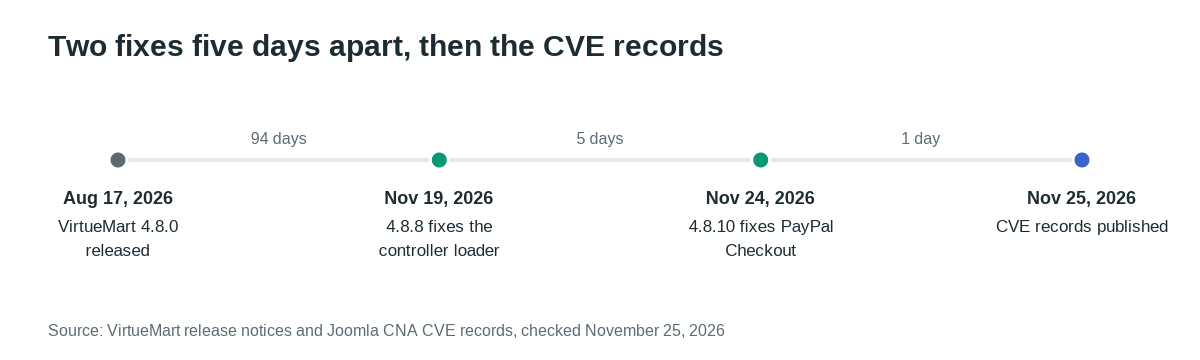
- 2026-08-17: VirtueMart 4.8.0 is released.
- 2026-11-19: VirtueMart 4.8.8 fixes the controller loader flaw.
- 2026-11-24: VirtueMart 4.8.10 fixes the PayPal Checkout flaw and the vendor publishes the security notice.
- 2026-11-25: the Joomla CNA publishes CVE-2026-133335, CVE-2026-133333 and CVE-2026-133334.
FAQ
Is VirtueMart 3 fixed?
No. The fix and the hotfix target VirtueMart 4.0 and above. The vendor has not said whether VirtueMart 3 is affected, so treat it as unsupported for this issue and plan the move to 4.8.10.
Do I need 4.8.10 if I already installed 4.8.8?
Yes, when the store uses PayPal Checkout. VirtueMart 4.8.8 closes the controller loader flaw, and 4.8.10 closes the payment flaw. A store that does not use PayPal Checkout is not exposed to the second flaw, but 4.8.10 is the release to run.
Does the hotfix change the version number?
No. The hotfix replaces the affected files but leaves the reported version unchanged. A scanner will flag the site as unpatched until the full 4.8.10 package is installed.
Is there a public proof of concept?
No. The Joomla CNA record states that the controller flaw has been exploited in the wild, and the vendor's notice describes the result as RCE. No public exploit code or request sequence is known as of 2026-11-25.
Is CVE-2026-133335 in CISA KEV?
No. The CVE is not in the CISA Known Exploited Vulnerabilities catalog as of 2026-11-25, although the CVE record marks exploit maturity as Attacked.
References
- CVE-2026-133335 record, Joomla, published 2026-11-25 (checked November 25, 2026)
- CVE-2026-133333 record, Joomla, published 2026-11-25 (checked November 25, 2026)
- CVE-2026-133334 record, Joomla, published 2026-11-25 (checked November 25, 2026)
- VirtueMart security notice for 4.8.10, published 2026-11-24 (checked November 25, 2026)
- VirtueMart 4.8.8 release notes, published 2026-11-19 (checked November 25, 2026)
- VirtueMart 4.8.2 package (checked November 25, 2026)
- VirtueMart 4.8.8 package (checked November 25, 2026)
- VirtueMart 4.8.10 package (checked November 25, 2026)
- mySites.guru analysis of the 4.8.10 release, published 2026-11-24 (checked November 25, 2026)
- W3Techs Joomla usage statistics, Joomla used by 1.0% of all websites on 2026-11-25 (checked November 25, 2026)
- CISA Known Exploited Vulnerabilities catalog, catalog version 2026.11.24 (checked November 25, 2026)
Keep reading