
Virtualizor SQL Injection to Admin Takeover (CVE-2026-135174)
Virtualizor put the OAuth email into a SQL query, so a crafted address returns the admin row; fixed in 3.2.9.
TL;DR
- Virtualizor's social-login callback concatenated the OAuth provider's email address into a SQL query. An address such as
x'OR/**/uid=1#@mydomain.comreturns the administrator row and writes its uid into the session. - Virtualizor before 3.2.9 with Social Login enabled and at least one OAuth provider configured is affected. Del Security confirmed the flaw on 3.2.8.5, and the vendor fixed it in 3.2.9 on 2026-05-12.
- VulnCheck published CVE-2026-135174 on 2026-11-23, rated CVSS v4.0 9.2 Critical and v3.1 8.1 High. No exploitation is known and the CVE is not in CISA KEV as of 2026-11-23.
- Upgrade to Virtualizor 3.2.9 or later. If the upgrade has to wait, disable Social Login, which removes the vulnerable callback from the login flow.
Am I affected?
All of these conditions must hold for an instance to be exposed:
- It runs Virtualizor before 3.2.9. Del Security confirmed the bug on 3.2.8.5, the current release when it reported the issue.
- Social Login is enabled, and at least one OAuth provider is configured. This is not a default-on feature.
- An attacker can reach the end-user login and the OAuth callback. The callback is the
enduser/auth_callback.phpscript on the panel.
The flaw is in the end-user social-login callback, not in the admin login or the API. An instance with Social Login disabled does not expose the vulnerable path through the login flow. The CVE record still lists every release before 3.2.9 as affected, because the vulnerable code is present even when the feature is off.
| Release | Affected versions | Fixed version |
|---|---|---|
| Virtualizor with Social Login enabled | Before 3.2.9, confirmed on 3.2.8.5 | 3.2.9 |
| Virtualizor with Social Login disabled | Before 3.2.9 by code, not reachable through the login flow | 3.2.9 |
The CVE record rates the flaw CVSS v4.0 9.2 Critical (CVSS:4.0/AV:N/AC:H/AT:P/PR:N/UI:N/VC:H/VI:H/VA:H/SC:N/SI:N/SA:N) and CVSS v3.1 8.1 High (CVSS:3.1/AV:N/AC:H/PR:N/UI:N/S:U/C:H/I:H/A:H), with CWE-89 SQL Injection. The high attack complexity and the present-attack prerequisite reflect the social-login configuration. Del Security assesses CVSS v3.1 9.8 (CVSS:3.1/AV:N/AC:L/PR:N/UI:N/S:U/C:H/I:H/A:H) for an instance that has Social Login enabled. Both scores describe the same bug under different assumptions.
Check the installed version and confirm that the vulnerable callback file exists:
virtualizor --version
cat /usr/local/virtualizor/version /usr/local/virtualizor/rev
ls -l /usr/local/virtualizor/enduser/auth_callback.php
Then open the admin panel's social-login settings and confirm whether any provider is enabled. A panel with no provider configured does not expose the callback through a login attempt.
How do I fix it?
Upgrade Virtualizor to 3.2.9 or later on every node, then confirm the version on each one. The fixed release binds the email address as a query parameter instead of concatenating it.
- On each node, run the signed updater. It starts in the background and writes its progress to
/var/virtualizor/log/upgrade_bg:
virtualizor --update
- On a master with slave servers, run the fleet update from the master after the master itself is current:
virtualizor --update-all
- Confirm the result on every node. The current command prints the installed version:
virtualizor --version
cat /usr/local/virtualizor/version /usr/local/virtualizor/rev
If the upgrade has to wait, disable Social Login in the admin panel. Del Security says disabling the feature removes the attack surface entirely. Limiting the end-user panel to a management network also reduces exposure, but it does not fix the query, so a reachable panel with Social Login on remains exploitable. There is no vendor workaround that keeps Social Login enabled and makes the callback safe on 3.2.8.5.
What is the root cause?
The social-login callback took the email address returned by the OAuth provider and put it directly into a SQL SELECT. The address is attacker-controlled, so the query could be rewritten.
Del Security reconstructed the vulnerable code from the IonCube-encoded enduser/auth_callback.php. The provider profile supplies $data['email'], and makequery() receives a string built with concatenation:
$data['email'] = $userProfile->email;
$qresult = makequery("SELECT uid, email FROM users WHERE email = '" . $data['email'] . "'");
$row = vsql_fetch_assoc($qresult);
$SESS['uid'] = $row['uid'];
The only check before the query is that the email is not empty. There is no filter_var() call, no format check and no inspection of the provider's email_verified flag. Virtualizor reads $userProfile->email, not $userProfile->emailVerified.
The same file already uses bound parameters elsewhere, and makequery() supports them. The callback simply did not use that form. The result of the query is written straight into the session as the identity, so the row the query returns becomes the logged-in user.
How is it exploited?
An attacker registers an OAuth account whose email address contains SQL syntax, completes the provider's verification, and logs in through Virtualizor's social-login button. The payload fits in a valid email local part.
- The attacker chooses an OAuth provider that Virtualizor trusts and creates an account with an address such as
x'OR/**/uid=1#@mydomain.com. - The attacker controls the mail server for
mydomain.comand confirms the address. Del Security verified that GitHub accepts and verifies this address as a primary email. - The attacker starts the social-login flow on the Virtualizor end-user panel and authorizes the provider.
- The provider returns the address, and Virtualizor builds this query:
SELECT uid, email FROM users WHERE email = 'x' OR /**/ uid=1 #@mydomain.com'
- MySQL treats
/**/as whitespace and#as the start of a comment. TheOR uid=1condition matches the administrator row, and the trailing quote and domain are commented out. - Virtualizor writes the returned
uidinto$SESS['uid']. The attacker now has the administrator's session without a password or a second factor.
The address is valid under RFC 5321 and RFC 5322 because the local part may contain ', /, *, =, # and the other atext characters. The original report used a payload with spaces and a -- comment, which mainstream sign-up forms reject. The all-atext form is what made the difference between the vendor's "could not reproduce" verdict and a working login.
An attacker who controls an OpenID Connect provider can return the payload directly and skip the provider-side registration trick. That path works against any instance that trusts the attacker's provider.
How does the attack flow?
A crafted email address crosses from the OAuth provider into an unparameterized SQL query, and the returned administrator row becomes the session identity.
with a SQL payload in the email"] --> B["Provider returns the address
to auth_callback.php"] B --> C["Email concatenated into
SELECT ... WHERE email = '...'"] C --> D["OR uid=1 returns
the administrator row"] D --> E["uid written to the session"] E --> F["Attacker holds an
administrator session"]
What can an attacker do?
An attacker who completes the flow holds an administrator session on the Virtualizor panel. From there, the panel's own permissions decide the impact.
- Control the hosting platform. The administrator session can create, modify, rebuild and delete VPS instances across the managed nodes. That includes the master API key and the panel's automation features.
- Read the user and API tables. Del Security reports that the administrator session exposes the
userstable password hashes and the master API key in theapitable. The short email payload cannot exfiltrate long data in one request, but the admin session is enough to read it through the panel. - Reach the infrastructure behind the panel. Virtualizor manages hypervisors and VPS lifecycle operations. An administrator can affect every customer VM the panel manages.
The conditions are listed in full here. The instance must have Social Login enabled with at least one OAuth provider, the attacker must reach the end-user panel, and the provider must return the crafted address. The attacker needs no password, no existing account and no administrator interaction. An instance with Social Login disabled is not reachable through this path.
The post does not claim that the flaw was exploited in the wild, and it does not claim that every Virtualizor deployment is exposed. The vendor's default keeps Social Login off, which limits the population.
Why does the fix work?
The fix binds the email address as a query parameter, so the database treats the whole address as data rather than SQL syntax. Del Security shows the fixed form used in 3.2.9:
- $qresult = makequery("SELECT uid, email FROM users WHERE email = '" . $data['email'] . "'");
+ $qresult = makequery("SELECT uid, email FROM users WHERE email = :email", [':email' => $data['email']]);
With a bound parameter, the payload string is compared as a literal email value. It cannot close the quote, add an OR condition or start a comment. The query returns the row whose email equals the full string, which is no row for the crafted address.
The vendor's 3.2.9 release notes describe the change as sanitising user input before the database query. The release notes also call the issue hypothetical and say it could not be reproduced, a verdict Del Security disputes. The fixed code path is still the right one, because it removes the concatenation that made the injection possible.
The fix covers the callback named in the CVE. It does not add a provider-side email_verified check, so an instance still trusts whichever address an enabled provider returns. Treat provider trust as a separate configuration decision.
How do I check if I was compromised?
Virtualizor does not publish indicators of compromise for this CVE, and Del Security did not publish a turnkey exploit script. Start with the panel's own login and audit records, then look for administrator sessions that do not match a known login.
Check the panel version first:
virtualizor --version
Then review the admin and end-user login history in the panel for a social-login session that has no password login behind it. Look for a session created for the administrator account from an address or provider the administrator does not use. Virtualizor's logs and database layout vary by build, so confirm the table names on the installation before querying them.
On the server, check whether the vulnerable file was modified outside an update. A file timestamp that does not match the last update is worth reviewing, but the callback is encoded and a modification is not required for exploitation.
If the panel exposes an API or shell history, look for create, delete or rebuild actions on VPS instances that no administrator performed. A failed injection attempt may leave only a normal OAuth login record, so the absence of a clear indicator does not prove that nobody tried.
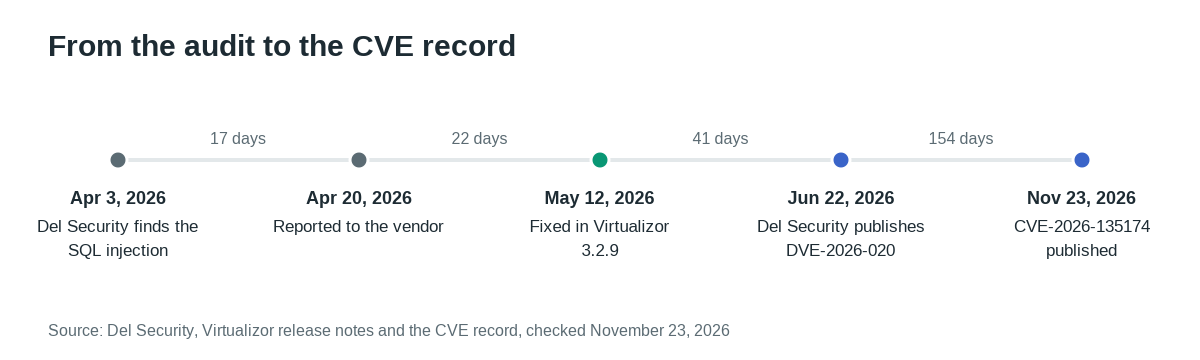
Timeline
- 2026-04-03: Del Security discovered the SQL injection during a whitebox audit of Virtualizor 3.2.8.5.
- 2026-04-20: Del Security reported the flaw to the vendor.
- 2026-05-12: Virtualizor 3.2.9 shipped with the parameterized query.
- 2026-06-22: Del Security published DVE-2026-020.
- 2026-11-23: VulnCheck published CVE-2026-135174 at 14:38 UTC.
FAQ
Is Social Login on by default? No. It is an optional feature, and the vendor's default keeps it off. An instance without an enabled OAuth provider does not expose the callback through a login attempt.
Does the vendor consider this a real vulnerability? Virtualizor's 3.2.9 release notes call it hypothetical and say it could not be reproduced. Del Security disputes that verdict because the vendor tested a payload with spaces, which providers reject. The patch and the CWE-89 record support the researcher's reading.
Is 3.2.9 the fixed version? Yes. The CVE record lists every release before 3.2.9 as affected, and 3.2.9 is the first fixed release. Later 3.2.9.x builds include the same parameterized query.
Can the attacker use any OAuth provider? The provider must be one the instance trusts. A permissive provider that accepts the address, a provider that returns unverified addresses, or an attacker-controlled OpenID Connect provider all work. A provider that rejects the address does not.
Is CVE-2026-135174 exploited in the wild? No exploitation is known as of 2026-11-23, and the CVE is not in CISA KEV. Del Security withheld its turnkey script, but the payload and the technique are public.
Do I need to rotate secrets after upgrading? If the panel ran with Social Login enabled before the upgrade, review the administrator sessions. Rotate the master API key and any credentials the panel stores. The patch closes the injection, but it does not invalidate a session an attacker may already hold.
References
- Del Security, "Virtualizor Pre-auth Admin Takeover via OAuth Email SQL Injection", published 2026-06-22 (checked November 23, 2026): https://www.del-sec.com/blog/dve-2026-020/
- Virtualizor, "Virtualizor 3.2.9 Launched", published 2026-05-12 (checked November 23, 2026): https://www.virtualizor.com/blog/virtualizor-3-2-9-launched/
- CVE-2026-135174 record, published 2026-11-23 (checked November 23, 2026): https://www.cve.org/CVERecord?id=CVE-2026-135174
- VulnCheck advisory, "Softaculous Virtualizor before 3.2.9 SQL Injection via Social Login Callback", published 2026-11-23 (checked November 23, 2026): https://www.vulncheck.com/advisories/softaculous-virtualizor-before-3.2.9-sql-injection-via-social-login-callback
- Virtualizor, "Virtualizor CLI" documentation (checked November 23, 2026): https://www.virtualizor.com/docs/admin/virtualizor-cli/
- Virtualizor, NOC partner directory, 419 listed partners (checked November 23, 2026): https://www.virtualizor.com/noc-partners
- Virtualizor product page, "in production since 2010" (checked November 23, 2026): https://www.virtualizor.com/
Keep reading