Traefik Auth Bypass via Dot-Segment Path Parameters (CVE-2026-137481)
Traefik's sanitizePath leaves /..;x/ segments unresolved, so a request can bypass auth middleware on a shared backend; fixed in 2.11.62 and 3.7.18.
TL;DR
- Traefik's
sanitizePathresolves.and..segments but leaves a dot-segment that carries a path parameter, such as/..;x/, untouched. The advisory GHSA-cp28-5662-543f describes the routing and middleware mismatch. - Traefik 2.11.61 and earlier, 3.0.0 to 3.7.17, and 3.8.0-rc.1 are affected. The bypass needs a backend that strips path parameters, shared by a public router and a protected router.
- The CVE record rates it CVSS v3.1 9.3 Critical and CVSS v4.0 7.8 High. No exploitation is known, and the CVE is not in CISA KEV as of 2026-11-27.
- Upgrade to Traefik 2.11.62, 3.7.18 or 3.8.0-rc.2. See "How do I fix it?" for the interim path controls.
Am I affected?
A Traefik deployment is exposed when all of these conditions hold:
- The proxy runs 2.11.61 or earlier, 3.0.0 to 3.7.17, or 3.8.0-rc.1.
sanitizePathis enabled on the entrypoint. It is enabled by default.- A backend that strips path parameters, such as a Servlet container or Spring application, sits behind Traefik.
- The same host shares that backend between a router with no authentication and a router protected by an authentication or authorization middleware.
- A protected path can be reached from the public prefix with a
..segment that carries a path parameter.
A deployment where every router on the host enforces the same authentication, or where the backend does not strip path parameters, is not on this path. The bypass needs the two routers to disagree about which one owns the request.
| Branch | Affected versions | Fixed version |
|---|---|---|
| 2.11 | 2.11.61 and earlier | 2.11.62 |
| 3.0 to 3.6 | 3.0.0 to 3.6.x | No patch; these lines are end of life, upgrade to 3.7.18 |
| 3.7 | 3.7.0 to 3.7.17 | 3.7.18 |
| 3.8 | 3.8.0-rc.1 | 3.8.0-rc.2 |
The advisory states that Traefik 3.0 to 3.6 are end of life and will not receive a patch. The remedy for those lines is an upgrade to 3.7.18 or later.
Traefik is widely deployed. The GitHub repository has 65,753 stars and the traefik Docker Hub image has 3,617,533,726 pulls (checked 2026-11-27).
Check the running version and the entrypoint setting:
docker exec traefik traefik version
docker inspect traefik --format '{{json .Config.Env}}'
The version is also printed at startup and in the dashboard. In the static configuration, sanitizePath is set under the entrypoint, for example entryPoints.web.http.sanitizePath. A missing key means the default, which is enabled.
How do I fix it?
Upgrade to Traefik 2.11.62, 3.7.18 or 3.8.0-rc.2. The fix is commit 67e4feb9bdeca926d69d116cae536cc516684226 in pkg/server/server_entrypoint_tcp.go.
- Pull the fixed image and recreate the container. A restart alone keeps the old image:
docker compose pull
docker compose up -d
- Confirm the running binary reports 2.11.62 or 3.7.18 or later:
docker exec traefik traefik version
- If the deployment pins an image tag in
docker-compose.ymlor a Kubernetes manifest, change it to a fixed tag and apply the change. Pulling an image does not update a running container. - For a binary install, replace the binary with the fixed release and restart the service.
To verify the fix, send /a/..;x/b/ to a test entrypoint and confirm the access log records /b/. A vulnerable build records the unresolved /a/..;x/b/ instead.
If the upgrade has to wait, reject request paths that carry a path parameter on a dot-segment before they reach Traefik. A rule at the load balancer or web application firewall that blocks ; in a path segment, or specifically /..; and /.;, stops the demonstrated request. Do not disable sanitizePath: that leaves every dot-segment unresolved and widens the mismatch.
A second interim control is to stop sharing a backend between public and protected routers. Then a request that matches the public router cannot reach the protected application.
What is the root cause?
sanitizePath cleans the request URL with Go's URL.JoinPath(). JoinPath removes . and .. only when a segment is exactly one of those strings. A segment such as ..;x is a normal segment, so it survives, and Traefik routes and applies middlewares on a path that still contains the traversal.
The vulnerable function is in pkg/server/server_entrypoint_tcp.go at tag v2.11.61, lines 925 to 940:
func sanitizePath(h http.Handler) http.Handler {
    return http.HandlerFunc(func(rw http.ResponseWriter, req *http.Request) {
        r2 := new(http.Request)
        *r2 = *req

        // Cleans the URL raw path and path.
        r2.URL = r2.URL.JoinPath()

        // Because the reverse proxy director is building query params from requestURI it needs to be updated as well.
        r2.RequestURI = r2.URL.RequestURI()

        h.ServeHTTP(rw, r2)
    })
}
JoinPath is the only normalization step. It sees the path /public/..;x/admin as four segments: public, ..;x, admin. None is . or .., so the path is unchanged. Traefik then matches its routers against that path. The public router matches the public prefix and applies no authentication. The protected router, which would match /admin, does not match.
JoinPath follows RFC 3986 section 6.2.2.3, which defines dot-segment removal for the path segments . and .. only. A path parameter is not part of the segment grammar that the function resolves. The mismatch is therefore structural: Traefik and the backend implement different path models, and the request crosses from one to the other.
The backend resolves the path differently. Servlet containers and Spring strip the ;x path parameter and then resolve .., so the application receives /admin. The two layers disagree about the path, and the access decision is made on the layer that did not resolve it.
The advisory records the same behavior in Traefik v3. The function is shared by the 2.11 and 3.x entrypoint code, so the fix lands on both lines.
How is it exploited?
An attacker needs a public router and a protected router on the same host, with a shared backend that strips path parameters.
- Identify a public path on the host, for example
/public/, and a protected path, for example/admin/. - Confirm that the protected path requires authentication when requested directly.
- Send a request that starts with the public prefix and carries a dot-segment with a path parameter:
GET /public/..;x/admin. - Traefik's
sanitizePathleaves..;xintact, so the public router matches the prefix and its middleware chain, which has no authentication, handles the request. - The backend strips
;x, resolves..and serves/admin/. The protected content is returned without a session.
The advisory gives /public/..;x/admin as the request shape. A client that normalizes dot segments before sending can be used with an option that preserves the path, or the encoded form %2E%2E can be sent instead. The fix's regression tests cover /a/..;x/b/, /a/.;x/b/, /a/;x/b/, the encoded dot-segment and the encoded slash.
How does the attack flow?
The attack is one request: the public prefix matches, the path-parameter dot-segment survives sanitization, and the backend resolves it to the protected path.
What can an attacker do?
An unauthenticated attacker can reach resources that the protected router was meant to guard. The demonstrated impact is disclosure of protected content, with limited integrity impact under the CVE score.
- The attacker can read pages, APIs and files served by the protected backend, as long as the backend strips the path parameter and resolves the traversal.
- The CVE record scores subsequent-system confidentiality as High and integrity as Low, so limited modification is within the scored impact.
- The vulnerable Traefik process itself is not changed by the request. The impact lands on the application behind it, which is why the score records no impact on the vulnerable system.
- The attacker cannot use this path to reach a different host or a different backend that is not shared with the public router.
The conditions are specific, and each one matters:
- The public and protected routers must share the same backend and host.
- The backend must strip path parameters. A backend that treats
..;xas a literal segment returns 404 and exposes nothing. sanitizePathmust be enabled, which is the default.- A protected path must be reachable from the public prefix with a dot-segment.
The advisory does not report exploitation in the wild, and the CVE is not in CISA KEV as of 2026-11-27. The advisory publishes the request shape, but no separate exploit tool is linked.
Why does the fix work?
The fix removes the path parameters from dot-segments and empty segments before JoinPath() runs. Once /..;x/ becomes /../, JoinPath collapses it, so the path Traefik routes on is the same path the backend will resolve.
The patch in commit 67e4feb9bdeca926d69d116cae536cc516684226 adds a pre-pass over the escaped path:
+       // Removes the path parameters of the dot-segments and empty segments, so that JoinPath collapses them.
+       if escapedPath := req.URL.EscapedPath(); strings.Contains(escapedPath, ";") {
+           segments := strings.Split(escapedPath, "/")
+           for i, segment := range segments {
+               switch {
+               case strings.HasPrefix(segment, "..;"):
+                   segments[i] = ".."
+               case strings.HasPrefix(segment, ".;"):
+                   segments[i] = "."
+               case strings.HasPrefix(segment, ";"):
+                   segments[i] = ""
+               }
+           }
+
+           r2.URL = new(url.URL)
+           *r2.URL = *req.URL
+           r2.URL.RawPath = strings.Join(segments, "/")
+           r2.URL.Path, _ = url.PathUnescape(r2.URL.RawPath)
+       }
+
        // Cleans the URL raw path and path.
        r2.URL = r2.URL.JoinPath()
The pre-pass handles the three forms the advisory names: a parent segment with parameters (..;x), a current segment with parameters (.;x) and an empty segment with parameters (;x). It rebuilds both RawPath and Path, so the routing path and the forwarded path agree. The regression tests require /a/..;x/b/ to resolve to /b/ and keep /a;x/b;y=z/ unchanged.
The fix is complete for the path-parameter forms the advisory covers. A backend with a different path-normalization rule can still disagree with Traefik. That is why the advisory also tells operators not to share a backend between public and protected routers without need.
How do I check if I was compromised?
No indicators of compromise are published for this issue. A successful request may appear as an ordinary 200 for a path that contains ;, and the backend may log the resolved path without the parameter.
Check the Traefik access log and the backend access log for requests whose path contains ; in a segment, especially a ..; or .; segment, or an encoded %2e%2e. Correlate a public prefix with a protected response and with the absence of an authentication event.
grep -Ei '(/\.\.;|/\.;|%2e%2e)' /var/log/traefik/access.log
A hit is a lead, not proof, because some applications use path parameters legitimately. If access logging is disabled, a successful bypass leaves no Traefik-side record beyond the backend's own log.
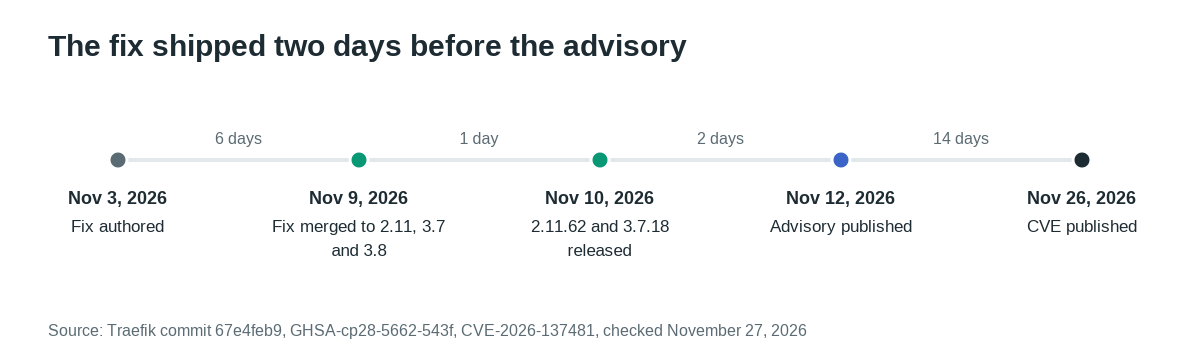
Timeline
- 2026-11-03: The fix is authored in commit 67e4feb9bdeca926d69d116cae536cc516684226.
- 2026-11-09: The fix is merged into the 2.11, 3.7 and 3.8 branches.
- 2026-11-10: Traefik 2.11.62, 3.7.18 and 3.8.0-rc.2 are released.
- 2026-11-12: The vendor advisory GHSA-cp28-5662-543f is published.
- 2026-11-26: The CVE record for CVE-2026-137481 is published.
FAQ
Does this affect every Traefik deployment?
No. The bypass needs a backend that strips path parameters and a host that shares that backend between a public router and a protected router. A deployment with uniform authentication on every router is not exposed.
Is sanitizePath off by default?
No. It is enabled by default. Disabling it does not fix the mismatch, because Traefik would then route on the raw path and the backend would still resolve it differently.
Which backends strip path parameters?
Servlet containers such as Tomcat and Jetty, and Spring applications, are the examples in the advisory. A backend that treats ;x as part of the segment name does not expose the protected path.
Can the attacker reach another host?
No. The request stays on the same host and the same backend. The bypass changes which router and middleware chain handle the path, not which upstream receives it.
Is Traefik 3.6 getting a patch?
No. The advisory states that Traefik 3.0 to 3.6 are end of life and will not receive a patch. Upgrade those deployments to 3.7.18 or later.
Was CVE-2026-137481 exploited in the wild?
No exploitation is known, and the CVE is not in CISA KEV as of 2026-11-27. The advisory publishes the request shape, so the bypass is easy to reproduce on a matching host.
References
- GitHub advisory GHSA-cp28-5662-543f, "sanitizePath does not remove path-parameter dot-segments (/..;x/), enabling path-based authorization bypass", published 2026-11-12 (checked November 27, 2026)
- CVE-2026-137481 record, published 2026-11-26 (checked November 27, 2026)
- Fix commit 67e4feb9bdeca926d69d116cae536cc516684226, "Resolve dot-segments and empty segments with path parameters" (checked November 27, 2026)
server_entrypoint_tcp.goat tag v2.11.61 (checked November 27, 2026)- Traefik 2.11.62 release (checked November 27, 2026)
- Traefik 3.7.18 release (checked November 27, 2026)
- Traefik 3.8.0-rc.2 release (checked November 27, 2026)
- Traefik repository (checked November 27, 2026)
traefikDocker Hub image (checked November 27, 2026)- CISA Known Exploited Vulnerabilities catalog, version 2026.11.25 (checked November 27, 2026)
Keep reading