
PHP2Shell: PHP RCE Bug Triggers Millions of Exploit Attempts (CVE-2026-109618)
PAN-OS is actively exploited; separately, a chain rooted 25 servers via an undisclosed vendor's firewalls: PHP RCE fixed in 8.5.12, 8.4.27, 8.3.36, 8.2.35.
TL;DR
PHP2Shell is the name researchers and vendors use for a pair of engine-level remote code execution bugs in PHP's request lifecycle.
- On October 26, Dream published the first confirmed real-world compromise chain: a suspected China-nexus attacker rooted 25 servers by October 24, three of them in a US government-affiliated environment, by chaining PHP2Shell with the Linux kernel bug CVE-2026-46300, starting from internet-facing firewalls of a vendor Dream does not name. Separately, Palo Alto Networks now reports active exploitation against PAN-OS management interfaces exposed to the internet, and Check Point reports the same bugs used against its gateways from October 30. CISA added the Check Point escalation flaw, CVE-2026-123039, to KEV on November 13 with a federal due date of November 16.
- Two memory-safety bugs in the PHP engine itself, CVE-2026-109618 (out-of-memory handling corrupts request state) and CVE-2026-109619 (stale global state survives into the next request), let an unauthenticated remote attacker execute code as the web worker. The bugs sit below any application: a clean WordPress, Drupal or Joomla install is exposed the same way.
- Every unpatched PHP installation that serves web requests is affected: PHP-FPM, Apache mod_php, php-cgi, FrankenPHP and LiteSpeed. The PHP security team rates both Critical, CVSS v4.0 9.2, and confirmed complete remote code execution over HTTP against mod_php with default limits.
- Exploit attempts surged within hours of disclosure and reached millions by October 22 (Cloudflare). Amazon's MadPot honeypots saw a first attempt on October 17, four days before disclosure.
- CISA added both flaws to its Known Exploited Vulnerabilities (KEV) catalog on October 26, with a federal patch deadline of October 29.
- On October 24 Adel Karimi confirmed remote code execution against honeypots: "This is now confirmed RCE with usable memory disclosure, not just a crash followed by a suspicious process." A public exploit won the StealMyBitcoin challenge on October 25.
- Update to PHP 8.5.12, 8.4.27, 8.3.36 or 8.2.35 now; the KEV listing makes this a deadline. PAN-OS 10.2, 11.1, 11.2, 12.1 and 12.2 embed affected PHP; Palo Alto Networks has released all 20 of its hotfix lines; the last, 11.1.7-h12, shipped late on October 29. If you cannot update today, the mitigations below only buy time.
Am I affected?
You are affected if both of these hold:
- The installation runs PHP 5.4 or newer and serves web requests through PHP-FPM, Apache mod_php, php-cgi, FrankenPHP or LiteSpeed. CLI-only installations that never parse request bodies are outside the demonstrated paths.
- For PHP 8.2 to 8.5, the version is older than the October 21, 2026 security release for its branch. PHP 7.4, 8.0 and 8.1 are end of life and affected in principle; the security team published minimal source backports for them. PHP 5.4 to 7.3 are also affected in principle, per Sysdig, with no backport from the PHP project.
Even if your application never calls request-body APIs, do not assume you are safe: the confirmed mod_php exploit triggers during request startup, before any application-specific code runs.
Check what you run, on the host and inside every container and CI image:
php -v
php -i | grep -E '^(memory_limit|post_max_size|session.upload_progress.enabled)'
apachectl -M 2>/dev/null | grep -i php      # Apache mod_php loaded?
php-fpm -v                                  # FPM pool version
docker ps --format '{{.Image}}' | sort -u   # images behind running containers
docker exec <container-name> php -v         # PHP inside a running container
docker images | grep php                    # locally pulled PHP image tags
For CI, check the image the pipeline actually builds, for example docker run --rm <registry>/<image>:<tag> php -v.
Palo Alto Networks lists PAN-OS 10.2, 11.1, 11.2, 12.1 and 12.2 as affected through their embedded PHP. Exposure is through the management plane only: the HTTPS web UI and the XML API. PAN-OS serves these on the management interface, or on any data plane interface with a management profile attached. GlobalProtect portals and gateways, Clientless VPN and the captive portal are not affected.
All twenty hotfix lines are released as of October 29, 2026: the advisory's changelog removed the last ETA for 11.1.7-h12 that evening, and the full list is in the advisory's table and the Timeline below. On October 27 Palo Alto Networks raised the impact to its products to Critical, CVSS-B 9.2 (CVSS:4.0/AV:N/AC:H/AT:N/PR:N/UI:N/VC:H/VI:H/VA:H/SC:N/SI:N/SA:N), with urgency HIGHEST. Its advisory now sets exploit maturity to ATTACKED and states that "active exploitation has been observed targeting the Palo Alto Networks management interface exposed to the internet". Its Cortex XCORE SaaS was affected and remediated on October 21.
| Branch | Affected versions | Fixed version |
|---|---|---|
| PHP 8.5 | 8.5.0 to 8.5.11 | 8.5.12 |
| PHP 8.4 | 8.4.0 to 8.4.26 | 8.4.27 |
| PHP 8.3 | 8.3.0 to 8.3.35 | 8.3.36 |
| PHP 8.2 | 8.2.0 to 8.2.34 | 8.2.35 |
| PHP 7.4, 8.0, 8.1 | all (end of life) | source backports published by the PHP security team |
| PHP 5.4 to 7.3 | all (end of life, affected in principle) | none from the PHP project; move to a supported branch |
The exposure is measured, not estimated. Qualys analyzed anonymized data from 12,000 customers:
- Only 199,000 PHP instances were patched within 12 hours of disclosure.
- Roughly 110 million instances, 71 percent of the PHP instances Qualys measured, run end-of-life PHP 5.4 through 8.1, which will never receive a vendor patch.
- Another 44 million run supported branches whose fixes had not yet been applied.
Censys tracks the internet-facing side of that lag in a public dashboard and counted more than 32.51 million PHP services still running an affected version as of October 27.
How do I fix it?
Update to the fixed release for your branch. Prefer your distribution's packages so the SAPI integrations stay consistent:
# Debian and Ubuntu (upgrades every installed php* package and Apache's mod_php)
sudo apt update
sudo apt install --only-upgrade $(dpkg -l 'php*' 'libapache2-mod-php*' | awk '/^ii/ {print $2}')
# RHEL, CentOS Stream, Rocky, Alma, Fedora
sudo dnf update 'php*'
# Containers: rebuild on a fixed tag and recreate the service
docker pull php:8.4.27
docker compose build --pull && docker compose up -d
Restart every PHP worker and the web server after the update. If you build from source or run an end-of-life branch, use the security team's 7.4, 8.0 and 8.1 backports, or move to a supported branch.
If you cannot update yet, these measures from the PHP advisory reduce specific attack paths. None of them makes an installation safe, and the advisory says so explicitly.
For CVE-2026-109618, remove the controllable memory limit and shrink the input surface:
; PHP-FPM pool (for example www.conf); php_admin_value stops apps from overriding it
php_admin_value[memory_limit] = -1
php_admin_value[post_max_size] = 8M   ; use 32M if you need file uploads
With Apache mod_php, set the same values in the Apache configuration:
php_admin_value memory_limit -1
php_admin_value post_max_size 8M
Also:
- Keep
upload_max_filesizebelowpost_max_size. - Enforce limits at the web server or proxy for decoded request size, input field count, multipart part count, header count and nesting depth, including requests without a usable Content-Length.
Do not use RLIMIT_AS or RLIMIT_DATA: forcing mmap() to fail reaches the vulnerable bailout path directly.
For CVE-2026-109619, in php.ini:
session.upload_progress.enabled = 0
; PHP 8.5 only:
fatal_error_backtraces = 0
In a PHP-FPM pool, use the pool syntax instead, then restart the workers:
php_admin_value[session.upload_progress.enabled] = 0
; PHP 8.5 only:
php_admin_value[fatal_error_backtraces] = 0
Three more steps:
- Do not rely on
ini_set(),.user.ini,error_reporting,@ordisplay_errors=Off; the advisory states the consumer runs before those take effect. - Remove invalid or deprecated INI settings applied per request, and fix attacker-reachable fatal errors and execution timeouts.
- Consider
pm.max_requests = 1if performance allows.
That FPM setting only helps against CVE-2026-109619, because it stops a second request from reaching the same worker; it does nothing against CVE-2026-109618, which is triggered and consumed within a single request.
For PAN-OS deployments that cannot take a hotfix yet, Palo Alto Networks' advisory gives threat-prevention coverage and four configuration steps. Enable Threat ID 543004 and the 24 Threat IDs between 97622 and 97678 that the advisory lists, from Applications and Threats content version 9162 or later, then make that coverage effective:
- Route incoming traffic for the MGT port through a DP port, for example by enabling a management profile on a DP interface for management access.
- Replace the certificate for inbound traffic management.
- Decrypt inbound traffic to the management interface so the firewall can inspect it.
- Enable threat prevention on the inbound traffic to management services.
Customers with Frontier Virtual Patching (ATP Plus) on PAN-OS 12.2.4 and later already received advance coverage through Threat ID 543004, released at 10:21 PM PT on October 20.
What is the root cause?
Both bugs are consequences of PHP's bailout mechanism, a longjmp() that aborts a request from deep inside the engine, combined with state that a long-lived worker keeps between requests.
CVE-2026-109618: PHP aborts the request with longjmp() on an out-of-memory (OOM) error. Request memory is sometimes reachable before it is fully initialized. If an allocation fails then, the advisory states, "PHP does not properly account for the early exit and leaves the request memory in an invalid state. The failed allocation does not need to be related to the invalid memory. The request shutdown procedure may then read or branch on it."
An attacker does not need a real memory shortage. Several multipart parsing quirks let one HTTP request exhaust memory_limit on demand:
- A multipart body without a usable Content-Length passes the initial
post_max_sizecheck while still feeding data. - A single part can carry an unrestricted number of headers whose in-memory representation is much larger than the wire format.
- Empty file controls create metadata arrays without counting toward
max_file_uploads.
CVE-2026-109619: the worker keeps global state (error, session, object and extension state) that temporarily points into request-owned memory, and must reset it before freeing the request heap. Two failure modes break that reset:
- A fatal error, including memory exhaustion or
Maximum execution time exceeded, can abandon an operation before its reset. - A late nonfatal diagnostic can repopulate cleared error state.
The heap is then freed while the worker's global still refers to it.
Two confirmed consumers read this stale state before the next request initializes:
- Warnings raised while INI settings are applied. With mod_php,
.htaccessand Apachephp_valuerun beforephp_request_startup(). - Session upload progress handling, which reaches session state before ordinary session initialization. It is enabled by default and needs no call to
session_start().
How is it exploited?
The CVE-2026-109618 attack is a crafted multipart request that exhausts memory_limit during startup. A failed allocation bails out while request memory is half-initialized, and mod_php's shutdown then reads that invalid state before any application code runs.
A public PoC exists, but it is calibrated to the StealMyBitcoin challenge's Alpine build and aborts on other builds. No publicly released exploit works against production builds out of the box. VulnCheck documents its own chain that does work on production-configured x86-64 systems, described below. Working tooling also exists on attacker infrastructure. The underground agrees on the gap: "In practice it's unexploitable crap. To exploit real targets you need the offsets from libphp.so, which are unique to every build and impossible to brute-force", a member of the XSS forum wrote, in a post Flare translated from Russian for its October 23 analysis. The Dream artifacts below show one attacker closing that gap privately, by extracting offsets from each targeted firmware version. The confirmed mod_php path, step by step:
- The attacker sends a multipart request crafted to exhaust
memory_limitduring request startup: no usable Content-Length, and a part with a very large header count, or empty file controls that create metadata arrays without counting towardmax_file_uploads. - An allocation fails and PHP bails out with
longjmp()while request memory is half-initialized. - mod_php unconditionally runs the request shutdown procedure even though startup failed, so shutdown processes the invalid state, before any application code has run.
- A strategically arranged heap turns the reads and branches on invalid state into control-flow hijack, and the attacker runs code as the web worker account.
For CVE-2026-109619, the attack needs two requests on the same worker:
- Producer and consumer: a producer request publishes request-owned state and then dies fatally (OOM, timeout, parse failure). A consumer request reaches the stale state before initialization resets it.
- Strongest demonstrated case: a fatal error with
fatal_error_backtracesenabled stores backtrace state that shutdown never resets. - Session path: an upload initializes session and decoder state early, an OOM abandons the reset, and the next request's upload-progress handling consumes the dangling pointers.
Two vendors documented working tooling:
- SOCRadar: a self-described one-click exploit for PHP 8.4.26 under mod_php, found on an exposed attacker server. It recycles the worker, leaks addresses through the session cookie to defeat ASLR, and uses session upload progress to run a shell command. The server also held screening scripts against about 20 sites, none of which met the exploit's preconditions as of October 22.
- VulnCheck: a chain of both CVEs that leaks memory to bypass ASLR and achieves code execution on PHP 8.4.26 on x86-64 with ASLR enabled and
display_errors=off, the production-recommended setting. VulnCheck says it knows of no other public or commercial exploit that does the same.
How does the CVE-2026-109618 exploit chain flow?
The OOM-to-code-execution sequence on mod_php, end to end:
no Content-Length, huge part headers"] --> B["Body parsing exhausts
memory_limit at startup"] B --> C["longjmp() bailout leaves
request memory half-initialized"] C --> D["mod_php still runs
request shutdown"] D --> E["Shutdown reads and branches
on invalid state"] E --> F["Heap control gives
code execution as the web worker"] style C fill:#f8d7da
What can an attacker do?
Successful exploitation gives unauthenticated remote code execution with the web worker's privileges: reading API keys, database credentials, environment variables and files the worker can reach, and a foothold to move further, as VulnCheck describes. Conditions it needs:
- Network access to the PHP endpoint, nothing else. No authentication, no user interaction.
- The conditions that push CVSS attack complexity to High: a worker that stays alive across requests and, for the OOM path, either a finite
memory_limitthe attacker can reach or an allocation that can be made to fail. - Same-worker request pairing for CVE-2026-109619; extra workers and recycling lower reliability but do not remove the condition, per the advisory.
How was it exploited against firewalls in the wild?
A suspected China-nexus attacker chained PHP2Shell with the Linux kernel bug CVE-2026-46300 ("Fragnesia") to root 25 servers by October 24, 2026, three of them in a US government-affiliated environment, in the first confirmed real-world compromise through these flaws.
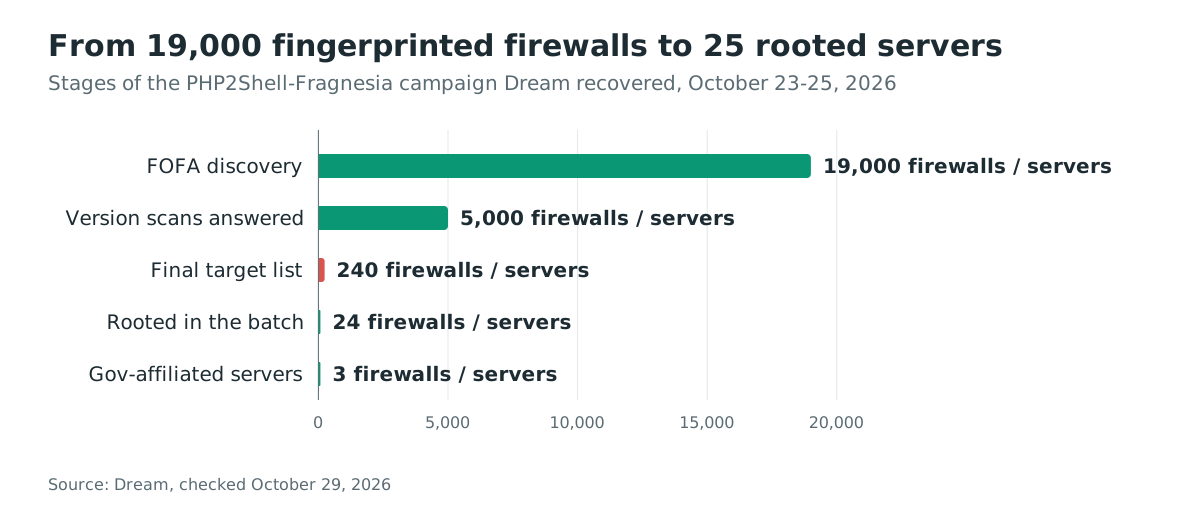
Dream recovered the operation's artifacts and published them on October 26. The attacker used FOFA to find about 19,000 internet-facing firewalls from one undisclosed vendor, ran a version scanner, to which about 5,000 devices responded, filtered to 240 targets in the United States, Japan, Taiwan and South Korea running firmware branches with PHP 8.0.30, and fed them to an automated batch runner.
The campaign rooted 24 firewalls, planting a 103-byte PHP root web shell in a publicly accessible directory on each and logging successes to a CSV; 22 of them were then left parked. Two belonged to a US government-affiliated organization. The batch rooted the first on October 23, but that firewall crashed under the roughly 900 MB of exploit traffic and never returned.
The second had timed out during the batch. A dedicated follow-up campaign rooted it on October 24, and through it an eight-port reverse SSH tunnel, wrapped in a systemd service and an rc.local hook so it survives reboots, reached the organization's internal firewall management server, the third government-affiliated server, which was rooted as the 25th server the same day.
From the management server, the attacker turned to Active Directory:
- Decrypted the LDAP service-account password from the device configuration.
- Enumerated every user and group in the domain.
- Sprayed organization-themed passwords against every account in a domain with lockoutThreshold=0.
- Attempted to create backdoor user and machine accounts.
- Attempted to extract the SAML signing key from the Keycloak identity provider configuration.
Whether the spray, the backdoor accounts or the SAML key extraction succeeded is not known: those results were not among the recovered artifacts.
The exploit is a custom, non-public build tailored to the targeted firewall platform, not a copy of any public PoC. Dream describes four stages against the firewall's appweb management server, which runs PHP 8.0.30 with a high memory limit:
- About 383 MB of memory exhaustion through crafted multipart requests.
- A forged stale session ID that triggers an out-of-bounds read and leaks the libphp.so base address through the Set-Cookie response.
- A second round of memory pressure, about 500 MB, that leaves a live zend_reference with mod_data set to NULL.
- A final request that forges a PHP HashTable entry whose pDestructor callback points to zif_system, so the cleanup handler executes a shell command as the nobody user.
The full chain, from unauthenticated HTTPS connection to persistent root web shell, completes in under 15 minutes.
How does Fragnesia (CVE-2026-46300) take the chain to root?
Code execution as nobody is not root on these devices, because SELinux confines the httpd_t context from modifying system files. The attacker chained CVE-2026-46300, a Linux kernel local privilege escalation rated CVSS v3.1 7.8 (CVSS:3.1/AV:L/AC:L/PR:L/UI:N/S:U/C:H/I:H/A:H), whose CVE record was published in May 2026.
In skb_try_coalesce(), the kernel can attach paged fragments from one socket buffer to another, but it loses the SKBFL_SHARED_FRAG marker when it does. ESP input checks skb_has_shared_frag() to decide whether an uncloned, nonlinear socket buffer can skip skb_cow_data(); when TCP receive coalescing has moved shared fragments into an unmarked buffer, ESP sees the check as false and decrypts in place over page-cache-backed fragments.
Fragnesia turns that into page-cache writes that overwrite /etc/pam.d/su with pam_permit.so, so su root succeeds without a password. CISA added CVE-2026-46300 to KEV on October 28 with a due date of October 31, stating it "can be chained with CVE-2026-109618 and CVE-2026-109619 to implant PHP webshells and run commands as root".
The kernel fix, "net: skbuff: preserve shared-frag marker during coalescing", propagates SKBFL_SHARED_FRAG when paged fragments are transferred. It is in stable branches 5.10.257, 5.15.208, 6.1.174, 6.6.141, 6.12.91, 6.18.33 and 7.0.10, and in 7.1; the flaw was introduced in kernel 3.9.
On firewall and other appliance platforms the kernel comes from the appliance vendor: Palo Alto's advisory covers the PHP flaws, so ask the vendor about the kernel side when applying the hotfix.
On standard Linux servers, apply the distribution kernel update that carries the fix and reboot. Distribution kernels backport the fix without moving to these upstream version numbers, so compare the running kernel with your distribution's advisory for CVE-2026-46300, not with the list above:
uname -r # look this version up in your distribution's CVE-2026-46300 advisory
A server that runs an unpatched PHP build on an unpatched kernel is exposed to the whole chain, not only to the PHP half.
How was PHP2Shell used against Check Point gateways?
Check Point reported on November 12, 2026 that an attacker used PHP2Shell against Mobile Access portals on unpatched Check Point Security Gateways, beginning on October 30, 2026. The first wave targeted Israeli organizations. A second wave on November 2 targeted organizations in several countries with no apparent sector focus.
Check Point found PHP session artifacts under /opt/CPcvpn-R81.20/tmp/, including files carrying the upload_progress_pwn marker. The portal's Apache/PHP workers also logged hundreds of segmentation faults during the same window.
The attacker escalated from the portal service account to root with CVE-2026-123039, a local privilege escalation in the Gaia OS DynamicCLI daemon. That daemon runs as root and listens on the world-writable local socket /tmp/dynamic_socket without authenticating connecting processes. A local user can send a command to the socket and have it executed as root.
The CVE record lists R81.20 with Jumbo Hotfix Take 173 or below, R82 with Take 130 or below, R82.10 with Take 50 or below, and R82.20 with Take 10 or below as affected. It rates the flaw CVSS v3.1 7.8 (CWE-862 and CWE-732) and was published on November 12, 2026.
CISA added CVE-2026-123039 to its KEV catalog on November 13, 2026, with a federal due date of November 16, 2026.
With root, the attacker wrote PHP web shells as zz*.tpl files in the portal's template directory. The expanded shell uses the hardcoded key zz2026 and saves uploads to /tmp/.up.tpl. The attacker then ran TSGA from /tmp/CPconfigdaemon.
The implant copies itself to the boot persistence directory as slot_CPconfigdaemon. It writes TSProxy to /lib/libcpfwcommon.so, where the library is loaded into appliance processes to proxy attacker traffic. TSGA accepts inbound connections on TCP port 11072 on all IPv4 interfaces and also listens on the Unix socket /tmp/.p_sock.
From the gateway, the attacker ran the gogo scanner and reached a VMware ESXi host over SSH with the vpxuser account. On the ESXi host, the attacker executed the destroy_v6 wiper, which overwrites files with zeros and writes DREAM_ANNEXATION.txt to each directory it processes.
Check Point links TSGA and TSProxy to the PhiliKit toolset previously used against Ivanti appliances. It says the evidence does not establish the actor's identity with high confidence. The destructive wave and the DREAM_ANNEXATION.txt branding do not fit known China-nexus motives, and Check Point lists a false-flag operation among the plausible explanations.
Which vendors are affected?
Products that embed PHP inherit the exposure, and the vendor advisory list has widened sharply. Palo Alto Networks confirmed PAN-OS 10.2, 11.1, 11.2, 12.1 and 12.2 are affected through embedded PHP, and reports active exploitation against internet-exposed management interfaces.
Beyond PAN-OS, advisories naming PHP2Shell impact now cover dozens of vendors, including:
- Network and security: Arista Networks, Check Point, F5, Huawei, NETGEAR, SonicWall
- Infrastructure and storage: Broadcom, Dell, HPE, IBM, QNAP, Synology, Veeam
- Software and SaaS: Citrix, Ivanti, Okta, Salesforce, Splunk
CMS projects such as Drupal, Craft CMS and WordPress have published advisories too.
On the industrial side, SecurityWeek reports these statuses:
- Schneider Electric patched EcoStruxure Security Expert 1.48.4.0 and its ProLeiT LINEoptimize and EcoStruxure Control Engineering products.
- Siemens listed Ruggedcom APE1808 as affected through its embedded PAN-OS and published an unaffected-product list.
- An ABB manufacturing execution system embedding DokuWiki was flagged.
- B&R listed APROL releases up to R4.4-65 as affected.
- Rockwell Automation and Johnson Controls were still assessing.
If you operate appliances from any of these vendors, patch verification now means checking their advisories, not only your PHP versions.
Why does the fix work?
One commit, 3584a98bda ("Avoid state corruption via bailout", authored October 18, 2026, merged October 21), fixes both CVEs. Its message names the two changes exactly:
- Replace bailout on OOM with UnwindExit
- Properly reset various globals that may be accessed during startup
For the OOM path, the patch removes the longjmp() bailout as the OOM response. A soft OOM is now recorded and deferred to the next VM safe point:
EG(delayed_oom).message = zend_string_init(buf, strlen(buf), /* persistent */ true);
GC_MAKE_PERSISTENT_LOCAL(EG(delayed_oom).message);
zend_string_addref(script_filename);
EG(delayed_oom).filename = script_filename;
EG(delayed_oom).lineno = script_lineno;
EG(delayed_oom).state = ZEND_OOM_STATE_PENDING;
zend_atomic_bool_store_ex(&EG(vm_interrupt), true);
The shutdown procedure can no longer observe partially initialized state, because OOM is handled at a point where the executor is consistent. The patch also adds a hard memory limit above memory_limit: by default twice memory_limit, or memory_limit plus 1 GiB when the limit exceeds 1 GiB. An allocation that would cross it ends the process at once with _exit() instead of unwinding.
For the stale-state path, the patch resets request-owned globals at the end of each request. Nothing the next request reads before its normal initialization still points into freed memory. For example, the executor shutdown now clears the error and exception state:
/* may be used by zend_error_zstr_at before init_executor */
EG(record_errors) = false;
EG(num_errors) = 0;
EG(errors) = NULL;
EG(error_handling) = EH_NORMAL;
EG(exception) = NULL;
The fix is complete for the demonstrated paths, and the advisory says the wider state reset is preventive: other error, exception, object and extension state families are covered by the reset, but whether they were reachable depends on each application's producers and consumers.
How do I check if I was compromised?
Watch for these five signals in logs and session files. Any of them warrants investigation, and none requires access to application code.
- In web server and PHP-FPM logs: bursts of multipart requests with missing or unusable Content-Length, repeated worker segfaults or OOM kills on requests that never reached application code, and
Maximum execution time exceededon attacker-reachable routes. - PHP session files containing unexpected code: VulnCheck observed a China-based IP attempting to drop a web shell through server-side session files.
- Session upload-progress fields in multipart requests: the StealMyBitcoin-winning PoC triggers its OOM stage in upload-progress parsing, and observed scanning probes use these fields too. This makes
session.upload_progress.enabled = 0a mitigation with demonstrated relevance. - Mirai-family follow-on traffic: Sophos tied attempts to the Potassium botnet variant, with connections to 134.199.154.64 on TCP port 50792 and DNS lookups for thunder.godofthunder.st; Wordfence published the source IPs it tracked.
- Environment-variable and credential enumeration from web workers, which several vendors describe as the goal of the scanning wave.
On appliances exposed through their management interfaces, hunt the artifacts Dream recovered from the firewall campaign:
- Unexpected outbound SSH tunnels: systemd services and rc.local entries that reconnect an eight-port reverse tunnel, including a SOCKS5 proxy, to attacker infrastructure.
/etc/pam.d/sucontainingpam_permit.so, the Fragnesia overwrite that letssu rootsucceed without a password.- Unexpected
.phpfiles in publicly accessible directories on the firewall, including 103-byte web shells. - Bursts of roughly 900 MB of multipart traffic from a single source against the management interface, and management-interface crashes that follow them.
- On the Active Directory side: LDAP user and group enumeration bursts, organization-themed password sprays in domains with lockoutThreshold=0, attempted backdoor user and machine accounts, and Keycloak SAML signing-key extraction attempts.
- On Check Point gateways:
zz*.tplfiles in the Mobile Access portal template directory,/tmp/CPconfigdaemonorslot_CPconfigdaemon,/lib/libcpfwcommon.so, the Unix socket/tmp/.p_sock, inbound connections to TCP port 11072, and session files under/opt/CPcvpn-R81.20/tmp/containing theupload_progress_pwnmarker. A destroyed ESXi datastore may carryDREAM_ANNEXATION.txt.
As of November 14, the confirmed real-world compromise record covers the Dream chain, with 25 servers rooted by October 24, and the Check Point gateway campaign that began on October 30. Dream could not determine the full extent of its campaign, and the confirmed demonstrations before Dream ran against targets configured to be exploitable, not against victims.
Adel Karimi verified complete remote code execution against his single-worker mod_php honeypots on October 24. He reported "an 800 KiB decoded cookie dump, and a function address derived from that dump using the public exploit's offsets appears in the subsequent execution payload".
The StealMyBitcoin challenge, a deliberately vulnerable PHP 8.4.26 target with a 0.0251 BTC prize, was won on October 25 after 19.28 hours. The public PoC leaks heap and code addresses, defeats ASLR and forges a HashTable to reach zif_system in at most 20 requests. Its offsets are calibrated to the challenge's Alpine build and abort at the code-leak stage on other builds.
Palo Alto Networks' Unit 42 reported on October 25 that a European government entity had been compromised through these flaws, then retracted the attribution the same day. It saw "an attack against a European government agency executed in the context of a vulnerable PHP application" but was "unable to confirm that initial access is associated with the specific PHP2Shell CVEs", the company told The Hacker News.
Timeline
- Since 2012: the vulnerable code paths exist from PHP 5.4 onward, per Sysdig's analysis.
- 2026-10-17: the first exploitation attempt later observed by Amazon's MadPot honeypot network, four days before disclosure.
- 2026-10-20: PHP publishes an advance notice of a critical release scheduled for October 21 at 14:00 UTC, both flaws rated CVSS v4.0 9.2.
- 2026-10-21: PHP releases 8.5.12, 8.4.27, 8.3.36 and 8.2.35 with advisories GHSA-w8hw-w9fx-j79w and GHSA-6wmf-4rv5-p3rp. Previdian records its first exploit attempt at 13:05 UTC; Cloudflare counts tens of thousands of attempts within 45 minutes of publication, and millions by early October 22. Palo Alto Networks publishes its PAN-OS advisory.
- 2026-10-22: The UK confirms 32 digital services taken offline as a precaution and the NCSC issues about 50,000 warnings; Sophos documents a public proof of concept and the Potassium attempts.
- 2026-10-23: SOCRadar documents one-click exploit tooling on an attacker server; Censys counts more than 34.4 million PHP services still vulnerable; PHP publishes an informational advisory for the related, still-unfixed CVE-2026-115560, recommending
session.upload_progress.enabled=0until the next regular release. - 2026-10-24: Palo Alto Networks updates its advisory with per-branch hotfix ETAs of October 27 to 30; Adel Karimi confirms complete remote code execution against single-worker mod_php honeypots, with a usable memory disclosure and an executed payload derived from the leaked addresses.
- 2026-10-25: This post is first published. Palo Alto Networks releases the first three PAN-OS hotfixes (10.2.18-h13, 11.1.16-h4, 11.2.10-h16); Unit 42 reports, then retracts the same day, a suspected government-entity compromise through these flaws; the StealMyBitcoin challenge, a deliberately vulnerable PHP 8.4.26 target, is won after 19.28 hours by a public ASLR-defeating PoC.
- 2026-10-26: Four more PAN-OS hotfixes are released (11.1.4-h38, 11.1.6-h40, 11.1.10-h36, 11.1.13-h16); CISA adds CVE-2026-109618 and CVE-2026-109619 to its KEV catalog with a federal due date of October 29.
- 2026-10-27: Palo Alto Networks releases 10.2.13-h27, 10.2.16-h12, 12.1.7-h11 and 12.2.4-h1, bringing the released lines to eleven, then raises the PAN-OS severity to Critical with urgency Highest; an oss-security thread shows operators of custom PHP 5.4 to 5.6 builds privately backporting the fix; this post is updated with the KEV listing and the vendor advisory list.
- 2026-10-28: Palo Alto Networks releases 11.2.7-h23, 11.2.13-h4 and 11.2.16-h1 and its advisory now reports active exploitation of internet-exposed management interfaces; CISA adds CVE-2026-46300 (Fragnesia) to KEV with a due date of October 31, noting the chain with the PHP flaws; Dream's chain analysis reaches wide coverage.
- 2026-10-29: The remaining PAN-OS hotfix lines 10.2.7-h39, 10.2.10-h42, 11.2.4-h23, 12.1.4-h13 and 12.1.10-h3 are released, and the advisory removes the ETA for 11.1.7-h12 that evening as released, closing all 20 lines; this post is updated with the Dream compromise chain, the Fragnesia KEV listing and the PAN-OS exploitation status.
- 2026-11-12: Check Point publishes the gateway campaign: PHP2Shell initial access, CVE-2026-123039 privilege escalation, the TSGA backdoor and an ESXi wiper.
- 2026-11-13: CISA adds CVE-2026-123039 to its KEV catalog with a federal due date of November 16, 2026.
FAQ
Is PHP-FPM as exposed as mod_php?
Both are affected, but differently. mod_php is the confirmed target with no application-specific prerequisites, because it runs request shutdown even after failed startup. FPM exits a child when startup fails, which blocks that exact sequence, but the advisory validates a separate FPM path that publishes state during application execution and consumes it in a later upload-progress request, and source analysis leaves FPM susceptible to the OOM path as well.
Does disabling error display or logging protect me?
No. The advisory is explicit that global state is touched before PHP decides whether to report, display or log a warning, and before error_reporting, @ or display_errors take effect. These settings only change what you see, not what the engine does with stale state.
My site runs clean, up-to-date application code. Am I safe?
No. The bugs are in the engine, so application hygiene does not change exposure. Sysdig notes any WordPress, Drupal or Joomla site is exposed regardless of its code quality, and Censys counted more than 34.4 million PHP services still vulnerable on October 23.
What about the third bug, CVE-2026-115560?
It is real but narrow, and unfixed as of October 27. Exploitation requires an application that sets session.serialize_handler to php_binary or php_serialize in its configuration and switches it back to php at runtime with ini_set() before calling session_start(), with session upload progress still enabled. PHP is fixing it in the next regular release; until then, keep session.upload_progress.enabled=0, which the October 21 advisory already recommended for CVE-2026-109619.
Is there a working exploit in the wild?
Treat the bugs as exploited. CISA added both flaws to its KEV catalog on October 26, its confirmation of active exploitation, and Karimi's honeypots recorded complete RCE on October 24. Dream then documented a real-world chain that rooted 25 servers by October 24 using a private, per-version-calibrated exploit, and Palo Alto Networks now reports active exploitation of internet-exposed PAN-OS management interfaces. The public PoCs alone remain unreliable against production builds, so exploitability still depends on the attacker's effort to calibrate offsets, exactly as the Dream artifacts show.
VulnCheck's chain works against production-configured x86-64 systems. The StealMyBitcoin winner targeted a deliberately vulnerable build with calibrated offsets. Read each for what it proves, not as a victim count, and patch on the KEV deadline.
Do I need to patch if PHP is only used for CLI scripts?
The demonstrated attack paths require request-body parsing, so a CLI-only installation is outside them. Update anyway: the fixed versions carry the state-reset hardening, and CLI hosts often gain a web endpoint later.
Inventory your PHP exposure
Use Ostorlab Attack Surface Discovery to inventory the internet-facing domains and hosts you own. Check their PHP versions and appliance advisories against the affected ranges above, including end-of-life branches and embedded PHP, then verify the patches on each instance.
References
- PHP security advisory, "Security advisory: Critical remote code execution vulnerabilities, update now", October 21, 2026, with both CVE descriptions and the incomplete-workaround list: https://www.php.net/archive/2026.php#2026-10-21-5 (checked October 25, 2026)
- GHSA-w8hw-w9fx-j79w, "RCE via OOM corruption", full OOM strategies, SAPI susceptibility and patch description: https://github.com/php/php-src/security/advisories/GHSA-w8hw-w9fx-j79w (checked October 25, 2026)
- GHSA-6wmf-4rv5-p3rp, "RCE via stale global state", producer and consumer model, confirmed cases and mitigations: https://github.com/php/php-src/security/advisories/GHSA-6wmf-4rv5-p3rp (checked October 25, 2026)
- CVE-2026-109618 record with the CVSS v4.0 9.2 vector and credits (Ryan at Calif.io, Wiz, OpenAI as reporters; Arnaud Le Blanc, Ilija Tovilo and Jakub Zelenka as remediation developers): https://cveawg.mitre.org/api/cve/CVE-2026-109618 (checked October 25, 2026)
- CVE-2026-109619 record with the CVSS v4.0 9.2 vector: https://cveawg.mitre.org/api/cve/CVE-2026-109619 (checked October 25, 2026)
- Fix commit 3584a98bda, "Avoid state corruption via bailout", replacing the OOM bailout and resetting startup-accessed globals: https://github.com/php/php-src/commit/3584a98bda (checked October 25, 2026)
- PHP informational advisory on session upload progress and CVE-2026-115560, October 23, 2026: https://www.php.net/archive/2026.php#2026-10-23-1 (checked October 25, 2026)
- CISA KEV catalog: CVE-2026-109618 and CVE-2026-109619 added October 26, 2026, due October 29, 2026, with the federal required action and the BOD 26-04 reference: https://www.cisa.gov/known-exploited-vulnerabilities-catalog (checked October 27, 2026, via the catalog's JSON feed)
- The Hacker News, "CISA Confirms Active Exploitation of Two PHP2Shell Flaws Enabling Remote Code Execution", October 27, 2026, carrying Karimi's honeypot-RCE quotes, the Censys 32.51 million figure and the widened vendor advisory list: https://thehackernews.com/2026/10/cisa-confirms-active-exploitation-of.html (checked October 27, 2026)
- Adel Karimi's PHP2Shell honeypot evidence reports, including the October 24 confirmed-RCE dataset: https://github.com/0x4D31/honeypot-data (referenced via The Hacker News and SecurityWeek, checked October 27, 2026)
- StealMyBitcoin challenge site, documenting the October 25 win after 19.28 hours and the 0.0251 BTC prize, and the winning public PoC with its stage table and build-calibration caveats: https://stealmybitcoin.com/ and https://github.com/KillaBoi/StealMyBitcoin-PoC (checked October 27, 2026)
- SecurityWeek on industrial vendors checking their products for PHP2Shell, October 26, 2026, with the Schneider, ProLeiT, Siemens Ruggedcom, ABB, B&R, Rockwell and Johnson Controls statuses: https://www.securityweek.com/industrial-vendors-check-their-products-for-php2shell-vulnerabilities/ (referenced via The Hacker News, checked October 27, 2026)
- oss-security thread on privately backported PHP 5.4 to 5.6 patches for CVE-2026-109618, October 27, 2026: https://www.openwall.com/lists/oss-security/2026/10/27/1 (checked October 27, 2026)
- Palo Alto Networks advisory on the impact of CVE-2026-109618 and CVE-2026-109619 on PAN-OS, updated October 29, 2026: exploit maturity ATTACKED with "active exploitation has been observed targeting the Palo Alto Networks management interface exposed to the internet", severity raised to Critical CVSS-B 9.2, all 20 hotfix lines released by October 29, threat-prevention coverage and the four mitigation steps: https://security.paloaltonetworks.com/CVE-2026-109618 (checked October 30, 2026)
- Dream, "Chained PHP2Shell Exploit Roots 25 Servers, including US Government Servers", October 26, 2026: the campaign funnel, the four exploit stages against the firewall's appweb server on PHP 8.0.30, the Fragnesia chain, the reverse-SSH tunnel and the Active Directory attacks, with the caveats on what could not be determined: https://dreamgroup.com/blog/chained-php2shell-exploit-roots-25-servers (checked October 29, 2026)
- The Hacker News, "Attackers Exploit PHP2Shell Flaws in Internet-Exposed Palo Alto Networks Management Interfaces", October 29, 2026, carrying the advisory update, the full PAN-OS hotfix matrix and the Fragnesia KEV addition: https://thehackernews.com/2026/10/attackers-exploit-php2shell-flaws-in.html (checked October 29, 2026)
- The Hacker News, "PHP2Shell Attack Roots 25 Servers, Breaches U.S. Government-Affiliated Network", October 28, 2026: https://thehackernews.com/2026/10/php2shell-attack-roots-25-servers.html (checked October 29, 2026)
- CVE-2026-46300 (Fragnesia) record: CVSS v3.1 7.8, affected since kernel 3.9, stable fixes in 5.10.257, 5.15.208, 6.1.174, 6.6.141, 6.12.91, 6.18.33, 7.0.10 and 7.1, with the skb_try_coalesce shared-frag root cause: https://cveawg.mitre.org/api/cve/CVE-2026-46300 (checked October 29, 2026)
- CISA KEV catalog: CVE-2026-46300 added October 28, 2026, due October 31, 2026, "can be chained with CVE-2026-109618 and CVE-2026-109619 to implant PHP webshells and run commands as root": https://www.cisa.gov/known-exploited-vulnerabilities-catalog (checked October 29, 2026, via the catalog's JSON feed)
- Flare, "PHP2Shell Exploits: What the Underground Really Thinks", October 23, 2026, quoting the XSS and Exploit.in threads on why the public PoCs do not yield reliable RCE on production builds: https://flare.io/learn/resources/blog/php2shell-exploits-underground-analysis (checked October 29, 2026)
- The Hacker News carrying Unit 42's October 25 retraction of the government-entity compromise attribution, with the spokesperson statement: https://thehackernews.com/2026/10/php2shell-exploitation-hits-government.html (checked October 26, 2026)
- Sophos on the public proof of concept and the unsuccessful Potassium Mirai-variant attempts: https://www.sophos.com/en-us/blog/proof-of-concept-exploit-released-for-php-vulnerabilities-109618-109619 (via The Hacker News, October 23, 2026: https://thehackernews.com/2026/10/php2shell-exploit-attempts-hit-millions.html, checked October 25, 2026)
- VulnCheck on the ASLR-bypassing exploit chain and the session-file web-shell attempt: https://www.vulncheck.com/blog/php2shell-vulnerabilities (checked October 25, 2026)
- SOCRadar on the one-click mod_php tooling found on an attacker server: https://socradar.io/blog/php2shell-exploit-tooling-attacker-server/ (checked October 25, 2026)
- Previdian telemetry for both CVEs, first event October 21 at 13:05 UTC, no successful RCE observed: https://previdian.com/CVE-2026-109618#telemetry (checked October 25, 2026)
- UK Parliament record confirming 32 digital services unavailable and the NCSC's approximately 50,000 warnings: https://hansard.parliament.uk/Lords/2026-10-22/debates/14CB4C6D-4E16-4377-8FCF-C2CF77BB5CC0/details (checked October 25, 2026)
- Censys count of more than 34.4 million vulnerable PHP services as of October 23, 2026: https://php2shell.censys.com/ (checked October 25, 2026)
- SecurityWeek, "Mirai Botnet Operators Join PHP2Shell Attacks as ASLR Bypass Exploits Emerge", October 23, 2026, carrying Qualys's patching analysis of 12,000 customers (199,000 instances patched within 12 hours; about 110 million instances, 71 percent, on end-of-life PHP 5.4 through 8.1; 44 million more on supported-but-unpatched branches): https://www.securityweek.com/mirai-botnet-operators-join-php2shell-attacks-as-aslr-bypass-exploits-emerge/ (checked October 26, 2026)
- Qualys analysis of the October 2026 critical release: https://blog.qualys.com/vulnerabilities-threat-research/2026/10/20/php-announces-critical-security-release-for-two-vulnerabilities (via SecurityWeek, October 23, 2026)
- Amazon on exploit attempts from October 17 against its MadPot honeypots: https://thehackernews.com/2026/10/someone-tried-to-exploit-php2shell-4.html (checked October 25, 2026)
- Sysdig on the vulnerable code dating back to PHP 5.4 (2012): https://www.sysdig.com/blog/php2shell-cve-2026-109618-and-cve-2026-109619-detecting-unauthenticated-remote-code-execution-in-php-core (checked October 25, 2026)
- Check Point Research, "PHP2Shell Exploitation on Check Point Gateway", November 12, 2026, the campaign timeline, the CVE-2026-123039 privilege escalation, the TSGA and TSProxy components and the indicators: https://research.checkpoint.com/2026/php2shell-exploitation-on-check-point-gateway/ (checked November 13, 2026)
- CVE-2026-123039 record, the Gaia OS DynamicCLI local privilege escalation, with the affected Jumbo Hotfix takes and the CVSS v3.1 7.8 score: https://www.cve.org/CVERecord?id=CVE-2026-123039 (checked November 13, 2026)
- CISA KEV catalog: CVE-2026-123039 added November 13, 2026, due November 16, 2026, with the federal required action and the BOD 26-04 reference: https://www.cisa.gov/known-exploited-vulnerabilities-catalog (checked November 14, 2026, via the catalog's JSON feed)
- Check Point support article sk1000362 for CVE-2026-123039, the vendor advisory the CVE record cites: https://support.checkpoint.com/results/sk/sk1000362 (checked November 13, 2026)