
Ostorlab vs Quokka Q-mast: Mobile DAST Comparison
Ostorlab vs Quokka Q-mast for mobile DAST: authenticated flows, TLS pinning bypass, PCAP evidence, geo-restricted apps, API scanning and Agentic Deep Scan.
Let's face a hard reality about modern mobile engineering: the apps your team ships are no longer self-contained client-side binaries. They are dynamic, high-speed gateways to cloud architectures, microservices, and complex backend APIs.
For DevSecOps teams, this evolution breaks traditional security testing. Static-only scanners and rigid, black-box dynamic tools simply cannot keep up with how apps operate in the real world. Real-world vulnerabilities rarely sit passively in an isolated app package. They trigger during live execution, hiding in the messy interactions between the app UI, the local operating system, and your backend servers.
If your engineering team is evaluating Mobile Application Security Testing (MAST) tools, you have likely narrowed the field to Ostorlab and Quokka Q-mast (formerly Kryptowire). While both tools provide dynamic analysis without requiring raw source code access, they are built on completely different philosophies:
- Quokka Q-mast leans heavily into automated Software Bill of Materials (SBOM) generation, static binary checks, and mapping checklists to rigid federal compliance standards like NIAP and NIST.
- Ostorlab delivers a full-stack Mobile DAST engineered specifically for high-velocity software pipelines. It is designed from the ground up to bypass runtime security barriers, handle complex authentication natively, and inspect backend API traffic without slowing down developers.
Beyond foundational DAST, Ostorlab introduces an optional Agentic Deep Scan module. Think of this as an autonomous AI penetration tester that acts like an on-demand human hacker, chaining logical exploits across user flows and automatically verifying that your developers' code fixes actually worked.
About this comparison
This comparison is published by Ostorlab, which develops and sells the Ostorlab platform compared here. Descriptions of Quokka Q-mast are based on Quokka's public website and documentation, mainly the Q-mast product page; descriptions of Ostorlab are based on Ostorlab's own product documentation. Information on other vendors reflects their public websites and documentation as of 15 July 2026.
Updated 2 October 2026: corrected the app sourcing row. Quokka Q-mast tests production apps directly from the app stores (Q-mast).
Evaluation criteria: setup and flow customization, global app sourcing, TLS and obfuscation handling, authentication handling, privacy and compliance, runtime evidence and visibility, framework compatibility, agentic add-on testing, remediation workflow, and backend API coverage.
Quick Verdict: Feature & Architecture Comparison Matrix
If you want the short version of how these tools stack up, this matrix highlights where Ostorlab’s base Mobile DAST outflanks Quokka Q-mast, along with what you gain by adding Ostorlab’s agentic capabilities :
| Technical Evaluation Criteria | Ostorlab Mobile DAST | Quokka Q-mast DAST | Why It Matters for DevSecOps |
|---|---|---|---|
| Setup & Flow Customization | Prompt-Based Customization: Guide testing using plain-text prompts; integrates into CI/CD in minutes. | Requires manual configuration, pre-defined execution paths, or custom scripting. | Eliminates hours spent writing and maintaining brittle UI test scripts. |
| Global App Sourcing | Geo-Restricted Search: Natively search the App Store or Play Store by country. | Tests production apps directly from the app stores with its "App Watch List"; we found no country selection on its public pages. | Lets you test the version regional users actually download. |
| TLS & Obfuscation Handling | Automated Bypass: Natively bypasses TLS pinning and code obfuscation for deep inspection. | Frequently blocked or blinded by runtime protections and custom encryption. | Prevents false negatives by allowing full inspection of encrypted network traffic. |
| Authentication Handling | Advanced Auth Support: Natively maintains authenticated sessions through complex login flows. | Often struggles or requires maintenance-heavy scripts to keep active sessions alive. | Ensures gated user journeys, user profiles, and internal features get tested. |
| Privacy & Compliance | Deep Privacy Scan: Detailed insights into data collection and privacy implications. | Basic privacy checks, often tied to static SBOM data. | Helps teams comply with privacy regulations by tracking exactly how data is collected. |
| Runtime Evidence & Visibility | Full Stack Access: Delivers PCAP captures, live traffic logs, stack traces, and screenshots. | Traditional security alerts with limited execution context or black-box logging. | Gives developers the exact, verifiable evidence needed to reproduce and fix bugs fast. |
| Framework Compatibility | Native runtime testing for Flutter, React Native, Java, Kotlin, Swift, and C/C++. | Binary-focused; dynamic exploration is often limited or framework-dependent. | Guarantees consistent dynamic coverage across modern hybrid and cross-platform stacks. |
| Advanced Add-On Engine | Agentic Deep Scan (Optional): Autonomous AI pentesting that chains logical exploits & re-tests fixes. | No equivalent autonomous, agentic penetration testing module available. | Delivers on-demand, deep-logical pentesting without the overhead of manual consulting. |
| Remediation Workflow | One-click automated secure code fixes + continuous validation through the testing cycle. | Static vulnerability reporting, ticketing, and SBOM mapping. | Cuts Mean Time to Remediate (MTTR) and automatically proves that a vulnerability is closed. |
Part 1: Why Ostorlab’s Foundational DAST Beats Quokka Q-mast
Before we even look at advanced AI add-ons, we need to settle the score on foundational dynamic testing. When you strip away the marketing fluff and deploy both platforms into a live CI/CD pipeline, how do their core DAST engines actually perform at runtime?
While Quokka Q-mast provides valuable dynamic checks and forced-path execution, its DNA is rooted in static vulnerability mapping and compliance reporting. Ostorlab approaches DAST from a different angle entirely: runtime execution built for high-velocity engineering teams. Here is how Ostorlab outflanks traditional dynamic analysis across five critical runtime pillars.
1. Prompt-Based Flow Customization vs. Rigid Scripting
Ask any QA or security engineer why they hate DAST automation, and you will get the exact same answer: maintenance-heavy test scripts. Traditional dynamic tools often force you to write complex Appium scripts or spend days manually mapping UI execution paths just to get the scanner to look at the right screens. Every time your frontend developers tweak a UI component or push a major redesign, your automated security tests break.
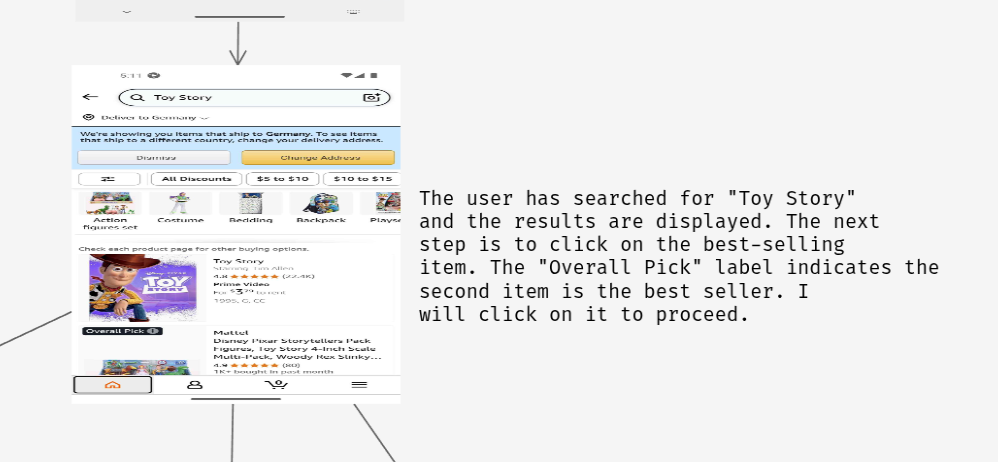
Ostorlab eliminates brittle scripts with Prompt-Based Flow Customization. Instead of coding rigid execution paths, your team guides the scanner using plain-text prompts. You simply tell the engine what to care about in natural language, such as: "Navigate to the shopping cart, apply a discount code, and test the payment gateway for input validation flaws."
The DAST engine dynamically explores the live app, finds the relevant UI components on its own, and concentrates its testing payload exactly where your business logic lives. What normally takes days of manual test configuration drops down to a five-minute pipeline setup.
2. Bypassing Shields (TLS Pinning & Obfuscation) at Runtime
Modern mobile apps rarely ship unprotected. To stop reverse engineering and eavesdropping, developers deploy runtime protections like TLS certificate pinning and heavy code obfuscation. While these shields are great for defense, they are a massive headache for standard DAST scanners. When a traditional scanner hits a pinned certificate or custom encryption, it gets blinded, locking you out of deeper network analysis and generating false negatives.
Ostorlab handles this obstacle out of the box with Automated Runtime Bypasses. When the scanner spins up your app on real physical iOS and Android devices, it actively bypasses TLS pinning and unrolls common obfuscation barriers on the fly. Instead of just treating the app as a black box, Ostorlab opens up encrypted network traffic and inspects internal API communications while the app is running. You get a clear view into the internal behavior of the app without needing developers to build special, stripped-down test builds just for your security scanner.
3. Authenticated Workflow Handling & Post-Login Coverage
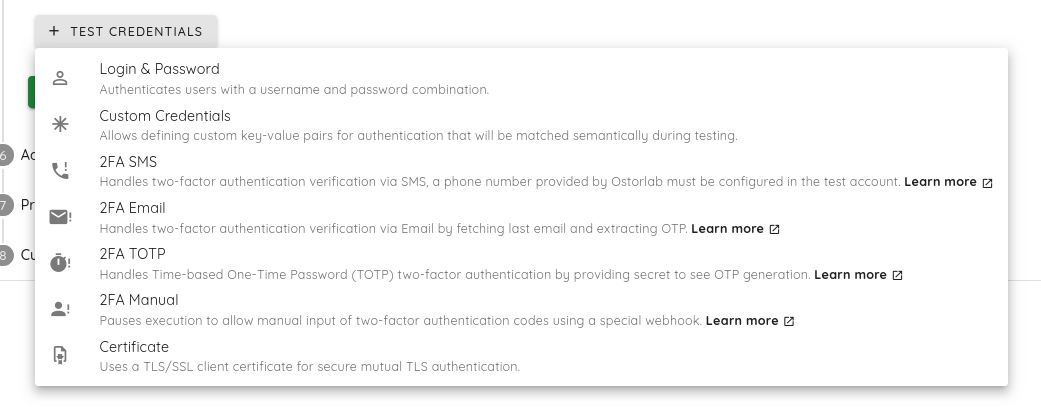
Here is an open secret in mobile application security: most critical vulnerabilities do not live on the public login screen. They hide inside gated user journeys, user profile settings, checkout flows, and account management dashboards. Yet, legacy DAST scanners frequently fail the moment they encounter an authentication barrier. If the tool cannot handle two-factor authentication (2FA), one-time passwords (OTP), or complex OAuth flows, it never reaches the post-login attack surface.
Ostorlab solves this problem natively with Advanced Authentication Handling. The engine is built to maintain persistent authenticated sessions across complex login sequences. It holds onto tokens, handles dynamic session refreshes, and navigates multi-step sign-ins without dropping the connection. While legacy tools crash against the login gate or force you to hardcode temporary bypass tokens, Ostorlab continuously maps and tests your gated user journeys just like a real user would.
4. Verifiable Artifacts: PCAPs, Stack Traces, and Screenshots
Finding a vulnerability is only half the battle. If your security tool simply alerts developers that it found an issue without explaining how it happened, you will waste days in triage meetings trying to reproduce the bug. Quokka Q-mast excels at pinpointing vulnerable library versions via its SBOM engine, but when it comes to runtime logic flaws, engineers need deeper execution context.
Ostorlab treats every vulnerability finding as a courtroom case that requires absolute proof. When the DAST engine flags an issue, it hands your developers a complete runtime evidence package:
- Full Network Visibility: Raw PCAP network traffic files and clean request/response logs showing exact API payloads.
- Deep System Context: Real-time stack traces and device crash logs that pinpoint exactly where the code failed during execution.
- Visual Proof: Synchronized screenshots and step-by-step visual replay logs showing the exact buttons and screens the engine interacted with to trigger the exploit.
Your developers never have to guess what went wrong. They grab the artifacts, see the exact network request or UI sequence that caused the leak, and start patching immediately.
5. Global App Sourcing & Geo-Restricted Testing
Testing applications that are only released in specific regions can be a logistical nightmare, usually forcing teams to manually hunt down localized APKs or IPAs from third-party sites.
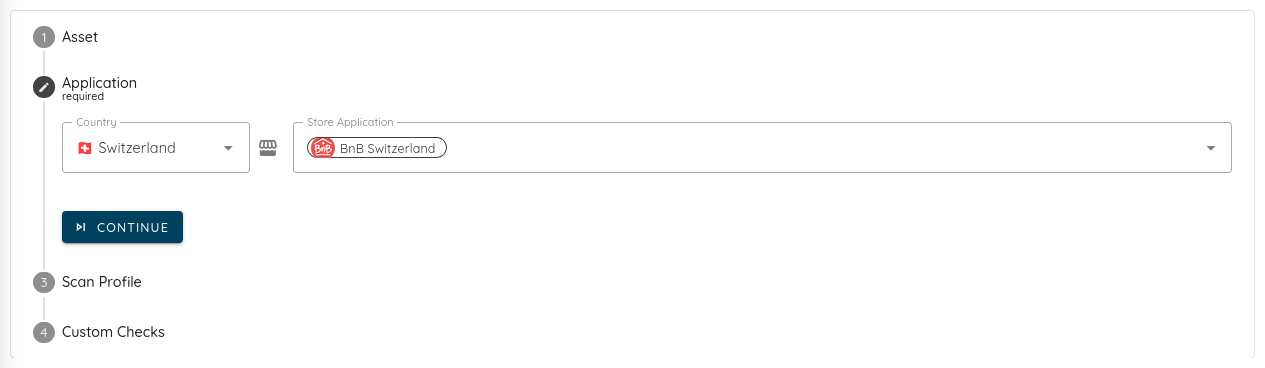
Ostorlab removes this friction entirely. You can natively search the App Store or Play Store by country directly from the platform. If you want to test an application that is only available in one specific country, you simply select the region, and Ostorlab pulls the correct localized binary automatically. This ensures your global application portfolio is tested exactly as regional users experience it.
Part 2: The Optional Superpower: Agentic Deep Scan
Our foundational Mobile DAST already gives your team a massive advantage over standard dynamic analyzers. But what happens when your threat model requires testing that goes beyond catching regression bugs and standard runtime crashes?
Historically, hunting down complex business logic errors, privilege escalation paths, and multi-step authorization bypasses required hiring an expensive human penetration testing firm. Standard automated scanners, no matter how good their rules are, simply lack the creative problem-solving skills needed to chain logical weaknesses together.
This is where Ostorlab completely separates itself from tools like Quokka Q-mast. To fill the gap between automated DAST and manual consulting, Ostorlab introduced Agentic Deep Scan, an optional, autonomous AI penetration testing module that acts like a relentless human researcher working inside your CI/CD pipeline.
1. When Foundational DAST Isn't Enough
Standard DAST is your daily driver. It catches low-hanging fruit, validates runtime configuration, and ensures your app passes continuous security checks on every pull request. However, certain vulnerability classes require human-like intuition.
Imagine an endpoint where creating a resource allows an attacker to pass an existing ID in a POST request, transferring ownership of someone else's data to themselves. A traditional scanner will miss this Broken Object Level Authorization (BOLA/IDOR) vulnerability every time because the server returns a valid 200 OK response. The syntax is correct, but the logic is broken. To catch these complex flaws, you need an engine that understands application context, builds hypotheses, and actively tries to break your business logic.
2. What Agentic Deep Scan Adds
When you trigger an Agentic Deep Scan, you are not just running a list of pre-set payloads. You are deploying an autonomous AI agent that actively investigates your application from the inside out.
Before firing a single test, the engine reverse engineers your mobile binary. It maps out internal deep links, WebViews, URL handlers, and candidate functions, automatically decompiling relevant code to understand how components interact. Once it builds an internal mental map of your app, the agent starts planning its attack. It navigates complex authenticated user journeys, handles two-factor authentication (2FA) and one-time password (OTP) barriers, and tests client-side trust boundaries.
Instead of dumping high-noise alerts onto your Jira board, the engine only reports what it can actually exploit. Every single finding comes backed by proof-grade evidence: exact request and response logs, device crash telemetry, and step-by-step screenshots showing your engineers exactly how the exploit went down.
3. Automated Verification Retesting
One of the most frustrating bottlenecks in AppSec is the endless back-and-forth between developers and security analysts. A developer ships a patch for a critical logic vulnerability and marks the ticket as resolved, but the security team does not have the bandwidth to manually retest the app until the following week.
Agentic Deep Scan automates this entire feedback loop with Verification Retesting. The moment your developers push a code fix, the agent spins the target app back up on real physical devices and re-runs the exact multi-step exploit chain it used to break the app in the first place. If the fix holds, the ticket automatically closes with confirmed proof of remediation. Your developers get instant validation that their patch worked without waiting on a human bottleneck.
4. Governed AI Compute (Cyber Models & BYOK)
Leveraging frontier AI models for security testing sounds amazing until the cloud infrastructure bill arrives. Uncontrolled AI agents can quickly burn through tokens, leading to unpredictable billing and CFO panic. Quokka Q-mast operates on a traditional software licensing model without managed agentic infrastructure, leaving teams on their own if they want to integrate LLM workflows.
Ostorlab solves the budget problem natively through Cyber Models, a managed, prepaid AI infrastructure tier. Instead of juggling external API keys or worrying about rate limits, your team funds a consolidated workspace wallet using prepaid credits. Before a deep scan launches, you select an effort profile (Core, Advanced, or Elite) that establishes a strict spending ceiling. You get governed access to powerful security models like GPT-5.5 Cyber and Opus 4.8. Best of all, if the AI finds the vulnerabilities early and finishes its investigation ahead of schedule, any unused tokens are automatically refunded back to your workspace wallet.
For organizations with strict internal data policies, Ostorlab also supports BYOK (Bring Your Own Key). You can plug in your own corporate AI provider credentials and set hard "Max Spend per Scan" guardrails, ensuring your deep exploration stays compliant, predictable, and fully under your control.
Part 3: Full-Stack Attack Surface & Automated Remediation
Finding client-side bugs is great, but a mobile scanner that stops at the edge of the device is leaving your biggest blind spots wide open. In the real world, mobile breaches rarely happen because an attacker stole local SQLite data; they happen because a client-side vulnerability unlocked a server-side backend flaw.
To give DevSecOps teams total visibility, Ostorlab connects mobile application scanning directly to backend infrastructure, active defensive validation, and developer remediation workflows. Here is how Ostorlab expands the attack surface while helping your developers fix bugs faster than ever.
1. Backend REST & GraphQL API Scanning
When you look at Quokka Q-mast, the center of gravity is the compiled mobile binary and its Software Bill of Materials (SBOM). While that is essential for software supply chain compliance, it ignores the backend servers powering your app. If your app communicates with vulnerable REST endpoints or leaky GraphQL APIs, a binary-only scanner will completely miss the threat.
Ostorlab treats your mobile app and its backend APIs as a single unified ecosystem. While the engine explores the app, it simultaneously intercepts network traffic, maps out function invocations, and tests server-side communications. It actively looks for client-to-server logic flaws, backend injection points, and data leakage across more than 500 distinct vulnerability classes. Instead of blinding your security team to server-side risks, Ostorlab catches the full exploit chain across both the mobile client and your cloud infrastructure.
2. Active Shielding Validation vs. Passive Obfuscation Checks
If your engineering team pays for commercial obfuscation or Runtime Application Self-Protection (RASP), you need to know if those defenses actually work under pressure. Traditional scanners usually settle for passive detection: they scan your binary, see a known obfuscation library, and check a static compliance box. But presence is not proof.
Ostorlab replaces theoretical checklists with Mobile Shielding Scan, an automated testing module that validates your runtime defenses on real physical iOS and Android devices. An adaptive AI analyst actively attacks your app, deploying live debuggers, hooking functions, and executing interactive bypass loops against root detection, anti-tampering, and SSL pinning.
If a defensive layer fails, Ostorlab gives you concrete proof of bypass. If the shield holds up against the AI, you get a validated strength rating mapped directly to global mobile security standards like OWASP MASVS. You turn "we hope our app is protected" into definitive engineering proof.
3. Weighted Enterprise App Vetting
Enterprise security leaders often suffer from alert fatigue when auditing large application portfolios. Basic scanners dump flat, high-noise severity lists that treat a minor data privacy warning with the same urgency as a critical remote code execution vulnerability.
Ostorlab solves this noise problem with App Vetting, a risk assessment framework engineered specifically for enterprise approvals. Instead of flooding your inbox with unverified tickets, the platform combines static analysis, dynamic testing, and secure sandbox execution to calculate contextual, weighted risk scores across five critical dimensions:
- Malware (35%): Detecting malicious behaviors, trojans, and suspicious telemetry.
- Security (25%): Mapping exploitable runtime and code-level vulnerabilities.
- Privacy (20%): Auditing unauthorized data tracking and third-party data sharing.
- Trust (10%): Verifying app signing certificates and installation origin legitimacy.
- Maintainability (10%): Evaluating outdated dependencies and architectural decay.
This structured scoring model tells your security board instantly whether a new mobile app is safe to deploy across corporate devices, keeping enterprise risk management clean and predictable.
4. Deep Privacy Scanning & Compliance
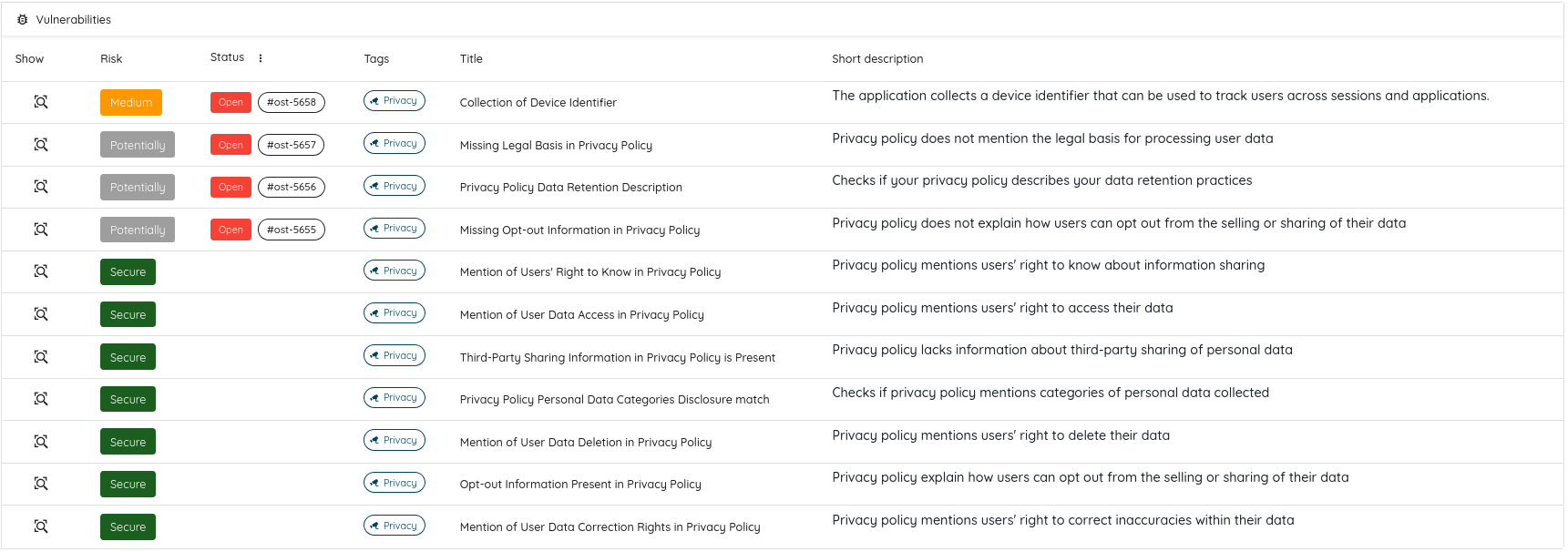
Beyond security flaws, DevSecOps teams must also manage regulatory risks. Ostorlab provides a comprehensive Privacy Scan to help you understand exactly what data your application collects, how it is collected, and the implications for user privacy. The scan provides detailed insights into your data collection practices to help you comply with privacy regulations, actively identifying unauthorized third-party tracking or data leakage.
5. One-Click Fixes & Continuous Lifecycle Validation
Finding security bugs is only half the job; fixing them before your next release deadline is where engineering teams usually stumble. Generating static SBOM reports and filing Jira tickets is helpful, but it still leaves your developers with hours of manual research trying to figure out how to write the patch.
Ostorlab closes the loop with One-Click Automated Fixes. By connecting directly to your source code repositories (supporting GitHub, GitLab, Bitbucket, and Azure DevOps), Ostorlab analyzes vulnerable decompiled binaries alongside your raw code. When the AI detects an issue, it generates customized, secure code suggestions tailored specifically to your app's architecture.
Your developers do not need to hunt through generic documentation. They review the AI-recommended code diff inside their normal workflow and apply the patch with a single click, slashing your Mean Time to Remediate (MTTR) from hours down to minutes.
Furthermore, Ostorlab provides validation through the testing cycle. When the application is scanned and we don't find the vulnerability, it's marked as fixed and verified. This continuous validation ensures that your security posture is always up-to-date and eliminates the need for manual ticket triage.
When to Choose Ostorlab over Quokka
Ostorlab is built specifically for high-velocity engineering teams and modern, full-stack application architectures. You should deploy Ostorlab if:
- You build cross-platform or hybrid apps: Your developers ship code using Flutter, React Native, MAUI, Kotlin, or Swift, and you need a runtime scanner that understands those frameworks natively without breaking.
- Your apps rely on complex authentication and self-defense: You need a scanner that can bypass TLS pinning and obfuscation automatically, maintain persistent sessions through 2FA or OTP login screens, and actively test RASP defensive layers using real physical devices.
- You care about server-side API security: You recognize that mobile vulnerabilities usually tie back to your infrastructure, and you want a unified scanner that tests both your client app and its backend REST or GraphQL endpoints.
- You want to replace manual pentesting bottlenecks: You want the option to trigger an Agentic Deep Scan to chain logical exploits autonomously and automatically verify that developer patches actually worked.
- You need one-click developer remediation: You want to stop dumping noisy PDF reports on your engineers and instead feed AI-generated code fixes directly into their GitHub, GitLab, Jira, or Azure DevOps workflows.
Frequently Asked Questions
When DevSecOps engineers evaluate MAST platforms, they usually ask direct, highly technical questions. Here are clear, authoritative answers to the most common queries surrounding Ostorlab and Quokka Q-mast.
How does Ostorlab's foundational Mobile DAST differ from Quokka Q-mast?
While both tools perform dynamic analysis without source code access, they execute differently at runtime. Quokka Q-mast relies on pre-configured execution paths and manual scripting. Ostorlab sets up in minutes using prompt-based flow customization, natively bypasses TLS pinning and code obfuscation, maintains authenticated sessions across complex login screens, and hands developers full runtime evidence like PCAP captures and stack traces.
What is the difference between Ostorlab Mobile DAST and Agentic Deep Scan?
Ostorlab Mobile DAST is an automated runtime scanner engineered for daily CI/CD pipeline integration, catching regression bugs and standard vulnerabilities on every pull request. Agentic Deep Scan is an optional, autonomous AI penetration testing engine that acts like an on-demand human hacker. It decompiles code, chains complex logical flaws together, handles 2FA or OTP barriers, and automatically re-tests the app once developers push a patch.
Can Ostorlab test authenticated mobile app workflows automatically?
Yes. Unlike legacy scanners that break when encountering login gates, Ostorlab features advanced authentication handling. It natively manages multi-step logins, OAuth flows, two-factor authentication (2FA), and one-time passwords (OTP), ensuring your gated user journeys and account management screens receive deep dynamic testing.
Does Quokka Q-mast scan backend APIs compared to Ostorlab?
Quokka Q-mast centers almost entirely on the compiled mobile binary and its SBOM. Ostorlab treats the mobile app and its backend APIs as a single ecosystem. While scanning the app, Ostorlab actively intercepts network traffic and tests backend REST and GraphQL endpoints for client-to-server logic flaws, injection vulnerabilities, and data leaks.
How do both platforms handle AI compute budgets and token costs?
Quokka operates on a traditional software licensing model without managed agentic AI infrastructure. Ostorlab solves AI billing risks through Cyber Models, a managed prepaid compute tier. You fund a workspace wallet, select an effort profile with a strict spending ceiling before a scan launches, and automatically receive refunds for any unused tokens when the scan finishes. Ostorlab also supports Bring Your Own Key (BYOK) for internal compliance.
Limitations of this comparison
- Vendor capabilities, pricing, and documentation change frequently. Details about Quokka Q-mast may have changed since 15 July 2026.
- No independent benchmark of detection rates, false-positive rates, or scan speed was run for this article.
- This article does not report hands-on testing of Quokka Q-mast. Statements about Quokka Q-mast reflect its public materials; statements about Ostorlab reflect Ostorlab's own product documentation.
- Verify current capabilities, pricing, and deployment options directly with each vendor, ideally by testing both platforms against your own applications.
Conclusion & Next Steps
The mobile threat landscape has evolved, and your security tooling needs to evolve with it. Relying strictly on static binary analysis, basic SBOM checklists, or rigid dynamic scanners leaves engineering teams blind to the complex, full-stack vulnerabilities that cause modern security breaches.
While Quokka Q-mast provides valuable compliance tracking for legacy requirements, Ostorlab represents the future of Mobile Application Security Testing. By combining a foundational DAST that deploys in minutes with automated shielding validation, full-stack API inspection, one-click developer fixes, and an optional Agentic Deep Scan engine, Ostorlab gives DevSecOps teams the exact tools they need to ship secure code at high velocity.
Already using Quokka Q-mast? Compare Ostorlab with Quokka Q-mast on the same app: same target, same time box. A finding counts only after your team has reproduced it.