N-able MailAssure SSRF, Exploited in the Wild (CVE-2026-134624)
N-able MailAssure and SpamExperts before build 20261121.1943 let an authenticated API user reach internal hosts; CISA KEV lists it.
TL;DR
- N-able MailAssure and SpamExperts run an LDAP synchronization connection check that accepts any destination. An authenticated API user can make the server probe internal hosts and send data to internal services.
- Builds before 20261121.1943 are affected. N-able patched the Hosted Cloud; Local Cloud operators must confirm the build.
- The CVE record rates the flaw CVSS v4.0 9.3 Critical. CISA added it to KEV on November 23, 2026, with a federal deadline of November 26, 2026.
- Update Local Cloud to build 20261121.1943, rotate API and OAuth tokens, and review relay LDAP settings and outbound connections.
Am I affected?
You are exposed if all of these conditions hold:
- You run MailAssure or SpamExperts. The Hosted Cloud is patched centrally. Local Cloud runs on your hardware.
- A Local Cloud build is earlier than 20261121.1943.
- An attacker can obtain an API user with high privileges. The advisory requires an authenticated API user, and the CVSS vector records a high privilege requirement.
- A relay is configured with LDAP synchronization.
- The MailAssure or SpamExperts server can reach internal hosts from its network position.
The Hosted Cloud is the service N-able runs for managed service providers. N-able patched it before it restored the dashboard and APIs on 2026-11-21. Local Cloud is the customer-hosted product, and its update documentation describes a weekly software schedule.
MailAssure and SpamExperts filter email for managed service providers. A relay is a mail route, and LDAP synchronization imports users and groups from a directory service. The connection check runs when a relay is configured.
| Deployment | Affected versions | Fixed build |
|---|---|---|
| MailAssure and SpamExperts Hosted Cloud | every build before the November 21 remediation | patched centrally on 2026-11-21 |
| MailAssure Local Cloud | builds before 20261121.1943 | 20261121.1943 |
| SpamExperts Local Cloud | builds before 20261121.1943 | 20261121.1943 |
The advisory lists builds earlier than 20261121.1943 as affected. The CVE record uses the same build as the fixed version.
Check the build number in the Local Cloud administration interface and compare it with 20261121.1943. N-able's update documentation describes the weekly update process. If the interface does not show a build number, ask N-able support to confirm the installed build.
How do I fix it?
Hosted Cloud customers do not install a patch. N-able patched the service and restored access on 2026-11-21. Local Cloud customers must update to build 20261121.1943.
- For Local Cloud, apply the 20261121.1943 update through the weekly update process or with N-able support.
- Rotate every API token and OAuth token. N-able revoked customers' existing tokens after the breach, and scripts or integrations that used them need new credentials.
- Reset local user passwords if you have not already. N-able reset local users' passwords on the Hosted Cloud.
- Review every relay with LDAP synchronization. Remove sync targets you do not use, and keep only the directory servers your organization operates.
- Restrict outbound traffic from the MailAssure or SpamExperts host. Allow the directory servers and the update endpoints, and block the rest of the internal network.
- Reconnect partner scripts and integrations with the new credentials. The exact steps differ by setup, and N-able says it emailed guidance to partners.
If you cannot update Local Cloud immediately, disable LDAP synchronization on relays that do not need it. Restrict the host's outbound connections to the directory servers you use. Ask N-able support for a supported mitigation. The CISA KEV entry tells federal agencies to apply mitigations or discontinue use if no mitigation is available.
What is the root cause?
The LDAP synchronization connection check takes its destination from the relay configuration without restricting it. An authenticated API user can point the server at any internal host and port.
MailAssure and SpamExperts run as email gateways. When an administrator configures a relay, the product can synchronize users and groups from an LDAP directory. The synchronization begins with a connection check to the directory server.
The advisory describes the defect in one paragraph. The advisory says the check "does not restrict the destination" before build 20261121.1943. An authenticated API user can set the LDAP destination to an arbitrary internal host and port. The server then opens the connection from its own network position.
This is a server-side request forgery (SSRF). The server is the client, and the attacker chooses the destination. The attacker does not need a route to the internal network, because the MailAssure server already has one.
The check is a normal feature. An administrator needs to know that the directory server answers before the synchronization starts. The defect is that the check trusts the API caller's destination. A correct design would bind the check to the directory server configured for the relay and reject every other address.
The advisory says the attacker can determine which internal hosts and ports are reachable and send crafted data to internal services. A reachable port and a protocol response are enough to map the internal network. A service that accepts the crafted data may act on it.
N-able has not published the patch diff, and the product is closed source. The advisory names the component and the defect but not the code. The fixed build is the only public fix artifact.
How is it exploited?
- The attacker obtains an API user with high privileges. The relay API action is a normal administrative call.
- The attacker creates or edits a relay with LDAP synchronization and sets the LDAP server address to an internal host and port.
- The attacker triggers the connection check.
- The MailAssure server connects to the chosen internal address from its own network position.
- The response or the timing tells the attacker whether the host and port are reachable.
- The attacker repeats the check across internal addresses and sends crafted data to services that answer.
The advisory does not publish a request or a proof of concept. It describes the capability, not a script. The CISA KEV entry confirms that the flaw was exploited.
The attacker does not need a public exploit. The API call that configures a relay is a normal administrative action, and the connection check is part of that action. The barrier is the high-privilege API user, which the attacker can obtain through a stolen token, a misconfigured integration or another foothold.
N-able has not said the flaw was the attackers' entry point in the November breach. It says it found the flaw during the investigation, and that exploitation was confined to one hosted server. The breach and the flaw are related by timing, not by a published causal link.
How does the attack flow?
An authenticated API user points the LDAP synchronization check at an internal address, and the MailAssure server connects to it from inside the network.
sync destination"] B --> C["Triggers the
connection check"] C --> D["MailAssure server connects
to the chosen host and port"] D --> E["Attacker learns
which ports answer"] E --> F["Sends crafted data
to internal services"] F --> G["Maps the internal network"]
What can an attacker do?
An attacker with the required API access can use the MailAssure server as a network proxy into the internal environment.
- Probe internal hosts and ports and learn which services are reachable.
- Send crafted data to internal services that accept the connection.
- Reach services that are not exposed to the internet but are reachable from the email gateway.
- Combine the reachability map with other access to plan a deeper intrusion.
The advisory does not claim code execution. It describes reachability and data sent to internal services. The breach investigation found unauthorized access to one Hosted Cloud server, and N-able says the attackers likely accessed credentials stored there.
The actions need the conditions in "Am I affected?". An affected build, a high-privilege API user, a relay with LDAP synchronization and a network path to the target are all required.
Why does the fix work?
The fixed build 20261121.1943 restricts the destination of the LDAP synchronization connection check. An API user can no longer point the server at an arbitrary internal host and port.
N-able has not published the patch diff. The advisory describes the vulnerable build as not restricting the destination, and the fixed build is the only public artifact. A destination restriction closes the SSRF when it limits the check to the directory servers that the relay is allowed to use. The server then connects only to approved endpoints, and the API user cannot choose an arbitrary address.
The fix is complete for the path the advisory describes only if every LDAP synchronization check applies the restriction. N-able has not published the code, so that cannot be verified from outside. Treat the build as the vendor's fix and keep the outbound restrictions in place as defense in depth.
How do I check if I was compromised?
N-able has published no indicators of compromise. Check the relay and LDAP configuration, then look for connections from the MailAssure server to internal addresses that are not your directory servers.
Start with the configuration:
- List every relay and its LDAP synchronization settings.
- Compare the LDAP destinations with the directory servers your organization operates.
- Check for relays, API users or tokens that no administrator created.
Review the API and audit logs for changes to relay or LDAP settings. Look for connection checks to internal addresses outside your directory service range. The product may log the destination and the result of each check.
On the network side, review firewall and flow logs for outbound connections from the MailAssure or SpamExperts host. A connection to an internal host and port that is not a directory server is a lead. A failed probe may leave no application log, so the network record matters.
N-able revoked API and OAuth tokens and reset local passwords after the breach. Review the partner guidance for the credentials that need replacement. If you find a sign of use, rotate the credentials the server stores and rebuild the host from a clean build.
Timeline
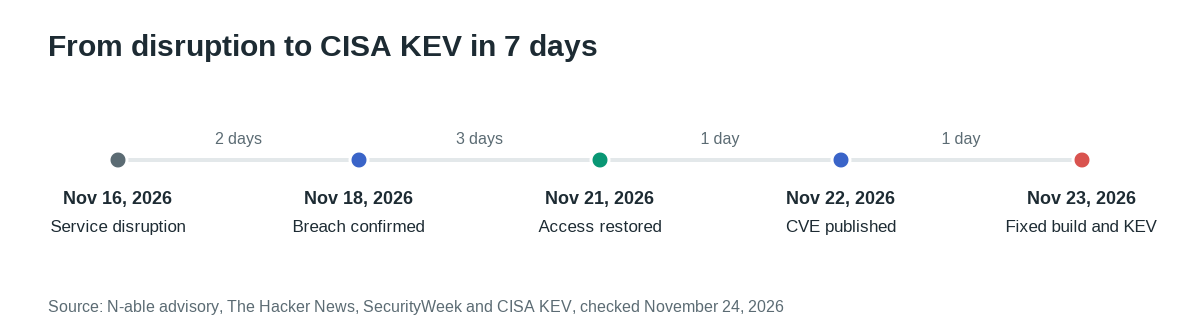
- 2026-11-16: N-able begins investigating a service disruption in the MailAssure and SpamExperts Hosted Cloud.
- 2026-11-18: N-able confirms that an unauthorized party accessed one Hosted Cloud server and takes the management interfaces offline.
- 2026-11-21: N-able restores the dashboard and APIs after revoking tokens and resetting local passwords.
- 2026-11-22: N-able publishes CVE-2026-134624.
- 2026-11-23: the fixed build 20261121.1943 is documented, and CISA adds the CVE to KEV.
FAQ
Was this flaw used to breach N-able?
N-able has not said. It found the flaw during the breach investigation, and it says exploitation was confined to one hosted server. The formal root cause analysis is due within two weeks of 2026-11-22.
Does the flaw need authentication?
Yes. The advisory says an authenticated API user, and the CVSS vector records a high privilege requirement. An unauthenticated internet user cannot trigger the check.
Is the Hosted Cloud still vulnerable?
No. N-able patched the hosted service before it restored the dashboard and APIs on 2026-11-21. Local Cloud operators must confirm build 20261121.1943.
Is there a public proof of concept?
No. N-able published the affected component, the fixed build and the capability. It did not publish a request or exploit script.
Was customer data stolen?
N-able says it has no evidence that customer data was compromised, including tenants' mailboxes. The investigation is ongoing, and the company says an outside incident-response team is validating the findings.
What is the KEV deadline?
CISA added CVE-2026-134624 to the Known Exploited Vulnerabilities catalog on 2026-11-23. The federal remediation deadline is 2026-11-26.
Find exposed MailAssure and SpamExperts interfaces with Ostorlab
Ostorlab's attack surface discovery inventories internet-facing services, including email-security management portals and APIs. Use it to see which hosts need the build check and the network restrictions: https://ostorlab.co/product/attacksurface_discovery
References
- N-able security advisory, "MailAssure / SpamExperts: Server-Side Request Forgery in relay LDAP synchronisation connection check" (checked November 24, 2026): https://me.n-able.com/s/security-advisory/aArVy0000002mrlKAA
- CVE record, CVE-2026-134624, published November 22, 2026 (checked November 24, 2026): https://www.cve.org/CVERecord?id=CVE-2026-134624
- CISA Known Exploited Vulnerabilities catalog, CVE-2026-134624 added November 23, 2026 (checked November 24, 2026): https://www.cisa.gov/known-exploited-vulnerabilities-catalog
- The Hacker News, "Hackers Breach N-able Cloud Server, Disrupting Email Security Management Across 3 Regions", published November 19, 2026 (checked November 24, 2026): https://thehackernews.com/2026/11/n-able-confirms-hackers-accessed-cloud.html
- The Hacker News, "N-able Discloses Critical Mail Assure Vulnerability Found During Breach Investigation", published November 23, 2026 (checked November 24, 2026): https://thehackernews.com/2026/11/n-able-discloses-critical-mail-assure.html
- SecurityWeek, "N-able Patches Critical Flaw Disclosed After Mail Assure Cyberattack", published November 23, 2026 (checked November 24, 2026): https://www.securityweek.com/n-able-patches-critical-flaw-disclosed-after-mail-assure-cyberattack/
Keep reading