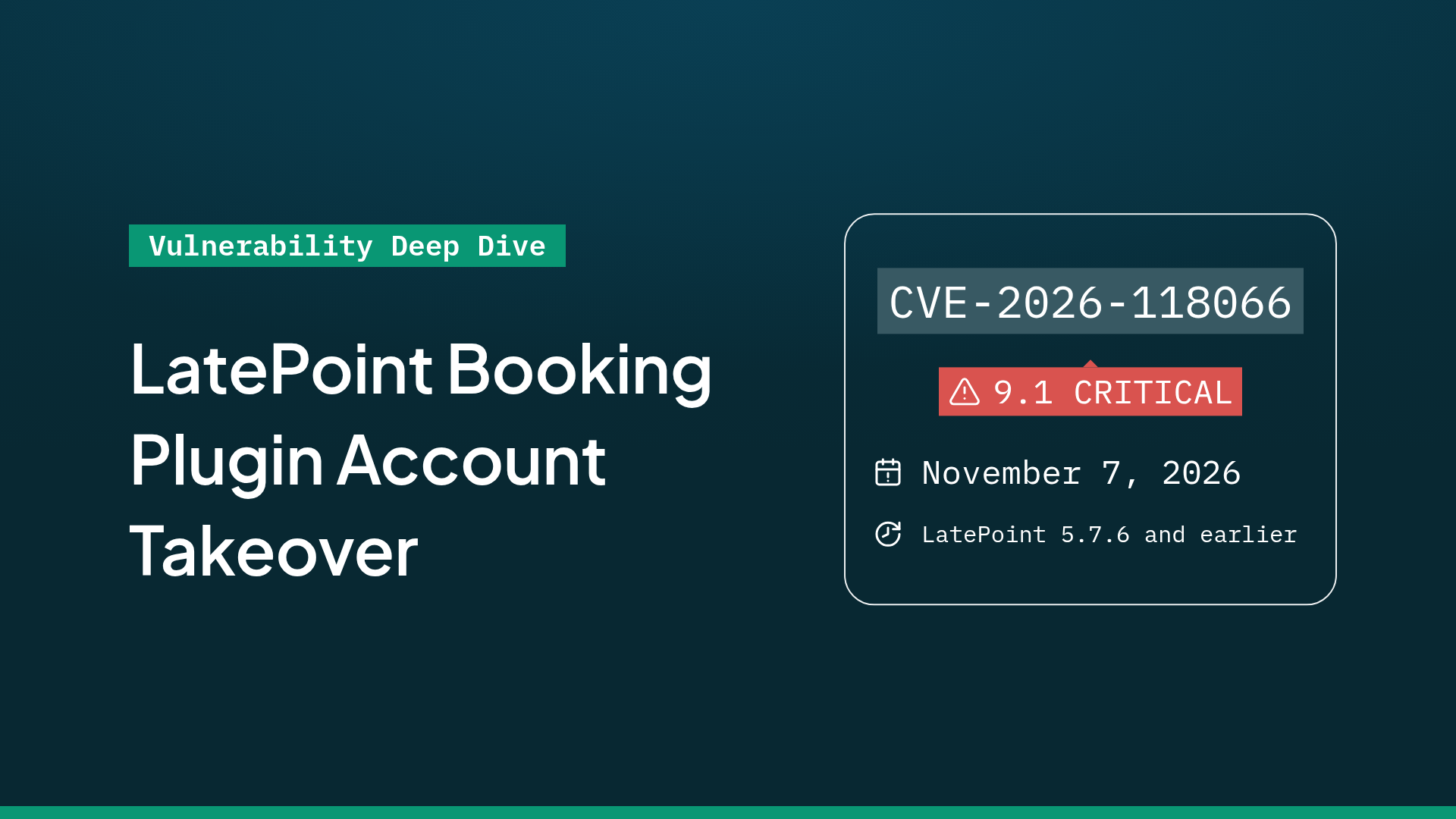
Joomla Installer Takeover and Core RCEs Fixed (CVE-2026-123214)
Joomla 5.4.10 and earlier let visitors rerun the installer and reach four critical flaws; 5.4.11 and 6.2.1 fix 58 issues.
TL;DR
- Joomla 5.4.11 and 6.2.1, released on 2026-11-24, fix 58 security issues, including four that Joomla rates Critical. The most serious lets an unauthenticated visitor rerun the web installer on an installed site.
- The installer and media-field flaws affect 4.0.0 through 5.4.10 and 6.0.0 through 6.2.0. The language-file flaw reaches back to 1.6.0, and the logger flaw to 3.6.0.
- The four CVEs are rated CVSS v4.0 9.2, 9.2, 9.2 and 9.4 Critical. No exploitation is known, and none is in CISA KEV as of 2026-11-25.
- Upgrade to 5.4.11 or 6.2.1, remove the
installationfolder, and move log files outside the web root. See "How do I fix it?".
Am I affected?
You are exposed when the site runs an affected Joomla release and the component named by the advisory is reachable with the precondition that the advisory describes.
All of these conditions must hold for the installer flaw:
- The site runs Joomla 4.0.0 through 5.4.10, or 6.0.0 through 6.2.0.
- A
configuration.phpexists, so the site is installed. - The
installationfolder is still present under the web root.
The other flaws have their own conditions:
- The language-file flaw needs the
languagerequest parameter to reach the code that builds a language path. - The logger flaw needs a log file that the web server can serve and attacker-influenced content that reaches it.
- The media-field flaw needs an account allowed to configure a media custom field.
| Branch | Affected versions | Fixed version |
|---|---|---|
| Joomla 5.x | 5.0.0 through 5.4.10 | 5.4.11 |
| Joomla 6.x | 6.0.0 through 6.2.0 | 6.2.1 |
| Joomla 4.x | 4.0.0 through 4.4.x | No fixed release in the advisory; migrate to 5.4.11 or 6.2.1 |
| Joomla 3.x and earlier | 1.6.0 through 3.10.x for the language-file flaw | No fixed release; migrate to 5.4.11 or 6.2.1 |
The release notice lists two fixed packages and no backport for Joomla 4 or 3. W3Techs reports that Joomla 3 still accounts for 50.0% of the websites it identifies as Joomla, so a large part of the installed base has no vendor fix for the language-file flaw.
Check the version in the administrator under System, System Information. On the command line:
grep -n "MAJOR_VERSION\|MINOR_VERSION\|PATCH_VERSION" libraries/src/Version.php
Check whether the four fixes are present:
grep -n "function isInstallerAllowed" installation/src/Application/InstallationApplication.php
grep -n "function isValidTag" libraries/src/Language/LanguageHelper.php
grep -n "function appendToFile" libraries/src/Log/Logger/FormattedtextLogger.php
grep -n "htmlspecialchars(\$this->directory" libraries/src/Form/Field/AccessiblemediaField.php
Each missing match means that part of the fix is absent. A site with any missing match is on the vulnerable code path for that flaw.
Check whether the installer is reachable on an installed site:
test -f configuration.php && test -d installation && echo "installer folder present"
How do I fix it?
Upgrade to Joomla 5.4.11 or 6.2.1, then remove the installation folder and confirm that each fix is present.
- Back up the site and the database.
- Update in the administrator under System, Update, Joomla. The release notice says to update every site right away.
- When the administrator update is unavailable, download the 5.4.11 or 6.2.1 package and install it with the Joomla update package.
- Remove or rename the
installationfolder after the update. The installer fix refuses the installer on an installed site, and removing the folder removes the path entirely. - Move the configured log path outside the web root. The logger flaw needs a log file that the web server can serve.
- Review the accounts allowed to manage
com_fieldsand remove that permission from anyone who does not need it. The media-field flaw needs a high-privilege account. - Confirm the four fixes with the
grepcommands in "Am I affected?".
A site that cannot update yet can block /installation at the web server and set log_path to a directory outside the document root. Those controls cover the installer and logger paths only. They do not cover the language-file flaw or the media-field flaw.
Joomla 3 and Joomla 4 have no fixed release in this advisory. The vendor's path is a migration to 5.4.11 or 6.2.1. A Joomla 3.10 site needs a migration to a supported release.
What is the root cause?
Four separate code paths failed to constrain input or state. The installer did not check whether the site was already installed, and the language helper used an unvalidated tag to build a path. The logger wrote its header and its data in two steps, and the media field placed configuration values into generated XML without escaping.
The installer dispatched any controller named in the task parameter without checking for an existing configuration:
private function executeController()
{
    $task = $this->input->getCmd('task', '');

    // The name of the controller
    $controllerName = 'display';

    // Parse task in format controller.task
    if ($task !== '') {
        list($controllerName, $task) = explode('.', $task, 2);
    }

    $factory = new MVCFactory('Joomla\\CMS', $this->getLogger());
The installer application runs while the installation folder exists. On a site that is already installed, the folder can remain after an update. An unauthenticated request could then reach the installer's own controllers and rewrite the configuration.
The language helper built a path from the language value and only checked that the directory existed:
public static function exists($lang, $basePath = JPATH_BASE)
{
    static $paths = [];

    // Return false if no language was specified
    if (!$lang) {
        return false;
    }

    $path = $basePath . '/language/' . $lang;

    // Return previous check results if it exists
    if (isset($paths[$path])) {
        return $paths[$path];
    }

    // Check if the language exists
    $paths[$path] = is_dir($path);

    return $paths[$path];
}
A value with . and / builds a path outside language/, and the caller uses the value to locate the language file it includes. The advisory rates the impact High and the exploit type Local File Inclusion.
The logger wrote the file header in initFile() and the log data in a second File::write() call:
// Initialise the file if not already done.
$this->initFile();

// Format all lines and write to file.
$lines = array_map([$this, 'formatLine'], $this->deferredEntries);

try {
    File::write($this->path, implode("\n", $lines) . "\n", false, true);
If the file is removed between the header write and the data write, File::write() recreates it with the log data and no header. The header is the line that stops the file from running as PHP when it is requested over HTTP. The advisory says the race can recreate a log file without its protective header and rates the result Remote Code Execution.
The media field built form XML by string interpolation:
$xml = <<<XML
<?xml version="1.0" encoding="utf-8"?>
<form>
        <fields name="params">
            <fieldset name="basic">
            <field
            name="imagefile"
            type="media"
            label="JLIB_FORM_FIELD_PARAM_ACCESSIBLEMEDIA_PARAMS_IMAGEFILE_LABEL"
            directory="$this->directory"
            preview="$this->preview"
A directory or preview value containing a double quote and XML closes the attribute and adds elements to the form definition. The advisory says the manipulated definition leads to remote code execution and rates the flaw CVSS v4.0 9.4 with high privileges required.
How is it exploited?
The installer flaw is the simplest unauthenticated path in the batch. It lets a visitor drive the installer's own controllers on a live site, and the other three flaws need a narrower precondition.
- The attacker requests
/installation/index.phpon an installed site that still has the folder. - The installer application starts because nothing checks for
configuration.php. - The attacker selects an installer controller through the
taskparameter. The controller runs the installer's configuration step against the live site. - The step rewrites
configuration.php, which can point the site at an attacker-controlled database or change the site's configuration. - With the configuration under the attacker's control, the site can be taken over or made to load attacker content.
The language-file flaw uses a language value with ../ segments. The helper accepts it, builds a path outside language/, and the caller includes a PHP file from that path. The result depends on which files exist on the server.
The logger flaw is a race. A concurrent removal of the log file between the header write and the data write makes the data write recreate it without its header. A request for the recreated log over HTTP can then run its contents. The advisory does not publish the request sequence.
The media-field flaw needs an account that can configure a media custom field. That account supplies a value that closes the XML attribute, and the manipulated form definition is what the advisory says leads to code execution. The advisory does not publish the payload.
No public proof of concept or in-the-wild exploitation is known for any of the four as of 2026-11-25.
How does the attack flow?
An unauthenticated request reaches the installer on a live site because the application never checks for an existing configuration, and the installer's own controller rewrites the configuration.
What can an attacker do?
An unauthenticated attacker who reaches the installer can rewrite the site's configuration, which is enough to take over the site.
Every condition from "Am I affected?" still applies. The site must be installed, the installation folder must be present, and the web server must serve it. The attacker needs no account and no user interaction.
The installer path gives configuration control, not direct code execution in the request. With the configuration changed, an attacker can redirect the site to a database they control, change the administrator account flow, or make the site load content they choose.
The language-file flaw gives local file inclusion. Code execution depends on a PHP file that the include can reach. The logger flaw gives code execution when the log file is web-readable and the attacker can place PHP in it. The media-field flaw gives code execution to an account that can already configure fields, so it is a privilege escalation rather than an unauthenticated entry point.
The four flaws are separate. Exploitation of one does not imply exploitation of another, and no source reports any of them exploited.
Why does the fix work?
The 5.4.11 and 6.2.1 releases close each path with a check at the point where the unsafe value is used.
The installer now refuses to run once a configuration exists, except for the session that wrote it:
+        // On an already installed site only the session that wrote the configuration may continue
+        if (!$this->isInstallerAllowed()) {
+            $this->setHeader('status', '403 Forbidden', true);
+            echo Text::_('INSTL_ALREADY_INSTALLED_FORBIDDEN');
+
+            return;
+        }
+    private function isInstallerAllowed(): bool
+    {
+        $configuration = JPATH_CONFIGURATION . '/configuration.php';
+
+        // Not installed yet, nothing to protect
+        if (!is_file($configuration) || filesize($configuration) <= 10) {
+            return true;
+        }
+
+        // Development builds allow repeating the installation
+        if ((new Version())->isInDevelopmentState()) {
+            return true;
+        }
+
+        // Only the session that wrote the configuration may continue
+        return (bool) $this->getSession()->get('setup.started', false);
+    }
The configuration model sets setup.started in the session that runs the setup, so that session can finish the installation but a new visitor cannot start one.
The language helper now validates the tag before it builds a path:
+    public static function isValidTag($lang): bool
+    {
+        return \is_string($lang) && preg_match('/^[a-z]{2,3}-[A-Z]{2}$/D', $lang) === 1;
+    }
...
-        if (!$lang) {
+        if (!$lang || !self::isValidTag($lang)) {
             return false;
         }
The pattern admits two or three lowercase letters, a hyphen and two uppercase letters, so a traversal value fails before the path is built.
The logger opens the file once, locks it, checks its size and writes the header and the data under the same handle:
+        $handle = fopen($this->path, 'c+');
...
+            if ($stat['size'] === 0) {
+                $data = $this->generateFileHeader() . $data;
+            } elseif (fseek($handle, 0, SEEK_END) !== 0) {
+                return;
+            }
A file that is recreated or emptied is written with its header in the same operation, so the race cannot produce a headerless file.
The media field escapes both values for XML before it builds the form:
+        $directory = htmlspecialchars($this->directory, ENT_QUOTES | ENT_XML1, 'UTF-8');
+        $preview   = htmlspecialchars($this->preview, ENT_QUOTES | ENT_XML1, 'UTF-8');
...
-           directory="$this->directory"
-           preview="$this->preview"
+           directory="$directory"
+           preview="$preview"
The same release adds MediaHelper::checkFileName(), which rejects a file name whose dot-separated segments include an executable extension such as image.php.gif.
How do I check if I was compromised?
Search the access log for requests to the installer on a site that was already installed. Any request that reached the installer after setup is a lead.
grep -Ei '/installation/(index\.php)?' /var/log/nginx/access.log
Look for language values with traversal sequences in the query string:
grep -Ei 'language=[^&]*(\.\.|%2e|%2f)' /var/log/nginx/access.log
Check for requests to log files under the configured log path, and for PHP files created in the log or temporary directories:
find /var/www/html \( -path '*/logs/*' -o -path '*/tmp/*' \) -name '*.php' -newermt '2026-11-01' -type f
Review the administrator account list and configuration.php for changes you did not make. The installer flaw rewrites the configuration, so a changed database host, user or prefix is a lead. The advisory publishes no indicators, and an attempt that failed may leave no trace.
Timeline
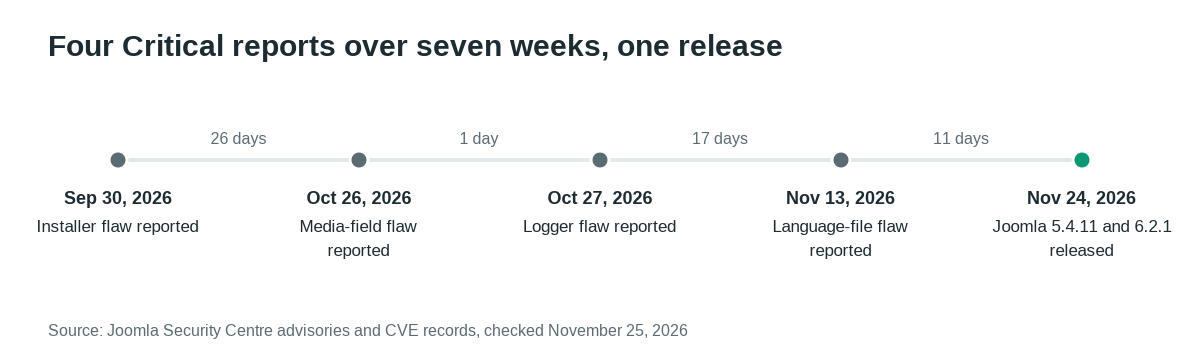
- 2026-09-30: the installer flaw is reported to the Joomla Security Strike Team.
- 2026-10-26: the media-field flaw is reported.
- 2026-10-27: the logger flaw is reported.
- 2026-11-13: the language-file flaw is reported.
- 2026-11-24: Joomla 5.4.11 and 6.2.1 are released and the four CVE records are published.
FAQ
Does this affect Joomla 3 and Joomla 4?
The advisory lists 5.4.11 and 6.2.1 as the fixed versions, with no Joomla 3 or 4 package. The language-file flaw reaches back to 1.6.0, so a Joomla 3 site is affected by that flaw and has no vendor fix. Migrate to 5.4.11 or 6.2.1.
Is the installer reachable if the installation folder was deleted?
No. The installer application lives in that folder. A site without the folder cannot serve /installation/index.php. The fix adds a second barrier by refusing the installer when a configuration exists.
Is there a public exploit?
No public proof of concept and no in-the-wild exploitation are known as of 2026-11-25. Joomla rates the exploit probability Low for all four flaws, and the CVE records carry no exploit maturity flag.
Which CVEs does this post cover?
CVE-2026-123214 for the web installer, CVE-2026-126045 for the language-file inclusion, CVE-2026-127297 for the logger race and CVE-2026-129393 for the media-field RCE. The release fixes 54 further issues rated High, Medium or Low.
Do I still need to remove the installation folder after updating?
Yes. The update refuses the installer on an installed site, but the folder is still a needless attack surface and older code may not carry the check. Remove or rename it after every update.
Is any of the four in CISA KEV?
No. None of the four CVEs is in the CISA Known Exploited Vulnerabilities catalog as of 2026-11-25.
References
- Joomla 6.2.1 security and bugfix release, published 2026-11-24 (checked November 25, 2026)
- Joomla advisory 20261111, missing authentication in web installer (checked November 25, 2026)
- CVE-2026-123214 record, Joomla, published 2026-11-24 (checked November 25, 2026)
- Joomla advisory 20261112, local file inclusion through language parameter (checked November 25, 2026)
- CVE-2026-126045 record, Joomla, published 2026-11-24 (checked November 25, 2026)
- Joomla advisory 20261117, race condition in formatted text logger (checked November 25, 2026)
- CVE-2026-127297 record, Joomla, published 2026-11-24 (checked November 25, 2026)
- Joomla advisory 20261156, RCE through media custom field parameters (checked November 25, 2026)
- CVE-2026-129393 record, Joomla, published 2026-11-24 (checked November 25, 2026)
- Joomla 5.4.10 to 5.4.11 comparison, the four fixes (checked November 25, 2026)
- W3Techs Joomla usage statistics, Joomla used by 1.0% of all websites and Joomla 3 at 50.0% of Joomla sites on 2026-11-25 (checked November 25, 2026)
- CISA Known Exploited Vulnerabilities catalog, catalog version 2026.11.24 (checked November 25, 2026)
Keep reading