Camunda 8 Session Deserialization RCE (CVE-2026-77230)
Camunda 8 deserializes persisted web-session attributes without a class filter, so a writer to the session store can run code; fixed in 8.10.10.
TL;DR
- Camunda 8 reads persisted web-session attributes with a plain Java
ObjectInputStream, so anyone who can write to the session store can choose the classes the process instantiates. VulnCheck published CVE-2026-77230 on 2026-11-25. - Camunda 8.8.0 through 8.8.46, 8.9.0 through 8.9.28, 8.10.0 through 8.10.9 and 8.11.0-alpha1 are affected when persistent web sessions are enabled and an attacker can write to the session store.
- The CVE record rates the flaw CVSS v4.0 9.2 Critical and CVSS v3.1 8.1 High. No public proof of concept or in-the-wild exploitation is published, and the CVE is not in CISA KEV as of 2026-11-25.
- Upgrade to 8.8.47, 8.9.29, 8.10.10 or later. See "How do I fix it?" for the version check and the session-store control.
Am I affected?
You are exposed when a Camunda 8 deployment persists web sessions to a store an attacker can write to, because the stored attribute bytes are deserialized without a class filter.
All of these conditions must hold:
- The deployment runs Camunda 8.8.0 through 8.8.46, 8.9.0 through 8.9.28, 8.10.0 through 8.10.9 or 8.11.0-alpha1.
- Persistent web sessions are enabled with
camunda.security.session.persistent.enabled=trueor one of the legacy keys that map to it. - The session store, such as Elasticsearch, OpenSearch or the RDBMS session table, accepts writes from the attacker. An Elasticsearch or OpenSearch cluster without authentication is the direct case.
- The attacker can present the session cookie that names the planted session record.
Persistent sessions are not the default for every deployment. Camunda keeps the values in its secondary storage so several webapp replicas can share a login. A deployment that keeps sessions in memory does not use this converter. The official camunda/camunda image has 3,712,628 Docker Hub pulls and the repository has 4,367 stars (checked 2026-11-25), so the Camunda 8 image is widely deployed and these long-lived release lines deserve immediate attention.
| Branch | Affected versions | Fixed version |
|---|---|---|
| 8.8 | 8.8.0 through 8.8.46 | 8.8.47 (current 8.8.48) |
| 8.9 | 8.9.0 through 8.9.28 | 8.9.29 (current 8.9.30) |
| 8.10 | 8.10.0 through 8.10.9 | 8.10.10 (current 8.10.11) |
| 8.11 | 8.11.0-alpha1 | 8.11.0-alpha2-rc1 carries the fix; use 8.10.11 in production |
Check the configured property in the container or the Helm values:
docker exec camunda printenv | grep -E 'CAMUNDA_(SECURITY_SESSION_PERSISTENT_ENABLED|PERSISTENT_SESSIONS_ENABLED|OPERATE_PERSISTENT_SESSIONS_ENABLED|TASKLIST_PERSISTENT_SESSIONS_ENABLED|OPERATE_PERSISTENTSESSIONSENABLED|TASKLIST_PERSISTENTSESSIONSENABLED)'
helm get values camunda -o yaml | grep -i -A 2 persistent
The canonical property is camunda.security.session.persistent.enabled. The legacy keys camunda.persistent.sessions.enabled, camunda.operate.persistent.sessions.enabled, camunda.operate.persistentSessionsEnabled, camunda.tasklist.persistent.sessions.enabled and camunda.tasklist.persistentSessionsEnabled still switch it on.
Check the running image, because the version in a compose file is not always the version in the container:
docker inspect --format '{{.Config.Image}}' camunda
How do I fix it?
Upgrade to a release that carries the allowlist filter and recreate the container or pod so the new image is running.
- Back up the secondary storage before the upgrade, because the session index is part of the cluster state.
- Set the image to 8.10.11, 8.9.30 or 8.8.48, the current patch release on each fixed line. The first fixed releases are 8.10.10, 8.9.29 and 8.8.47.
- Recreate every Camunda container or pod. Pulling the image alone does not replace a running container.
- Confirm the image tag with
docker inspect --format '{{.Config.Image}}' camunda, or read the version in the startup log. - If the session store was reachable without authentication, rotate the credentials it held and review its access log before you reconnect it.
If you cannot upgrade yet, turn persistent web sessions off and restart. Set camunda.security.session.persistent.enabled=false, or remove the legacy key that enabled it. The cost is that webapp replicas no longer share sessions, so users log in again after a restart and each replica keeps its own in-memory sessions. The change removes the deserialization path this CVE uses.
Restricting the session store is a second control. Require authentication on Elasticsearch or OpenSearch, bind it to a private network, and do not expose its port to the same network as untrusted clients. This control reduces the attacker's ability to write the record but does not fix the deserialization sink.
The same filter is in 8.11.0-alpha2-rc1. An 8.11 alpha is a pre-release, so production deployments should use 8.10.11 until the 8.11 line is generally available.
What is the root cause?
Camunda's persistent session converter deserializes attacker-writable bytes with a plain ObjectInputStream. The stream has no class filter, so any serializable class on the classpath can be instantiated when a session is loaded.
Camunda 8 stores web-session attributes in its secondary storage so the webapps can share a login across replicas. The converter serializes each attribute with Spring's SerializingConverter and reads it back with a DeserializingConverter. On the read path, the converter wraps the stored bytes in an ObjectInputStream and calls readObject():
private static final class MigratingDeserializer implements Deserializer<Object> {

    @Override
    public Object deserialize(final InputStream inputStream) throws IOException {
      try (final var ois = new MigratingObjectInputStream(inputStream)) {
        return ois.readObject();
      } catch (final ClassNotFoundException e) {
        throw new IOException("Failed to deserialize object type", e);
      }
    }
}

private static final class MigratingObjectInputStream extends ObjectInputStream {

    MigratingObjectInputStream(final InputStream in) throws IOException {
      super(in);
    }
The constructor calls super(in) and nothing else. There is no setObjectInputFilter call, no allowlist, and no depth or reference limit. Java deserialization reads the class name from the stream and instantiates the class before the application can inspect it. The writer of the stream therefore chooses which constructors and read methods run.
The fix commit describes the assumption that failed: "Session attributes are read back from secondary storage with a plain ObjectInputStream. Whoever can write to the session store therefore decides which classes the process instantiates when the matching session cookie is presented. The stream accepted every serializable class on the classpath."
The converter is still used for old sessions that carry the pre-migration io.camunda.security.auth.CamundaAuthentication class name. That migration path is why the converter exists, and why it stayed on the session read path after the class rename.
How is it exploited?
An attacker who can write to the session store plants a serialized object in a session record, then presents the cookie for that record so Camunda deserializes the object.
- The attacker reaches the session store. In the case VulnCheck describes, an Elasticsearch cluster deployed through Camunda's docker-compose files has no authentication.
- The attacker writes a session record whose serialized attribute contains a gadget chain. VulnCheck reports that the distribution bundles Commons Collections 3.1-RC1, which supplies a known chain.
- The attacker presents a session cookie that maps to the planted record. Spring Session asks the converter to read the attribute.
readObject()instantiates the classes named in the stream. The gadget chain runs during deserialization, before the application reads the session fields.- The chain executes code in the Camunda service account, which runs the webapp and has access to the process data and the credentials configured for it.
The attacker does not need a Camunda account for the store-write step when the store is open. The cookie step is what triggers the read; the CVE record describes the attacker as presenting a matching session cookie, not as logging in through the Camunda login page.
VulnCheck published the CVE on 2026-11-25. No public proof-of-concept program and no in-the-wild exploitation are published as of that date. VulnCheck credits the CodeAnt AI Security Research Team for the finding.
How does the attack flow?
The attacker writes a serialized object into the session store, then presents the matching cookie so Camunda deserializes it into a gadget chain and runs code as the service account.
What can an attacker do?
An attacker who completes the chain runs code as the Camunda service account, which can read and change the workflow data the account can reach.
The conditions from "Am I affected?" still apply: an affected release, persistent sessions enabled, write access to the store, and a matching cookie. The attacker reaches the code path through the store, not through the Camunda login, when the store is unauthenticated.
The service account runs the webapp and holds the credentials for the secondary storage and the other services the deployment connects to. Code in that account can read process variables and incident data, change running instances, and use the configured credentials against the connected systems.
The exact blast radius depends on the deployment's IAM and network policy. The CVE record does not publish a measured impact beyond code execution as the service account.
The flaw is not a crash or a denial of service. A failed gadget chain can throw during deserialization, but a successful chain runs code. The CVE does not describe a path that reads data without code execution.
Why does the fix work?
The fix installs an ObjectInputFilter allowlist on the session ObjectInputStream, so the stream can instantiate only the classes a Camunda session is known to contain and rejects everything else.
+  private static final ObjectInputFilter ALLOWLIST =
+      ObjectInputFilter.Config.createFilter(
+          "maxdepth=50;maxrefs=100000;maxarray=100000;"
+              + String.join(";", ALLOWED_CLASSES)
+              + ";!*");
+
   private static final class MigratingObjectInputStream extends ObjectInputStream {

     MigratingObjectInputStream(final InputStream in) throws IOException {
       super(in);
+      setObjectInputFilter(ALLOWLIST);
     }
The allowlist names the Camunda authentication class, the Spring Security authentication and OIDC classes, the JDK collection types, and the JSON value types that a real session carries. The trailing !* rejects every class that is not on the list. The filter also caps depth, references and array length, so a crafted stream cannot exhaust memory before it is rejected.
The filter is a fence around the sink, not a rewrite of the session format. The commit message says an allowlist fences the sink but does not remove it. It adds that replacing Java serialization for session attributes is a larger change outside this fix. Java serialization remains on the read path, but the classes it can instantiate are now the ones the application expects.
A rejected session fails to load like any unreadable session, and the user logs in again. The filter logs the rejected class at WARN with the depth, reference count and array length, so an operator can see when a stream is rejected.
How do I check if I was compromised?
No indicators of compromise are published for this CVE. Start with the exposure checks, because a store that was writable is the precondition for an attack.
Check whether the session store accepts unauthenticated requests. For Elasticsearch or OpenSearch, a request that returns cluster information without credentials is a finding:
curl -sS -o /dev/null -w '%{http_code}\n' http://<store-host>:9200/
A 200 means the store answered without authentication. Review the store's access log for writes to the Camunda session index from hosts that are not the Camunda webapps. The exact index name depends on the configured index prefix; list the indices and look for the one whose name contains the session template's prefix.
curl -sS http://<store-host>:9200/_cat/indices?v | grep -i session
For a store that keeps sessions in a relational table, review the table's write history and the database audit log for clients outside the Camunda deployment.
A write to the session store is a lead, not proof: the Camunda webapps write there on every login. An attempt that fails during deserialization can leave a rejected-class line in the Camunda log and no other trace. If the store was open and you cannot account for its writes, rotate the credentials the Camunda service account can reach and invalidate the persisted sessions.
Timeline
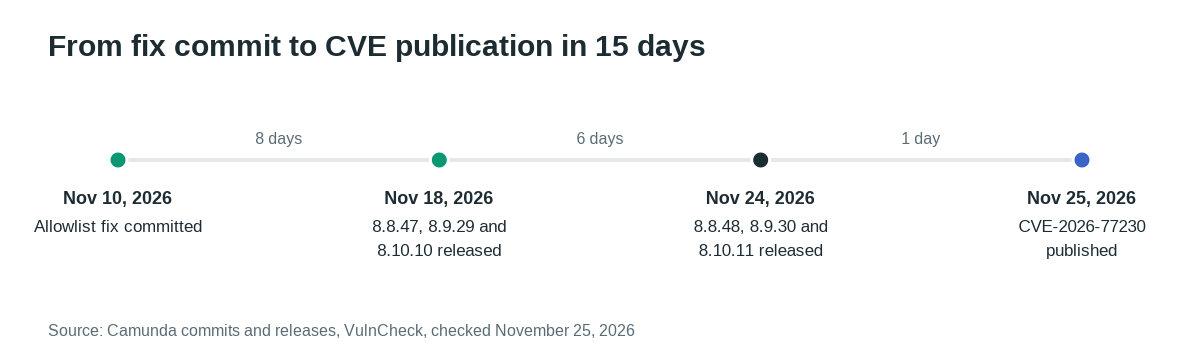
- 2026-11-10: Camunda commits the
ObjectInputFilterallowlist on the main branch. - 2026-11-18: Camunda releases 8.8.47, 8.9.29 and 8.10.10 with the fix.
- 2026-11-24: Camunda releases 8.8.48, 8.9.30 and 8.10.11, the current patch releases on the fixed lines.
- 2026-11-25: VulnCheck publishes CVE-2026-77230.
FAQ
Is CVE-2026-77230 exploited in the wild?
No in-the-wild exploitation is published as of 2026-11-25. The CVE is not in CISA KEV, and VulnCheck's advisory describes the mechanism without reporting attacks.
Is the flaw unauthenticated?
The session-store write can be unauthenticated when the store is open, which is the case VulnCheck describes. The trigger still needs a session cookie that maps to the planted record, and the Camunda login page is not the entry point.
Are persistent web sessions on by default?
Camunda does not enable persistent sessions in every deployment. Check camunda.security.session.persistent.enabled and the legacy keys in "Am I affected?"; a deployment that keeps sessions in memory is not on this path.
Does upgrading to 8.11.0-alpha2-rc1 fix it?
The 8.11.0-alpha2-rc1 release candidate carries the filter, but it is a pre-release. Production deployments should use 8.10.11 until the 8.11 line is generally available.
Does this affect Camunda 7?
The CVE names Camunda 8.8 through 8.11. Camunda 7 is a different codebase and is not in the affected range in the CVE record.
What if I cannot upgrade today?
Turn persistent web sessions off and restart, then require authentication on the session store. Both steps reduce exposure; the upgrade is the complete fix.
References
- VulnCheck, "Camunda 8 Insecure Deserialization via Web Session Storage" (checked November 25, 2026)
- CVE-2026-77230 record (checked November 25, 2026)
- Camunda fix commit aaf0498ec37dc9b43dbbab2616f3bf5303f911ce (checked November 25, 2026)
- Camunda 8.10.10 release (checked November 25, 2026)
- Camunda 8.9.29 release (checked November 25, 2026)
- Camunda 8.8.47 release (checked November 25, 2026)
- Camunda
MigratingWebSessionAttributeConverterat 8.10.9 (checked November 25, 2026) - Camunda Docker image on Docker Hub (checked November 25, 2026)
- Camunda repository (checked November 25, 2026)
- CISA Known Exploited Vulnerabilities catalog (checked November 25, 2026)
Keep reading