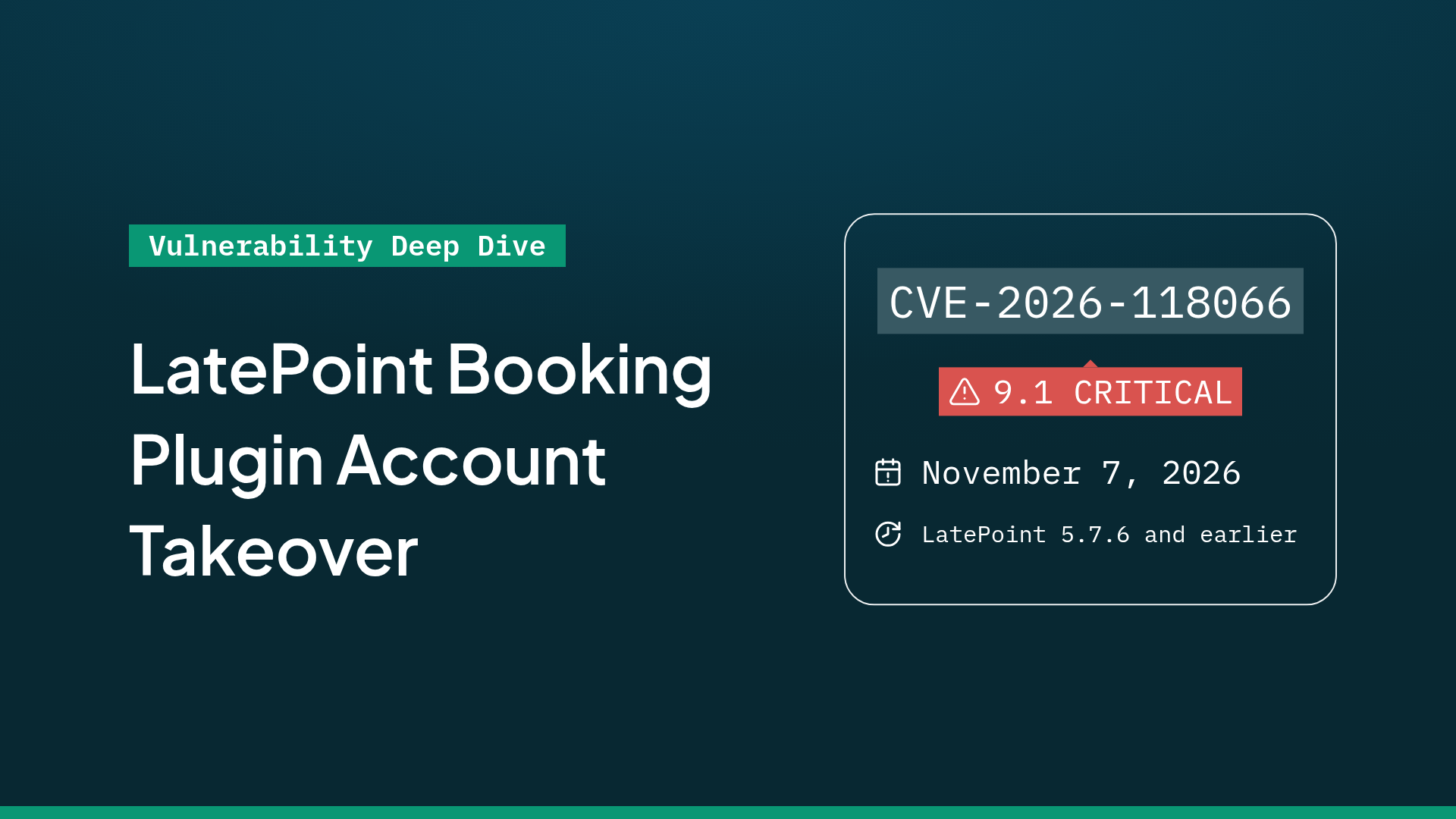
Budibase SSO Account Takeover via Unverified Email (CVE-2026-137499)
An unverified OIDC email links to a password-less global Builder in Budibase 3.41.0 to before 4.0.0, giving full app and datasource control; fixed in 4.0.0.
TL;DR
- Budibase links an OIDC or SSO login that asserts an unverified email to an existing password-less global Builder account. The GitHub advisory GHSA-jm85-crv2-88px names the allowlist that omits the builder roles.
- Budibase Server 3.41.0 to before 4.0.0 is affected when an OIDC provider is configured and a password-less global Builder exists. The vulnerable path is present in 3.44.0 and absent from 3.45.0.
- The CVE record rates it CVSS v3.1 9.8 Critical and CVSS v4.0 9.3 Critical. No exploitation is known, and the CVE is not in CISA KEV as of 2026-11-27.
- Upgrade to Budibase 4.0.0 or later, which removes the unverified-email reconcile path. See "How do I fix it?" for the interim controls.
Am I affected?
A Budibase deployment is exposed when all of these conditions hold:
- The server runs a release from 3.41.0 to before 4.0.0 that contains the unverified-email reconcile path.
- An OIDC or SSO provider is configured for the tenant.
- An attacker can authenticate at that provider with an arbitrary email address and
email_verified=false. A self-registration IdP, or a trusted IdP that does not verify addresses, provides this. - A password-less global Builder account exists with the victim's email address. SSO-enforced tenants create these by default.
- The default
allowUnverifiedEmailLinkingsetting is false. That setting is what sends the login down the separate reconcile path.
A tenant that requires passwords for Builder accounts is not on this path, because the first allowlist check rejects an account with a password. A tenant with no OIDC provider is also not exposed.
| Branch | Affected versions | Fixed version |
|---|---|---|
| 3.x | 3.41.0 to 3.44.1, and any build with the reconcile path | 3.45.0 is the first 3.x release without the path |
| 4.x | None; the CVE record lists before 4.0.0 | 4.0.0 or later |
The CVE record lists 3.41.0 to before 4.0.0 as affected. The reconcile path is present in the v3.44.0 source and absent from v3.45.0, where the removal commit first appears. The CVE record still names 4.0.0 as the fixed release. Upgrade to 4.0.0 or later even if your 3.x build appears to lack the path.
Budibase is widely deployed: 2,356,973 Docker Hub pulls, 28,454 GitHub stars and 20,020 weekly npm downloads of @budibase/server (checked 2026-11-27).
Check the running version from the container and the package inside it:
docker inspect budibase --format '{{.Config.Image}}'
docker exec budibase sh -c "node -p \"require('/app/packages/server/package.json').version\"" 2>/dev/null
Then review the authentication settings. In the Budibase portal, open Auth and list the OIDC or SSO providers. A provider that allows self-registration or does not verify email addresses is the risky configuration.
How do I fix it?
Upgrade to Budibase 4.0.0 or later. The current stable release is 4.1.0. The fix commit c8b746d removes the unverified-email reconcile path instead of extending the allowlist.
- Pull the fixed image and recreate the container. A restart alone keeps the old image:
docker compose pull
docker compose up -d
- Confirm the running container reports 4.0.0 or later with the version command from "Am I affected?".
- If the deployment builds from source, update to the 4.0.0 tag or later and rebuild the server and worker services.
- Republish the apps and confirm that a fresh OIDC login with an unverified email creates a new user instead of opening an existing Builder account.
If the upgrade has to wait, require email verification at the identity provider and disable self-registration there. That removes the attacker's ability to assert an arbitrary unverified address, which is the first condition of the attack.
A second interim control is to give every global Builder account a password or to remove dormant Builder accounts that are only used through SSO. Both controls reduce exposure, but neither repairs the account-linking logic, so upgrade when you can.
What is the root cause?
Budibase runs a separate account-reconciliation path when an OIDC login arrives with an unverified email and allowUnverifiedEmailLinking is false. That path looks up an existing account by email and links it when isAccountLinkable() returns true. The allowlist rejects an account with a password, an inactive account, a global administrator and an account already bound to an SSO identity, but it omits every builder role.
The trigger is in packages/backend-core/src/middleware/passport/sso/sso.ts at tag 3.44.0, lines 77 to 80:
const emailLookupWasSkipped =
  !details.emailVerified && !allowUnverifiedEmailLinking
if (!dbUser && !pendingInvite && emailLookupWasSkipped) {
  dbUser = await findLinkableAccountByEmail(details)
}
findLinkableAccountByEmail() loads the account by email and passes it to isAccountLinkable(). That function is at lines 140 to 156 of the same file:
function isAccountLinkable(user: User, details: SSOAuthDetails): boolean {
  if (
    user.password ||
    user.status === UserStatus.INACTIVE ||
    user.admin?.global ||
    user.ssoId
  ) {
    return false
  }
  if (isSSOUser(user)) {
    return (
      user.provider === details.provider &&
      user.providerType === details.providerType
    )
  }
  return true
}
The four checks do not mention builder.global, builder.apps, builder.creator or roles. A password-less, active, non-admin global Builder with no ssoId passes all four. In an SSO-enforced tenant, UserDB.bulkCreate() and buildUser() delete the password and set requirePassword: !isSSOEnforced, so a password-less Builder is the normal state.
syncAndSaveUser() then spreads the victim document into the SSO user, preserving the victim's _id, roles and builder fields, and issues a session for that _id. The attacker is logged in as the victim Builder.
The design has two gates, and the second one is the problem. The first gate at line 67 only looks up an account by email when the address is verified or unverified linking is explicitly allowed. The second gate runs when that lookup is skipped, which is the default for an unverified address.
The second gate was meant to reconcile an invite that had already been accepted, but it also matches any existing account that passes the four-clause allowlist. Because the allowlist omits the builder fields, a password-less Builder is treated as an unclaimed account.
The path was introduced by commit bc8377ee79 on 2026-07-23, which added the reconcile step for invites that had already been accepted. It first shipped in 3.41.0, after the fix for the earlier unverified-email advisory GHSA-hp6v-6jw7-gv2f.
How is it exploited?
An attacker needs control of an identity at the tenant's OIDC provider, or the ability to register one, and the victim's email address. The advisory's proof of concept uses a self-hosted identity provider with email verification switched off.
- Stand up or use a trusted OIDC provider and register it in the target Budibase tenant.
- Create an attacker account at the provider with a distinct subject identifier and set its email attribute to the victim's address, unverified.
- Confirm that a password-less global Builder with that address exists. This is the normal state in an SSO-enforced tenant.
- Start the OIDC login at
/api/global/auth/default/oidc/configs/:id, authenticate at the provider and let the callback reach/api/global/auth/oidc/callback?code=...&state=.... GET /api/global/selfreturns the victim's_idwithbuilder.global, so the attacker now holds the victim's Builder session.
The callback asserts email=victim@corp.example and email_verified=false. The line-67 email gate is skipped because the email is unverified and allowUnverifiedEmailLinking is false. The reconcile path then runs, and isAccountLinkable() returns true for the password-less Builder.
How does the attack flow?
The attack is one OIDC login: an unverified email skips the normal lookup, the reconcile path accepts the password-less Builder, and the session is issued for the victim's account.
email=victim, verified=false"] --> B["Normal email gate skipped"] B --> C["Reconcile path: find account by email"] C --> D["isAccountLinkable(): no builder check"] D --> E["Victim Builder passes the allowlist"] E --> F["syncAndSaveUser keeps victim _id and roles"] F --> G["Session issued as the victim Builder"]
What can an attacker do?
An unauthenticated attacker who controls an identity at the tenant's OIDC provider can take over a password-less global Builder account. That account can read and modify every app, every datasource and every automation in the tenant.
- The attacker can read and change every app, including its screens, queries and published versions.
- The attacker can read the stored datasource credentials, which often include production database passwords.
- The attacker can change automations, including server-side JavaScript and HTTP actions, and use them against connected systems.
- The attacker can lock the legitimate Builder out or delete apps and datasources, which affects availability.
The conditions are specific, and each one matters:
- An OIDC or SSO provider must be configured for the tenant.
- The attacker must be able to obtain an identity at that provider with an arbitrary email and
email_verified=false. A provider that verifies addresses, or that only lets administrators create accounts, blocks this step. - A password-less global Builder must exist with the victim's email. A Builder with a password is rejected by the allowlist.
allowUnverifiedEmailLinkingmust be false, which is the default.
The advisory does not report exploitation in the wild, and the CVE is not in CISA KEV as of 2026-11-27. The proof of concept is public in the advisory.
Why does the fix work?
The fix removes the unverified-email reconcile path. Without that path, an unverified email cannot link to an existing account, and Budibase creates a new user for the identity instead of opening the victim's Builder.
Commit c8b746d deletes the trigger block, isAccountLinkable() and findLinkableAccountByEmail():
-  const emailLookupWasSkipped =
-    !details.emailVerified && !allowUnverifiedEmailLinking
-  if (!dbUser && !pendingInvite && emailLookupWasSkipped) {
-    dbUser = await findLinkableAccountByEmail(details)
-  }
-
@@
-function isAccountLinkable(user: User, details: SSOAuthDetails): boolean {
-  if (
-    user.password ||
-    user.status === UserStatus.INACTIVE ||
-    user.admin?.global ||
-    user.ssoId
-  ) {
-    return false
-  }
-  ...
-}
-
-async function findLinkableAccountByEmail(
-  details: SSOAuthDetails
-): Promise<User | undefined> {
-  const user = await users.getGlobalUserByEmail(details.email!)
-  if (user && isAccountLinkable(user, details)) {
-    return user
-  }
-  return undefined
-}
The commit also rewrites the tests so an unverified email must not resolve to an existing account, including a previously linked SSO account. That closes the whole class for this login path rather than patching one missing role check.
The advisory's suggested fix was to add builder.global, builder.apps, builder.creator and roles to the allowlist. The shipped fix is stronger because it removes the reconcile path entirely. It is complete for the unverified-email login path, and the normal verified-email lookup still works.
How do I check if I was compromised?
No indicators of compromise are published for this issue. A successful takeover looks like a normal OIDC login, and Budibase records the session against the victim's user ID.
Check the identity provider's logs for OIDC or SSO logins that asserted an unverified email for a Builder account. Look especially for logins from a new subject identifier or a new network location.
Then compare Budibase's user documents and session records with the legitimate Builder accounts. A user document whose provider or providerType changed without an authorised login, or a session for a Builder who did not sign in, is a lead.
grep -Ei 'email_verified[=: ]+(false|0)' /var/log/idp/oidc.log
A hit is a lead, not proof, because legitimate unverified logins can occur during onboarding. If the provider does not log the claim, an attempt that succeeded leaves no IdP-side record beyond the login itself.
Timeline
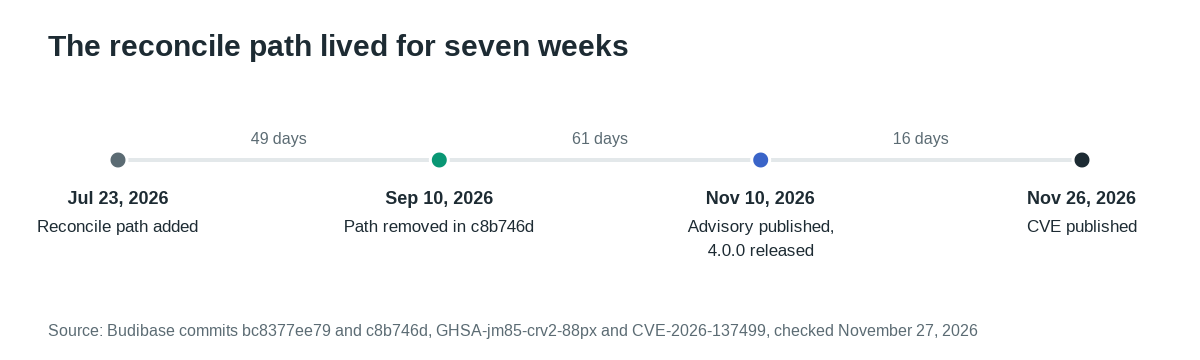
- 2026-07-23: Commit bc8377ee79 adds the unverified-email reconcile path.
- 2026-09-10: Commit c8b746d removes the path.
- 2026-11-10: The vendor advisory GHSA-jm85-crv2-88px is published and Budibase 4.0.0 is released.
- 2026-11-26: The CVE record for CVE-2026-137499 is published.
FAQ
Does this affect Budibase Cloud?
The advisory covers the server code and does not list a separate status for the hosted service. Budibase Cloud runs a managed build, so ask Budibase which release your tenant runs.
Do I need a malicious identity provider?
No. A legitimate provider that lets users self-register and does not verify email addresses is enough. The attacker only needs to assert the victim's address with email_verified=false.
Is a Builder account with a password safe?
Yes for this path. The allowlist rejects any account with a password, so a password-protected Builder cannot be linked. SSO-enforced tenants usually delete Builder passwords, which is why they are exposed.
Is the default configuration vulnerable?
Yes. allowUnverifiedEmailLinking defaults to false, and that value is exactly what sends the login down the reconcile path. Setting it to true does not fix the issue.
Which version should I install?
Budibase 4.0.0 or later. The current stable release is 4.1.0. The reconcile path is already absent from 3.45.0, but the CVE record names 4.0.0 as the fixed release.
Was CVE-2026-137499 exploited in the wild?
No exploitation is known, and the CVE is not in CISA KEV as of 2026-11-27. The advisory publishes a five-step proof of concept, so the takeover is reproducible on a matching tenant.
References
- GitHub advisory GHSA-jm85-crv2-88px, "Unverified-email OIDC/SSO account linking takes over password-less global Builder", published 2026-11-10 (checked November 27, 2026)
- CVE-2026-137499 record, published 2026-11-26 (checked November 27, 2026)
- Fix commit c8b746d, "fix: prevent unverified SSO account linking" (checked November 27, 2026)
- Introducing commit bc8377ee79, "Reconcile already-accepted invites during unverified-email OIDC/SSO logins" (checked November 27, 2026)
sso.tsat tag 3.44.0 (checked November 27, 2026)sso.tsat tag 3.45.0 (checked November 27, 2026)- Budibase 4.0.0 release (checked November 27, 2026)
- Budibase 4.1.0 release (checked November 27, 2026)
- Budibase Docker Hub repository (checked November 27, 2026)
- Budibase repository (checked November 27, 2026)
- CISA Known Exploited Vulnerabilities catalog, version 2026.11.25 (checked November 27, 2026)
Keep reading