AutoGPT Marketplace Takeover, Fixed in 0.11.0 (CVE-2026-133453)
Any AutoGPT user could add a version under another user's workflow ID and take over its Marketplace listing; fixed in 0.11.0 and Docker 0.11.1.
TL;DR
- AutoGPT's save endpoint appended a version to a workflow ID without checking who created it. A signed-up user could take over another user's Marketplace listing.
- Self-hosted AutoGPT Platform releases 0.6.0 through 0.10.x are affected. The Docker image is affected from 0.7.1 through 0.11.0.
- The CVE record rates CVE-2026-133453 at CVSS v3.1 9.1 Critical. No public exploit or in-the-wild use is known, and the CVE is not in CISA KEV as of 2026-11-25.
- Upgrade the Platform to 0.11.0 or later, and the Docker deployment to 0.11.1 or later. The current release is 0.12.0.
Am I affected?
You are exposed when a self-hosted AutoGPT Platform release in the affected range lets other people create accounts. A workflow ID is public, because every published Marketplace page carries it. The CVE record gives CVSS v3.1 9.1, CVSS:3.1/AV:N/AC:L/PR:L/UI:N/S:C/C:L/I:H/A:L.
All of these conditions must hold:
- The Platform runs a release from 0.6.0 through 0.10.x, or the Docker image runs a tag from 0.7.1 through 0.11.0.
- The deployment allows other people to create accounts. A single-user installation with no untrusted accounts is not exposed.
- A target workflow is published or otherwise has its ID visible. The advisory says every published agent's Marketplace page carries its workflow ID.
- The attacker can reach the save endpoint that adds a version to a workflow.
| Package | Affected versions | Fixed version |
|---|---|---|
| AutoGPT Platform GitHub release | 0.6.0 through 0.10.x | 0.11.0 |
| significantgravitas/autogpt Docker image | 0.7.1 through 0.11.0 | 0.11.1 |
The advisory gives the Platform release versions, whose Git tags are autogpt-platform-beta-v followed by the number. The current release is autogpt-platform-beta-v0.12.0 from 2026-11-19.
The Platform release line and the Docker image line do not share version numbers, which is why the advisory lists two ranges. A Docker tag of 0.11.0 is affected while the Platform release 0.11.0 is fixed. Read the version from the running deployment, not from the release notes of the other package.
Check the deployment version. For a source checkout:
git -C AutoGPT describe --tags --always
For Docker:
docker images significantgravitas/autogpt
docker inspect --format '{{.Config.Image}}' <container>
How do I fix it?
Upgrade to AutoGPT Platform 0.11.0 or later. The current release, 0.12.0, contains the fix and later changes.
- For a source checkout, fetch the release tag and rebuild the backend and frontend:
git -C AutoGPT fetch --tags
git -C AutoGPT checkout autogpt-platform-beta-v0.12.0
- For Docker, update the image tag in the compose file and recreate the containers:
docker compose pull
docker compose up -d
- Run the platform's database migrations as the upgrade guide requires, then confirm the running version.
If you cannot upgrade, stop publishing new Marketplace entries and remove untrusted accounts from the deployment. That control does not fix the save path, and an account that already holds a workflow ID can still add a version to it.
Hosted deployments need a different check. The advisory covers the self-hosted releases and the Docker image, and it does not state whether the hosted service was affected. Ask the operator for the patch status and for the version they run. A self-hosted deployment that cannot move to 0.11.0 should treat every Marketplace listing as untrusted until it does.
What is the root cause?
A workflow is stored as a set of versions that share a graph ID. The save endpoint, update_graph() in the Platform API, found every existing version by that ID. It chose the next version number and saved the caller's graph as the next version of the same ID:
if not existing_versions:
    raise HTTPException(404, detail=f"Workflow #{graph_id} not found")

latest_version = max(g.version for g in existing_versions)
graph.version = latest_version + 1
current_active_version = next((v for v in existing_versions if v.is_active), None)

graph = graph_db.make_graph_model(graph, user_id)
Nothing in that path compared the caller's user ID with the user ID on the first version. The other features that key on a workflow ID, including the library and the Marketplace store, then treated the caller's row as ownership of every version under the ID. That is how a new version taken from the attacker came to sit under the creator's listing.
The ownership check is not the only place that keyed on the ID. The library stores a workflow's versions as a list, and the Marketplace store reads the listing by the same ID. Once a row with the attacker's user ID sat under the victim's ID, those features had no separate ownership column to consult. The fix therefore had to change the save path and the submission path together.
How is it exploited?
The attack needs an account and a victim's workflow ID. It does not need a vulnerability in the victim's browser or any interaction from the victim.
- The attacker creates an account on the AutoGPT deployment.
- The attacker reads a public Marketplace page and takes the workflow ID of the listing they want.
- The attacker sends a save request that names that workflow ID and supplies their own graph.
- The server appends the attacker's graph as the next version under the victim's ID.
- The attacker submits that version to the Marketplace, or waits for the creator's pending submission to be reviewed. The approval then makes the creator's page install the attacker's workflow.
- Separately, the attacker can stop the owner from saving new versions, break runs that name no version, and after the owner saves again, move the owner's versions into an organization the attacker controls and read the nodes' stored inputs there.
The advisory publishes no proof-of-concept code. The fix commit includes tests that create a second user's version under the first user's graph ID and assert that the save is refused or becomes a separate copy.
The attacker does not need to guess the graph ID format or brute-force it. The ID appears in the public Marketplace URL and in the page source. A single authenticated request that names it is enough to create the version, and the response returns the new version as if the save were ordinary.
How does the attack flow?
A signed-up attacker who knows a public workflow ID saves a version under that ID. The server never checks the ID's owner, so the attacker's workflow ends up under the creator's Marketplace listing.
What can an attacker do?
An attacker with an account can take control of another creator's Marketplace listing and use it to distribute their own workflow. Every visitor who installs from that listing then runs the attacker's workflow.
The approval step is the part that turns the flaw into a supply-chain problem. A Marketplace submission is reviewed by a person who sees the creator's listing and the workflow it names. When the attacker's version is the one the listing points at, the reviewer's approval attaches the attacker's workflow to the creator's page. Visitors then install it under the creator's reputation.
The advisory lists four impacts:
- Replace the creator's pending Marketplace submission, so an approval makes the creator's page install the attacker's workflow.
- Stop the owner from saving new versions under the workflow ID.
- Break every run that names no version.
- Move the owner's versions into an organization the attacker controls and read the nodes' stored inputs there.
The attacker needs an account, the target's workflow ID and network access to the Platform. The advisory does not describe a case that works without an account or against a deployment that has no untrusted users.
Why does the fix work?
The fix makes a workflow ID belong to the user who created its first version. The save endpoint now compares the caller with the owner and saves a fork instead of appending to the original:
     latest_version = max(g.version for g in existing_versions)
     graph.version = latest_version + 1
     current_active_version = next((v for v in existing_versions if v.is_active), None)

+    requested_graph = graph
     graph = graph_db.make_graph_model(graph, user_id)
     submitted_node_ids = graph.reassign_ids(user_id=user_id, reassign_graph_id=False)
     _validate_graph_to_save(graph, submitted_node_ids)

+    if await graph_db.graph_owner_id(graph_id) != user_id:
+        return await _save_as_fork(requested_graph, latest_version, user_id, ctx)
+
     # If this new version is going to be active, validate node credentials
The owner lookup reads the first version's user ID:
async def graph_owner_id(graph_id: str, tx: Prisma | None = None) -> str | None:
    """The owner of the graph ID's first version, or None when it has none."""
    first_version = await AgentGraph.prisma(tx).find_first(
        where={"id": graph_id}, order={"version": "asc"}
    )
    return first_version.userId if first_version else None
The same change refuses a Marketplace submission for a listing that belongs to another creator, which covers IDs that already had two owners. It also applies to sub-workflows, so a nested graph cannot be used to bypass the check.
The store and library changes follow the same rule. Creating a library agent now checks that the graph ID belongs to the caller, and an update to a listing refuses a graph the caller does not own. The advisory notes that this covers IDs that already had two owners, which is the state an affected release can leave behind.
The fix is complete for the save and submission paths the commit touches. It does not rewrite existing rows. A deployment that ran an affected release may already hold a workflow ID with versions from two users, and the new submission check is what covers that state.
How do I check if I was compromised?
No indicators of compromise are published. The anomaly the bug leaves is a graph ID whose versions have different owners.
Query the AgentGraph table for IDs with more than one userId:
SELECT id, COUNT(DISTINCT "userId") AS owners, COUNT(*) AS versions
FROM "AgentGraph"
GROUP BY id
HAVING COUNT(DISTINCT "userId") > 1;
A result is a lead, not proof of an attack. Review the versions under each returned ID, the account that added them, and any Marketplace submission that pointed at that ID. Check the submission history for entries approved under a creator who did not write the approved workflow.
Timeline
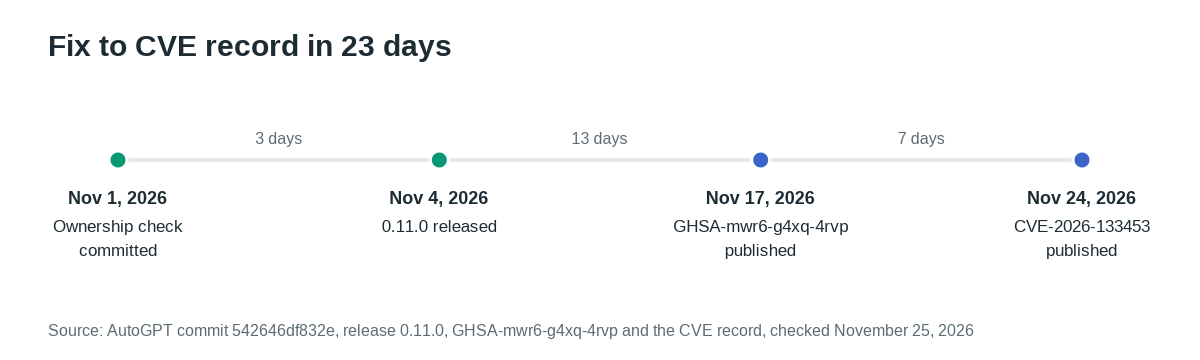
- 2026-11-01: The fix commit 542646df832e is authored.
- 2026-11-04: AutoGPT Platform 0.11.0 is released.
- 2026-11-17: GitHub advisory GHSA-mwr6-g4xq-4rvp is published.
- 2026-11-24: The CVE record for CVE-2026-133453 is published with CVSS v3.1 9.1.
FAQ
Does this affect the hosted AutoGPT service?
The advisory covers the self-hosted Platform releases and the Docker image. It does not state a status for the hosted service, so ask the operator.
Do I need to be an administrator to exploit it?
No. Any signed-up account can call the save endpoint. The attacker needs the victim's workflow ID, which a published Marketplace page exposes.
Can the attacker run code on my server through this flaw?
Not directly. The flaw lets the attacker place a workflow under the creator's listing and read stored node inputs after moving versions into an organization. The workflow itself runs when a user installs and runs it.
Is 0.11.0 enough, or do I need 0.11.1?
The Platform release 0.11.0 carries the fix. The Docker image needs 0.11.1, because the advisory lists Docker 0.11.0 as affected. The current release, 0.12.0, is later than both.
References
- GitHub advisory GHSA-mwr6-g4xq-4rvp, "AutoGPT: Users can hijack Marketplace listings by adding versions to unowned workflow IDs", 2026-11-17 (checked November 25, 2026)
- AutoGPT fix commit 542646df832ea40a430d4c76f89b5c616ab9bbd7, "fix(backend): bind every version of a workflow ID to the user who created it", 2026-11-01 (checked November 25, 2026)
- CVE.org, CVE-2026-133453 record (checked November 25, 2026)
- AutoGPT release autogpt-platform-beta-v0.11.0, 2026-11-04 (checked November 25, 2026)
- AutoGPT repository releases page, current release autogpt-platform-beta-v0.12.0, 2026-11-19 (checked November 25, 2026)
- GitHub, Significant-Gravitas/AutoGPT repository metadata (checked November 25, 2026)
- CISA, Known Exploited Vulnerabilities catalog JSON feed, catalogVersion 2026.11.24 (checked November 25, 2026)
Keep reading