
Weblate Unicode Email Takeover, Fixed in 2026.11 (CVE-2026-134838)
Weblate before 2026.11 matches reset e-mail addresses with locale case folding, letting a lookalike mailbox take over an account; fixed in 2026.11.
TL;DR
- Weblate looked up the account for a password reset with a PostgreSQL case-insensitive comparison. That comparison uses the database locale, so two different Unicode addresses can compare equal.
- Weblate before 2026.11 is affected. The account must have an e-mail address, and the attacker must control a lookalike domain and mailbox that the database folds onto that address.
- VulnCheck rates the flaw CVSS v4.0 9.1 Critical and CVSS v3.1 7.4 High. No public proof of concept and no known in-the-wild exploitation are reported, and the CVE is not in CISA KEV as of 2026-11-23.
- Upgrade to Weblate 2026.11 or later, preferably 2026.11.2. Version 2026.11.1 adds an upgrade check that flags legacy lookalike identities, so review the account security findings and reset the affected accounts.
Am I affected?
All of these conditions must hold for an account to be exposed:
- The instance runs Weblate before 2026.11.
- The database is PostgreSQL, which is required by Weblate's verified-email model.
- The target account has an e-mail address, and the attacker can register a lookalike mailbox whose address the database locale case-folds onto that address. The long s
ſfolds toSin many locales, and dotlessıfolds toIunder Turkish and Azeri locales. - The attacker can register the lookalike domain and a mailbox with the same local part.
- Password reset is enabled, which is the default.
An account without an e-mail address cannot be reached through this flow. An account with an e-mail address can be reached even if the attacker does not know its password.
The official weblate/weblate image has been pulled 21,699,504 times on Docker Hub as of 2026-11-23.
| Branch | Affected versions | Fixed version |
|---|---|---|
| 2026.11.x | None | 2026.11 or later |
| 2026.10.x | 2026.10 and 2026.10.1 | 2026.11 or later |
| 2026.9.x and earlier | All releases before 2026.11 | 2026.11 or later |
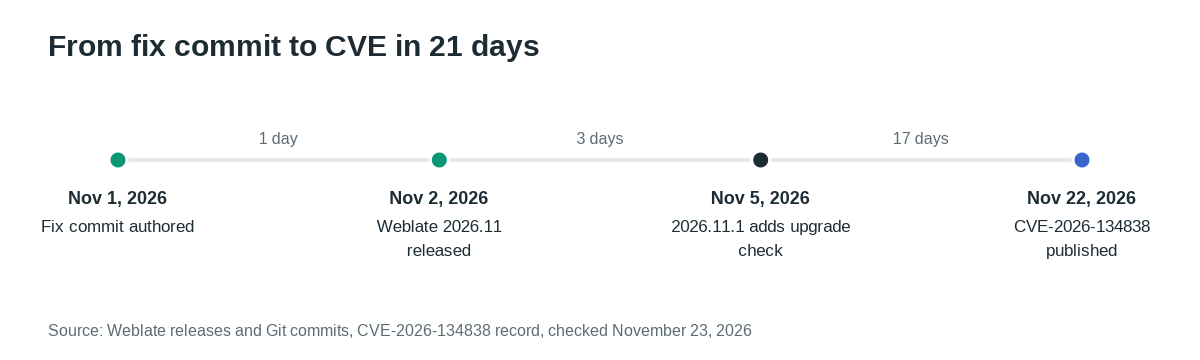
Weblate 2026.11 was released on 2026-11-02. Version 2026.11.1 followed on 2026-11-05 with the upgrade check and the administrator cleanup action, and 2026.11.2 on 2026-11-12 is the current release.
Check the running version:
python -c "from weblate.utils.version import VERSION; print(VERSION)"
docker exec <container> python -c "from weblate.utils.version import VERSION; print(VERSION)"
Then check whether the database folds the lookalike characters. Run this on the Weblate database:
SELECT datcollate, datctype FROM pg_database WHERE datname = current_database();
SELECT UPPER('ſ') = UPPER('s') AS long_s_collides,
       UPPER('ı') = UPPER('i') AS dotless_i_collides;
A true result means the database maps those characters to the same uppercase form, which is the condition the reset lookup used. Database locales differ, so run the query rather than assume the result.
List addresses that contain non-ASCII characters as a lead:
SELECT email FROM weblate_auth_user WHERE email !~ '^[ -~]*$';
SELECT email FROM accounts_verifiedemail WHERE email !~ '^[ -~]*$';
A non-ASCII address is not proof of an attack. It is a lead worth checking against the account security findings after the upgrade.
How do I fix it?
Upgrade to Weblate 2026.11 or later. The fix changes the e-mail comparison to ASCII-only folding and sends the reset link to the stored address rather than the typed one. Version 2026.11.1 adds the upgrade check that finds identities created under the old comparison.
- For a Docker deployment, update the image tag and recreate the container:
docker compose pull weblate
docker compose up -d weblate
If the container was started with docker run, remove it before starting the new one, because the name stays in use:
docker rm -f <container>
- For a pip deployment, upgrade the package and run the migrations:
pip install -U "weblate==2026.11.2"
weblate migrate
- For a source deployment, check out the release tag and reinstall:
git fetch --tags
git checkout weblate-2026.11.2
pip install -e .
weblate migrate
- Restart the WSGI server and the Celery workers. A running process keeps the old code until it restarts.
After the upgrade, open the administration page for account security findings. Version 2026.11.1 adds a finding for verified e-mail addresses that matched their account only under the old locale-sensitive comparison.
Use the action that removes the lookalike e-mail identities and resets the selected accounts. That action removes the suspect address and its sign-in identity, disables the account password, invalidates sessions, revokes API tokens and notifies the primary address.
If the upgrade cannot happen now, there is no supported configuration switch for this flaw. As an interim control, reject password-reset requests whose address contains non-ASCII characters at the reverse proxy, and watch the reset endpoint. That blocks the described lookalike variants, but it is not a complete fix and it does not address a fold that uses only ASCII characters in a particular locale. The supported fix is the upgrade.
What is the root cause?
Weblate's e-mail fields are case-insensitive, and the case-insensitive lookup was implemented with Django's iexact. On PostgreSQL, iexact compares UPPER() of both sides, and UPPER() follows the database locale. Distinct Unicode characters can therefore compare equal.
The field that caused it is the custom EmailField in weblate/utils/fields.py at tag weblate-2026.10.1. It rewrites an exact lookup to iexact:
class CaseInsensitiveField(models.CharField):
    LOOKUP_CONVERSIONS: ClassVar[dict[str, str]] = {
        "exact": "iexact",
        "contains": "icontains",
        "startswith": "istartswith",
        "endswith": "iendswith",
        "regex": "iregex",
    }

    def get_lookup(self, lookup_name):
        converted = self.LOOKUP_CONVERSIONS.get(lookup_name, lookup_name)
        return super().get_lookup(converted)
The password-reset form used that lookup to find the account:
@staticmethod
def get_email_user(mail: str) -> User | None:
    """Return an active user matching the e-mail address."""
    users = User.objects.filter(
        email=mail,
        is_active=True,
        is_bot=False,
    )
    if not users:
        users = User.objects.filter(
            social_auth__verifiedemail__email__iexact=mail,
            is_active=True,
            is_bot=False,
        )
    if users:
        return users[0]
    return None
The email=mail filter is converted to iexact by the field, so the primary address is compared with UPPER(). The fallback compares a verified address with an explicit iexact. Both comparisons can match a lookalike that the database folds to the same uppercase form.
The reset view then sent the link to the address the caller typed:
email_user = form.get_email_user(email)
if email_user:
    response = send_password_reset_email(
        request,
        email_user,
        email=email,
        scope=get_password_reset_scope(request, email),
    )
The lookup and the delivery address were two different strings. A typed lookalike could match the victim's account and still receive the message.
The same locale-sensitive comparison backed the uniqueness rules. The user model declared UniqueConstraint(Upper("email")), and the verified-email model declared an Upper("email") index. Both were built on the same locale-dependent expression.
How is it exploited?
An attacker requests a password reset with a lookalike address. Weblate matches the victim's account, sends the reset link to the attacker's mailbox, and the attacker sets a new password.
- The attacker learns the victim's e-mail address, which is often public in a project's commit metadata or profile.
- The attacker registers a lookalike domain and a mailbox with the same local part. For
victim@staff.com, one lookalike isvictim@ſtaff.com, whereſis the long s. - The attacker submits
victim@ſtaff.comto the password reset endpoint at/accounts/reset/. - Weblate's
get_email_usercompares the address with the case-insensitive lookup, and the database foldsſontos. - The lookup returns the victim's account, and Weblate sends the reset message to the typed lookalike address.
- The attacker opens the reset link, chooses a new password and signs in as the victim.
A captcha or a rate limit on the reset endpoint slows the attempts but does not change the comparison. The attacker needs the lookalike mailbox to be reachable, and the address must collide under the database locale. The long-s variant is the one the fix's regression test demonstrates; the dotless-i variant depends on a Turkish or Azeri database locale.
How does the attack flow?
A lookalike address matches the victim's account through a locale-aware case comparison, and the reset link goes to the attacker's mailbox.
domain and mailbox"] --> B["Reset request uses
the lookalike address"] B --> C["E-mail lookup uses locale
UPPER, not ASCII folding"] C --> D["Lookalike matches
the victim account"] D --> E["Reset link sent to
the typed address"] E --> F["Attacker sets a new password
and signs in"]
What can an attacker do?
An attacker who completes the reset signs in as the victim and inherits every permission the account holds. On a translation platform, that can reach project content, other users and, for an administrator, the whole instance.
- Read and change translations. The account can edit, review and download the projects it can access.
- Reach linked services. API tokens and project tokens issued to the account remain usable until revoked.
- Change account settings. The attacker can change the password, e-mail address and linked sign-in methods.
- Escalate through administration. An administrator account gives access to users, projects, components and instance settings.
Every condition is listed here. The instance must run an affected release. The target account must have an e-mail address. The attacker must control a lookalike domain and mailbox. The address must collide under the database locale. Password reset must be enabled. No authentication is needed to start the reset.
Why does the fix work?
The fix replaces the locale-sensitive comparison with ASCII-only folding, sends the reset link to the stored address, and rebuilds the uniqueness rules on the new expression. It also adds an upgrade check for identities that the old comparison created.
-        users = User.objects.filter(
-            email=mail,
-            is_active=True,
-            is_bot=False,
-        )
-        if not users:
-            users = User.objects.filter(
-                social_auth__verifiedemail__email__iexact=mail,
-                is_active=True,
-                is_bot=False,
-            )
-        if users:
-            return users[0]
+        match = UniqueEmailMixin.get_email_owner(mail)
+        return match[0] if match else None
The new get_email_owner() matches the primary address and the verified address, and it returns the stored address together with the user. The reset view passes that stored address to send_password_reset_email, so the message can no longer go to a lookalike.
def email_key(email: str) -> str:
    """Fold ASCII case without equating distinct Unicode e-mail addresses."""
    return email.translate(ASCII_LOWER_TABLE)


def email_key_expression(field: str) -> Func:
    """Match email_key in PostgreSQL independently of the database locale."""
    return Func(
        F(field),
        function="LOWER",
        template='LOWER((%(expressions)s) COLLATE "C")',
    )
The COLLATE "C" clause makes the comparison use byte order rather than the database locale. The custom EmailField now returns a SafeEmailLookup for exact and iexact, so every ordinary lookup uses the same ASCII-only rule. The migrations recreate the unique constraint and the index with email_key_expression.
The fix is complete for the e-mail identity paths the patch touches. A custom deployment that keeps its own copy of get_email_user, or that stores addresses outside the models the migration covers, should apply the same ASCII-only comparison.
Version 2026.11.1 adds the upgrade check that reports verified addresses which matched only under the old comparison. That check is how an existing compromise is found after the code is fixed.
How do I check if I was compromised?
The primary check is the upgrade finding. After installing 2026.11.1 or later, open the administration page for account security findings and look for the legacy lookalike e-mail identities report. A finding means the account had a verified address that matched only under the old locale-sensitive comparison, which is a possible earlier takeover.
If a finding is present, use the action that removes the lookalike e-mail identities and resets the selected accounts. The action removes the suspect address and identity, disables the password, invalidates sessions, revokes API tokens and notifies the primary address. Review the account's recent changes before restoring access.
Check the audit log for password resets and sign-ins from addresses the account's owners do not recognise. Weblate records account activity in its audit log, and an unusual reset followed by a sign-in is the pattern to look for.
The non-ASCII address queries in "Am I affected?" list candidates, not proof. A legitimate user can have a non-ASCII address, so confirm each hit against the security finding and the account owner.
No indicators of compromise are published for CVE-2026-134838. The reset happens through the normal application flow, so it can look like a legitimate password reset in the logs.
Timeline
- 2026-11-01: The main fix commit
8340ccd9dee8was authored. - 2026-11-02: Weblate 2026.11 was released.
- 2026-11-04: The legacy lookalike detection commit
c129f67ec98ewas authored. - 2026-11-05: Weblate 2026.11.1 was released with the upgrade check and the administrator action.
- 2026-11-12: Weblate 2026.11.2 was released as the current version.
- 2026-11-22: VulnCheck published CVE-2026-134838.
FAQ
Does this affect the hosted Weblate service?
The CVE describes the Weblate software before 2026.11. A hosted service is patched by its operator, so its exposure depends on when that operator upgraded. Ask the provider which version it runs.
Is my account affected if I sign in with a password?
The vulnerable lookup is on the e-mail address, so an account with an e-mail address can be targeted whatever sign-in method it uses. A linked verified e-mail is a second path to the same comparison.
Is there a public exploit?
No public proof of concept is published as of 2026-11-23. The fix's regression tests show the long-s and dotless-i variants, and they are not a weaponized exploit.
Is CVE-2026-134838 exploited in the wild?
No in-the-wild exploitation is reported, and the CVE is not in CISA KEV as of 2026-11-23. A takeover would look like a normal password reset in the application logs.
Which Weblate version fixes it?
Weblate 2026.11 fixes the account-takeover path. Version 2026.11.1 adds the upgrade check for legacy lookalike identities, and 2026.11.2 is the current release, so install 2026.11.2.
Does changing the database collation fix it?
No. The comparison used the column's collation, and changing the database collation is not a supported fix for the code path. Upgrade to 2026.11 or later, which compares with an explicit COLLATE "C" expression.
References
- CVE-2026-134838 record, published 2026-11-22 (checked November 23, 2026): https://www.cve.org/CVERecord?id=CVE-2026-134838
- VulnCheck advisory for Weblate before 2026.11, published 2026-11-22 (checked November 23, 2026): https://www.vulncheck.com/advisories/weblate-before-2026.11-account-takeover-via-unicode-e-mail-matching-in-password-reset
- Main fix commit 8340ccd9dee8, "prevent Unicode email identity collisions", authored 2026-11-01 (checked November 23, 2026): https://github.com/WeblateOrg/weblate/commit/8340ccd9dee8c6d0586e62c19697c3de2c42ffd2
- Legacy detection commit c129f67ec98e, "flag legacy lookalike email identities", authored 2026-11-04 (checked November 23, 2026): https://github.com/WeblateOrg/weblate/commit/c129f67ec98e6da36b4f27103283a091fa15310c
- Fix pull request 22506 (checked November 23, 2026): https://github.com/WeblateOrg/weblate/pull/22506
- Weblate 2026.11 release, published 2026-11-02 (checked November 23, 2026): https://github.com/WeblateOrg/weblate/releases/tag/weblate-2026.11
- Weblate 2026.11.1 release, published 2026-11-05 (checked November 23, 2026): https://github.com/WeblateOrg/weblate/releases/tag/weblate-2026.11.1
- Weblate 2026.11.2 release, published 2026-11-12 (checked November 23, 2026): https://github.com/WeblateOrg/weblate/releases/tag/weblate-2026.11.2
- Vulnerable e-mail form at tag weblate-2026.10.1 (checked November 23, 2026): https://github.com/WeblateOrg/weblate/blob/weblate-2026.10.1/weblate/accounts/forms.py
- Fixed e-mail form at tag weblate-2026.11 (checked November 23, 2026): https://github.com/WeblateOrg/weblate/blob/weblate-2026.11/weblate/accounts/forms.py
- ASCII-only e-mail helpers at tag weblate-2026.11 (checked November 23, 2026): https://github.com/WeblateOrg/weblate/blob/weblate-2026.11/weblate/utils/email.py
- Case-insensitive field and safe lookup at tag weblate-2026.11 (checked November 23, 2026): https://github.com/WeblateOrg/weblate/blob/weblate-2026.11/weblate/utils/fields.py
- Weblate account security findings documentation for 2026.11.1 (checked November 23, 2026): https://docs.weblate.org/en/weblate-2026.11.1/admin/access.html
- Docker Hub pull count for weblate/weblate, checked 2026-11-23: https://hub.docker.com/r/weblate/weblate
- CWE-178, Improper Handling of Case Sensitivity (checked November 23, 2026): https://cwe.mitre.org/data/definitions/178.html
- CISA Known Exploited Vulnerabilities catalog, checked for CVE-2026-134838 on 2026-11-23: https://www.cisa.gov/known-exploited-vulnerabilities-catalog