The True Cost of False Positives: Calculating the Engineering Tax of Noisy Scanners
False positives are an engineering-capacity problem, not only a scanner-quality problem. Learn how to measure their cost and evaluate the ROI of proof-of-exploit testing.
A false positive can cost an engineering team $30, $300, or $3,000.
At a loaded rate of $90 an hour, a 20-minute close costs $30. The $300 scenario below assumes 2.5 developer hours at $120 an hour. A reconstruction requiring eight hours each from a senior developer at $180 an hour and an AppSec reviewer at $195 an hour costs $3,000 (8 × ($180 + $195)).
The same scanner can create very different costs depending on who touches the alert and how much context they must reconstruct.
That is why “our scanner has fewer false positives” is not a business case by itself. The useful question is:
How much engineering time does an alert consume before the team can confidently decide to fix it, defer it, or close it?
For a noisy security program, that time becomes an engineering tax. It is paid in interrupted feature work, AppSec investigation, Slack threads, duplicate tickets, and lost trust in the next alert.
How much do false positives cost engineering teams?
False positives cost engineering teams the loaded cost of every non-actionable alert, defined here as an alert closed without a remediation task, that reaches a human workflow. Developer time alone is $300 per alert in the worked example below.
Use this model:
Annual noise cost =
non-actionable alerts that reach humans
× average labor cost per alert
× number of periods per year (12 when the alert count is monthly)
For an individual alert:
Labor cost per alert =
((developer investigation time + context-recovery time) × loaded developer hourly cost)
+ (security-review time × loaded security hourly cost)
+ other coordination costs not already included above
Use loaded cost, rather than salary alone: employer taxes, benefits, equipment, management, and overhead all matter.
Count only alerts that actually reach a human workflow. Automatically suppressed alerts do not impose the same marginal cost.
A worked example: why one false alarm can exceed $300
Assume a developer spends:
- 90 minutes checking the code path, application behavior, or configuration;
- 15 minutes reading the ticket and coordinating with AppSec;
- 45 minutes reconstructing the interrupted development context.
That is 2.5 hours of developer time. At a fully loaded cost of $120 per hour:
2.5 hours × $120/hour = $300 per non-actionable alert
This is a scenario, not an industry average. A team with a different hourly cost or workflow should substitute its own numbers.
Now apply it to a modest volume:
| Assumption | Value |
|---|---|
| Alerts routed to developers each month | 120 |
| Share later closed as non-actionable | 25% |
| Developer effort per non-actionable alert | 2.5 hours |
| Loaded developer cost | $120/hour |
| Monthly developer cost | $9,000 |
| Annual developer cost | $108,000 |
If an AppSec engineer spends 20 minutes on each of those 30 monthly alerts at a loaded $100 per hour, that adds another $1,000 per month. Together, that is about $333 per non-actionable alert, or $10,000 per month. The modeled annual tax becomes $120,000 before counting delivery delay, duplicate work, or the risk that developers start ignoring the queue.
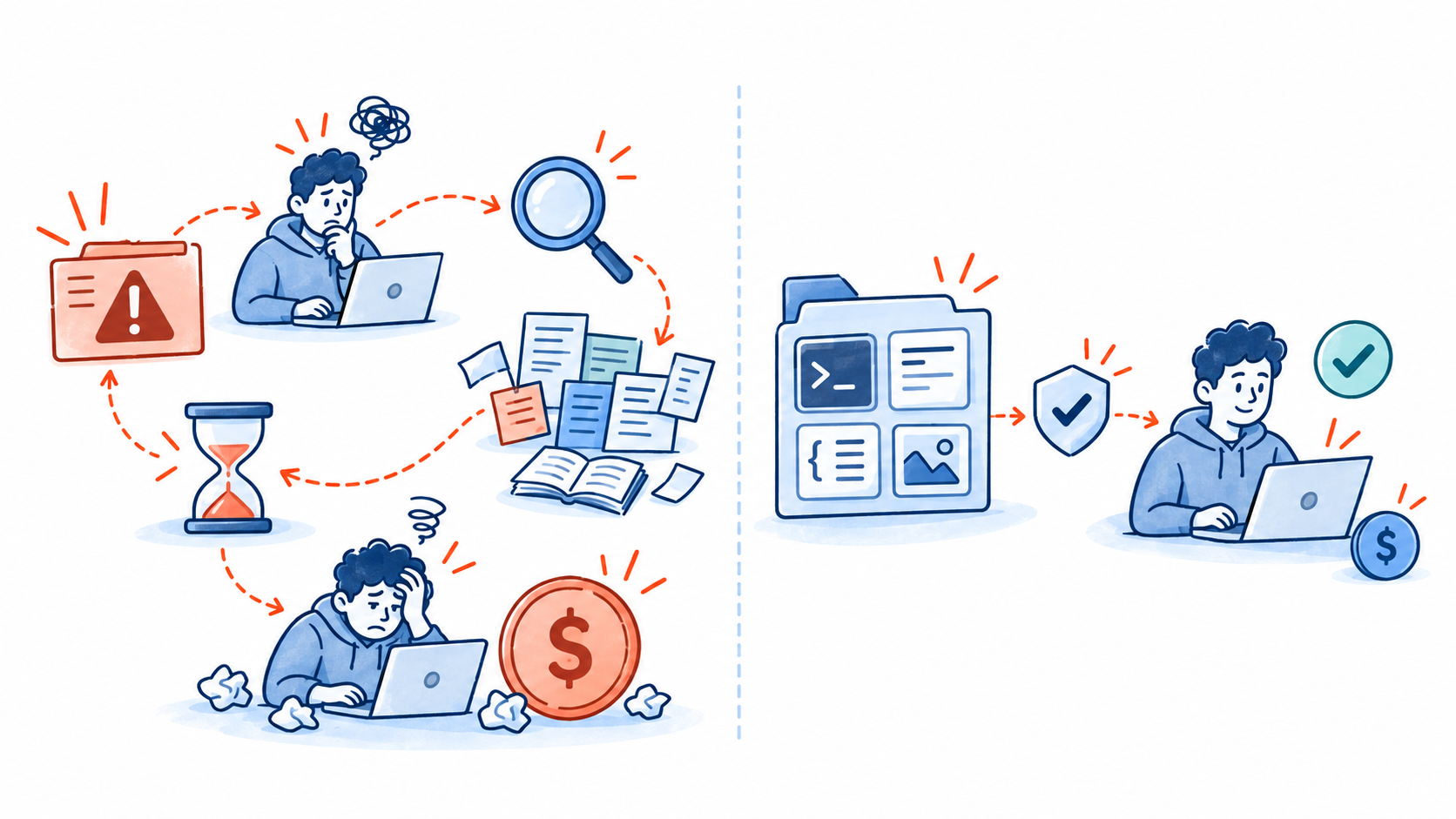
Figure 1: A noisy alert requires repeated investigation and context recovery, while an evidence-backed finding lets an engineer verify the proof and act directly.
Why do false positives cost more than the logged triage time?
The minutes logged in a ticket are the smallest part of the tax; the hidden cost is the investigation, context recovery, and return-to-work a developer performs that the ticket never captures.
A security alert can require a developer to identify the affected release, recover the intended authorization model, reproduce a request with suitable test data, determine whether an upstream control applies, and explain the result to security. After that, they must return to their original work.
That recovery work is not imaginary overhead.
In an exploratory study of task resumption after breaks in programming activity, Chris Parnin and Spencer Rugaber found that developers commonly had to navigate and seek additional task context before editing again; only a small fraction of recorded sessions resumed coding in under a minute.
A noisy alert can create the same context-recovery burden when a developer returns to feature work. The study does not quantify security-alert interruptions directly, so the $300 figure remains an illustrative scenario rather than a result of the study. Read the Parnin and Rugaber task-resumption study
The cost model is broader than strict false positives, but its categories should not be collapsed. False positives, duplicates, and out-of-scope alerts are candidate findings that do not become remediation work. Accepted risks and genuine-but-unreachable weaknesses can be real findings that require governance decisions.
Track both categories because each consumes time, but do not report governance work as scanner error.
Non-actionable alert volume is the operational number to instrument: alerts closed without a remediation task, reported by category rather than equated with the scanner's raw false-positive count.
Why do security scanners produce false positives?
Scanners produce noise because candidate detection operates with incomplete information about custom controls, runtime configuration, external components, reachability, and business logic. They are still valuable: static analysis can identify potentially dangerous paths early in development, and dynamic testing can reveal behavior that source code alone cannot prove.
But candidate detection is not the same as a reportable vulnerability.
OWASP draws the same boundary: static-analysis tools can generate false positives, and confirming whether an identified issue is an actual vulnerability is often difficult. OWASP’s static-analysis guidance
False-positive rates are therefore not portable marketing statistics. In the current extended report on 258 open-source embedded projects, CodeQL reported 709 true defects with a 34% false-positive rate; that is useful evidence of the problem’s scale in one environment, not a rate that should be applied to every scanner or codebase. Read CodeQL’s 258-project report
The right response is not to stop scanning. Research on 35 industrial projects found that static-analysis tools could still be cost-effective overall because they helped teams find and remove defects earlier Read the cost-benefit study.
The operational goal is to retain that early signal while preventing unsupported hypotheses from becoming developer tickets.
What is proof-of-exploit security testing?
Proof-of-exploit testing validates a candidate weakness in a controlled environment before it becomes a developer ticket.
Proof-of-exploit testing changes the handoff from:
Possible weakness → developer repeats the investigation → verdict
to:
Candidate weakness → controlled validation → evidence-backed finding, conditional result, or suppression
The evidence should let a reviewer answer four questions quickly:
- What exactly was tested, and against which version or environment?
- What conditions or test identity were required?
- What request, action, or code path triggered the behavior?
- What observable result establishes impact—and what negative control shows the result is meaningful?
Use suppression only when validation includes comparable-environment evidence and meaningful negative controls. A failure to reproduce in a constrained test alone does not prove the candidate was a false positive.
For a web or API finding, that may be a redacted curl command, the corresponding HTTP request and response, and a comparison showing the expected authorization failure versus the observed result. Sanitized developer evidence should retain placeholders and reproduction context; complete requests, secrets, and other sensitive artifacts belong in access-controlled evidence records. For mobile testing, it may include screenshots, runtime logs, device telemetry, and replayable steps.
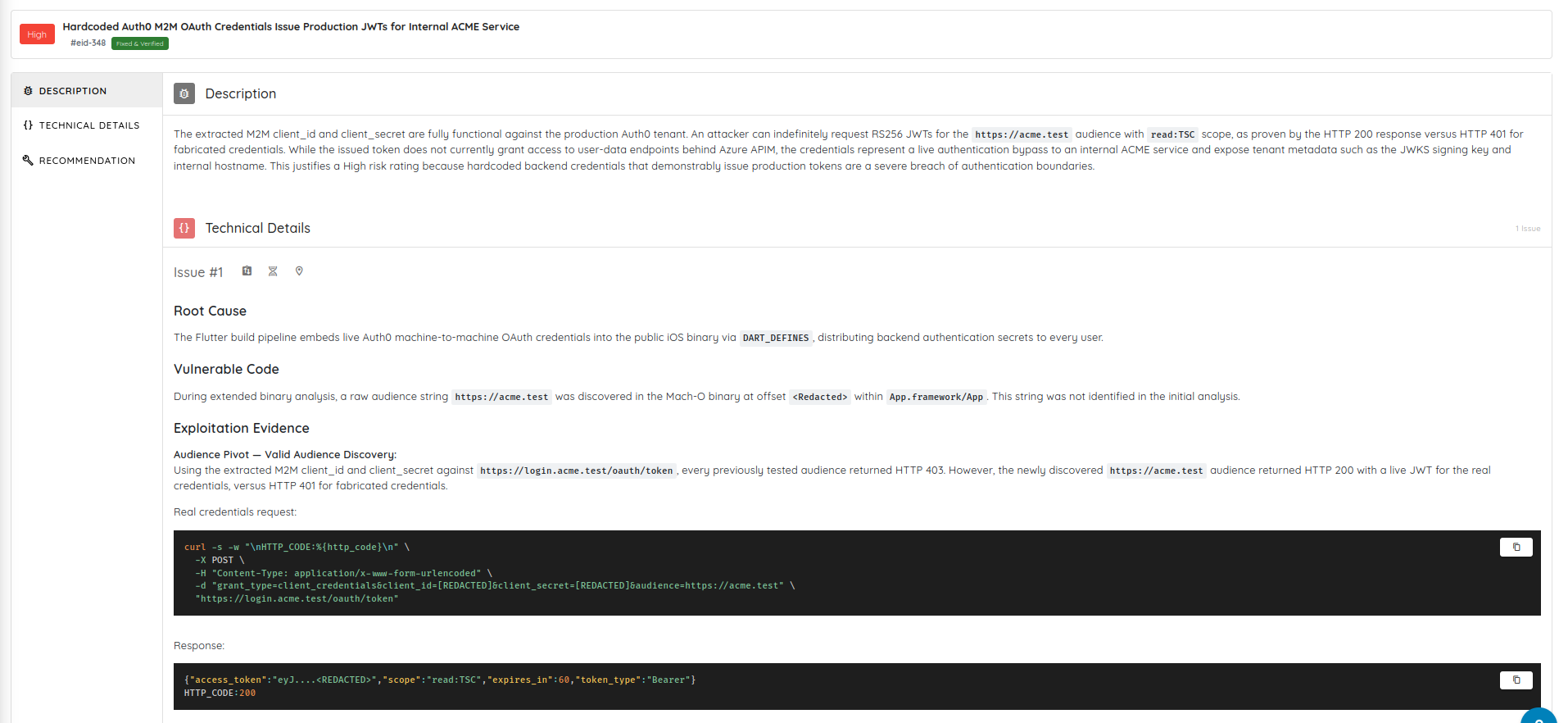
Figure 2: A sanitized finding links the root cause to a redacted request and observed response, so a reviewer can verify the result without recreating the initial investigation.
Proof can also be code-grounded rather than a runtime request. In the RawSpeed source-code finding below, the Exploitation Evidence panel keeps the width-class analysis, minimized PoC conditions, and vulnerable-versus-fixed validation with the finding. A reviewer with access to the report can revisit that stored evidence in the detail view instead of reconstructing it from a ticket summary.
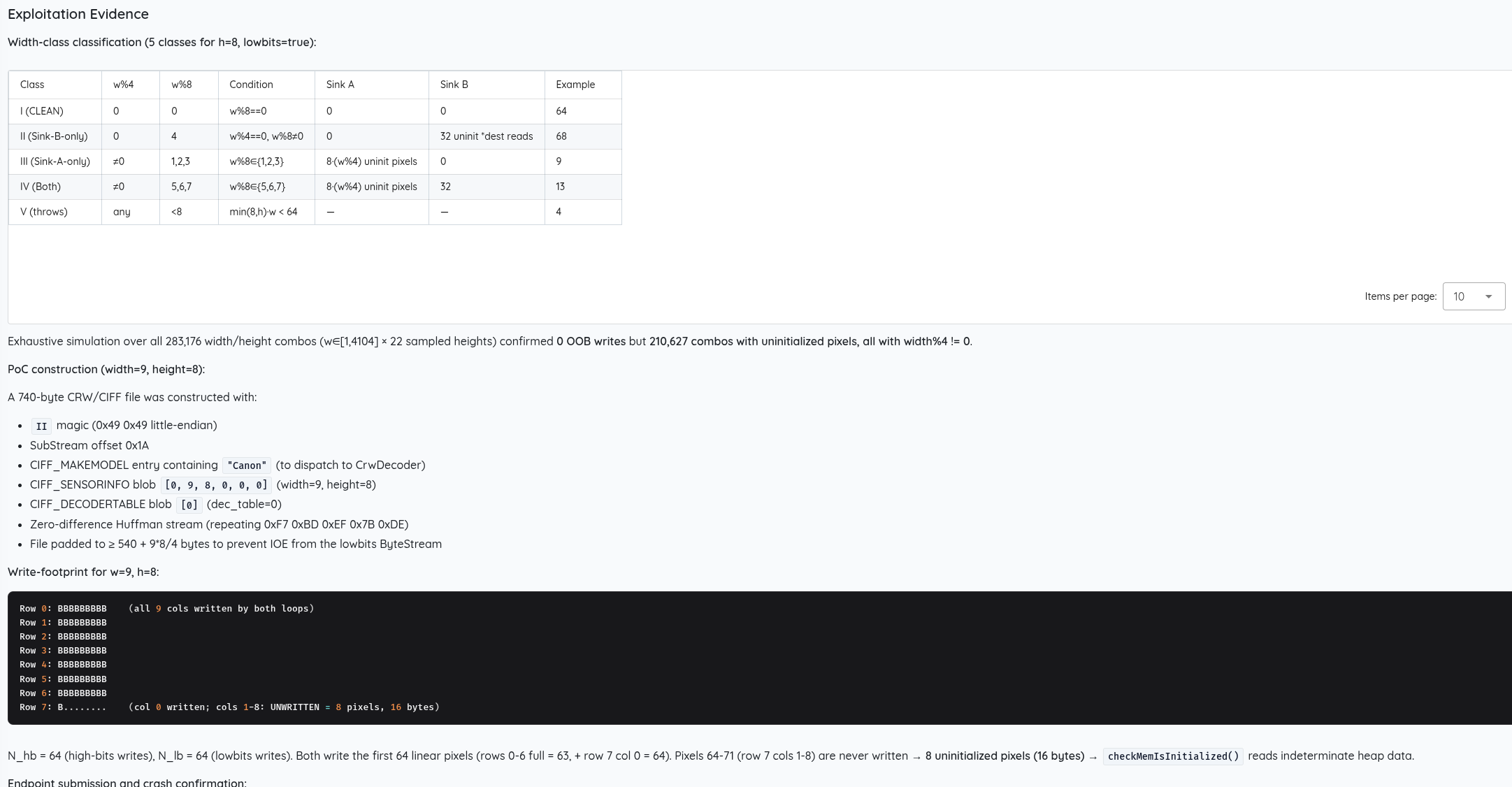
Figure 3: A source-code finding's stored evidence record. The report preserves the bounded conditions and observed validation that support the finding for later reviewer inspection.
For mobile apps and their APIs, Agentic Deep Scan delivers that evidence—screenshots, request/response logs, and step-by-step reproduction—then adds remediation guidance and verification retesting.
The important boundary: proof should make the reproduction and fact-finding portion of triage much smaller. It does not make human judgment zero.
A developer may still need to assess business impact, confirm the test environment matches production, decide on a safe remediation, and validate that the fix does not create a regression. A credible ROI model must not pretend those decisions disappear.
How do you calculate proof-of-exploit ROI?
Proof-of-exploit testing can recover developer capacity by shortening time-to-verdict. Financial ROI is realized only when that recovered capacity avoids spend or produces measurable output, so keep capacity value separate from cash savings.
Use a pilot to compare the current workflow with the evidence-backed workflow.
Annual developer capacity value recovered =
alerts prevented from reaching developers or shortened by evidence
× (baseline developer handling time − post-evidence developer handling time)
× loaded developer hourly cost
× periods per year (12 for a monthly alert count)
Then calculate:
Financial ROI =
((annual developer capacity value recovered × realization factor)
− annual incremental testing cost)
÷ annual incremental testing cost

realization factor (0–1) =
share of recovered capacity that avoids spend or creates measured output
Consider an illustrative developer-capacity scenario:
| Measure | Baseline scanner | Evidence-backed workflow |
|---|---|---|
| Time per non-actionable developer ticket | 2.5 hours | 0.5 hours |
| Loaded developer cost | $120/hour | $120/hour |
| Capacity consumed per alert | $300 | $60 |
| Capacity recovered per shortened alert | — | $240 |
If proof shortens each of 30 monthly developer-routed non-actionable alerts (120 routed × 25% later closed as non-actionable) to 0.5 hours of developer time:
30 × $240 × 12 = $86,400 annual developer capacity value recovered
This is still a model, not a promise. Use summed logged hours or an arithmetic mean per alert when estimating total capacity value; use median and P90 time-to-verdict to report workflow performance. Then substitute the team’s own loaded costs, realization factor, and number of alerts actually routed to developers.
What should a proof-of-exploit pilot measure?
A proof-of-exploit pilot should measure four outcomes: alert disposition, time-to-verdict, evidence quality, and detection coverage.
Do not judge a testing platform solely by alert count or severity distribution. A quieter queue can also result from weaker detection. Run it against a representative set of applications, APIs, and authenticated workflows, then track:
- alerts generated;
- alerts routed to AppSec;
- alerts routed to developers;
- confirmed vulnerabilities;
- false positives and other non-actionable alerts;
- total developer hours across all alerts;
- arithmetic mean developer time per alert;
- median and P90 time-to-verdict;
- percentage of findings with replayable evidence;
- time from remediation to verified retest;
- developer acceptance of the finding and remediation guidance;
- supported attack-surface and authenticated-workflow coverage;
- seeded or independently adjudicated positive cases and their detection rate.
Segment those metrics by finding type. A simple dependency alert, a potential injection path, and a multi-step authorization flaw have different validation costs. Combining them into one average can hide the bottleneck.
What are the limits of proof-of-exploit testing?
Proof-of-exploit testing can be limited by environment change, sensitive reproduction data, the gap between controlled test accounts and production impact, and errors in scope, authentication, or comparison conditions.
That is why an evidence-backed workflow needs, at minimum:
- written authorization and rules of engagement;
- explicit scope and prohibited actions;
- safe test identities;
- rate and stop conditions;
- incident contacts;
- credential handling;
- access-controlled evidence retention and deletion;
- human accountability for high-impact decisions; and
- retesting after remediation.
NIST’s testing guidance treats technical testing as a process of planning, analyzing findings, and developing mitigation strategies—not merely generating a report. NIST SP 800-115
What is the real ROI of proof-of-exploit testing?
Proof-of-exploit ROI is the capacity recovered when evidence shrinks reproduction and fact-finding before handoff; its financial return depends on how much of that capacity is realized.
False positives are not just a scanner-quality problem. They are an engineering-capacity problem.
Measure the alerts that reach humans, the time needed to reach a verdict, and the loaded cost of that time. Then evaluate proof-of-exploit testing by one practical standard:
Does it remove enough uncertainty before handoff that developers spend their time fixing real risk rather than reproducing the scanner’s hypothesis?
That is the operational return of proof: fewer interrupted engineers, faster remediation of confirmed findings, and a security queue developers can trust.
Run a scoped proof-of-exploit evaluation with Agentic Deep Scan on representative mobile apps and their APIs. Measure time-to-verdict and developer-routed non-actionable alerts before and after—not just the number of findings reported.