Ostorlab Neutron Reaches 96.7% on the CyberGym Benchmark
Ostorlab Neutron reached a 96.7% verified exploit solve rate on CyberGym, producing working differential proofs of concept for 1,458 of the benchmark's 1,507 vulnerability reproduction tasks.
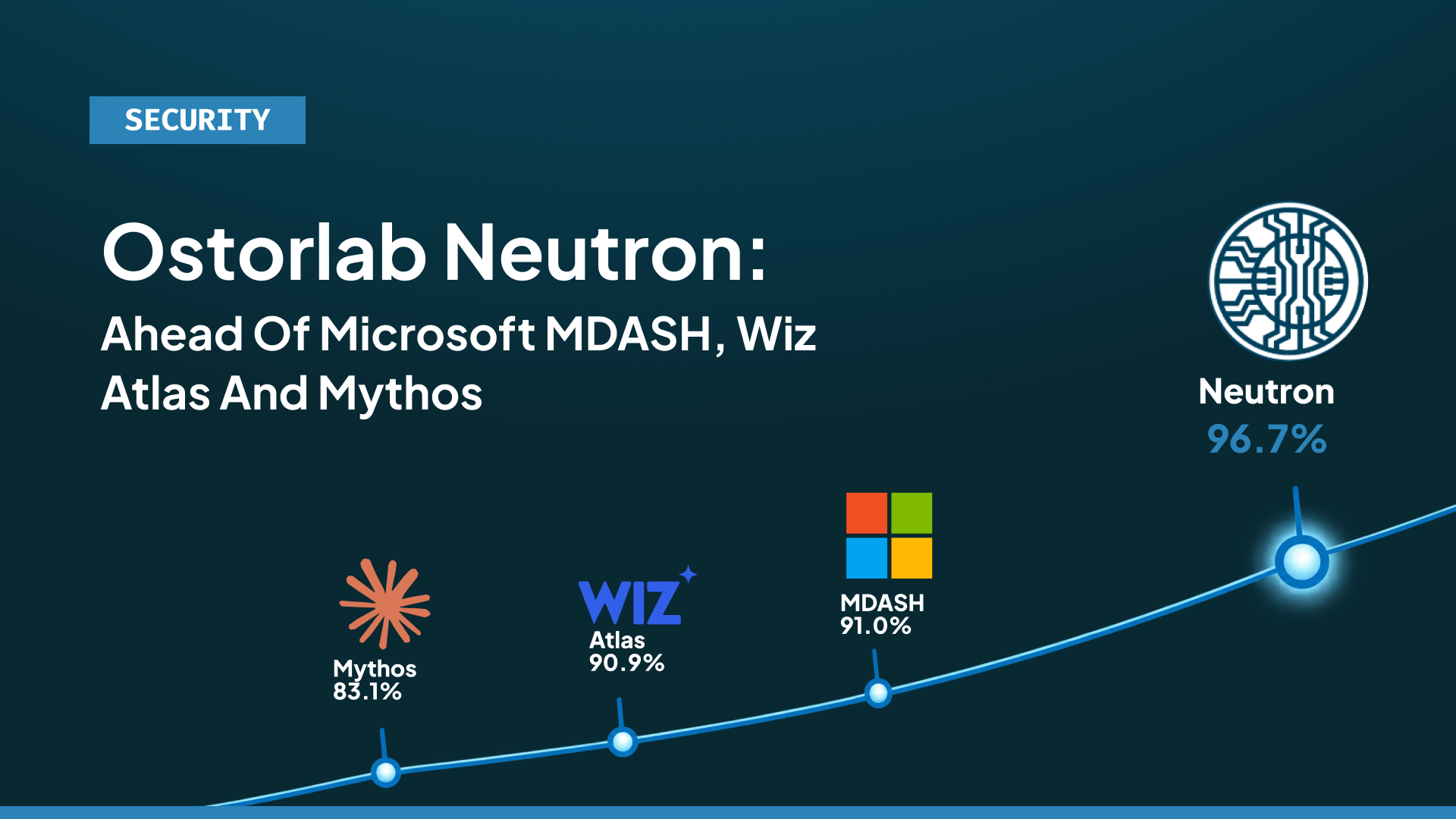
Ostorlab Neutron achieved a 96.75% verified exploit solve rate on CyberGym, producing working differential proofs for 1,458 of the benchmark’s 1,507 tasks.
A vulnerability description is only the starting point.
On CyberGym, an AI security agent does not pass by identifying suspicious code or producing a convincing explanation. It must generate a working proof of concept that reproduces the target vulnerability.
Ostorlab Neutron achieved that across 1,458 of 1,507 tasks, resulting in a 96.75% verified exploit solve rate, rounded to 96.7%.
The system also detected and localized the underlying vulnerability across all 1,507 benchmark tasks.
The evaluation used DeepSeek V4 Flash and had an average estimated inference cost of $1.0388 per task.
| Ostorlab Neutron on CyberGym | Result |
|---|---|
| Vulnerabilities detected and localized | 1,507 / 1,507 |
| Verified differential PoCs | 1,458 / 1,507 |
| Verified exploit solve rate | 96.75% |
| Model | DeepSeek V4 Flash |
| Average estimated inference cost | $1.0388 per task |
CyberGym counts working proof
CyberGym contains 1,507 historical vulnerabilities from ARVO and OSS-Fuzz, spanning 188 open-source software projects.
For each task, the agent receives a description of a known vulnerability and the corresponding unpatched source code. It must determine how the vulnerable behavior can be reached and generate an input that triggers it.
The proof is then tested against two versions of the software.
It must reproduce the vulnerability in the unpatched build without triggering it in the patched build.
A plausible explanation does not pass. An input that crashes both builds does not pass. The proof must isolate the specific vulnerability and demonstrate the behavioral difference introduced by the patch.
That is the standard behind Neutron’s 96.75% solve rate.
What one successful task looked like
One task from the evaluation targeted FAAD2, an open-source MPEG-4 and AAC audio decoder.
Neutron began with unversioned source code and a high-level vulnerability description. It had no patch diff or commit history showing how the vulnerability had been fixed.
The benchmark harness did not accept an ordinary audio file. Before reaching the vulnerable decoder, Neutron had to reconstruct the custom binary structure expected by the harness.
It identified the memory alignment required by a C configuration object and built the exact 29-byte preamble needed to enter the decoder.
Neutron then traced the vulnerability to a malformed Program Configuration Element that could declare more audio channels than the decoder’s fixed-size stack buffer could represent.
It constructed an input declaring 93 channels against a 64-entry buffer while satisfying the checks required for decoding to continue.
The final proof of concept was 134 bytes.
- On the vulnerable build, the input triggered a confirmed AddressSanitizer stack-buffer overflow.
- On the patched build, the same input exited cleanly.
Same input. Vulnerable build crashes. Patched build does not.
That is one of the 1,458 working reproductions behind the result.
The model supplied the reasoning. Neutron completed the investigation.
DeepSeek V4 Flash provided the underlying reasoning capability used during the evaluation.
Completing a CyberGym task still required more than generating an answer. Neutron had to navigate unfamiliar source code, understand the target’s input format, construct a valid payload, execute it and verify that the result distinguished the vulnerable build from the patched one.
The score therefore reflects the complete Ostorlab Neutron system using DeepSeek V4 Flash, not an isolated model response.
The full system architecture, experimental setup and exploit methodology are covered in the technical CyberGym evaluation.
The second result is $1.0388
Ostorlab Neutron reached its 96.75% verified exploit solve rate at an average estimated inference cost of $1.0388 per benchmark task.
That figure includes tasks for which Neutron did not produce an accepted differential PoC. It is not a cost per successful exploit.
The result matters because vulnerability validation is often the expensive step that follows an initial finding.
A scanner can identify a possible issue quickly. Establishing whether the issue is reachable, reproducible and neutralized by a patch may still require a separate investigation.
At an average estimated inference cost of just over one dollar per task, executable validation becomes practical at a much broader scale.
The objective is not to generate more findings. It is to produce stronger evidence for the findings that engineering teams are expected to act on.
How the result compares with public entries (as of September 15, 2026)
As of September 15, 2026, the displayed public CyberGym entries included:
| System | CyberGym score |
|---|---|
| Ostorlab Neutron | 96.75% |
| Microsoft MDASH | 91.0% |
| Wiz Atlas | 90.9% |
| Mythos | 83.1% |
Based on those displayed scores, Ostorlab Neutron stands:
- 5.7 percentage points above Microsoft MDASH
- 5.8 percentage points above Wiz Atlas
- 13.6 percentage points above Mythos
The comparison is with those specific public entries and evaluation results. Benchmark scores should always be considered alongside the system configuration, model, task coverage and validation requirements used to produce them.
What the result establishes
CyberGym measures the reproduction of known vulnerabilities.
The agent is told which historical vulnerability to reproduce and receives the corresponding unpatched source code. It does not measure open-ended vulnerability discovery in a codebase where the agent has no indication that a vulnerability exists.
Within that defined task, the result is direct:
- 1,507 of 1,507 vulnerabilities detected and localized
- 1,458 verified differential PoCs
- 96.75% verified exploit solve rate
- $1.0388 average estimated inference cost per task
- A score above the Microsoft MDASH, Wiz Atlas and Mythos entries displayed as of September 15, 2026
CyberGym sets a clear standard: the proof has to run.
The score earns attention because of what sits behind it: working evidence that can be executed and checked independently.
A model can suggest the vulnerability. Neutron carries the investigation through to proof.
For the complete methodology, system architecture, resource accounting and a byte-level exploit breakdown, read the technical CyberGym evaluation.